-
Call Now
1800-102-2727


Determination of Empirical Formulae - Determination of Molecular Formulae - Definitions, Examples, practice problems & FAQs

During research you have discovered a chemical species which has some very useful properties now how can you write its exact chemical formula (molecular formula).
First, We test this chemical in the lab and find its constituents and percentage composition of constituents. Then with suitable techniques (like osmotic pressure), find its molecular mass with minimum error. Then we can easily write its exact molecular formula.
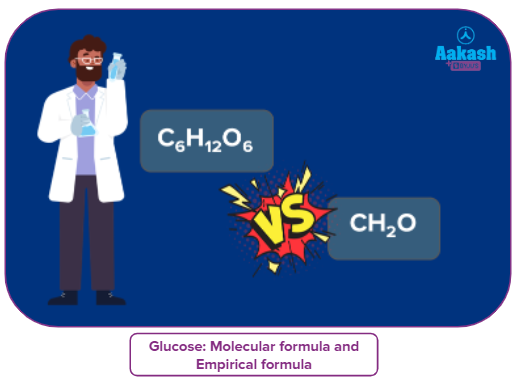
Table of contents
- Empirical formula
- Rules to finding empirical formula of any compound if percentage composition is known
- Practice problems
- Frequently asked questions-FAQs
Empirical formula
It is very easy to calculate the percentage of elements present in a molecule if the molecular formula is known but if the percentage of elements are known then to find the molecular formula is not a simple task.
First, we have to calculate the relative number of atoms of each element in the particular compound. Then, we can find the empirical formula of the compound. From some other technique, we have to find the molecular mass of the compound then we are able to calculate the exact molecular mass of the compound.
The empirical formula is a chemical formula presenting the simplest ratio of elements in a compound (nor exact number).
The molecular formula gives the exact number of different atoms present in a compound.
E.g- if empirical formula id CH then the molecular formula can be C2H2, C6H6
if empirical formula id CH2 then the molecular formula can be C2H4, C3H6 etc.
E.g- Molecular formula of Glucose is C6H12O6 but empirical formula is CH2
Molecular formula of benzene is C6H6 but empirical formula is CH
With the help of empirical formula, the exact molecular formula can be calculated only if the molecular mass of the mentioned compound is known.
So, Molecular formula = n empirical formula
Rules to finding empirical formula of any compound if percentage composition is known
Step 1: Relative mole of atoms
If a compound on analysis gave the following results: C = 39.99%, H = 6.71% and O = 53.28%.
|
Element |
Percentage |
Molar weight (g) |
No. of moles |
|
C |
39.99% |
12 |
3.33 |
|
H |
6.71% |
1 |
6.71 |
|
O |
53.28% |
16 |
3.33 |
Step 2: Find the simplest ratio of moles of atoms
|
Element |
Percentage |
Molar weight (g) |
No. of moles |
Simplest whole no. ratio |
|
C |
39.99% |
12 |
|
|
|
H |
6.71% |
1 |
|
|
|
O |
53.28% |
16 |
|
|
 = 3.33
 = 6.71
 = 2
= 2 = 3.33
Thus, CH2O this is the empirical formula of the above compound.
Step 3: Find empirical formula then multiply the empirical formula by n to find the molecular formula.
Empirical formula mass for CH2O = 12 + 2 + 16 = 30

Molecular formula = n × Empirical formula
= 6 × (CH2O)
= C6H12O6
Practice problems
Q1. Empirical formula if acetylene and benzene are
A. CH
B. CH2
C. CH & CH2
D. C2H2 & C6H6
Answer: (A)
Solution: molecular formula of acetylene and benzene are C2H2 & C6H6 respectively.
Empirical formula is a chemical formula presenting the simplest ratio of elements in a compound (nor exact number).
So, the empirical formula of both compounds is CH.
Q2. A compound on analysis gave the following results: C = 39.99 %, H = 6.71 %, and O = 53.28 %. Determine the molecular formula of the compound if the molar mass is 180 g mol-1.
A. C6H12O6
B. CH2O
C. C6H10O6
D. C5H12O6
Solution: (A)
Step 1: Find the moles of each element
Given: Mass % of C = 39.99 %, H = 6.71 % and O = 53.28 %.
Assuming mass of compound to be 100 g
Molar mass of C = 12 g mol-1, H = 1 g mol-1l and O = 16 g mol-1.
Given Mass of C = 39.99 g, moles of C =  = 3.33 mol
Given Mass of H = 6.71 g, moles of H = 6.71 mol
Given Mass of O = 53.28 g, moles of O =  = 3.33 mol
Step 2: Find the empirical formula
For making the elements in a simple whole number ratio, we divide by the element having the least moles (by carbon or oxygen)
Simple ratio of C = = 1
= 1
Simple ratio of H = = 2
= 2
Simple ratio of O = = 1
Carbon : Hydrogen : Oxygen is 1 : 2 : 1
Empirical formula becomes = CH2O
Step 3: Find the molecular formula
Empirical formula mass = 12 + (1 x 2) + 16 = 30 g
Given: Molar mass = 180 g mol-1
So, Molecular formula = n empirical formula

Molecular formula = n × Empirical formula= 6 × (CH2O) = C6H12O6
Q3. In an organic compound of molar mass 108 g mol-1, C, H, and N atoms are present in 9: 1: 3.5 ratio by weight. The molecular formula can be
A. C6H8N2
B. C7H10N
C. C5H16N3
D. C4H18N3
Answer: (A)
Solution: Step 1: Converting the given ratio into simple whole numbers ratio
Given: The mass ratio of C: H: N = 9: 1: 3.5 = 36: 4: 14
Step 2:
Finding the mole ratio and empirical formula
Dividing individual masses by respective molar mass.

Hence, the empirical formula becomes C3H4N.
Step 3:
Find molecular formula
For calculating the Molecular formula we need to
use the formula

Given: Molecular mass = 108 g mol-1
Hence, the molecular Formula is C6H8N2
Q4. The simplest formula of a compound containing 50 % by mass of element X (atomic weight 10 amu) and 50 % by mass of element Y (atomic weight 20 amu) is
A. XY2
B. X2Y
C. X2Y2
D. XY3
Answer: Step 1: Find the number of moles in 1 g of the sample
Given: 50% by mass of both X and Y
Molar mass of X = 10 g mol-1
Molar mass of Y = 20 g mol-1
Assuming that we have 1 g of the compound.
So, we have 0.5 g of X and 0.5 g of Y.
Now, find the number of moles,
Moles of X =  = 0.050 and Y =
  = 0.025.
Step 2:
Find the simple whole-number ratio
So, X: Y = 0.050: 0.025
X = 2 and Y = 1
Hence, the formula is X2Y
Frequently asked questions-FAQs
Question 1. Which methods are generally used for calculation of the molecular mass of unknown compounds?
Answer: Generally, the osmotic pressure technique is used to calculate the molecular mass of unknown compounds, elevation in boiling points, and depression in freezing points also can be used.
Question 2. Can any compound have the same empirical and molecular formula?
Answer: Yes, compounds have the same molecular formula and empirical formula
E.g- formaldehyde
Molecular formula = HCHO, Empirical formula = HCHO
Question 3. Can molecular formula apply to ionic compounds?
Answer: No, the Molecular formula is not defined for the ionic compounds. To find the formula of an ionic compound, first, identify the cation and write down its symbol and charge. Then, identify the anion and write down its symbol and charge. Finally, combine the two ions to form an electrically neutral compound.
Question 4. Can two or more two compounds have the same empirical formula?
Answer: yes, e.g- The empirical formula is acetylene and benzene is CH.
Their molecular formula is C2H2& C6H6
Related topics
|
Percentage composition |
Atomic Number and Mass Number |
|
mole |
Atomic mass |
|
Average atomic mass |
Law of chemical reaction |

 Call Now
 Let's Chat
 Share
Share