-
Call Now
1800-102-2727


Cupric Oxide-Introduction, Preparation, Properties, Uses, Practice Problems, FAQs

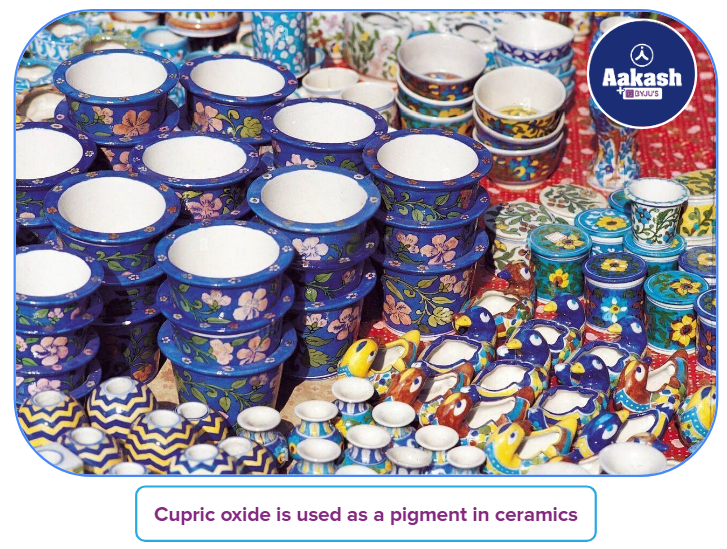
You might have many such designer articles in gift shops and as fashion exhibits. They are designs made with certain colouring pigments on pieces like ceramics, metals, terracotta, etc. The colours are so variant all the possible mixtures of VIBGYOR colours. People lime such beautiful things for decorative purposes.
But, did you ever thought about how these colouring pigments are made?
On this page, you will find from we get such beautiful pigmentations and designs on ceramics. One such colour and the widely used pigment is derived from the element copper and its oxide-namely cupric oxide.
Copper is related to our historic period. Our forefathers realised that copper is malleable, holds a sharp edge, and can be fashioned into tools, ornaments, and weapons more quickly than a stone between 7,000 and 10,000 years ago, a discovery that would impact humanity forever.
Let’s study the important compounds derived from copper i.e, cupric oxide and see how beneficial they are. So come and let’s begin!
TABLE OF CONTENT
- Introduction
- Cupric oxide- Preparation
- Cupric Oxide- Properties and Reactions
- Cupric Oxide- Uses
- Practice Problems
- FrequentlyAasked Questions
Introduction
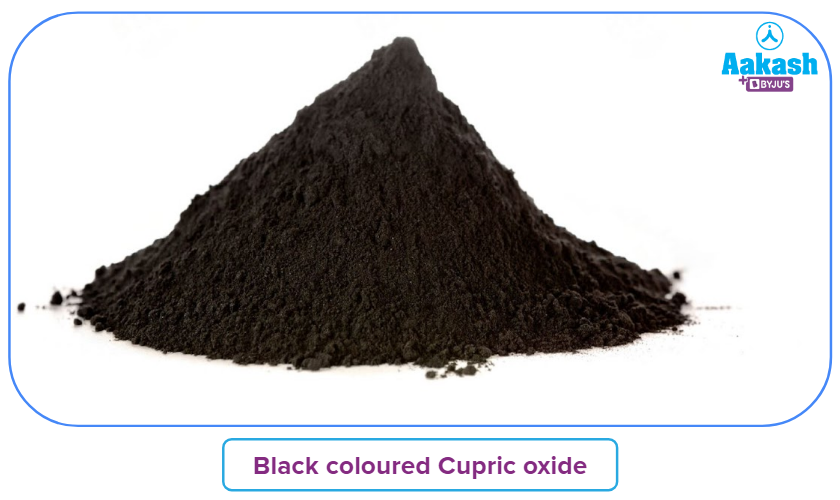
Copper forms two oxides. CuO is the chemical formula for cupric oxide, also known as copper(II) oxide. It is one of the two stable oxides of copper and black in colour, while the other cuprous oxide with the formula Cu2O or copper(I) oxide, is a brown solid. Mineral, cupric oxide is known as a tenorite. It is a byproduct of copper mining and a starting point for many other chemical compounds and products that contain copper.
Cupric Oxide-Preparation:
Cupric oxide is a black copper oxide that can be found in nature as Tenorite.
Preparation of Cupric Oxide:
- Cupric oxide is prepared by heating Cu2O in air or heating copper in the air for a long time keeping the temperature, not above 1100℃.
- Cupric hydroxide on heating forms Cupric oxide.
- Heating copper nitrate produces cupric oxide.
- It's made commercially by heating malachite ore, which is present in nature.
Cupric Oxide- Properties and reactions:
- It is a black powder that is stable till mild heating.
- The oxide is water-insoluble but dissolves in acids and forms salts.
- Mineral acids like hydrochloric acid, sulfuric acid, or nitric acid can be used to dissolve copper (II) oxide and produce the corresponding copper (II) salts.
For example,
- It produces cuprate salts when combined with concentrated alkali:
Where M is any alkali metal.
- Using carbon dioxide, carbon monoxide, or hydrogen, it can be transformed into copper metal.
- It is transformed to cuprous oxide with the release of oxygen when heated to 1100-1200°C.
Cupric oxide- Uses:
- Copper(II) oxide, a substantial byproduct of copper mining, serves as the raw material for synthesising additional copper salts. For instance, copper oxide is used to make a variety of wood preservatives.
- In ceramics, the cupric oxide is used as a pigment to create glazes in the colours blue, red, and green, occasionally grey, pink, or black.
- When welding with copper alloys, the cupric oxide is utilised.
- It is used to remove sulphur from petroleum.
- It is utilised for carbon estimation and detection in organic analysis.
Practice Problems:
Q1._____________ is the oxidation state of Copper in cupric oxide.
A. 0
B. +1
C. +2
D. +3
Answer: C
Solution: Let the oxidation state of copper in CuO be x.
For calculating this we know that the oxidation state of the oxygen we consider is -2.
Now, calculating this we get,
Hence, +2 is the oxidation state of Copper in CuO.
Q2. Copper (II) oxide when heated with hydrochloric acid, the main product we get are____________.
A. cuprous chloride and hydrogen
B. cupric chloride and water
C. cupric chloride and hydrogen
D. cuprous chloride and water
Answer: B
Solution: Copper (II) oxide when heated with hydrochloric acid, the main product we get are cupric chloride and water. Here is the mentioned reaction.
Q3. In the following reaction
___________ substance is oxidised and ________substance is reduced
A. Cu and H2 respectively.
B. H2 and Cu respectively.
C. H2 and H2O respectively.
D. CuO and H2 respectively.
Answer: B
Solution: A chemical reaction known as an oxidation-reduction (redox) reaction includes the exchange of electrons between two substances. In a redox reaction, an electron is either gained or lost, changing the oxidation number of a molecule, an atom, or an ion.
in the reaction H2 is oxidised since it has lost electrons and Cu is getting reduced since it has gained electrons.
Q4. Heating malachite will release ___________ gas.
A. H2
B. CO2
C. CO
D. O2
Answer: B
Solution: Cupric oxide is made on a commercial basis by heating malachite, which is present in nature.
Frequently Asked Questions-FAQ
Q1. What distinguishes copper oxide from cupric oxide?
Solution: Cuprous and cupric vary primarily because cuprous is a copper +1 cation, whereas cupric is a copper +2 cation. Copper and oxygen combine to generate stable molecules Cu2O and CuO. CuO is black in colour, while Cu2O is red in colour.
Q2. What causes copper to turn green?
Solution: Copper will be oxidised by the atmospheric oxygen to cupric oxide. In the presence of atmospheric moisture and carbon dioxide, copper oxide further reacts to form slowly, a blue-green coloured basic copper carbonate.
Q3. Is CuO, an insulator?
Solution: Cupric oxide as a mineral is a ceramic insulator. However, tin films of cupric oxide can be doped and act as an n-type semiconductor.
Q4. What type of oxide is copper oxide?
Answer: CuO or copper oxide, is a basic substance. It reacts with an acid to form cupric salt.

NEET Related Links
JEE MAIN Related Links
JEE Advanced Related Links
JEE Advanced Eligibility Criteria
JEE Advanced Chemistry Syllabus
JEE Advanced Registration Dates
CUET Related Links
Important Topics
Anemometer : Measurement of Wind Speed
Angular Acceleration Atomic Theory Audible and Inaudible Sound Average Speed and Average Velocity Average Velocity Avogadros Number Avogadros Hypothesis Azimuthal Quantum Number Balanced Force Bar Magnet Biconvex Lens Boyles Law Buoyancy Calorimeter Carnot Engine Celestial Bodies Centripetal And Centrifugal Force Concave and Convex Lenses Concave Convex Mirrors Contact and Non Contact Force Controlled Thermonuclear Fusion Convection Currents Convex Lens Convex Mirror Destructive Interference Difference Between Conduction Convection and Radiation Difference Between Electric Field and Magnetic Field Difference Between Heat And Temperature Difference Between Series And Parallel Circuits Differences Between Acceleration And Velocity Distance and Displacement Distance Time Graph Electrical Force : Electric Forces and Their Types Electromagnetic Waves : Definition, Equation and Properties of Electromagnetic Waves Electromagnetism Electron Spin Fluid Flow : Bernoullis Equation Derivation and Fluid Mechanics Fluid Friction : Types and Factors of Fluid Friction Frames of Reference : Inertial and Non- Inertial Frame of Reference Frequency and Wavelength Frictional Force Importance of Hydrosphere Instantaneous Speed and Velocity Introduction to Motion Kinetic and Potential Energy Difference Law Of Conservation of Energy Layers of the Earth Light Energy Light Sources List of physics scientists and Their inventionsLoudness of Sound
Magnetic Dipole Moment Magnetic Field Non - Contact Force Non - Renewable Energy Ohms Law Optics P Wave Physics Symbols Plane Mirrors Poissons Ratio Projectile Motion Properties of Water : Anomalous Expansion of Water Radius of Gyration Reflection of Light Reflection of Waves Relative Density Resonance Reverberation Rolling Friction Rotation and Revolution Screw Gauge Semiconductors and Insulators Sliding Friction Speed Time Graphs Static Friction Stefan Boltzmann Law Stress Tension Tension Force Thermometer: Clinical Laboratory Thermometer Types of Rocks Types of Waves Uniform Motion and Non Uniform Motion Unit of Voltage Uses of Convex Lens Uses Of Convex Mirror Uses of Electromagnet Uses of Optical Fibre Wave Wavelength of Light What is Scattering of Light Working of Electric Bell Conventional and Non-conventional Sources of Energy Buoyant Force Bulk Modulus of Elasticity Bernoulli’s Principle Angular Momentum Difference Between Speed And Velocity ForceUnit of Heat
Difference between Distance and Displacement Simple Microscope Derivation Of Equation Of Motion Thermometer: Clinical & Laboratory Thermometer Difference between Concave and Convex LensDerivation Of Lens Maker Formula
Unit Of Pressure Velocity Uses of Plane Mirror
Wave Theory of Light
Unit of Density Unit of Light Unit of Force Unit of Magnetic Field Unit of wavelength Unit of Viscosity Uses of Electroplating Young's Modulus
What is the Scattering of Light
Lenz Law Space Wave Propagation Schrodinger Wave Equation Relation between Fahrenheit and Celsius Refractive Index Potentiometer Working Pascal Law Oscillatory Motion Optical Instruments Newton's Laws of Motion - First Law Modulation and Demodulation Magnetic Flux Lens Formula and Magnification Kaleidoscope Faradays Law Epsilon Naught Value Energy Bands Electrostatics Electroscope AC Generator Unit of Current Lithosphere Bending Equation Derivation Difference Between Pound and Kilogram Semiconductor Devices OTEC - Ocean Thermal Energy Conversion Hall Effect Rectilinear Propagation of Light Difference Between Ammeter and Voltmeter Coefficient of Linear Expansion Ampere’s Law Cyclone and Thunderstorm Save The Environment From Pollution Particle Nature of Light Types of DC Motor Uses Of Transistor Derivation of Phase Rule Unit of Humidity

 Call Now
 Let's Chat
 Share
Share