-
Call Now
1800-102-2727


Compounds of Boron - Halides of Boron, Orthoboric Acid, Borax, Diborane, Borazine - Preparation, Properties, Uses, Practice Problems and FAQ

How powerful are a family's youngest members? Every family will most likely have a unique perspective on this. However, one thing is certain: the youngest members are unquestionably the most important. Quite similar is the case for the youngest member of the Boron family (Group 13) - ‘Boron’ himself!

Boron has always piqued the interest of scientists trying to solve the mysteries of the universe's formation and the emergence of life. Boron may have been important in the evolution of life on Earth. The element stabilises ribose, a component of RNA, a self-assembling molecule that may have existed before DNA.
Boron can be found in the Earth's oldest rocks, dating back 3.8 billion years, according to a study published in June 2014. The ingredients needed to make RNA were present on the early Earth, according to this study. Perhaps the first RNA contained boron from space.
Boron compounds are equally important and fascinating. Borax, for example, is a common household component found in a variety of detergents. (Hint: A borax-sugar solution is an effective ant-killing solution!)
It is also in the science fair to make a strange, goopy fluid recipe known as 'oobleck' or 'slime.' It is a liquid with peculiar properties. When borax solution and liquid glue are combined, a substance that is liquid when poured but solid when under pressure is formed. It's the main ingredient in "slime," which both kids and adults enjoy playing with.
TABLE OF CONTENTS
- Compounds of Boron
- Halides of Boron
- Orthoboric Acid - Structure
- Orthoboric Acid - Preparation
- Orthoboric Acid - Properties
- Orthoboric Acid - Uses
- Borax - Structure and Preparation
- Borax - Properties
- Borax - Bead Test
- Borax - Uses
- Diborane - Structure
- Diborane - Preparation
- Diborane - Properties
- Diborane - Uses
- Borazine
- Practice Problems
- Frequently Asked Questions - FAQ
Compounds of Boron
Plced next to carbon in the Periodic Table of Elements, boron is a metalloid - a substance with both metallic and nonmetallic properties. Boron belongs to Group 13, Period 2. It is one of the most common elements on the planet. It makes up less than 0.0001% of the mass of the earth's crust. It comes in a variety of forms, including borax, orthoboric acid, and kernite. Boron is found as borax in Rajasthan and Ladakh, India.
Boron is a highly reactive element, and many different boron compounds can be found in nature. These compounds have been found to be extremely useful in the production of a variety of products in a variety of fields. Some of the most important boron compounds found in nature are discussed below.
Halides of Boron
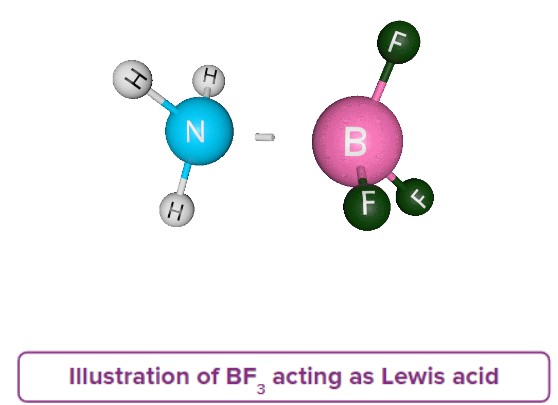
The halides of boron include BF3, BCl3, BBr3 and BI3. These are some examples of electron-deficient molecules as their octet is incomplete, since boron has six electrons in its outermost shell in the monomeric trihalide form. As the monomeric trihalides are electron-deficient, they are strong Lewis acids and form Lewis acid-base adducts.
Example: H3N : →BF3
Here, ammonia donates its lone pair of electrons to the empty p-orbital of boron. Boron is sp2 hybridised, but after accepting the lone pair of electrons from ammonia, it becomes sp3 hybridised.
Orthoboric Acid - Structure
It is also known as boric acid or hydrogen borate. Each boric acid molecule features boron-oxygen single bonds. The boron atom occupies the central position and is linked to three hydroxyl groups. The overall molecular geometry of boric acid is trigonal planar, and its molecular formula is H3BO3.
- In orthoboric acid, boron has sp2 hybridisation.
- In orthoboric acid, oxygen has only two bonds (one with B and one with H) and two lone pairs. Therefore, oxygen should be in sp3 hybridisation, but orthoboric acid is found in the 2D sheet. Thus, it should be in sp2 hybridisation.
- Hence, oxygen in boric acid has sp2 hybridisation because there is p𝛑-p𝛑 back bonding between the lone pairs of oxygen and the empty orbital of boron.


Orthoboric Acid - Preparation
- It is precipitated by treating an aqueous solution of borax with mineral acid (i.e., H2SO4, HCl, or HNO3).
- After dissolving borax, concentrated acid is mixed with the hot borax solution and the solution is allowed to cool. As a result, crystals of orthoboric acid appear in the bottom of the beaker and it is filtered to obtain the crystals of orthoboric acid.
Na2B4O7 (s)+ 2HCl (l) + 5H2O (l) 2NaCl (aq) + 4H3 BO3 (s)
Na2B4O7 (s)+ 2H2SO4 (l) + 5H2O (l) Na2SO4 (aq) + 4H3BO3 (s)


- It is also prepared by the hydrolysis of boron compounds (halides, hydrides, etc).
Examples:
2BH3 + 6H2O ⟶ 2H3BO3 (s)+ 6H2(g)
2BCl3+ 6H2O ⟶ 2B(OH)3 (s) + 6HCl
Orthoboric Acid - Properties
- It is a white crystalline solid with a soapy touch.
- It is sparingly soluble in water, but highly soluble in hot water.
- Orthoboric acid is a weak monobasic Lewis acid with the chemical formula H3BO3. It contains three hydrogen atoms, yet it acts as a monobasic acid rather than a tribasic acid. This is because it does not act as a proton donor, but rather acts as a Lewis acid by accepting electrons from a hydroxyl ion.
- Orthoboric acid is considered a weak acid because the acceptance of hydroxyl ion is a reversible reaction that is significantly less in the forward direction. However, according to Le Chatelier's principle, if the product [B(OH)4]- is removed continuously, then the reaction goes in the forward direction at a high speed.

- It has a layered structure, in which planar BO3 units are joined by hydrogen bonds.

- If polyols containing cis-vicinal diols such as glycerol and mannitol are added, B(OH)3 behaves as a strong monobasic acid.
- The cis-diol forms a very stable complex with [B(OH)4]-, removing it from the solution. As we know, the reaction of orthoboric acid with hydroxyl ion or water is a reversible reaction. Thus, the removal of one of the products shifts the equilibrium in the forward direction (according to Le Chatelier's principle).
B(OH)3 (s)+ 2H2O(l) ⇌ [B(OH)4]-(aq) + H3O+(aq)
- The reaction with cis-diol is given as follows:

- Ethanol does not form similar complexes, but catechol, salicylic acid, and mannitol form similar complexes.
For example:

- Polymeric metaborate species are formed at higher concentrations.
3B(OH)3 ⇌ H3O+ + [B3O3(OH)4]- + H2O

- On heating above 100 °C, orthoboric acid forms metaboric acid, HBO2, which on heating at 160 °C gives pyroboric acid (H2B4O7), which on further heating to red hot gives boron trioxide as the product.

- Boric acid dissolves in aqueous HF to form HBF4 (Fluoroboric acid).
B(OH)3 + 4HF ⇌ H3O+ + BF4- + 2H2O
- Test for Borate Radical: When boric acid is heated with ethyl alcohol, the evolved gas is burned, forming a green edged flame due to ethyl borate.
H3BO3 + 3C2H5OH B(OC2H5)3+ 3H2O
Orthoboric acid Ethyl Borate
Orthoboric Acid - Uses
- Boric acid can be used as an antiseptic.
- It is used as powder on infections, for babies skin rashes and also on carrom boards. It is used as an eyewash to cleanse the eyes.
- It provides relief from eye irritation. It's used in the production of heat-resistant glasses.
- It's used to keep food fresh for a long time.
- Insecticides and pesticides are made with it.
- Orthoboric acid is also used in the cosmetic industry to make a variety of products.
- Orthoboric acid makes wood fireproof, so it is used to fireproof houses.
- Ceramics and enamels are also made with it.
Borax - Structure
Borax is a compound consisting of boron, united to oxygen and sodium. It contains the tetranuclear units [B4O5(OH)4]2-. The formula of borax is Na2[B4O5(OH)4].8H2O. Borax dissolves in water to give an alkaline solution. It contains five B−O−B linkages.


Borax - Preparation
- When colemanite powder is heated with sodium carbonate solution, calcium carbonate is precipitated.

The solution is now concentrated and cooled to crystallise borax. BO33- is orthoborate and BO2- is metaborate.
- By the action of Na2CO3 on H3BO3.
4H3BO3 + Na2CO3 Na3B4O7 + 6H2O + CO2
Borax - Properties
- Borax is a white crystalline solid.
- It is less soluble in cold water but more soluble in hot water.
- Its aqueous solution is alkaline.
Na2B4O7 + 7H2O 4H3BO3 + 2NaOH.
- Effect of heating: It first swells due to loss of water in the form of steam. When borax powder is heated, it first swells due to the loss of water in the form of steam. However, at 740 0C, it gets converted into colourless transparent borax bead.

Borax - Bead Test
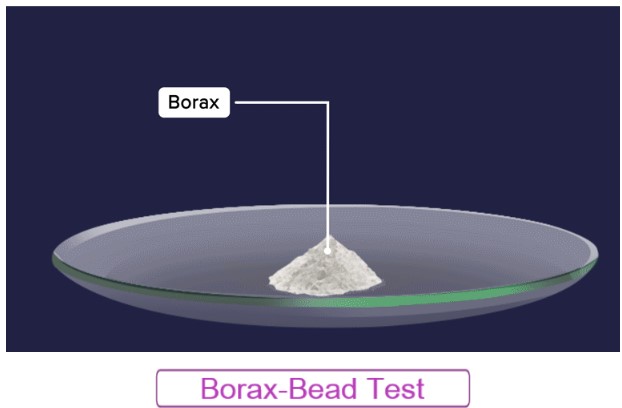
The mixture of sodium metaborate and boric anhydride as obtained on heating borax as explained above forms borax beads.
Borax reacts with certain metal salts such as Ni2+, Co2+, Cr3+, Cu2+, Mn2+etc., to form coloured metaborates. The colour of the metaborates can be used to identify the metallic ions (cations) in its salts. This is called borax-bead test.
Example:
Formation of copper beads: First, copper salt is heated to form copper oxide.
CuSO4 ⟶ CuO + SO3
On further heating with borax beads, this copper oxide forms copper metaborate, which has a sky blue colour.
CuO + B2O3 ⟶ Cu(BO2)2

Borax - Uses
- Borax is used in the manufacture of enamels and, in particular, glass.
- It is also used to make cleaning products, drying oils, and ceramics.
- A flux is required in welding processes, and borax serves as a flux in such processes.
- In our daily lives, we notice that the wick of a candle is made of a hard material. It's made with borax.
- Borax is also used in the production of fabric softeners and laundry detergents.
- Borax has a germicidal effect.

Diborane - Structure
The binary compounds of boron with hydrogen are known as boron hydrides or boranes. The simplest boron hydride is diborane. It is a dimer of borane (BH3).
- The four terminal hydrogen atoms and the two boron atoms lie in one plane. Above and below this plane are two bridging hydrogen atoms.
- The four terminal B-H bonds are regular two centre-two electron bonds, while the two bridge (B-H-B) bonds (banana bond) are three centre-two electron (3c-2e) bonds.
- The bridging bonds are longer and weaker as compared to the terminal bonds.
- The hybridisation of boron is sp3.
Diborane - Preparation
1. By treating boron trifluoride with LiAlH4 in a solvent of diethyl ether.
2. Laboratory method of preparation of diborane: A convenient laboratory method for the preparation of diborane involves the oxidation of sodium borohydride with iodine. Iodine is the best oxidising agent in that reaction because we need a very mild oxidising agent (iodine).

2NaBH4 + I2 B2H6 + 2NaI + H2
LiAlH4 and NaBH4 are good sources of hydride ion (H-).
3. By treating BF3 with NaH.
4. By treating BCl3 with excess B2.


Diborane - Properties
- B2H6 is a colourless and highly toxic gas with a boiling point of 180 K. There are no strong intermolecular attractions between B2H6 molecules. Thus, they exist as gases at room temperature, and to make them solid or liquid, they have to be cooled.
- Diborane catches fire spontaneously upon exposure to air.
- It is unstable and electron deficient.
- It burns with oxygen, evolving an enormous amount of energy. Most of the higher boranes are also spontaneously flammable in the air.
B2H6 + 3O2 ⟶ B2O3 + 3H2O; cHo = –1976 kJ mol-1
- It reacts with water to give boric acid.
B2H6(g) + 6H2O(l) ⟶ 2B(OH)3(aq) + 6H2(g)
- The electronegativity of B = 2.0 and that of H = 2.2. Thus, in a compound containing B and H, B will get a delta positive charge and H will get a delta negative charge. Here, instead of B2H6, BH3 molecules interact and B(OH)3 is formed.
- The formed B(OH)3 does not form a dimer, because there is a possibility of backbonding, which stabilises it.
- Diborane is also hydrolysed by weaker acids (e.g. alcohols) or aqueous alkalis.
B2H6 + 6ROH ⟶ 2B(OR)3 + 6H2
B2H6 + 2KOH + 2H2O ⟶ 2KBO2 + 6H2
- Diborane undergoes cleavage reactions with Lewis bases (L) to give borane adducts, BH3.L
B2H6 + 2NMe3 ⟶ 2BH3.NMe3
- It reacts with carbon monoxide under pressure to form carbonyl, BH3.CO.
B2H6+ 2CO ⟶ 2BH3.CO
- Reduction of diborane can be accomplished with Na or sodium borohydride. Na does unsymmetrical cleavage with B2H6.
2B2H6 + 2Na ⟶ NaBH4 + NaB3H8
B2H6 + NaBH4 ⟶ NaB3H8 + H2
- Li and Na react with B2H6 to give borohydrides.
B2H6 + 2MH ⟶ 2M+ [BH4]-; where M = Li or Na
Diborane - Uses
- Diborane is used as a rocket propellant.
- It is utilised in the manufacture of borophosphosilicate, which is a form of glass.
- In most of the chemical reactions, it is employed as a reducing agent.
- Diborane is used as a catalyst and rubber vulcanizer in polymerisation reactions.
- It is even used as a doping agent in the manufacturing of semiconductor devices.
Borazine (B3N3H6)
- The reaction of diborane with ammonia produces borazine. At low temperatures, an addition product is obtained with ammonia.
3B2H6 + 6NH3⟶ 6BH3.NH3
- When the addition product B2H6.2NH3 formulated as [BH2(NH3)2]+ [BH4]- is heated at 200 °C, a volatile compound called borazine or inorganic benzene is formed.


- On reaction with NH3, unsymmetrical cleavage of B2H6 takes place. Borazine has a ring structure like benzene.


- (BN)x is also called inorganic graphite.
- Borazine is a highly polar molecule due to the high electronegativity difference between boron and nitrogen atoms.
- Both boron and nitrogen atoms are sp2 hybridised.
- Borazine and its derivatives are used as boron nitride ceramic precursors.
Practice Problems
Q 1. B(OH)3 + NaOH Na[B(OH)4](aq)
The addition of which of the following proceeds the reaction in the forward direction?
a. Cis-1,2-diol
b. Trans-1,2-diol
c. Borax
d. Na2HPO4
Answer: We know that the reaction of orthoboric acid with hydroxyl ion is a reversible reaction and cis-diol forms a very stable complex with [B(OH)4]-, removing it from the solution. Thus, the removal of one of the products shifts the equilibrium in the forward direction (according to Le-Chatelier's principle).
So, option (A) is the correct answer.
Q 2. Boric acid forms a polymeric structure due to?
a. Its acidic nature
b. presence of H-bonding
c. Monobasic naire
d. Geometry
Answer: Boric acid forms a polymeric structure, connecting the H3BO3 molecules through hydrogen bonds.
So, option B) is the correct answer.
Q 3 How much water of crystallisation is present in borax?
a. 3
b. 5
c. 8
d. 7
Answer: Water of crystallisation means having a fixed number of water molecules in one formula unit
of salt. Crystal salts with water of crystallisation are known as hydrates. The other names of water of crystallisation are crystallisation water or water of hydration. The correct formula of borax is Na2[B4O5(OH)4].8H2O. Therefore, borax has 8 molecules of water of crystallisation.

So, option C) is the correct answer.
Q 4. What is the hybridisation state of oxygen in boric acid?
a. sp3
b. sp2
c. sp
d. None of the above
Answer: The oxygen in boric acid has sp2 hybridisation because there is p𝛑-p𝛑 back bonding between the lone pairs of oxygen and the empty orbital of boron.
Frequently Asked Questions - FAQ
Q 1. Why BF3 can exist as monomer but BH3 can not?
Answer: Boron has an empty p-orbital, while fluorine has a lone pair of electrons in its p-orbital. BF3 is stable because of the back bonding, while in BH3, the back bonding is not possible. So, it exists as a dimer (B2H6).
Q 2. What is the difference between borazine and benzene?
Answer: We consider that borazine and benzene are isoelectronic species.

Q 3. How many oxygen atoms will form back bonding in borax?
Answer: The formula of borax is Na2[B4O5(OH)4].8H2O. The structure of borax is:
Only sp2 hybridised boron atoms participate in pπ−pπ back bonding. So, the oxygen attached to sp3 Boron will not show pπ−pπ back-bonding. So only two oxygen atoms attached to the sp2 hybridised boron atoms, will participate in pπ−pπ back bonding.

Q 4. What is inorganic graphite?
Answer: Inorganic graphite is known as boron nitride (BN). The most stable crystalline form is the hexagonal one, also called h-BN, α-BN, or g-BN (graphitic BN).
Because its hexagonal form is the most stable and soft of the BN polymorphs, it is used as a lubricant and cosmetic additive.
Related Topics
|
Factors affecting Electronegativity |
Potassium |
|
Electronegativity |
Alkali Metals |
|
Modern Periodic Table |
Sodium Chloride |

 Call Now
 Let's Chat
 Share
Share