-
Call Now
1800-102-2727


Cationic Hydrolysis- Salts, Types, Concept of Hydration and Hydrolysis, Types, Practice Problems and FAQs

Everybody knows about table salt and you know more that salts are formed by the reaction between an acid and a base.
Why study this concept? You may be thinking that all salts have similar properties, but not so.
For a surprise, there are four major categories in which thousands of salt that exists in our nature and being used by us in our daily life can be classified. In this topic, we are going to discuss how these salts are formed and some interesting aspects about them.
Table of content
- What are salts?
- Concept of hydration
- Salt Hydrolysis
- Cationic Hydrolysis
- Practice Problems
- Frequently Asked Questions -FAQ
What are salts?
Salts are made up of a positive ion of a base and a negative ion of an acid

Cl-in NaCl salt, is the negative ion (anion) of the acid HCl.
Na+ in NaCl salt is the positive ion (cation) of the base NaOH.
There are four major categories of salts
|
Acid |
Base |
Salt |
Examples |
|
Strong Acid (SA) |
Strong Base (SB) |
Salt of SASB |
NaCl(HCl+NaOH) |
|
Strong Acid (SA) |
Weak Base (WB) |
Salt of SAWB |
NH4Cl(HCl+NH4OH) |
|
Weak Acid (WA) |
Strong Base (SB) |
Salt of WASB |
CH3COONa(CH3COOH+NaOH) |
|
Weak Acid (WA) |
Weak Base (WB) |
Salt of WAWB |
CH3COONH4(CH3COOH+NH4OH) |
Concept of hydration
All the four categories of salt ionize when dissolved in water to release the cations and anions. Some of these cations and anions will be surrounded by the water molecules. Higher the charges and size higher will be the number of water molecules around them. This process of being surrounded by water molecules is called hydration
The cations and anions of salts produced by the reaction of strong acids and strong bases are hydrated. For example Na+and Cl- in NaCl (HCl+NaOH) get hydrated because they are stable in ionic form and don't want to react further.

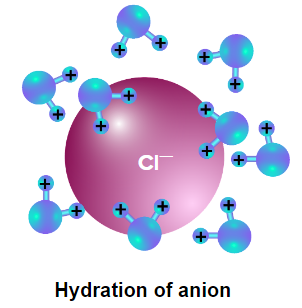
But some other ions can react with water and this reaction is called as Hydrolysis.
It's really interesting that ion from weak electrolyte (weak acid or weak base) undergoes hydrolysis and ion from strong electrolyte (strong acid and strong base) undergoes hydration..
|
Salt |
Examples |
Ion undergoing hydration |
Ion undergoing hydrolysis |
|
Salt of SASB |
NaCl (HCl+NaOH) |
Both Na+ & Cl- |
nil |
|
Salt of SAWB |
NH4Cl (HCl+NH4OH) |
Cl- |
NH4+ |
|
Salt of WASB |
CH3COONa (CH3COOH+NaOH) |
Na+ |
CH3COO- |
|
Salt of WAWB |
CH3COONH4 (CH3COOH+NH4OH) |
nil |
CH3COO-, NH4+ |
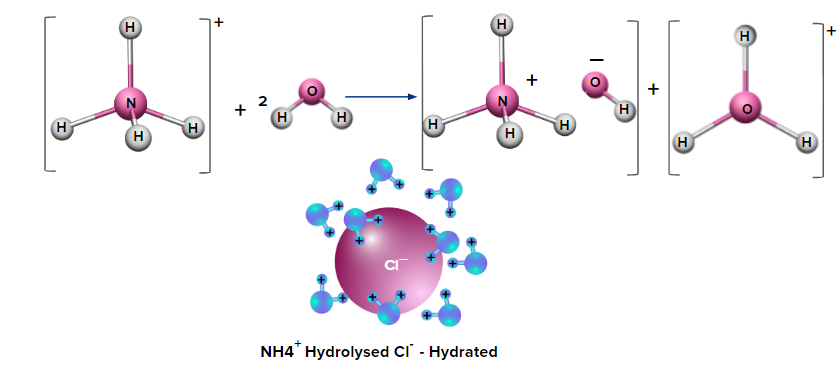
Let's take example of NH4Cl (HCl+NH4OH), NH4+ - Hydrolysed, Cl- - Hydrated
Salt Hydrolysis
It is the chemical reaction of water with cations or anions or both types of ions present in salts.
It can be categorized in two types of hydrolysis.
1. Cationic Hydrolysis
2. Anionic Hydrolysis
We will discuss Cationic hydrolysis here
Cationic Hydrolysis
The cation of salt always comes from the base and if it is from the weak base then it will react with water to give H+ions. The salt solution will be acidic in nature. Hence, pH of the solution decreases because of increasing H+ions. So, we can say that when the cation of a weak base is hydrolysed, this is known as Cationic Hydrolysis- example ammonium chloride.
If we consider cation B+ from weak base BOH, it reacts with water to form a less ionizable weak base BOH.
B+(aq)+2H2O(l)⇌BOH(aq)+H3+O(aq)
Let's take example of NH4Cl (HCl+NH4OH), NH4+ - Hydrolysed, Cl- - Hydrated
NH4+(aq)+2H2O(l)⇌ NH4OH(aq)+H3+O(aq)
|
Salt |
Base |
Nature of base |
Cation |
Hydrolysis |
|
Ca(CH3COO)2 |
Ca(OH)2 |
Strong base |
Ca2+ |
no |
|
NH4Cl |
NH4OH |
Weak base |
NH4+ |
yes |
|
NaCl |
NaOH |
Strong base |
Na+ |
no |
|
Mg(HCOO)2 |
Mg(OH)2 |
Strong base |
Mg2+ |
no |
|
Na2(COO)2 |
NaOH |
Strong base |
Na+ |
no |
|
C5H5NHCl |
C5H5NHOH |
Weak Base |
C5H5NH+ |
yes |
Practice Problems
Q1. Arrange the solution of salt AlCl3, GaCl3 and InCl3in order of decreasing pH.
Answer: These hydroxides of these metals are weak bases. Salts containing the strong acid HCl will undergo cationic hydrolysis. The charge and size of the cation influence hydrolysis. The greater the size and charge, the greater the hydrolysis to produce hydrogen ions. Because they all have the same charge, aluminum has the smallest size and is thus highly hydrolyzed, resulting in a more acidic solution.
The pH sequence will be Al < Ga < Tl
|
Ions |
Origin |
|
Cl- |
HCl - Strong acid |
|
Al3+ |
Al(OH)3 - Weak base |
|
Ga3+ |
Ga(OH)3 - Weak base |
|
In3+ |
In(OH)3 - Weak base |
Q2. Comment for the pH of table salt when added in water whether it is acidic or basic.
Answer: Table salt : NaCl

|
Ions |
Origin |
Hydrolysis |
|
Cl- |
HCl- Strong acid |
No |
|
Na+ |
NaOH - Strong base |
No |
NaCl is a combination of strong acid and strong base. Hence, hydration of respective ions takes place. Hence, the pH of solution should be approaching 7 and the nature of salt should be neutral.
Q3. Comment for the pH of KClO4 salt when added in water

|
Ions |
Origin |
Hydrolysis |
|
ClO4- |
HClO4 - Strong acid |
No |
|
K+ |
KOH - Strong base |
No |
Answer: KClO4 is a combination of strong acid and strong base. Hence, hydration of respective ions takes place. Hence, the pH of solution should be approached to 7 and the nature of salt should be neutral.
Q4. Predict whether Mg(CN)2 salt undergoes cationic hydrolysis or not ?

|
Ions |
Origin |
Hydrolysis |
|---|---|---|
|
CN- |
HCN - Weak acid |
yes |
|
Mg2+ |
Mg(OH)2 - Strong base |
No |
Answer: Mg(CN)2 salt is a combination of weak acid and strong base. It will not undergo cationic hydrolysis as cation is from a strong base. Hence cation gets hydrated rather than hydrolysed.
Q5. Comment for the pH of KCl salt when added in water

|
Ions |
Origin |
Hydrolysis |
|
Cl- |
HCl - Strong acid |
No |
|
K+ |
KOH - Strong base |
No |
Answer: KCl is a combination of strong acid and strong base. Hence, hydration of respective ions takes place. Hence, the pH of solution should be approached to 7 and the nature of salt should be neutral.
Frequently Asked Questions -FAQ
Question 1. What are basic salts?
Answer: The salt which is formed by combination of weak acid and strong base is known as basic salts. For example : CaCO3 is a basic salt.
Question 2. What are acidic salts?
Answer: The salt which is formed by combination of strong acid and weak base is known as acidic salts. For example : NH4ClO4(explosive) is an acidic salt.
Question 3. Is washing soda an acid, base or salt ?
Answer: Washing soda (Na2CO3) is a combination of strong base (NaOH) and weak acid (H2CO3). Hence it is a basic salt.
Question 4. Why table salt (NaCl) will not form HCl & NaOH when it is added to water ?
Answer: NaCl (HCl+NaOH)is a combination of strong acid and strong base. Hence, Na+and Cl- get hydrated rather than hydrolysed .They are stable in ionic form and don't want to react further.
Question 5. Is Baking soda an acid, base or salt ?
Answer: baking soda (NaHCO3) is a combination of strong base (NaOH) and weak acid (H2CO3). Hence it is a basic salt.
Related topics
|
Anionic Hydrolysis |
Hydrolysis of salt weak acid and weak base_SEOABS11CHE09CON010 |
|
Hydrolysis of salts- salt of weak acid and strong base_ |
Acids, Bases and Salts |
|
Hydrolysis of salts - salt of weak acid and strong base_SEOABS11CHE09CON009 |
Theory of Indicators_SEOABS11CHE09CON014 |

 Call Now
 Let's Chat
 Share
Share