-
Call Now
1800-102-2727



Carbohydrates – Classification, Functions, Sources, Importance, Practice Problems and FAQ
Every day, we engage in a variety of activities, including studying, going to classes, travelling, shopping, working out, and more. However, have you ever questioned where we obtain the energy to accomplish so much in a single day?
Consider what would happen if we went a day without eating. Will you have enough energy to do all of these tasks?
No way! What then is in the meal that provides us with energy and enables us to work all day?
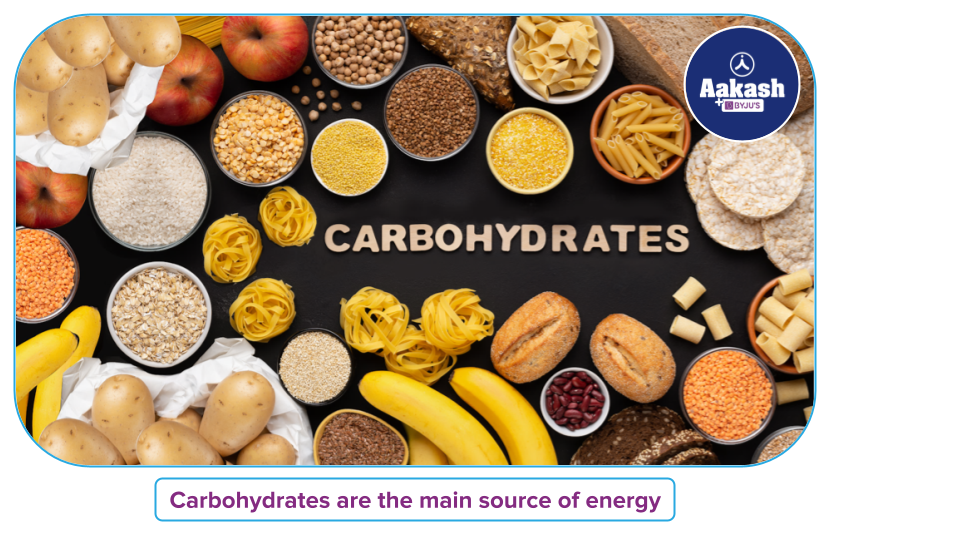
Biomolecules are the solution to this dilemma. Carbohydrates in particular are the main source of energy, making them an essential component of our diet. Your training will be more effective if you consume enough carbohydrates, which are also necessary for healthy brain function. Almost all foods contain carbohydrates, with the exception of meat, eggs, and some kinds of seafood.
Let’s get to know more about carbohydrates on this concept page.
TABLE OF CONTENTS
- Carbohydrates
- Carbohydrates – Classification
- Carbohydrates – Functions
- Carbohydrates – Sources
- Carbohydrates – Importance
- Practice Problems
- Frequently Asked Questions – FAQ
Carbohydrates
Carbohydrates are essential nutrients which include sugars, fibres and starches. Carbohydrates are primarily produced by plants. They can be found in grains, vegetables, and fruits, as well as milk and other dairy products. They are the basic food group that is essential for living a healthy life.
Carbohydrates are made up of carbon (C), hydrogen (H), and oxygen (O) atoms. Carbohydrates got their general name from early observations that they frequently have the formula Cx(H2O)y. They appeared to be the ‘hydrates of carbon’.
For example, if we look at the formula of Glucose which is C6H12O6, it definitely fits into the general formula of carbohydrates i.e., Cx(H2O)y.
So, can we say that all the compounds that fit into this formula may be classified as carbohydrates?
The answer to this question is ‘No’. Not all compounds that fit into this formula may be classified as carbohydrates. Let’s see some examples.
- Acetic acid, CH3COOH, is not a carbohydrate but fits into this general formula, C2(H2O)2.
- Rhamnose, C6H12O5, is a carbohydrate but does fit in this formula.
So, we can say that carbohydrates can’t just by explained using this formula only.
Another way of defining carbohydrates is that they are optically active polyhydroxy aldehydes and ketones or substances that hydrolyse to yield polyhydroxy aldehydes and ketones. Nearly all carbohydrates are optically active and chiral. 1,3-Dihydroxypropanone is an exception to this rule. Sugars and saccharides are other names for simple carbohydrates.
Carbohydrates – Classification
Classification of Carbohydrates are done in terms of three features:
- Based on product obtained on hydrolysis of the carbohydrates
- Carbohydrates are based on their reducing nature. (Ability to reduce Tollens and Fehling’s Solution).
- Carbohydrates (Monosaccharides) based on the number of carbon atoms and functional groups.
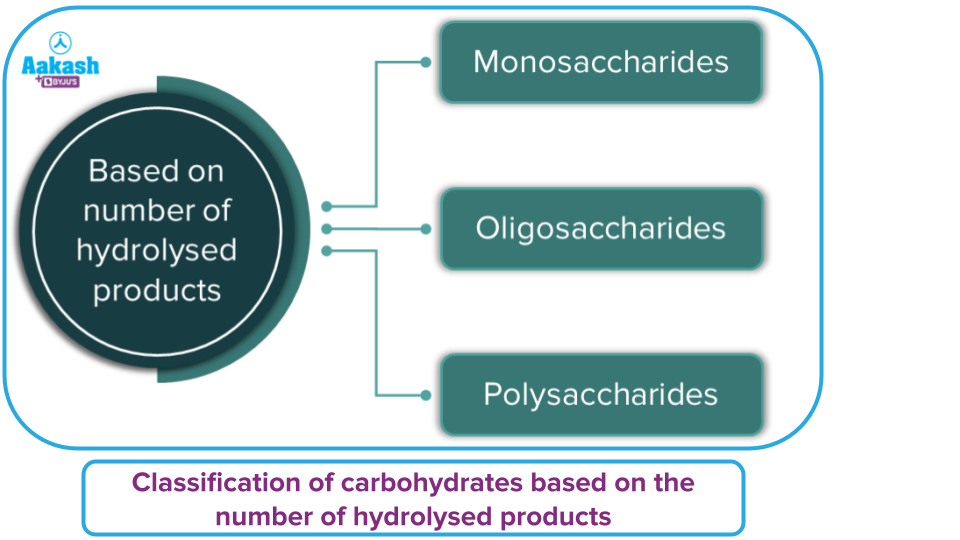
Carbohydrates are classified broadly into three categories on the basis of their behaviour on hydrolysis. Based on number of hydrolysed products, they are classified as:
- Monosaccharides
- Oligosaccharides
- Polysaccharides
Simple carbohydrates have one or two sugar molecules. Because molecules are easily ingested and converted, they raise blood sugar levels. Milk products, refined sugars, alcohol, fruits, candy, and other foods contain simple carbohydrates.
Let’s understand more about monosaccharides.
Monosaccharides
The simplest carbohydrates that cannot be hydrolyzed into simpler carbohydrates are known as monosaccharides.
Examples: Glucose, fructose, ribose, etc.


Oligosaccharides
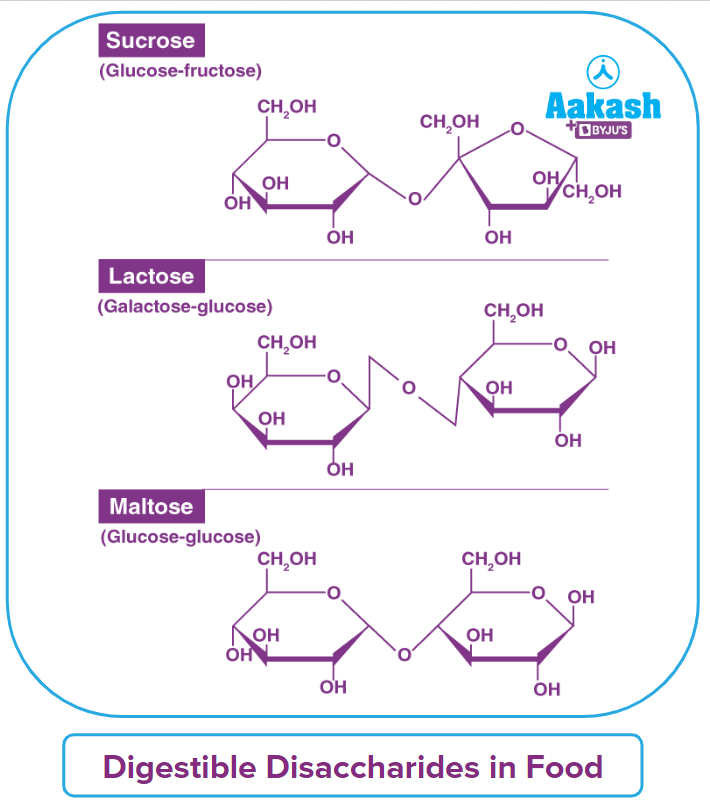
The condensation of 2–9 monomers results in the formation of oligosaccharides, which are molecules of carbohydrates. Depending on how many monosaccharide units are connected, oligosaccharides are referred to as disaccharides, trisaccharides, and so on. Polysaccharides are often categorised separately from oligosaccharides when they include more than 10 sugar residues. Examples: Sucrose, maltose and lactose.
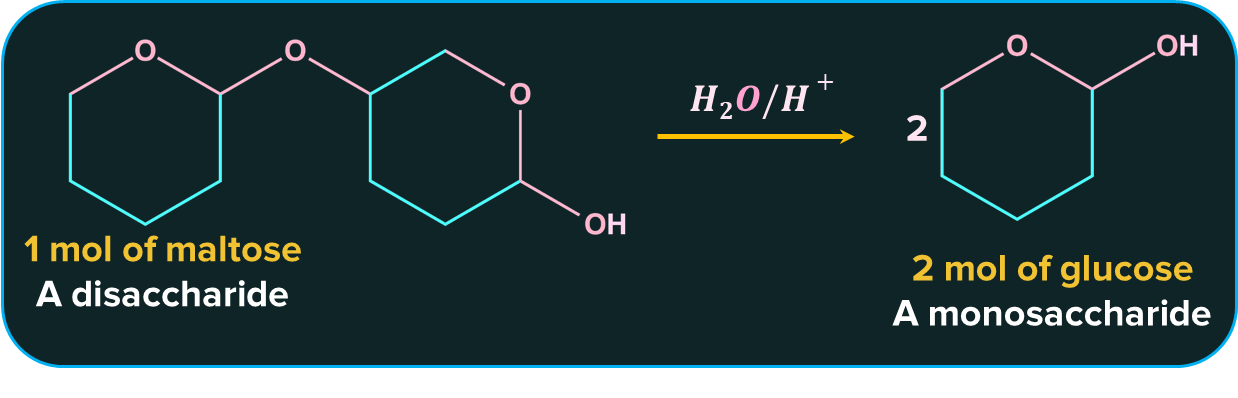
For instance, the hydrolysis of one molecule of sucrose yields two molecules: one of glucose and one of fructose.
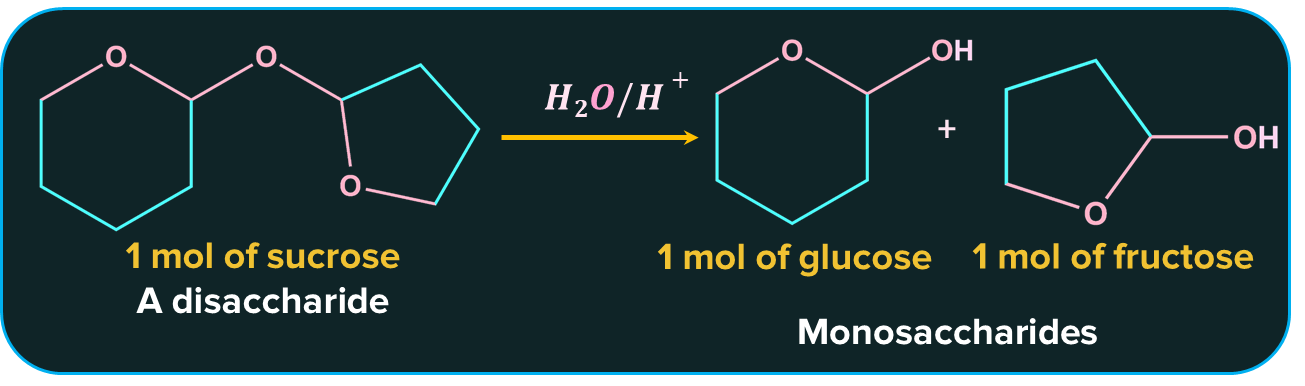
Also, maltose on hydrolysis gives two molecules of only glucose as shown below.
Polysaccharides
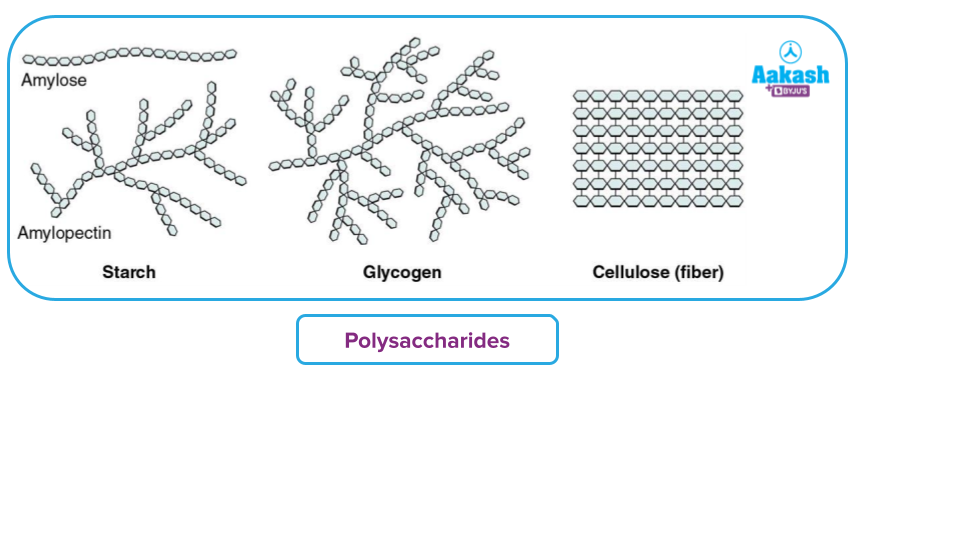
They are carbohydrates that produce a large number of molecules of monosaccharides (>10). They can also be defined as complex carbohydrates made up of several monomers polymerized together. Polysaccharides include starch, glycogen, cellulose, and other carbohydrates that have a lot of branching and are homopolymers (made up of just glucose units).
Complex carbohydrates are made up of two or more sugar units. In comparison to simple carbs, molecules in complex carbohydrates are digested and transformed slowly. They are abundantly found in, beans, lentils, potatoes, peanuts, corn, peas, cereals, whole-grain bread, etc.

The following are some examples of polysaccharides.
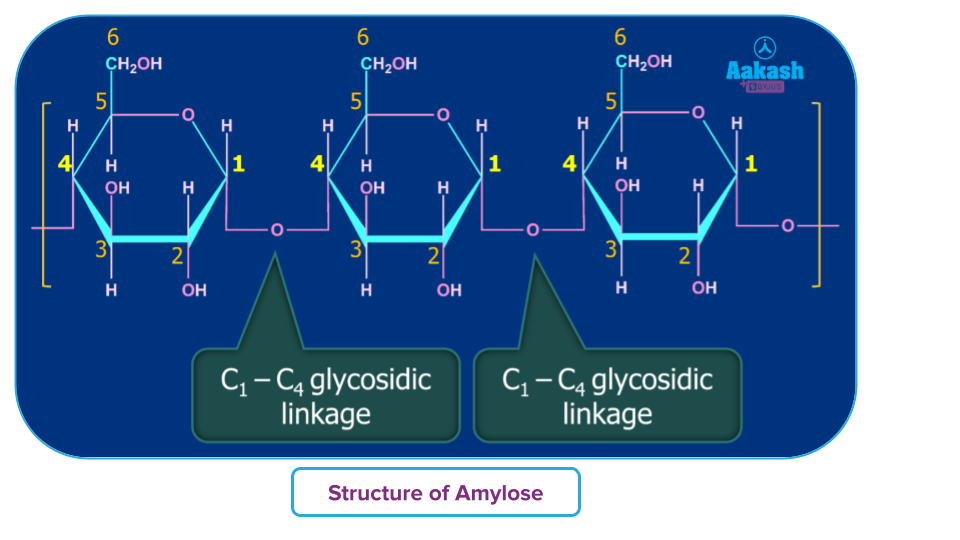
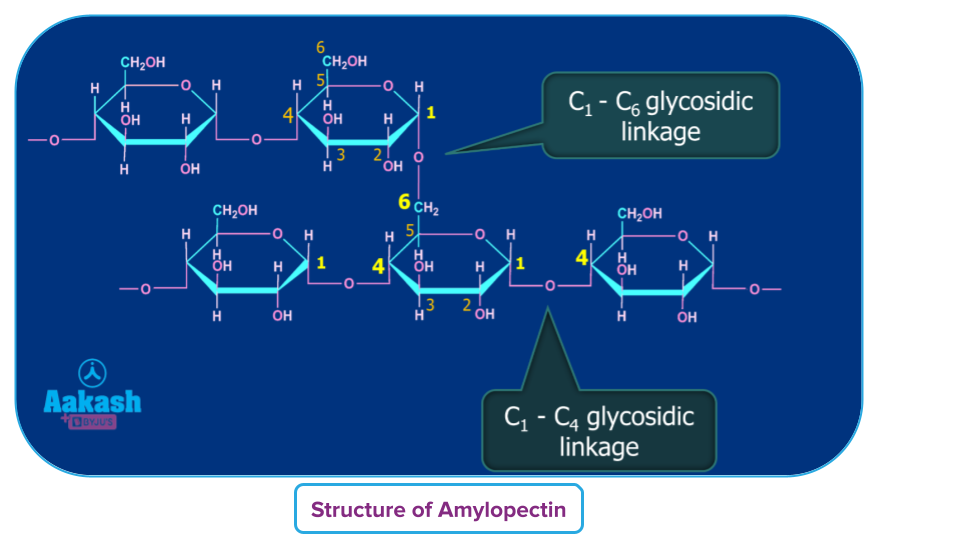
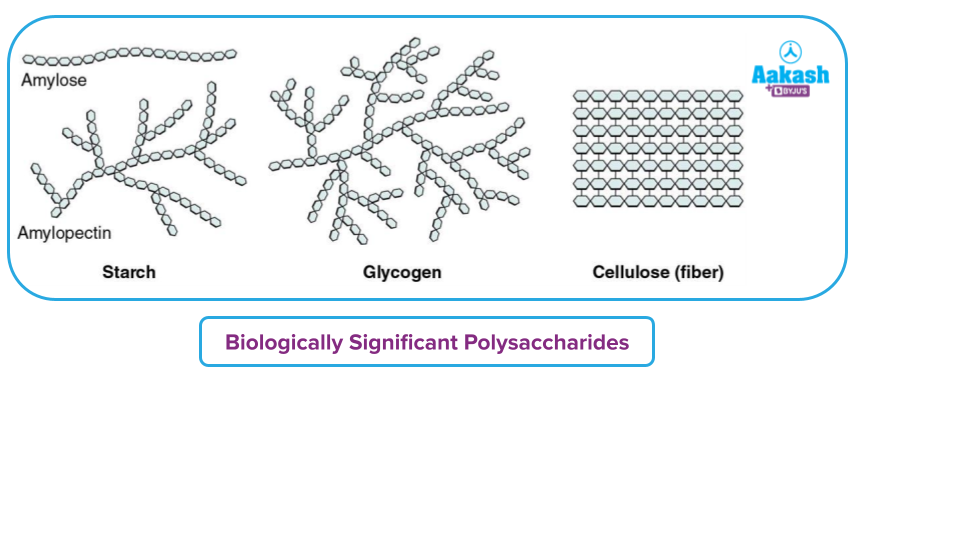
- Starch - It is composed of two components namely, amylose and amylopectin. While amylopectin is a heavily branched chain, amylose forms a linear chain.
- Glycogen - It is known as animal starch. Starch-like in structure, but with more widespread branching.
- Cellulose - It is a structural carbohydrate and is the main structural component of the plant cell wall. It is a fibrous polysaccharide with high tensile strength. Cellulose, unlike glycogen and starch polymerizes linearly into a linear structure.
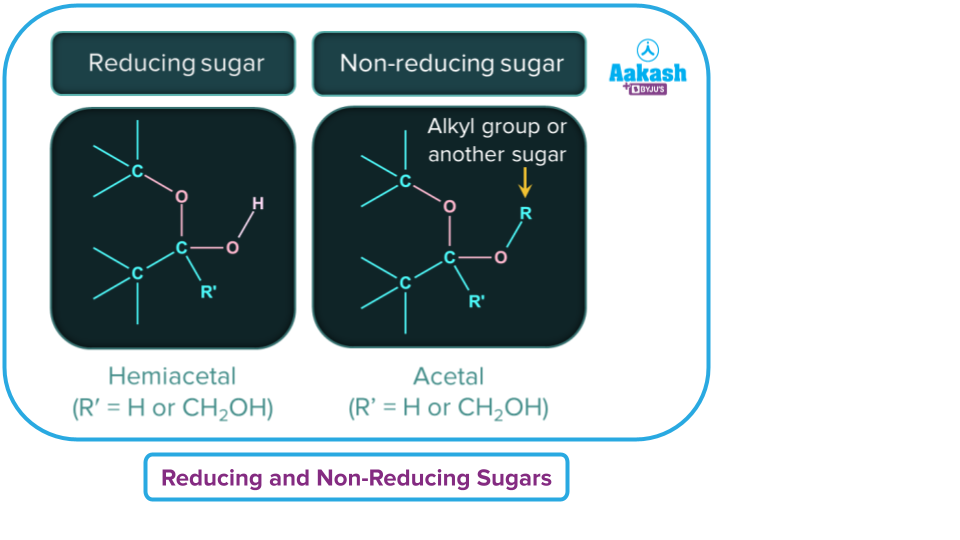
- Carbohydrates can also be classified on the basis of their reducing nature as reducing sugar and on-reducing sugar, based on the ability to reduce Tollens’ & Fehling’s reagent.
- Reducing sugars, reduces Tollens’ & Fehling’s reagent and they should have at least one hemiacetal or hemiketal functional group.
- Non-reducing sugars, does not reduce Tollens or Fehling’s solution and should have acetal linkage.
Example: All monosaccharides and oligosaccharides except sucrose are reducing sugars, All polysaccharides are non-reducing sugars.
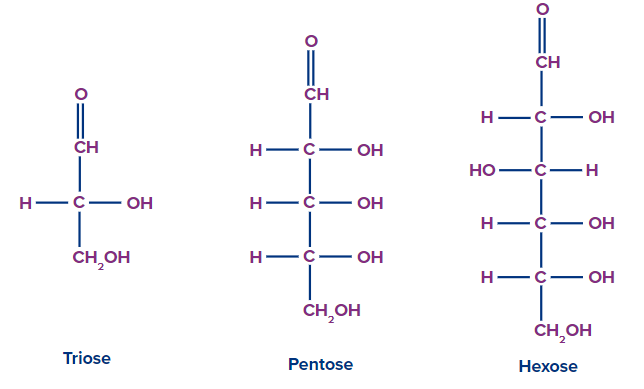
- Monosaccharides are further classified into two categories based on the number of carbon atoms present and functional groups.
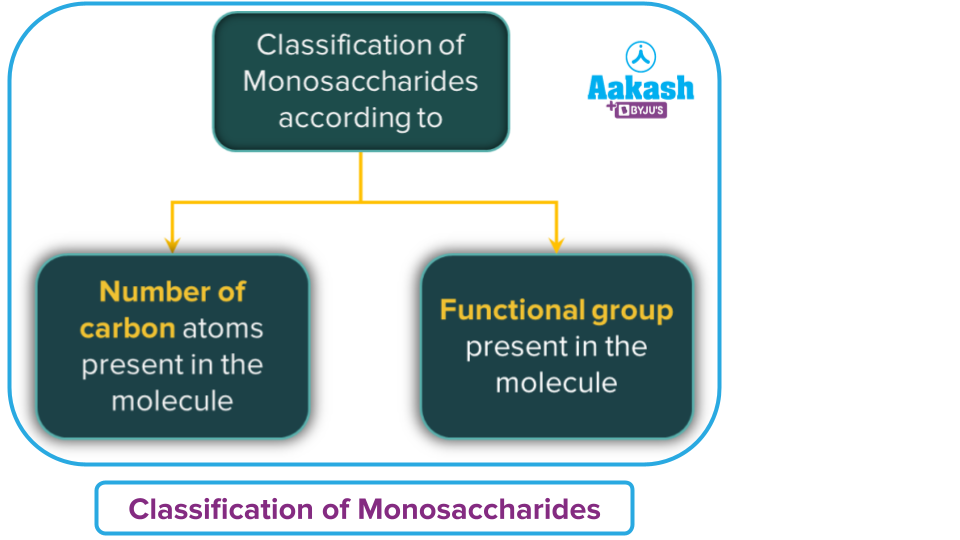
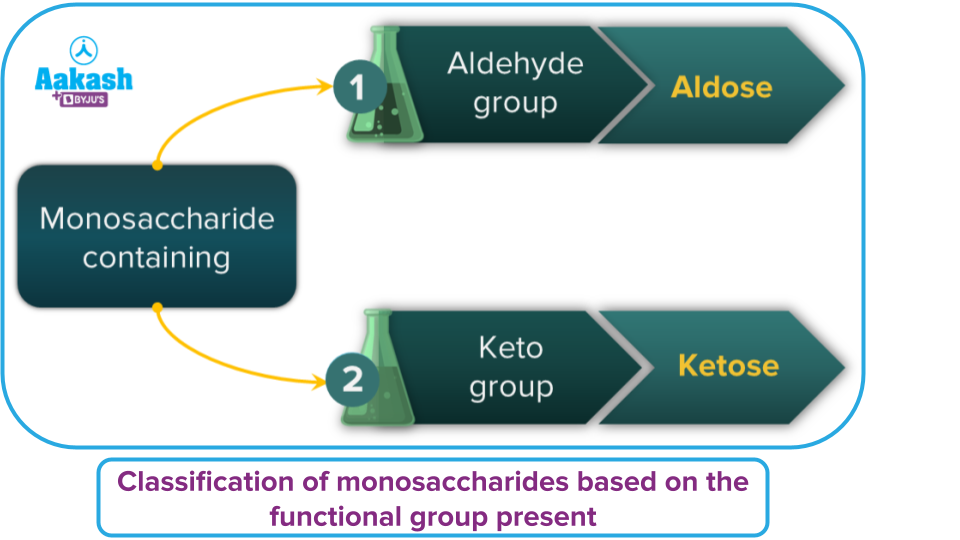
|
Number of carbonn atoms |
General term for monosaccharides |
Aldehyde |
Ketone |
|
3 |
Triose |
Aldotrose |
Ketotriose |
|
4 |
Tetrose |
Aldotetrose |
Ketotetrose |
|
5 |
Pentose |
Aldopentose |
Ketopentose |
|
6 |
Hexose |
Aldohexose |
Ketohexose |
|
7 |
Heptose |
Aldoheptose |
Ketoheptose |
Carbohydrates – Functions
- Carbohydrates' primary function is to provide energy and food to the body and nervous system.
- Carbohydrates, which include sugars, starch, and fibre, are abundant in grains, fruits, and milk products and are one of the basic components of food.
- Carbohydrates are also referred to as starch, simple sugars, complex carbohydrates, and other terms.
- Carbohydrates inhibit the breakdown of proteins for energy as they are the primary source of energy.
Carbohydrates – Sources
We can get carbohydrates from different sources. They are:
- Fructose, a simple sugar, is present in a variety of fruits.
- Each dairy product contains galactose.
- Lactose is a substance found in milk and other dairy products in substantial proportions.
- Beer, Cereal, processed cheese, potatoes, pasta, and other foods all contain maltose.
- Sugar and honey, which naturally contain small amounts of vitamins and minerals, are the sources of sucrose.
Carbohydrates – Importance
- Starch in plants and glycogen in mammals are two examples of how carbohydrates are employed as storage molecules.
- They offer the raw materials for several significant businesses, including breweries, lacquers, textiles, and paper.
- Carbohydrates are found in the biosystem in combination with many proteins and lipids.
- Both plants and animals depend on carbohydrates for survival. They form a major portion of our food.
Practice Problems
- Which of the following option is correct for the importance of carbohydrates in our body?
- It provide energy to the body
- It breaks down into glucose and eneters our blood stream
- Body cell utilize glucose to produce ATP
- All of the above is correct
Answer: D)
Solution: Carbohydrates provide energy to the body. It converts to glucose and gets into our circulation.The body cells utilise glucose to produce ATP.
So, option D is the correct answer.
- What is the product obtained on hydrolysis of glycogen?
- β-D-Glucose
- β-D-Fructose
- -D-Glucose
- -D-Fructose
Solution: Glycogen on hydrolysis produces monomeric units of alpha-D-glucose. All of the monomeric units of glycogen's long polymer chains of glucose units are alpha-D-glucose, which are joined together by an alpha acetal linkage.
Due to the fact that glycogen is composed of -D-Glucose monomer units joined by glycosidic linkages, it only produces glucose when hydrolyzed. So option C is correct..
- Why are carbohydrates important for plants?
Solution:
- Plant cells are composed of cellulose, a disaccharide. Plant cellulose is also used in the production of papers, fabrics, and wood for construction.
- Plants use sunlight and carbon dioxide to release oxygen into the atmosphere during photosynthesis, and glucose is prepared and stored in plants as a form of energy. When animals eat plants, they get energy from the stored carbohydrate, which allows us to survive.
- Plants store starch as an energy source containing thousands of glucose units.
- Can we convert polysaccharides to monosaccharides? If yes, how?
Solution: Starch in the presence of distaste enzymes converts into maltose which is a disaccharide. In the presence of maltase, maltose is converted into glucose which is a monosaccharide molecule with formula C6H1206.

Frequently Asked Questions – FAQ
Q1. Are all carbohydrates digestible in nature?
Ans. No, not all carbohydrates are digestible. Cellulose is an insoluble plant fibre which is a carbohydrate but is indigestible.
Q2. Which is better for digestion? Simple carbohydrates or complex carbohydrates?
Ans. Complex carbs are lengthy, complex sugar molecule chains that are digested slowly and steadily to release energy. Simple carbohydrates exhibit faster digestion, release energy, and they raise blood sugar, which is not seen as healthy.
Q3. What is blood sugar and why does it matter?
Answer: Glucose, a chemical that fuels our cells and significantly affects our health, is what we mean when we discuss blood sugar levels. The fundamental fuel that powers our bodies' cellular motion is glucose. We get glucose from the things we eat.
Q4. What is the difference between starch and glycogen?
Ans. Glycogen: It is an energy-saving or stockpiling carbohydrate found in all living things. Glucose is the monomer for glycogen which is tightly bound and supported by glycosidic bonds.
Starch: Amylopectin and amylose are the two monomers that makeup starch. Amylopectin has a branched structure, whereas amylose is more straight and coiled. It is a form of polysaccharide.

NEET Related Links
JEE MAIN Related Links
JEE Advanced Related Links
JEE Advanced Eligibility Criteria
JEE Advanced Chemistry Syllabus
JEE Advanced Registration Dates
CUET Related Links
Important Topics
Anemometer : Measurement of Wind Speed
Angular Acceleration Atomic Theory Audible and Inaudible Sound Average Speed and Average Velocity Average Velocity Avogadros Number Avogadros Hypothesis Azimuthal Quantum Number Balanced Force Bar Magnet Biconvex Lens Boyles Law Buoyancy Calorimeter Carnot Engine Celestial Bodies Centripetal And Centrifugal Force Concave and Convex Lenses Concave Convex Mirrors Contact and Non Contact Force Controlled Thermonuclear Fusion Convection Currents Convex Lens Convex Mirror Destructive Interference Difference Between Conduction Convection and Radiation Difference Between Electric Field and Magnetic Field Difference Between Heat And Temperature Difference Between Series And Parallel Circuits Differences Between Acceleration And Velocity Distance and Displacement Distance Time Graph Electrical Force : Electric Forces and Their Types Electromagnetic Waves : Definition, Equation and Properties of Electromagnetic Waves Electromagnetism Electron Spin Fluid Flow : Bernoullis Equation Derivation and Fluid Mechanics Fluid Friction : Types and Factors of Fluid Friction Frames of Reference : Inertial and Non- Inertial Frame of Reference Frequency and Wavelength Frictional Force Importance of Hydrosphere Instantaneous Speed and Velocity Introduction to Motion Kinetic and Potential Energy Difference Law Of Conservation of Energy Layers of the Earth Light Energy Light Sources List of physics scientists and Their inventionsLoudness of Sound
Magnetic Dipole Moment Magnetic Field Non - Contact Force Non - Renewable Energy Ohms Law Optics P Wave Physics Symbols Plane Mirrors Poissons Ratio Projectile Motion Properties of Water : Anomalous Expansion of Water Radius of Gyration Reflection of Light Reflection of Waves Relative Density Resonance Reverberation Rolling Friction Rotation and Revolution Screw Gauge Semiconductors and Insulators Sliding Friction Speed Time Graphs Static Friction Stefan Boltzmann Law Stress Tension Tension Force Thermometer: Clinical Laboratory Thermometer Types of Rocks Types of Waves Uniform Motion and Non Uniform Motion Unit of Voltage Uses of Convex Lens Uses Of Convex Mirror Uses of Electromagnet Uses of Optical Fibre Wave Wavelength of Light What is Scattering of Light Working of Electric Bell Conventional and Non-conventional Sources of Energy Buoyant Force Bulk Modulus of Elasticity Bernoulli’s Principle Angular Momentum Difference Between Speed And Velocity ForceUnit of Heat
Difference between Distance and Displacement Simple Microscope Derivation Of Equation Of Motion Thermometer: Clinical & Laboratory Thermometer Difference between Concave and Convex LensDerivation Of Lens Maker Formula
Unit Of Pressure Velocity Uses of Plane Mirror
Wave Theory of Light
Unit of Density Unit of Light Unit of Force Unit of Magnetic Field Unit of wavelength Unit of Viscosity Uses of Electroplating Young's Modulus
What is the Scattering of Light
Lenz Law Space Wave Propagation Schrodinger Wave Equation Relation between Fahrenheit and Celsius Refractive Index Potentiometer Working Pascal Law Oscillatory Motion Optical Instruments Newton's Laws of Motion - First Law Modulation and Demodulation Magnetic Flux Lens Formula and Magnification Kaleidoscope Faradays Law Epsilon Naught Value Energy Bands Electrostatics Electroscope AC Generator Unit of Current Lithosphere Bending Equation Derivation Difference Between Pound and Kilogram Semiconductor Devices OTEC - Ocean Thermal Energy Conversion Hall Effect Rectilinear Propagation of Light Difference Between Ammeter and Voltmeter Coefficient of Linear Expansion Ampere’s Law Cyclone and Thunderstorm Save The Environment From Pollution Particle Nature of Light Types of DC Motor Uses Of Transistor Derivation of Phase Rule Unit of Humidity

 Call Now
 Let's Chat
 Share
Share