-
Call Now
1800-102-2727


Bleaching Powder Preparation - Preparation, Applications, Practice Problems and FAQs

Priya, a student from class 12th, went to meet her grandparents who live in a village. She is absolutely mesmerised by the beauty of the village. One of her favourite activities in the village is to take out water from the well.
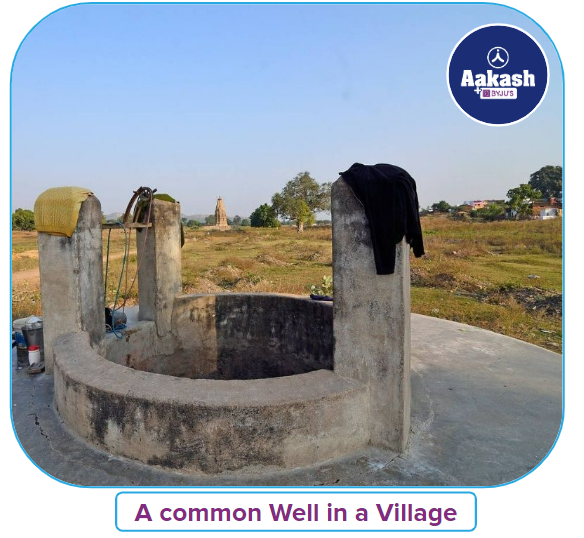
Obviously, for an urban student, this is fascinating. She immediately went to the well but was disappointed looking at the condition of the water. Due to unwanted rain, the water has gone dirty inside the well. Looking at the sad face of granddaughter, her grandfather took the matter in charge.
The next day when Priya woke up got surprised while looking at the well. It was looking so clean as if someone had changed the water overnight. She rushed to her grandfather and asked about the magic. Her grandfather told her about this magical substance that cleaned the dirt from the water. It was bleaching powder.
In this article, we will find out the process and techniques that are used to prepare bleaching powder.
Table of Contents
- What is Bleaching Powder?
- Preparation of Bleaching Powder
- Applications of Bleaching Powder
- Practice Problems
- Frequently Asked Questions - FAQs
What is Bleaching Powder?
Bleaching powder, also known as chloride of lime, is a solid white powder, although the commercially available samples appear yellowish-white. Bleaching powder is also known by several other names like chlorine powder, chlorinated lime, chloride of lime, etc and is used extensively for water treatment, and as a bleaching agent.
Calcium hypochlorite CaOCl2 is the main active ingredient of commercially available bleaching powder. It is quite stable at room temperature. It has the tendency to slowly decompose in moist air, liberating chlorine gas which gives it its characteristic chlorine-like strong and pungent odour.
The composition of bleaching powder is . The commercially available bleaching powder generally contains 15-25% of Ca(OH)2 and only about 35% of Cl2 available for oxidation.
When bleaching powder is dissolved in water, it forms a basic aqueous solution. Bleaching powder behaves as an oxidising agent. As there is chlorine present in the bleaching powder, it causes the bleaching action.
Preparation of Bleaching Powder
The process of producing bleaching powder is common which includes reacting chlorine with dry slaked lime. But in industries two different types of plants are established for the preparation of bleaching powder.
- Bachmann’s Plant
- Hasenclever Plant
Bachmann’s Plant:
In Bachmann's plant, bleaching powder is produced in the following ways:
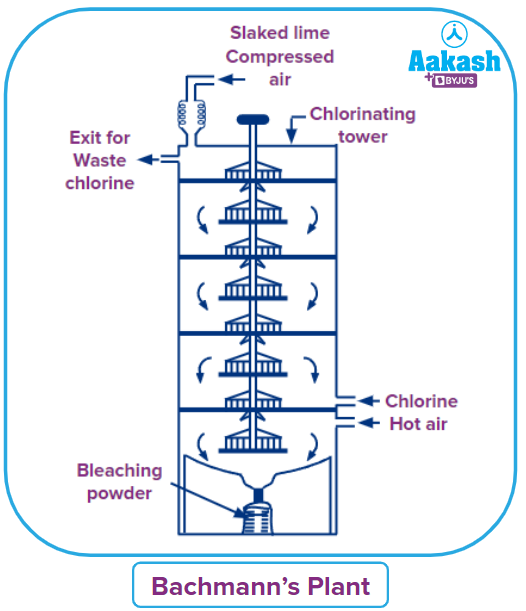
The important components of this manufacturing plants are:
- A vertical cast-iron tower with a hopper at the top.
- An inlet for Cl2 and an inlet for hot air, just above the base.
- An exit route for waste gases.
The tower is equipped with revolving rakes and 8 shelves at various heights. The hopper is initially filled with slaked lime. Moving slowly upward, it gradually comes into touch with chlorine gas. Bleaching powder, the end product, is subsequently gathered in the barrel area at the tower's base. Two important points that should be followed during the preparation of bleaching powder in this plant are:
- The concentration of Cl2 used should be dilute.
- Optimum temperature required is 40°C.
The reaction taking place inside the manufacturing plant is described below:
Storage: In order to protect it from exposure to air and moisture, bleaching powder is often stored in an airtight container. It interacts with CO2 in the presence of air to produce CaCO3 and chlorine.
Hasenclever Plant:
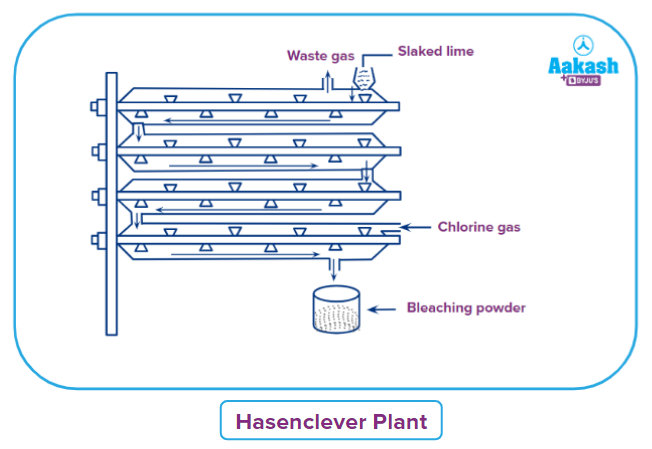
In this plant, a few channelled cylinders are placed horizontally. Dry slaked lime, Ca(OH)2, is passed into the plant system through an inlet at the topmost cylinder. Then, the slaked lime goes ahead through the revolving blades of the shafts. The chlorine gas is passed into the lowermost cylinder through the inlet present on it. The chlorine gas moves up, and in the upper cylinder, it reacts with the dry Ca(OH)2 producing bleaching powder. When bleaching powder is formed, it comes out through the outlet present at the bottom of the middle cylinder and is collected in a vessel.
Applications of Bleaching Powder
- Due to the great supply of chlorine, both drinking water and sewage are disinfected using it.
- By cleaving the bonds in glycols and keto acids, it is utilised to produce fragmented aldehydes and carboxylic acids.
- It is employed to clean jewellery, antique objects, etc.
- It is utilised in the haloform reaction to make chloroform.
- It protects against bacterial deterioration during preservation. For instance, using a small amount of bleaching powder in a vase of cut flowers will prolong their freshness.
- In the textile industry, it is used to bleach cotton and linen.
- Thiol and sulphide byproducts of organic synthesis can be safely disposed of after being oxidised by calcium hypochlorite, which also reduces their odour.
Practice Problems
Q1. Generally, what is the percentage of available chlorine in a commercially bought, good sample of bleaching powder is:
a. 23%
b. 35%
c. 65%
d. 56%
Answer: (B)
Solution: The composition of bleaching powder is Ca(OCl)2.CaCl2.Ca(OH)2.2H2O. The commercially available bleaching powder generally contains 15-25% Ca(OH)2 and only about 35% Cl2 available for oxidation. So, option (B) is the correct answer.
Q2. Bleaching powder is which of the following types of salt?
a. Double Salt
b. Mixed Salt
c. Complex Salt
d. None of the above
Answer: (B)
Solution: A mixture of calcium chloride (CaCl2), calcium hypochlorite (Ca(ClO)2) and calcium hydroxide (Ca(OH)2) makes up bleaching powder. Hence, bleaching powder is a mixed salt.
Q3. What is the optimum temperature required for the preparation of bleaching powder in Bachmann’s plant?
a, 300 C
b. 400 C
c. 500 C
d. 600 C
Answer: (B)
Solution: The optimum temperature required for the preparation of bleaching powder in Bachmann’s plant is 400 C. Hence, option B is the correct choice.
Q4. Which of the following gas react with dry Ca(OH)2 to produce bleaching powder?
a. Chlorine Gas
b. Oxygen Gas
c. Nitrogen gas
d. None of the above
Answer: (A)
Solution: Dry slaked lime, Ca(OH)2, is passed into the plant system through an inlet at the topmost cylinder. Then, the slaked lime goes ahead through the revolving blades of the shafts. The chlorine gas is passed into the lowermost cylinder through the inlet present on it. The chlorine gas moves up, and in the upper cylinder, it reacts with the dry Ca(OH)2 producing bleaching powder.
Frequently Asked Questions - FAQs
Q. What is the difference between bleaching powder and bleach?
Answer: In the process known as bleaching, any chemical agent used to clean or remove stains from fabric or fibres or to remove the colour from them is referred to as bleach. Bleach is a diluted sodium hypochlorite solution, commonly called liquid bleach. notably for creating chlorine bleaches, which act as an active ingredient in many household bleaches and are a potent oxidizer.
Non-chlorine oxidising bleaching agents often rely on peroxides such hydrogen peroxide (H2O2), sodium percarbonate (Na2CO3·1.5H2O2), and sodium perborate(NaBO3.4H2O). These bleaches are also known as "colour-safe bleach," "oxygen bleach.’'
Bleaching powder" on the other hand usually means a formulation containing calcium hypochlorite.
Q. How dangerous is bleaching powder?
Answer: The corrosive nature of the hypochlorite moiety makes calcium hypochlorite a dangerous substance that must be stored carefully. It must be stored in a cold, dry environment and must not be exposed to any metals or acids. If any acid comes in contact with calcium hypochlorite, highly toxic fumes of chlorine gas can be produced.
Health problems can also result from ingesting the materials, breathing the fumes, or coming into contact with the eyes or skin.
Q. Is clorox and bleaching powder the same?
Answer: Clorox is a bleaching substance with the major ingredient sodium hypochlorite, whereas bleaching powder is calcium hypochlorite. Clorox bleach has an active sodium hypochlorite concentration between 5% and 6.5%
Q. Is Bleaching powder an acid, base or salt?
Answer: Calcium hypochlorite is the salt of a strong base. When calcium hypochlorite is dissolved in water, the anion (hypochlorite) takes protons from water molecules and releases hydroxide ions. Hence, bleaching powder is considered as basic salt.
The chemical reaction is given by

 Call Now
 Let's Chat
 Share
Share