-
Call Now
1800-102-2727


Blackbody Radiation - Definition, Electromagnetic Spectrum, Laws, Practice Problems & Frequently Asked Questions(FAQs)

How many of you have played Call Of Duty? Or CounterStrike? In those games, you might have come across some missions where you would have put on Night-Vision Goggles (NVG). The screen would have turned somewhat greenish and you would be able to locate people even from a longer distance. Do I sound correct?
Have you ever wondered what or how this shift in your vision takes place?
How would you react if I told you that electric heaters, incandescent light bulbs, stoves, the sun, the stars, burglar alarms, etc work more or less on the same principle. Does that grab your attention?
Let's now look at the very same principle. It's called “Black-Body Radiation”. Since we now have your attention, let us study the same in a bit more detail.

Table of contents
- Electromagnetic Spectrum
- Black body
- Wien’s law
- Stefan’s law
- Practice problems
- Frequently asked questions-FAQs
Electromagnetic Spectrum
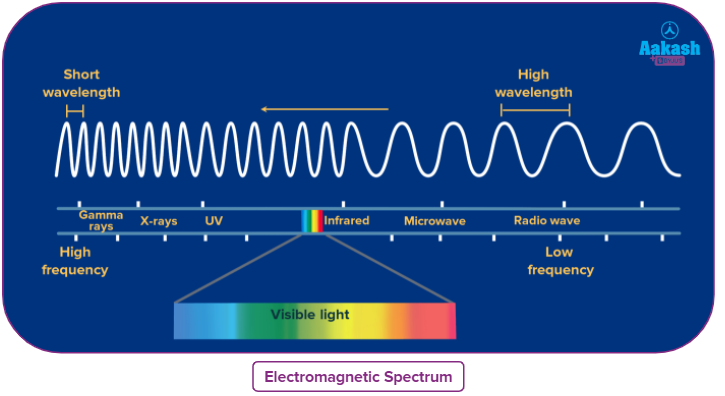
The range of wavelengths or frequencies over which the electromagnetic radiation extends is known as the electromagnetic spectrum. The order of wavelengths in the electromagnetic spectrum is as follows:
γ-rays < X-rays < Ultraviolet < Visible < Infrared < Microwaves < Radio waves
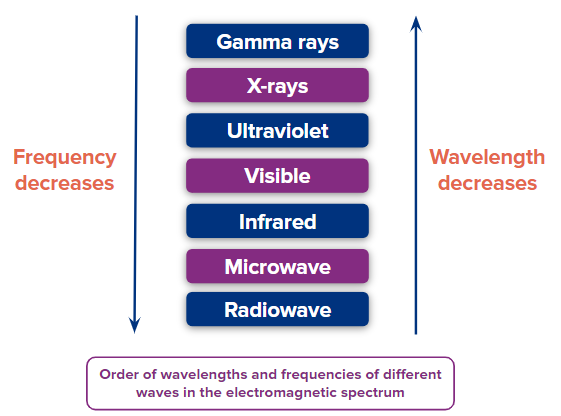
Wavelengths in the range of 4000 Å to 7500 Å lie in the visible region of the electromagnetic spectrum with respect to the human eye.
Wave theory couldn’t explain the following phenomena
- Black-body radiation
- Photoelectric effect
- Variation of heat capacities of solids with temperature
- Line spectrum of hydrogen
Black Body (idealized system)
First introduced by Gustav Kirchhoff in 1860, a black body is a theorized physical object with a mass that can internally absorb all the energy targeted at it, containing it wholly and not reflecting off any residue, independent of the wavelength of the incident radiations or the angle of incidence. It is called a “black body” because it absorbs all light that falls on its surface. A black body at a constant temperature, and therefore in thermal equilibrium, radiates electromagnetic black-body radiation. The emitted radiation is in accordance with Planck’s law, meaning that the emitted radiation has a spectrum that is purely dependent on the temperature of the black body and not the shape and composition of the black body. A black body at constant temperature has two desirable properties:
- It is an ideal emitter: the thermal radiative energy emitted by a black body is as much or more than any other body at the same temperature.
- It is a diffuse emitter: the energy which is measured per unit area perpendicular to the direction of the back body is radiated isotropically, independent of direction.
A blackbody is one that allows all incidents and all types of radiation from all directions and internally absorbs all of it.
Conclusions: Blackbody has zero reflectance and zero transmittance
Any real body also absorbs radiation which is very lower than blackbody.
E.g of a blackbody, lamp black, platinum black
Wien’s law:
Also known as Wien’s displacement law, is the relationship between the temperature of a black body (an ideal substance that emits and absorbs all frequencies of light) and the wavelength emitted having a maximum intensity at that temperature.
The exact frequency distribution of the emitted radiation from a black body depends only on its temperature.
Wien found that the radiative energy, dW, per wavelength interval,  , has a maximum at a certain
wavelengths  and that the maxima shifts to shorter wavelengths as the temperature T is increased. He found that the product
  T is an absolute constant.

where b is the Wien’s displacement constant which is equal to 2.897 × 10⁻³ m.K.
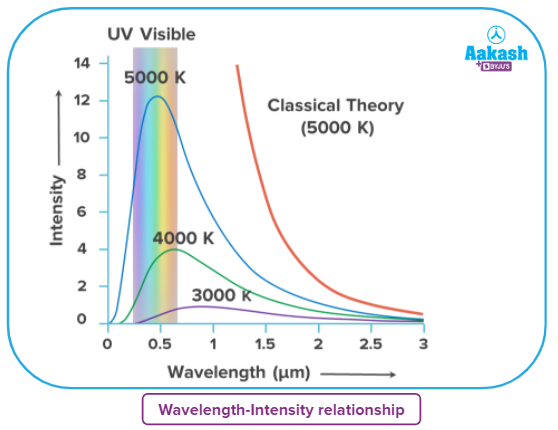
In the graph, there is a peak intensity but as per the Rayleigh-Jeans law (A mathematical formula for waves), there must be an infinite peak as we approach zero wavelength.
So, the wave theory failed to explain this experimental graph.
Later, Planck’s equation, which considered that atoms and molecules could emit or absorb energy only in discrete quantities (known as quantum), and not in a continuous manner, tallied with the graph proving the particle nature of light.
Stefan’s law
Stefan Boltzmann's law establishes that the total amount of radiation energy produced by a black body per unit time from a specific area (A) at absolute temperature (T) is directly proportional to the fourth power of that black body.
Mathematical form:
 (for perfect absorber and emitter or blackbody)
Where, σ (= 5.67 10-8 Wm-2K4) is called the Stefan Boltzmann constant and is a constant of proportionality and T is the temperature of the black body
For a body that is not black, the radiant emittance is given by, u=∈AT4
where ∈ is called emissivity, which is defined as the ability of a surface to radiate energy in the form of thermal radiation.
Practice problems:
Q1. Which of the following is correct regarding the black body spectrum?
A. With an increase in temperature peak of the curve shifted towards higher wavelength
B. With an increase in temperature peak of the curve shifted towards lower wavelength
C. With the increase in temperature no shift observe in the peak of curve
D. None of these
Answer: (B)
Solution: With an increase in temperature maxima of curve shifts to shorter wavelengths as the temperature T is increased.
Q2. During blackbody radiation, the energy of radiation is proportional to Tx. What is the value of x
A. 1
B. 2
C. 3
D. 4
Answer: (D)
Solution:  (for perfect absorber and emitter or blackbody)
SO, x = 4
Q3. Two bodies kept at the same temperature ‘T’, if the wavelength corresponding to the maxima of the curve is  for intensity v/s wavelength then find the relation between
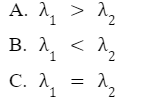
D. None of these
Answer: (C)
Solution: The exact frequency distribution of the emitted radiation from a black body depends only on its temperature.
Wien found that the radiative energy, dW, per wavelength interval,  , has a maximum at a certain wavelengths
  and that the maxima shifts to shorter wavelengths as the temperature T is increased.
Q4. Three-body A, B and C during an experiment on heating glowing red, blue, and yellow at temperature T1, T2 & T3 respectively. Find the relation between T1, T2 & T3
- T2 <T1< T3
- T1 >T2> T3
- T1 <T2< T3
- T1 <T3< T2
Answer: (D)
Solution: increasing wavelength: Blue > yellow > red
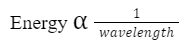
At higher temperature body glow blue colour and at lowest temperature body glow red.
Frequently asked questions-FAQs
Question 1. Is blackbody always seem black in colour?
Answer: No but generally blackbody appears black because, black bodies are very good absorbers, the maximum fraction of light is absorbed so the body appears colour.
Question 2. What are electromagnetic waves?
Answer: Electromagnetic waves are composed of oscillating magnetic and electric fields. EM waves are capable of showing interference or diffraction. An EM wave can travel through any medium (air, solid medium or vacuum).
Question 3. What are additive and subtractive colour theories and where are they used?
Answer: Additive colour - Primary colours are RGB (red, green and blue) on mixing they form white colour. This principle is used for mobiles, laptops, tv screens etc.

Subtractive colour - Primary colours are CYM (cyan, yellow and magenta) on mixing they form a black colour. This principle is used for printing paper, flex, fabric etc.

Question 4. Is the curve obtained for intensity vs wavelength only dependent on temperature or also depends on the type of material, size and shape of material?
Answer: The curve obtained for intensity vs wavelength only depends on temperature not depend on the type of material, size and shape of material
Related topics:
|
Planck's Quantum Hypothesis |
Atomic Number and Mass Number |
|
Dual nature of Matter-Wave nature of light |
Photoelectric effect |
|
De-Broglie Hypothesis |
Heisenberg's uncertainty principle |

 Call Now
 Let's Chat
 Share
Share