-
Call Now
1800-102-2727


Biot–Savart Law: Formula, Applications, and Solved Numericals

The Biot–Savart Law is a fundamental law of electromagnetism in Physics. It helps us in calculating the magnetic field that is produced by a current-carrying conductor.
It plays a similar role to Coulomb's law in electrostatics, but instead of dealing with electric charges, it deals with moving charges that are electric currents.
Biot–Savart Law is one of the important topics because it forms the basis for finding the magnetic field due to current elements, straight conductors, circular loops, and other current configurations.
Requirement of Biot–Savart Law
From Ørsted's experiment, it is noticed that a current-carrying conductor produces a magnetic field around it. However, to calculate the magnitude and direction of this magnetic field at a given point, we require a mathematical relation.
That particular relation is provided by the Biot–Savart Law.
It helps us to find:
- How the magnetic field depends on current
- How distance affects the magnetic field
- How the orientation of the current element affects the field
Statement of Biot–Savart Law
Biot–Savart Law states that:
The magnetic field dB at a point due to a small current element I dl is directly proportional to the current, the length of the current element, and the sine of the angle between the current element and the line joining the element to the point, and inversely proportional to the square of the distance between them.
Mathematical Form of Biot–Savart Law
The magnetic field due to a small current element is given by:
The magnitude form is given as:
Explanation of Symbols
| Symbol | Meaning |
|---|---|
| dB | Small magnetic field produced |
| μ₀ | Permeability of free space |
| I | Current in the conductor |
| dl | Small length element of conductor |
| θ | Angle between dl and r |
| r̂ | Unit vector along r |
| r | Distance from current element to point |
Value of permeability of free space:
Direction of Magnetic Field (Right-Hand Rule)
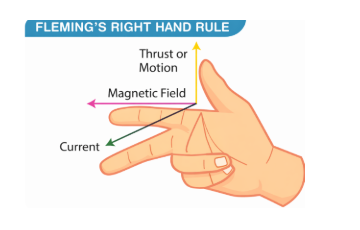
Determination of the direction of the magnetic field given by the Biot–Savart Law is done by using the right-hand thumb rule.
- Point the thumb of the right hand in the direction of the current.
- The curl of the fingers gives the direction of the magnetic field lines.
This rule helps us to determine the direction of the dB vector.
Important Observations from Biot–Savart Law
From the formula, we observe:
- Magnetic field is always directly proportional to current I.
- Magnetic field is always inversely proportional to the square of distance r².
- The magnetic field of a current is dependent on the orientation of the conductor.
- If θ = 0°, then the magnetic field remains zero.
- If θ = 90°, then the magnetic field is maximum.
Applications of Biot–Savart Law
1. Magnetic Field Due to a Long Straight Current-Carrying Conductor
Using the Biot–Savart Law and integration, the magnetic field at a distance r from a long straight wire is given by:
2. Magnetic Field at the Centre of a Circular Loop
For a circular loop of radius R carrying current I:
If the loop consists of N turns, then:
3. Magnetic Field on the Axis of a Circular Coil
By the use of the Biot–Savart Law, we can calculate the magnetic field at a point on the axis of a circular coil. This application is important in understanding magnetic fields in coils and solenoids.
Limitations of Biot–Savart Law
- Applicable only to steady currents
- Not suitable for time-varying currents/fields
- Calculations become complex for irregular shapes
- Cannot be easily applied to closed magnetic circuits
For complex systems, Ampere's Circuital Law is preferred.
Important Points
- Use the vector form carefully
- Direction matters
- θ = 90° gives maximum field
- Remember standard results
- Units of magnetic field → Tesla (T)
Real-Life Importance
- Used in designing electromagnets
- Basis of motors and generators
- Helps understand magnetic fields in wires
- Foundation of modern electromagnetic theory
Summary
The Biot–Savart Law provides a mathematical relationship that is used to calculate the magnetic field produced by a current-carrying conductor. It shows how the magnetic field depends on current, distance, and orientation of the conductor.
Although calculations can be complex, the law is extremely powerful and forms the basis for many standard magnetic field results. Understanding the Biot–Savart Law is essential for mastering magnetism and electromagnetic induction.
Numerical 1: Magnetic Field due to a Long Straight Wire
A long straight conductor carries a current of 10 A. Find the magnetic field at a point 2 cm away from the wire.
Given: Current, I = 10 A; Distance, r = 2 cm = 0.02 m
We know that the permeability of free space is μ₀ = 4π × 10⁻⁷ T·m/A
Formula:
Solution:
The π cancels between numerator and denominator:
Therefore, the answer is:
Numerical 2: Magnetic Field at the Centre of a Circular Loop
A circular coil of radius 10 cm carries a current of 5 A. Calculate the magnetic field at the centre of the loop.
Given: Radius, R = 10 cm = 0.1 m; Current, I = 5 A
Formula:
Therefore, the magnetic field at the centre of the loop is:
FAQs
1. Why does the magnetic field become zero when the point lies along the direction of current?
Because the angle θ between the current element and position vector becomes 0°, and since sin 0° = 0, the magnetic field is zero.
2. Why is Biot–Savart law not used for time-varying currents?
Biot–Savart law is valid only for steady (constant) currents. For time-varying currents, Maxwell's equations are required.
3. Why does the magnetic field decrease rapidly with distance?
The magnetic field is inversely proportional to r², so as distance increases, the field strength decreases sharply.
4. Is Biot–Savart law applicable to closed loops only?
No. It is applicable to any current-carrying conductor, but calculations become easier for symmetric shapes like straight wires and circular loops.
5. Why is Ampere's law preferred over Biot–Savart law in some cases?
Because Ampere's law simplifies calculations for highly symmetric current distributions, whereas Biot–Savart law involves lengthy integration.

NEET Related Links
JEE MAIN Related Links
JEE Advanced Related Links
JEE Advanced Eligibility Criteria
JEE Advanced Chemistry Syllabus
JEE Advanced Registration Dates
CUET Related Links
Important Topics
Anemometer : Measurement of Wind Speed
Angular Acceleration Atomic Theory Audible and Inaudible Sound Average Speed and Average Velocity Average Velocity Avogadros Number Avogadros Hypothesis Azimuthal Quantum Number Balanced Force Bar Magnet Biconvex Lens Boyles Law Buoyancy Calorimeter Carnot Engine Celestial Bodies Centripetal And Centrifugal Force Concave and Convex Lenses Concave Convex Mirrors Contact and Non Contact Force Controlled Thermonuclear Fusion Convection Currents Convex Lens Convex Mirror Destructive Interference Difference Between Conduction Convection and Radiation Difference Between Electric Field and Magnetic Field Difference Between Heat And Temperature Difference Between Series And Parallel Circuits Differences Between Acceleration And Velocity Distance and Displacement Distance Time Graph Electrical Force : Electric Forces and Their Types Electromagnetic Waves : Definition, Equation and Properties of Electromagnetic Waves Electromagnetism Electron Spin Fluid Flow : Bernoullis Equation Derivation and Fluid Mechanics Fluid Friction : Types and Factors of Fluid Friction Frames of Reference : Inertial and Non- Inertial Frame of Reference Frequency and Wavelength Frictional Force Importance of Hydrosphere Instantaneous Speed and Velocity Introduction to Motion Kinetic and Potential Energy Difference Law Of Conservation of Energy Layers of the Earth Light Energy Light Sources List of physics scientists and Their inventionsLoudness of Sound
Magnetic Dipole Moment Magnetic Field Non - Contact Force Non - Renewable Energy Ohms Law Optics P Wave Physics Symbols Plane Mirrors Poissons Ratio Projectile Motion Properties of Water : Anomalous Expansion of Water Radius of Gyration Reflection of Light Reflection of Waves Relative Density Resonance Reverberation Rolling Friction Rotation and Revolution Screw Gauge Semiconductors and Insulators Sliding Friction Speed Time Graphs Static Friction Stefan Boltzmann Law Stress Tension Tension Force Thermometer: Clinical Laboratory Thermometer Types of Rocks Types of Waves Uniform Motion and Non Uniform Motion Unit of Voltage Uses of Convex Lens Uses Of Convex Mirror Uses of Electromagnet Uses of Optical Fibre Wave Wavelength of Light What is Scattering of Light Working of Electric Bell Conventional and Non-conventional Sources of Energy Buoyant Force Bulk Modulus of Elasticity Bernoulli’s Principle Angular Momentum Difference Between Speed And Velocity ForceUnit of Heat
Difference between Distance and Displacement Simple Microscope Derivation Of Equation Of Motion Thermometer: Clinical & Laboratory Thermometer Difference between Concave and Convex LensDerivation Of Lens Maker Formula
Unit Of Pressure Velocity Uses of Plane Mirror
Wave Theory of Light
Unit of Density Unit of Light Unit of Force Unit of Magnetic Field Unit of wavelength Unit of Viscosity Uses of Electroplating Young's Modulus
What is the Scattering of Light
Lenz Law Space Wave Propagation Schrodinger Wave Equation Relation between Fahrenheit and Celsius Refractive Index Potentiometer Working Pascal Law Oscillatory Motion Optical Instruments Newton's Laws of Motion - First Law Modulation and Demodulation Magnetic Flux Lens Formula and Magnification Kaleidoscope Faradays Law Epsilon Naught Value Energy Bands Electrostatics Electroscope AC Generator Unit of Current Lithosphere Bending Equation Derivation Difference Between Pound and Kilogram Semiconductor Devices OTEC - Ocean Thermal Energy Conversion Hall Effect Rectilinear Propagation of Light Difference Between Ammeter and Voltmeter Coefficient of Linear Expansion Ampere’s Law Cyclone and Thunderstorm Save The Environment From Pollution Particle Nature of Light Types of DC Motor Uses Of Transistor Derivation of Phase Rule Unit of Humidity

 Call Now
 Let's Chat
 Share