-
Call Now
1800-102-2727


Bases- Bases, Their Varieties, Their Properties, Alkalis, Practice problems and FAQs

Some of these substances taste sour, others bitter, some sweet, and still others salty.
So, how about baking soda? Is it also sour in flavour?
If not, how does it taste? Because it does not taste sour, it does not contain any acids. It has a bitter taste. Its solution feels soapy when rubbed between your fingers. Bases are generally defined as substances that have a bitter taste and feel soapy when touched. Such substances are said to be basic. Let us discuss more bases.
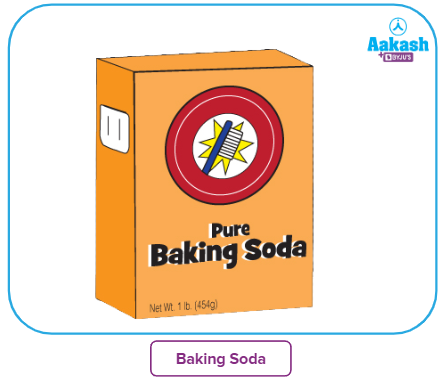
Table of Contents
- What exactly is a base?
- Base Varieties
- Properties of bases
- Alkalis
- Frequently Asked Questions
What exactly is a base?
In chemistry, a base is any substance that is slippery to touch in water solution, tastes bitter, changes the colour of indicators (e.g., turns red litmus paper blue), and reacts with acids to form salts.
Bases include alkali and alkaline earth metal hydroxides (sodium, calcium, etc.) and water solutions of ammonia or its organic derivatives (amines).
Bases are ionic compounds that produce negative hydroxide (OH-) ions and positive sodium (Na+) ions when dissolved in water. The following equation can be used to represent base:
NaOH(aq)Na+(aq)+OH-(aq)
A broader definition of bases is given by Lewis as substances, that can donate electrons.
By this definition, ammonia does not contain a hydroxyl group but can donate its lone pair of electrons to say boron trifluoride and can be called a base. Ammonia reacts with water to release hydroxyl ions, so that solution other definitions of a base.
Base Varieties
- Strong Base: A strong base is a compound that can remove a proton from a very weak acid. In water, they completely dissociate into its ions. Potassium hydroxide (KOH) and sodium hydroxide are two examples (NaOH). They are also known as Strong bases.
They ionise completely to give hydroxyl ions.
Example: NaOH(aq)Na+(aq)+OH-(aq)
- Weak Base: In water, there is incomplete dissociation. Both the weak base and its conjugate acid are present in the aqueous solution. Ammonia ( NH3 or NH4OH) and water are two examples (H2O). They are also known as Organic bases.
They ionise partially to give hydroxyl ions
Example: NH4OH (aq) ⇌ NH4+(aq)+OH-(aq)
- Solid Base: It is active when it is in solid form. Silicon dioxide and sodium hydroxide mounted on alumina are two examples.
- Super Base: When compared to a strong base, superbases are better at deprotonation. The conjugate acids in these are extremely weak. They are created by combining an alkali metal and its conjugate acid. Because it is a stronger base than hydroxide ion, it cannot survive in an aqueous solution. Examples include sodium hydride (NaH).
Properties of bases
React with metals to form hydrogen gas.
2NaOH (aq) + Zn (s) Na2ZnO2(aq)+H2(g)
React with non-metal oxide to farm salt and water.
Ca(OH)2+CO2CaCO3+H2O
Alkalis
Alkalis are soluble hydroxides of alkali metals of the first group. An example of alkali is sodium hydroxide. Because copper(ll) oxide is insoluble in water, it is a base rather than an alkali. As a result, while all alkalis are bases, not all bases are alkalis.
Practice Problems
1. Which of the following is an organic base?
- HCN
- NaOH
- C5H5N
- Ca(OH)2
Solution: All organic bases are weak bases.
In option (A), HCN is not a base, it is a weak acid.
In option (B), NaOH is a strong base.
In option (C), C5H5N is a weak base. Hence it is an organic base.
In option (D), Ca(OH)2 is a strong base.
Hence, the correct answer is an option (C).
2. Which of the following is a mineral base?
- CsOH
- Zn(OH)2
- (CH3)2NH
- Al(OH)3
Solution: All mineral bases are strong bases.
In Options (B), (C) and (D), Zn(OH)2, (CH3)2NH and Al(OH)3 are weak bases.
In option (A), CsOH is a strong base.
Hence, the correct answer is an option (A).
3. Which of the following is an organic base?
- HCOOH
- KOH
- (CH3)3N
- None of these
Solution: All organic bases are weak bases.
In option (A), HCOOH is not a base, it is a weak acid.
In option (B), KOH is a strong base.
In option (C), (CH3)3N is a weak base. Hence it is an organic base.
Hence, the correct answer is an option (C).
4. Which of the following species is a mineral base?
- (CH3)2NH
- Na2CO3
- NaHCO3
- None of these
Solution: In option (A), (B) and (C), all the given species are weak bases. Mineral bases are strong bases. So, none of these are mineral bases
Hence, the correct answer is an option (D).
Frequently Asked Questions
1. What do base taste and feel like?
Answer: Bases have a stronger flavour than acids and are less common in foods. They are bitter. Many bases, such as soaps, have a slick feel to them.
2. Without an indicator, how can you tell an acid from a base?
Answer: They're sticky, sour, and smell sickly sweet, like soured milk. They have a pH of less than 7.0 and react with the metal to produce hydrogen gas and salt.
3. ENO is used to treat acidity. Can you describe the nature of the ingredients in it?
Answer: If we want to reduce the amount of acid in our bodies, we must take some base to neutralise it. Basic salts such as sodium carbonate and bicarbonates are found in ENO. The sour taste of ENO is caused by the presence of a trace amount of citric acid.
4. What is the significance of the base?
Answer: Because many reactions and industrial processes generate acidic waste products, bases' ability to neutralise acids is extremely useful. Here are a few examples of how bases can be used to neutralise dangerous acids. Acid rain can be neutralised by basic minerals such as limestone.
5. Is milk acidic or alkaline?
Answer: Milk is commonly thought to be alkaline, but it has a pH between 6.5 and 6.7, making it slightly acidic. As a result, it can neutralise stomach acid to some extent, but not as much as you might think.

 Call Now
 Let's Chat
 Share
Share