-
Call Now
1800-102-2727


Fundamentals of Alpha & Beta Emission- Gamma Decay, Beta Decay, Alpha Decay, Practice Problems, FAQs

Have you heard of Little Boy or Fat Man? These are nicknames of two atom bombs that were dropped on Japan in 1945. The bombs killed and crippled hundreds of thousands of people, and the effects are witnessed even today.
These killer bombs were believed to have killed approximately 140,000 people in Hiroshima and an additional 74,000 in Nagasaki, both in Japan. Many of the survivors would go on to develop leukaemia, cancer, or other horrific radiation-related side effects in the years that followed.
So, what is so special in these bombs which are causing destruction after 77 years also? They contained the Radioactive element Uranium which emits radiation or does some decay like alpha decay, beta decay and gamma decay. Let's discuss them in detail.
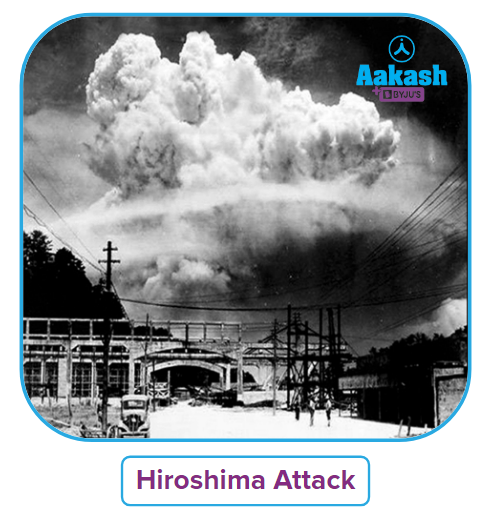
Table of Contents
- Fundamentals of Alpha & Beta emission
- Gamma-Decay
- Beta-Decay
- Alpha Decay
- Practice Problems
- Frequently Asked Questions
Fundamentals of alpha & beta emission
Are the terms radioactivity and radioactive decay, familiar to you?
If not, let us first define what it is. Nuclear instability causes radioactivity to occur in the nuclei of atoms. Historically, a little amount of uranium compound was wrapped in black paper and stored in a drawer alongside photographic plates. An examination of these plates later indicated that they had been exposed. This phenomenon was referred to as "radioactive decay."
Some elements constantly dissolve from their parent elements in an attempt to stabilise themselves by emitting large amounts of energy in the form of radiation and turning into a different element.

By chance, Henry Becquerel discovered radioactivity. There are basically three decays which occur to stabilise a radioactive atom. These are
- Gamma Decay and Emission (Photons having high energy are emitted)
- Beta Decay and Emission (Emission consists of Electrons)
- Alpha Decay and Emission (Emission consists of Helium nucleus)
All these are ionizing radiations, that can knock out neutral atoms into ions. Depending upon their mass and energy their effect varies. Alpha particles can cause damage by their charge and mass but will be stopped by a piece of paper on its way. Beta particles move with more kinetic energy and can be stopped by a thin sheet of aluminium. Gamma rays are the most energetic and need about 6cm thick lead material to protect us from them.
Gamma-Decay
This refers to the emission of high-energy electromagnetic radiations, from the radioactive nuclei. The
-ray emission of a radioactive atom has no effect on its atomic weight or number. As a result, its position in the periodic table stays unchanged. Radiation is followed by either emission or emission in natural radioactivity.
Beta-decay
- Beta () decay is of three types, corresponding to either electron emission or positron emission or Electron capture (also referred to as inverse beta decay) from lower orbitals into the nucleus..
- The positron (+1e0), the electron's antimatter, has the same mass as it but the opposite charge.
- The electrons and positrons emitted during - decay does not directly escape the nucleus.
- Photons are produced at the moment of emission in the same way that they are released when an electron shifts from a higher energy level to a lower energy level.
- Electron emission occurs when the neutron to proton ratio in the nucleus is much larger.
- Positron emission occurs when the neutron to proton ratio in the nucleus is much lower.
- During beta decay, the conversion of proton to neutron or neutron to proton takes place. This makes the daughter element have a group displacement of the daughter element from the parent element.
For beta, particles
Consider the element ZXA, whose mass number is A and atomic number Z. It changes into a daughter nucleus Y after decaying.
Mass of the parent nucleus,
Mass of the daughter nucleus,
Mass of the beta particle , me- the mass of the electron in amu.
Example of a - decay:
Alpha decay
- An alpha particle is an energetic He-nucleus (2He4) with mass number 4 and atomic number 2. It has a positive charge of +2e.
- When heavy materials, such as uranium U-235, decay radioactively, alpha particles are emitted.
- During decay, the atomic number decreases by two and the mass number decreases by four.
For alpha particle
Consider the element ZXA, whose mass number is A and atomic number Z. It changes into a daughter nucleus Y after decaying.
Mass of the parent nucleus,
Mass of the daughter nucleus,
Mass of the alpha particle , me- a mass of the electron in amu.
Example of a - decay:
Practice Problems
1. A mass number of A and an atomic number of Z are given for the element112Cn285. After alpha decay, it transforms into a daughter nucleus, Y. Determine Y
- 110Cn281
- 113Np285
- 114Fl289
- 110Ds281
Solution: 112Cn285 decays to110Ds281 emitting a - particle because, during a decay, the atomic number decreases by two and the mass number decreases by four. Hence, the correct answer is option (D).
2. A mass number of A and an atomic number of Z are given for the element84Po209. After beta decay, it transforms into a daughter nucleus, Y. Determine Y
- 85At209
- 82Pb207
- 83Bi209
- 85Po209
Solution: 84Po209 decays to85At209 emitting a - particle because, during this decay, the atomic number increases by one and the mass number remains same. Hence, the correct answer is option (A).
3. A mass number of A and an atomic number of Z are given for the element86Rn222. After beta decay, it transforms into a daughter nucleus, Y. Determine Y
- 84Po218
- 87Fr222
- 87Rn222
- 86Rn222
Solution: 86Rn222 decays to87Fr222 emitting a - particle because, during this decay, the atomic number increases by one and the mass number remains same. Hence, the correct answer is option (B).
4. A mass number of A and an atomic number of Z are given for the element106Sg269. After alpha decay, it transforms into a daughter nucleus, Y. Determine Y
- 107Bh269
- 108Hs273
- 108Hs265
- 104Rf265
Solution: 112Cn285 decays to110Ds281 emitting a - particle because, during a decay, the atomic number decreases by two and the mass number decreases by four. Hence, the correct answer is option (D).
Frequently Asked Questions
1. Name a few radioactivity applications.
Answer: Here are a few radioactive applications:
It is used in residential smoke detectors.
It is used to sterilise medical equipment.
It is used to detect and treat disorders.
It is used to produce power.
2. Which radioactive decay is the most dangerous?
Answer: Alpha particles are the most dangerous internal threat when compared to beta and gamma particles. Ingestion, inhalation, absorption, and injection are the most dangerous means of exposure to radioactive materials that emit alpha and beta particles. Gamma radiation is the most dangerous external threat.
3. What is the source of radioactive decay?
Answer: It all comes down to thermodynamics. Every atom tries to be the most stable possible. In the case of radioactive decay, instability develops when the number of protons and neutrons in the atomic nucleus is imbalanced. To put it simply, there is too much energy inside the nucleus to hold all of the nucleons together.
4. What Is the Distinction Between Natural and Man-Made Radioactivity?
Answer: Natural radioactivity is radiation that occurs naturally, whereas artificial radioactivity is radioactivity that is created by man-made techniques.

NEET Related Links
JEE MAIN Related Links
JEE Advanced Related Links
JEE Advanced Eligibility Criteria
JEE Advanced Chemistry Syllabus
JEE Advanced Registration Dates
CUET Related Links
Important Topics
Anemometer : Measurement of Wind Speed
Angular Acceleration Atomic Theory Audible and Inaudible Sound Average Speed and Average Velocity Average Velocity Avogadros Number Avogadros Hypothesis Azimuthal Quantum Number Balanced Force Bar Magnet Biconvex Lens Boyles Law Buoyancy Calorimeter Carnot Engine Celestial Bodies Centripetal And Centrifugal Force Concave and Convex Lenses Concave Convex Mirrors Contact and Non Contact Force Controlled Thermonuclear Fusion Convection Currents Convex Lens Convex Mirror Destructive Interference Difference Between Conduction Convection and Radiation Difference Between Electric Field and Magnetic Field Difference Between Heat And Temperature Difference Between Series And Parallel Circuits Differences Between Acceleration And Velocity Distance and Displacement Distance Time Graph Electrical Force : Electric Forces and Their Types Electromagnetic Waves : Definition, Equation and Properties of Electromagnetic Waves Electromagnetism Electron Spin Fluid Flow : Bernoullis Equation Derivation and Fluid Mechanics Fluid Friction : Types and Factors of Fluid Friction Frames of Reference : Inertial and Non- Inertial Frame of Reference Frequency and Wavelength Frictional Force Importance of Hydrosphere Instantaneous Speed and Velocity Introduction to Motion Kinetic and Potential Energy Difference Law Of Conservation of Energy Layers of the Earth Light Energy Light Sources List of physics scientists and Their inventionsLoudness of Sound
Magnetic Dipole Moment Magnetic Field Non - Contact Force Non - Renewable Energy Ohms Law Optics P Wave Physics Symbols Plane Mirrors Poissons Ratio Projectile Motion Properties of Water : Anomalous Expansion of Water Radius of Gyration Reflection of Light Reflection of Waves Relative Density Resonance Reverberation Rolling Friction Rotation and Revolution Screw Gauge Semiconductors and Insulators Sliding Friction Speed Time Graphs Static Friction Stefan Boltzmann Law Stress Tension Tension Force Thermometer: Clinical Laboratory Thermometer Types of Rocks Types of Waves Uniform Motion and Non Uniform Motion Unit of Voltage Uses of Convex Lens Uses Of Convex Mirror Uses of Electromagnet Uses of Optical Fibre Wave Wavelength of Light What is Scattering of Light Working of Electric Bell Conventional and Non-conventional Sources of Energy Buoyant Force Bulk Modulus of Elasticity Bernoulli’s Principle Angular Momentum Difference Between Speed And Velocity ForceUnit of Heat
Difference between Distance and Displacement Simple Microscope Derivation Of Equation Of Motion Thermometer: Clinical & Laboratory Thermometer Difference between Concave and Convex LensDerivation Of Lens Maker Formula
Unit Of Pressure Velocity Uses of Plane Mirror
Wave Theory of Light
Unit of Density Unit of Light Unit of Force Unit of Magnetic Field Unit of wavelength Unit of Viscosity Uses of Electroplating Young's Modulus
What is the Scattering of Light
Lenz Law Space Wave Propagation Schrodinger Wave Equation Relation between Fahrenheit and Celsius Refractive Index Potentiometer Working Pascal Law Oscillatory Motion Optical Instruments Newton's Laws of Motion - First Law Modulation and Demodulation Magnetic Flux Lens Formula and Magnification Kaleidoscope Faradays Law Epsilon Naught Value Energy Bands Electrostatics Electroscope AC Generator Unit of Current Lithosphere Bending Equation Derivation Difference Between Pound and Kilogram Semiconductor Devices OTEC - Ocean Thermal Energy Conversion Hall Effect Rectilinear Propagation of Light Difference Between Ammeter and Voltmeter Coefficient of Linear Expansion Ampere’s Law Cyclone and Thunderstorm Save The Environment From Pollution Particle Nature of Light Types of DC Motor Uses Of Transistor Derivation of Phase Rule Unit of Humidity

 Call Now
 Let's Chat
 Share
Share