-
Call Now
1800-102-2727


Pregnancy Test, Practice Problems and FAQs

You all know that we came to this beautiful world through our mother. She carried us in her womb for nearly 9 months +/- 7 days. This duration is called pregnancy or gestation period. If a woman has recently missed her periods and had unprotected sexual intercourse. What could be the possible issue she is facing? Yes, you are right there are high chances that the woman might be pregnant. Being pregnant can be shocking if it is an unwanted pregnancy or it could be good news in cases she is actually expecting. In both cases it is necessary to detect the pregnancy as soon as possible.

Fig: Pregnant woman
If it is an unwanted pregnancy early detection is important so that it can be medically terminated under the guidance of a health care specialist to avoid any further complications. If it is intended to be kept then also it is important to meet the doctor and start with required medications and care. But how can a woman be sure if she is pregnant or not? There are ways available by which it can be confirmed. One of the important ones is the instant pregnancy detection kits also known as home pregnancy kits which use urine or lab tests which use blood samples. In this article we will discuss in depth about the pregnancy tests.
Table of contents
Fertilisation
For a female to conceive it is important that male gamete (sperm) reaches the ovum in the ampullary region of the fallopian tube at the right time. When this happens the fusion of male and female gamete results in the formation of zygote by the process called fertilisation. Fertilisation normally occurs in the ampullary region of the uterine (fallopian tube) within 12 to 24 hours after ovulation. Pregnancy is most likely to occur if intercourse takes place during a 3-day window period that is from 2 days before ovulation to 1 day after ovulation. This is called the fertile period.
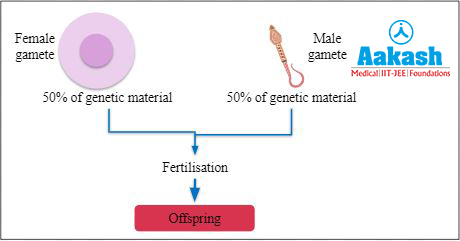
Fig: Fertilisation
Reasons for absence of menstrual cycle
If the fertilisation takes place, all the events of the menstrual cycle stops and hence there is no menstruation. However, stress, hormonal imbalance, medications and poor health can also be responsible for the absence of a menstrual cycle.
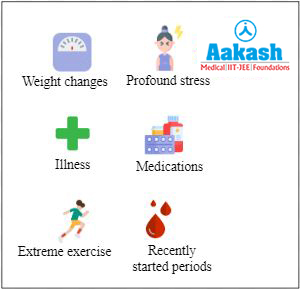
Fig: Common reasons for absence of menstrual cycle
Post fertilisation events
After fertilisation the zygote starts cell division (cleavage). The zygote undergoes repeated cell divisions to form a 16 - 32 celled structure known as a blastocyst which implants itself into the endometrial wall. This blastocyst is a spherical structure consisting of an inner cell mass surrounded by a layer of cells known as the trophoblast. In order to nourish the embryo the endometrium will prepare itself before implantation and it will be supplied with a lot of blood vessels. The process by which an embryo attaches to the endometrial surface of the uterus is called implantation.
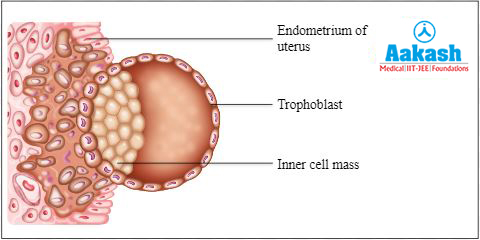
Fig: Post fertilisation events
Formation of germ layers
Gastrulation is the process in which embryoblast cells (inner cell mass) form a structure called gastrula which differentiate to form three germ layers shortly after implantation. The exterior layer is called ectoderm and the innermost layer is called endoderm. Between the ectoderm and the endoderm appears a mesoderm (middle layer). These layers form different tissues and parts of the body.
The cells of the inner cell mass get organised into two layers, upper epiblast and lower hypoblast. The epiblast is composed of two layers of cylindrical cells. A small cavity develops between these two layers and forms the amniotic cavity which eventually gets filled with the amniotic fluid and protects the foetus from shocks and injuries. The epiblast gives rise to the ectoderm and mesoderm and the hypoblast gives rise to the endoderm. The inner cell mass contains stem cells, called embryonic stem cells. They are pluripotent, that is, they have the ability to give rise to all of the tissues and organs.
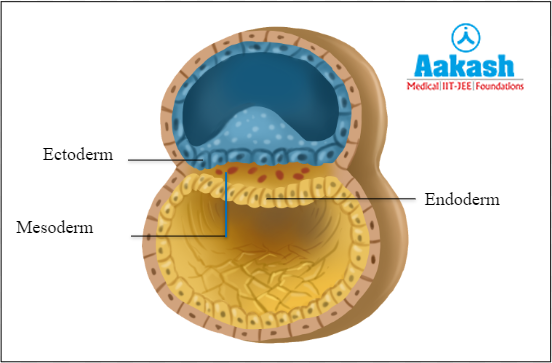
Fig: Germ layers
Placenta formation
After implantation finger-like projections appear on the trophoblast called chronic villi. The chorionic villi are surrounded by uterine tissue and maternal blood and become interdigitated to form a structure called the placenta that forms an intimate connection between the developing embryo (foetus) and the mother’s body. The spaces between the growing villi from trophoblast is called lacuna and the maternal blood vessels come in contact with these empty spaces. This way the maternal blood vessels and the foetal blood vessels will come in contact with each and this gives rise to the placenta. The developing foetus will be connected to the placenta via umbilical cord.
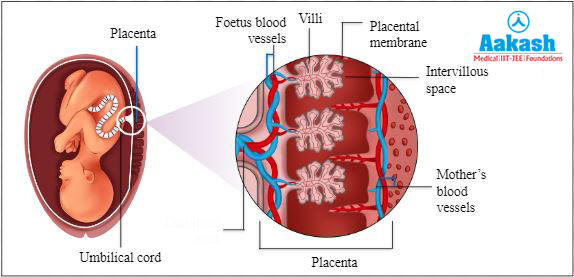
Fig: Formation of placenta
Placenta as an endocrine organ
Placenta releases several hormones only during pregnancy, thus it is considered as a temporary endocrine organ. The various hormones produced by placenta include human chorionic gonadotropin (hCG), human placental lactogen (hPL), estrogens, progestogens etc.
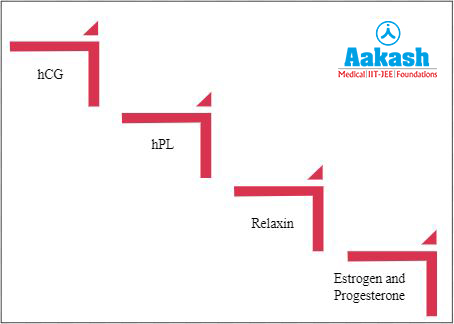
Fig: Hormones of placenta
Embryonic development
In humans, pregnancy lasts around 9 months +/- 7 days. The time period of pregnancy during which a foetus develops within the mother’s womb is also called gestation period. It is divided into 3 trimesters consisting of 3 months each.
Pregnancy test - hCG detection
A pregnancy test is taken to check for a particular hormone i.e., hCG in blood or urine samples. hCG is human chorionic gonadotropin hormone. It promotes progesterone secretion by corpus luteum and helps in maintaining the pregnancy. This hormone is produced in case of pregnancy and is detected using various tests to confirm the same. This hormone is produced by placenta only after fertilised egg implants the uterus.
Time to check pregnancy
One can take a pregnancy test from the first day of her missed period. There are some tests available that can be taken even before the missed period, this depends on the sensitivity of the test.
Principle of pregnancy test
All pregnancy tests work by detecting the hCG hormone which is expected to be produced around 6 days after fertilisation. The pregnancy strips have antibodies that detect the presence of hCG in the urine. This is a preliminary test done for confirmation
Methods of pregnancy tests
There are two different ways by which hCG hormone can be detected. These are urine tests and blood tests.
Urine tests
Urine tests can be done at home. This is done by placing the urine sample on the test strip. The result takes around 3 - 5 minutes to confirm with the help of bands that appear on the strip.
- The individual collects the urine in a container and either dips the strip in the sample or, using a dropper, places some sample on the test strip.
- Depending on the test, the result may appear as
- Change of colour
- Showing plus or minus sign, or single or double line
One can check the results based on the instructions given. It is preferable to take the test in the morning with the first urine of the day as hCG concentration will be higher compared to the day's urine.

Fig: Strip test
Blood tests
Blood test for confirming the pregnancy is a more accurate and detailed way to confirm the pregnancy. For this a healthcare provider is necessary to take care of the procedure. The test can be qualitative which detects whether the hCG is present or not, or it can be quantitative which measures the exact amount of hCG present in the blood sample.
Blood tests is better than the urine testing due to the following reasons:
- It allows early pregnancy detection.
- I can measure even low concentration.
- It is a more accurate method.
Practice Problems
Q1. Select the correct option with respect to the hormone and its site of production.
- Progesterone - Graafian follicle
- Human placental lactogen - Corpus luteum
- Follicle stimulating hormone - Hypothalamus
- Human chorionic gonadotropin - Placenta
Solution: Human chorionic gonadotropin (hCG) is a hormone secreted by the placenta. Presence of hCG in the urine confirms pregnancy. Progesterone is produced by the corpus luteum which is formed from the ruptured Graafian follicle after ovulation. Human placental lactogen (hPL) is secreted by the placenta. Follicle stimulating hormone is secreted by the anterior lobe of the pituitary gland. Hence the correct option is d.
Q2. The hormone that maintains the endometrium of the uterus is secreted by______.
- uterus
- ovary
- anterior pituitary
- hypothalamus
Solution: The hormone that maintains the endometrium of the uterus is progesterone. It is secreted by the corpus luteum in the ovary which is a temporary endocrine gland. The Graafian follicle gets ruptured to release the secondary oocyte. The ruptured Graafian follicle converts into a yellow coloured body called corpus luteum. Maintenance of a thick endometrium is necessary during pregnancy as the embryo gets implanted in the endometrium. Hence the correct option is b.
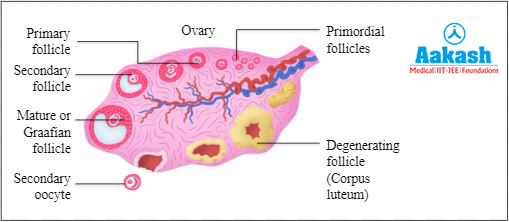
Fig: Section of ovary
Q3. Absence of menstruation can be an indicator of ________________.
- stress
- poor health
- pregnancy
- all of the above
Solution: Menstruation is the discharge of blood along with the mucosal tissues due to the shedding of endometrial lining of the uterus. This is called the menstrual or bleeding phase of the menstrual cycle. During pregnancy, all the events of the menstrual cycle stop and hence there is no menstruation. However, stress and poor health can also be responsible for the absence of a menstrual cycle. Hence the correct option is d.
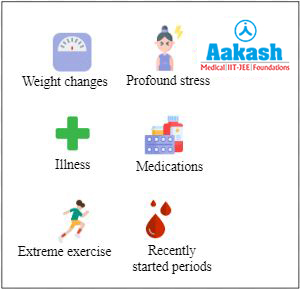
Fig: Common reasons for absence of menstrual cycle
Q4. Which hormone is detected in a pregnancy test?
- Relaxin
- Oxytocin
- hCG
- Progesterone
Solution: A pregnancy test is taken to check for a particular hormone i.e., hCG in blood or urine samples. hCG hormone is expected to be produced around 6 days after fertilisation. It promotes progesterone secretion by corpus luteum and helps in maintaining the pregnancy. Hence the correct option is c.
FAQs
Q1. What is the principle of pregnancy kits?
Answer : The hCG pregnancy test kit is a rapid chromatographic immunoassay for the detection of human chorionic gonadotropin in urine. The test involves a combination of antibodies that are specific for hCG. The hCG first binds to immobilised antibodies that are marked with enzymes. As the sample moves in chromatographic paper, these antibodies with enzymes attached change the colour of the strip.
Q2. What precautions should be taken when undertaking a pregnancy test?
Answer : The following measures should be taken while taking urine pregnancy test at home:
- Taking the urine pregnancy test preferably with the first urine in the morning (hCG concentrated).
- Before taking the test to avoid too much water intake, it can dilute the sample.
- If the test is taken very early it may lead to false negative results.
- Before taking the test check for the expiry date of the kit.
- Proper storage of the test kit.
- If a woman has previously tested ‘pregnant or positive’ but after taking the test again it shows ‘not pregnant or negative result’, or the period has begun. What does that mean?
Answer : In such conditions there are chances that the woman was pregnant but natural loss of early pregnancy occurred due to some reasons. This could be a possible reason for showing ‘not pregnant or negative results’.
Q4. How accurate are home pregnancy tests?
Answer : Home pregnancy test via urine sample has claimed to be 99% accurate but blood tests are considered even more accurate. A home pregnancy test accuracy depends upon the following factors:
- Following the instructions carefully.
- The period in which pregnancy is tested.
- Sensitivity of the pregnancy test.
- Proper collection of the sample.

 Call Now
 Let's Chat
 Share
Share