-
Call Now
1800-102-2727


Polygenic Inheritance: Characteristics, Examples, Practice Problems and FAQs

Most of you may be active in social media. Today's world gives us lots of opportunities to explore social media. In social media platforms like whatsapp and instagram you might have seen various emojis. You might have noticed that there are emojis for different skin tones like the ones given in the below image.
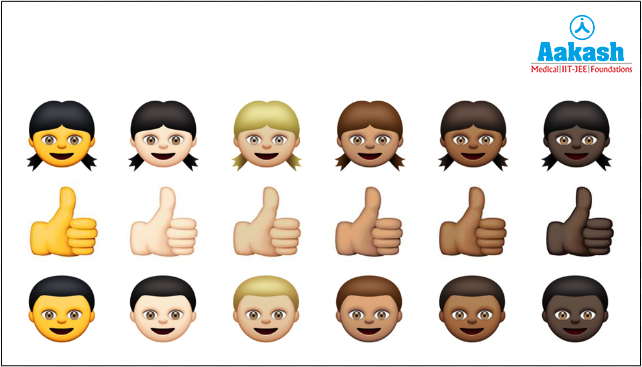
Fig: Some emojis with different skin tones in the social media
You all know that we all are not having the same skin tone. These skin tone emojis allow the users to feel more represented when expressing visual reactions. Some people have dark complexions and some people have fair complexions. But most of the people have a skin tone between the fair and dark colour. But can you tell me why the skin colours differ in people or what is the science behind this? Yes, you are correct. The skin colour is a polygenic trait which is controlled by two or more than two genes.
Similarly, you might have noticed that there are different hair colours in emojis? Yes, the hair colour is also a polygenic inheritance. Now let’s take a deep dive into the details of polygenic inheritance and understand the various examples related to it in this article.
Table of contents
- Polygenic inheritance
- Discovery of polygenic inheritance
- Characteristics of polygenic inheritance
- Examples of polygenic inheritance
- Effect on environment on polygenic inheritance
- Difference between monogenic and polygenic inheritance
- Practice problems
- FAQs
Polygenic inheritance
Polygenic inheritance is a type of inheritance in which a single trait is controlled by two or more pairs of genes. The dominant alleles of these genes have a cumulative effect. Each dominant allele expresses a different aspect of the trait, and the whole trait is only seen when all dominant alleles are present. It is also known as multiple factor inheritance. Examples include height and eye colour in human beings.
Quantitative inheritance
Polygenic inheritance is also known as quantitative inheritance as these traits can be measured in terms of quantity. The common examples of polygenic inheritance are height and skin pigmentation in humans. As you can see, there are many different forms of these two traits. One cannot categorise people in just two categories like tall and short for height and dark and light for skin pigmentation. One can see a continuous variation in these two traits because these are controlled by more than two genes.
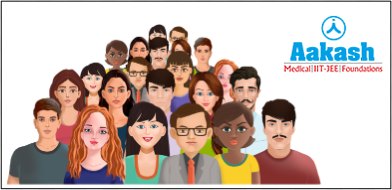
Fig: Skin colour and height in human beings
Polygenes
The genes that are responsible for polygenic inheritance are called polygenes. The traits that are controlled by multiple genes are known as metric traits. This is because these types of traits are measured in terms of unit of size, height, weight or number.
Types of polygenes
Polygenes are of two types as follows:
Contributing alleles
These are the dominant polygenes that contribute to the expression of the trait. Examples include A, B and C genes in humans responsible for the dark skin tone.

Fig: Contributing alleles
Non-contributing alleles
These are the recessive polygenes. Examples include the a, b and c genes in humans responsible for the light skin tone.
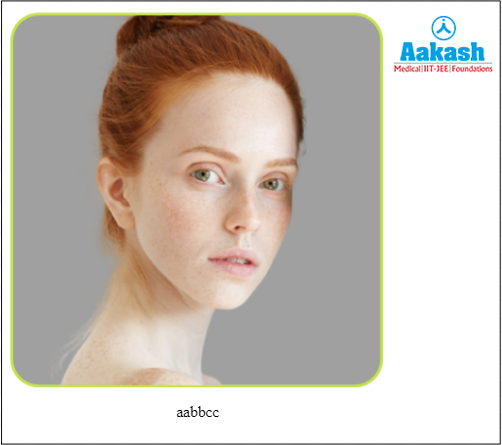
Fig: Non-contributing alleles
Discovery of polygenic inheritance
Polygenic inheritance was first studied by J.Kolreuter in 1760 in tobacco and F. Galton (1883) in human beings. F. Galton predicted that in human beings characters like height, mental capabilities and skin colour are heritable and show a continuous range of variations. Nilson Ehle in 1908 obtained the first experimental proof of polygenic inheritance in wheat kernel colour.
Characteristics of polygenic inheritance
Major characteristics of the polygenic inheritance are listed below:
- Polygene is a type of gene that exerts a little effect on phenotype along with other genes.
- The effect of a single gene is so small that it is difficult to detect.
- All the multiple genes produce an equal effect.
- Each allele shows a cumulative or additive effect.
- The phenomenon of polygenic inheritance is different from multiple allelism. This is because in multiple allelism three or more alleles control a character and two alleles are present in an organism. The example of multiple allelism is ABO blood grouping.
- In polygenic inheritance, linkage and dominance does not occur.
- The alleles are classified into contributing and non-contributing alleles which are also known as active and null alleles, respectively.
- The continuous variation of a phenotype takes place here.
- The pattern of polygenic inheritance is complicated and the phenotype is difficult to predict.
- The statistical analysis can give a picture of the estimate of population parameters.
Examples of polygenic inheritance
Some of the common examples of quantitative inheritance are as follows:
- Kernel colour in wheat
- Cob length in maize
- Skin colour in human beings
- Height in human beings
- Eye colour in human beings
- Milk and meat yield in animals
- Length of the corolla in tobacco
Polygenic inheritance in humans
In humans, there are many traits that show quantitative inheritance. Some of the examples are skin colour, eye colour, height and the risk of diseases.
Skin pigmentation in humans
Human skin colour is a polygenic trait. It depends on the presence of melanin pigment. The amount of melanin produced depends on the three pairs of genes A, B and C. These genes are present on the different loci and each dominant gene is responsible for the synthesis of a fixed amount of melanin. The effect of all dominant genes is additive. Thus the amount of melanin produced is always proportional to the number of dominant alleles.
The homozygous dominant alleles are responsible for dark phenotype and the homozygous recessive alleles are responsible for light phenotype. When black or extremely dark (AABBCC) and white or albino (aabbcc) people marry, the offspring or individuals of the F1 generation have a mulatto pigmentation (AaBbCc).

Fig: F1 generation in polygenic inheritance
When two people of mulatto or intermediate race marry, their children's skin colour will range from very dark or black to very light or white.
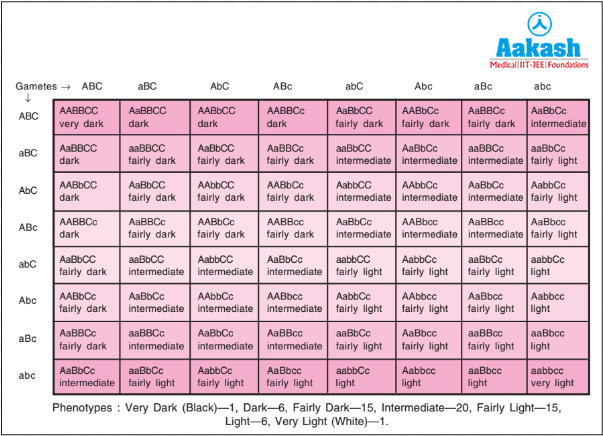
Fig: Polygenic inheritance of human skin colour
In the gametes, there are a total of eight allele combinations, resulting in 64 genotypes divided into seven phenotypes. The seven phenotypes are as follows:
- Very dark or pure black (1/64)
- Dark (6/64)
- Fairly dark (15/64)
- Intermediate (20/64)
- Fairly light (15/64)
- Light (6/64)
- Very light (1/64)
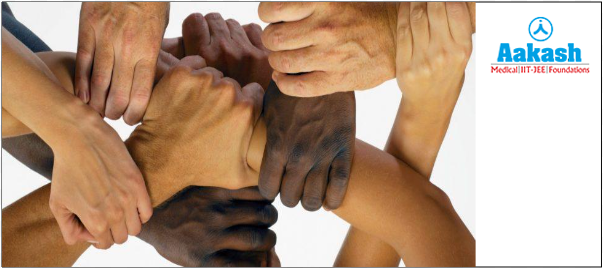
Fig: Allele combinations
Height in man
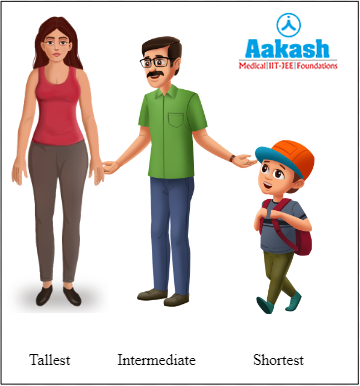
Height in man is also controlled by three pairs of genes located at different gene loci. The height develops by the addictive effect of the number of dominant alleles of these genes. People with all six dominant alleles are the tallest whereas people with any three dominant alleles have average height. People with all recessive alleles and no dominant alleles are the shortest.
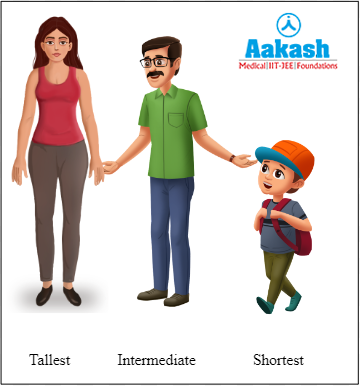
Fig: Height in human beings
Eye colour in human beings
The colour of the eye is determined by polygenes. It is identified that a minimum of 9 colours of eye colour are recognised in humans. There are two major eye colour genes and 14 more genes that normally determine the expression of the phenotype in human beings. A different number of alleles contribute to each colour. The eye colour is mostly associated with the two adjacent genes on the chromosome 15. The OCA2 or Oculocutaneous albinism type 2 and HERC2 genes are mainly associated with the eye colour. HERC2 gene is a giant E3 ubiquitin protein ligase which is responsible for pigmentation.
Fig: Eye colour in human beings
Polygenic inheritance in plants
Polygenic inheritance is also seen in plants. Some of the examples of polygenic inheritance are listed below:
- Colour of the stem
- Shape of the stem
- Flowers
- Pollen grains
- Oil content
- Yield
Kernel colour in the wheat
The kernel colour of wheat is controlled by two pairs of alleles and they show independent assortment. The dominant genes are R1 and R2. The recessive alleles are r1 and r2. The homozygous dominant alleles are responsible for dark phenotype (dark red) and the homozygous recessive alleles are responsible for light phenotype (white). For example, the dark red wheat kernel (R1R1R2R2 ) is crossed with a white wheat kernel (r1r1r2r2). The F1 generation obtained has an intermediate red colour kernel (R1r1R2r2). The F1 generation is then self-crossed to obtain the F2 generation. The F2 generation produced 63 red kernel plants with different red shades and one white kernel plant.
The F2 generation are shown below:
|
1 |
6 |
15 |
20 |
15 |
6 |
1 |
|
Dark red |
Moderate red |
Red |
Intermediate red |
Light red |
Very light red |
White |
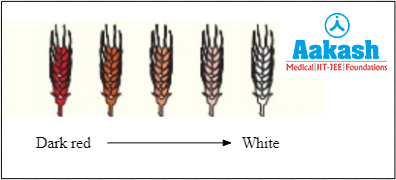
Fig: Kernel colour in the wheat
Length of the corolla in tobacco
More than four pairs of genes are identified to be involved in the expression of phenotype of corolla length of tobacco (Nicotiana). There is a wide variety in the length of the corolla in tobacco occurs due to polygenic inheritance.
Effect of environment on polygenic inheritance
The expression of genes involved in polygenic inheritance is influenced by environmental conditions. The genotype tries to set the range for a quantitative trait normally but it is the environmental conditions that decide the phenotype. This is due to the fact that the genes function differently in various environmental conditions. Environment regulates the activity of some genes and sets them on or off.
Norm of reaction
The range of phenotypes that are possible under the various environmental conditions from the same genotype is called the ‘norm of reaction’. The norm of the reaction may be narrow or broad. It depends on the genes. For example, the various genotypes produced in human height have a broad norm of reaction.
Example to show the effect of environment on polygenic inheritance
Consider the case of identical twins who are formed from the same zygote. If we raise them in two different environments then some of the genes show the genetic potential or vulnerability to express differently. Here the environmental conditions influence the expression of the genes. The common human characters like skin colour, intelligence, height etc., show the effect of the environment on gene expression. This may be due to the following reasons:
- The diet provided and the general health of the individual affect the height.
- The education provided and the social status affect intelligence.
Difference between monogenic and polygenic inheritance
The following are the major differences between the monogenic and polygenic inheritance:
Monogenic inheritance |
Polygenic inheritance |
|
It deals with the inheritance of qualitative characters |
It deals with the inheritance of quantitative characters |
|
It is under the control of a pair of genes |
It is under the control of two or more pairs of genes |
|
It produces two distinct phenotypes |
It produces a wide range of phenotypes |
|
In this inheritance the F1 individuals are similar to the dominant parent |
In this inheritance the F1 individuals are intermediate between the two parents |
|
Phenotypic expression of the genotype in this inheritance is not influenced by the environment |
Phenotypic expression of the polygenes is affected by the environment |
|
The degree of expression remains the same whether the character is controlled by one or both the dominant genes |
The degree of expression depends on the number of dominant genes |
|
It shows discontinuous pattern of inheritance |
It shows continuous pattern of inheritance |
|
F2 individuals shows 3:1 phenotypic ratio and intermediate expressions are not found |
In F2 generation, individuals with intermediate phenotypes are more than the parent types |
|
Examples include inheritance of yellow and green seed colour in peas |
Examples include inheritance of height in human beings |
|
|
Fig: Polygenic inheritance |


Practice Problems
Q1. The phenomenon known as ___(A)___ occurs when a single gene impacts many phenotypes. The phenomenon known as __(B)__ occurs when more than two genes influence the same trait. Identify (A) and (B).
a. (A) polygenic inheritance, (B) pleiotropism
b. (A) pleiotropism, (B) polygenic inheritance
c. (A) multiple allelism, (B) pleiotropism
d. (A) pleiotropism, (B) multiple allelism
Solution: Pleiotropism is described as the phenomenon in which a single gene regulates many phenotypes. Examples include phenylketonuria in human beings. Therefore, (A) represents pleiotropism. Polygenic inheritance is a type of inheritance in which a single trait is controlled by two or more pairs of genes. The dominant alleles of these genes have a cumulative effect. Examples include inheritance of height in human beings. Therefore, (B) represents polygenic inheritance. Hence, the correct option is b.
Q2. Is the human blood group an example of polygenic inheritance?
Answer: Human blood group is an example of multiple allelism in which a single gene possesses different alleles. Out of these, a person contains any of the two alleles. It is different from polygenic inheritance. Here the gene I possess three alleles IA, IB and i. The combination of two alleles decides the type of blood group. For example, if a person has IA and IB , then he has AB blood group. Polygenic inheritance is a type of inheritance in which a single trait is controlled by two or more pairs of genes. The dominant alleles of these genes have a cumulative effect. Examples include inheritance of height or eye colour in human beings.
Q3. Is eye colour a polygenic inheritance? If yes, how?
Answer: Yes, eye colour in humans is a polygenic inheritance. It is identified that a minimum of 9 colours of eye colour are recognised in humans. There are two major eye colour genes and 14 more genes that normally determine the expression of the phenotype in human beings. A different number of alleles contribute to each colour. The eye colour is mostly associated with the two adjacent genes on the chromosome 15. The OCA2 or Oculocutaneous albinism type 2 and HERC2 genes are mainly associated with the eye colour. HERC2 gene is a giant E3 ubiquitin protein ligase which is responsible for pigmentation.
Q4. How does skin colour in humans inherited?
Answer: Human skin colour is a polygenic inheritance. It depends on the presence of melanin pigment. The amount of melanin produced depends on the three pairs of genes A, B and C. These genes are present on the different loci and each dominant gene is responsible for the synthesis of a fixed amount of melanin. The effect of all dominant genes is additive. Thus the amount of melanin produced is always proportional to the number of dominant alleles.
The homozygous dominant alleles are responsible for dark phenotype and the homozygous recessive alleles are responsible for light phenotype. There are seven phenotypes that exist in between these two. When black or extremely dark (AABBCC) and white or albino (aabbcc) people marry, the offspring or individuals of the F1 generation have a mulatto pigmentation (AaBbCc).
FAQs
Q1. Why do polygenic traits have many phenotypes?
Answer: Polygenic inheritance has many phenotypes because of the combinations of multiple alleles. The environmental factors are also responsible for producing various types of phenotypes.
Q2. Is intelligence a polygenic trait?
Answer: Intelligence is a polygenic trait in which different genes exert extremely small influence. The different genes exert their own influence at different stages of development. It is also influenced by the environment. For example, the diet followed by the individual, education provided, social status etc.
Q3. What is the reason behind that if a person's face gets darker without sunlight?
Answer: Hyperpigmentation is the most common cause of skin darkening without exposure to the sun. This is a disorder in which the body produces extra melanin, the pigment responsible for skin colour. Hyperpigmentation causes dark spots and patches to appear on various sections of a person's body.
Q4. How does the environment affect polygenic inheritance?
Answer: Environmental factors have a significant impact on polygenic expression. The genotype sets a range for quantitative traits but the phenotype within those genetic boundaries is determined by environmental factors. Distinct environmental factors have different effects on genes. The environment controls how active some genes are and whether they are turned on or off. For example, the diet provided and the general health of the individual affect the height.
Youtube link: Need to be created
Related topics
|
Sex determination: Genotypic and environmental sex determination, Genic balance theory of sex determination, Practice Problems and FAQs |
|
Linkage and recombination: Morgan’s experiment, Linkage, and its types, Recombination and gene mapping, Practice Problems and FAQs |
|
Mendelian disorder: Haemophilia, Colour blindness, Sickle cell anaemia, Thalassemia, Phenylketonuria, Practice problems and FAQs |
|
Multiple Allelism, Practice Problems and FAQs |
|
Incomplete dominance, Codominance, Practice Problems and FAQs |

NEET Related Links
JEE MAIN Related Links
JEE Advanced Related Links
JEE Advanced Eligibility Criteria
JEE Advanced Chemistry Syllabus
JEE Advanced Registration Dates
CUET Related Links
Important Topics
Anemometer : Measurement of Wind Speed
Angular Acceleration Atomic Theory Audible and Inaudible Sound Average Speed and Average Velocity Average Velocity Avogadros Number Avogadros Hypothesis Azimuthal Quantum Number Balanced Force Bar Magnet Biconvex Lens Boyles Law Buoyancy Calorimeter Carnot Engine Celestial Bodies Centripetal And Centrifugal Force Concave and Convex Lenses Concave Convex Mirrors Contact and Non Contact Force Controlled Thermonuclear Fusion Convection Currents Convex Lens Convex Mirror Destructive Interference Difference Between Conduction Convection and Radiation Difference Between Electric Field and Magnetic Field Difference Between Heat And Temperature Difference Between Series And Parallel Circuits Differences Between Acceleration And Velocity Distance and Displacement Distance Time Graph Electrical Force : Electric Forces and Their Types Electromagnetic Waves : Definition, Equation and Properties of Electromagnetic Waves Electromagnetism Electron Spin Fluid Flow : Bernoullis Equation Derivation and Fluid Mechanics Fluid Friction : Types and Factors of Fluid Friction Frames of Reference : Inertial and Non- Inertial Frame of Reference Frequency and Wavelength Frictional Force Importance of Hydrosphere Instantaneous Speed and Velocity Introduction to Motion Kinetic and Potential Energy Difference Law Of Conservation of Energy Layers of the Earth Light Energy Light Sources List of physics scientists and Their inventionsLoudness of Sound
Magnetic Dipole Moment Magnetic Field Non - Contact Force Non - Renewable Energy Ohms Law Optics P Wave Physics Symbols Plane Mirrors Poissons Ratio Projectile Motion Properties of Water : Anomalous Expansion of Water Radius of Gyration Reflection of Light Reflection of Waves Relative Density Resonance Reverberation Rolling Friction Rotation and Revolution Screw Gauge Semiconductors and Insulators Sliding Friction Speed Time Graphs Static Friction Stefan Boltzmann Law Stress Tension Tension Force Thermometer: Clinical Laboratory Thermometer Types of Rocks Types of Waves Uniform Motion and Non Uniform Motion Unit of Voltage Uses of Convex Lens Uses Of Convex Mirror Uses of Electromagnet Uses of Optical Fibre Wave Wavelength of Light What is Scattering of Light Working of Electric Bell Conventional and Non-conventional Sources of Energy Buoyant Force Bulk Modulus of Elasticity Bernoulli’s Principle Angular Momentum Difference Between Speed And Velocity ForceUnit of Heat
Difference between Distance and Displacement Simple Microscope Derivation Of Equation Of Motion Thermometer: Clinical & Laboratory Thermometer Difference between Concave and Convex LensDerivation Of Lens Maker Formula
Unit Of Pressure Velocity Uses of Plane Mirror
Wave Theory of Light
Unit of Density Unit of Light Unit of Force Unit of Magnetic Field Unit of wavelength Unit of Viscosity Uses of Electroplating Young's Modulus
What is the Scattering of Light
Lenz Law Space Wave Propagation Schrodinger Wave Equation Relation between Fahrenheit and Celsius Refractive Index Potentiometer Working Pascal Law Oscillatory Motion Optical Instruments Newton's Laws of Motion - First Law Modulation and Demodulation Magnetic Flux Lens Formula and Magnification Kaleidoscope Faradays Law Epsilon Naught Value Energy Bands Electrostatics Electroscope AC Generator Unit of Current Lithosphere Bending Equation Derivation Difference Between Pound and Kilogram Semiconductor Devices OTEC - Ocean Thermal Energy Conversion Hall Effect Rectilinear Propagation of Light Difference Between Ammeter and Voltmeter Coefficient of Linear Expansion Ampere’s Law Cyclone and Thunderstorm Save The Environment From Pollution Particle Nature of Light Types of DC Motor Uses Of Transistor Derivation of Phase Rule Unit of Humidity

 Call Now
 Let's Chat
 Share
Share