-
Call Now
1800-102-2727


Uptake and Translocation of Mineral Ions, Practice Problems and FAQs

We know that plants are the only organism which can prepare their own food through photosynthesis. They are the primary producers. Why are they called so? Because they produce glucose and store it in the form of insoluble starch. This is the food for all other organisms. What are the products of photosynthesis? They are glucose and oxygen. Are these the only essential requirements for a plant to survive? The answer will be no.
Have you ever seen plants with few yellow coloured leaves or with stunted growth? These plants do photosynthesis, right? Then why do they show reduced growth or discolouration of leaves? Compare this condition in plants with your body. Why do we suffer from weak bones, weak teeth, anaemia, dizziness, confusion, etc. These are different symptoms reflected by our body when it is deficient in one or more essential minerals. This same situation occurs in plants too. Plants also need minerals to carry out their metabolic activities and to make their body grow. If a mineral which is essential for the growth and development of plants is deficient then its deficiency is reflected in the form of several deficiency symptoms.
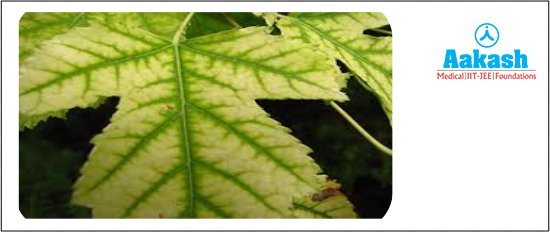
Fig: Yellowing of leaves
From where do plants get minerals? Obviously from soil, which is the storehouse of minerals. The root system of plants helps in the uptake of minerals from the soil. But how do they absorb minerals? These minerals should reach the whole plant body for various functions. How are they transported? Let us find all the answers to these questions through this article.
Table of contents:
- Mineral ions
- Uptake of mineral ions
- Translocation of mineral ions
- Practice Problems
- FAQs
Mineral ions
The products of photosynthesis are not enough for the overall growth and development of the plants. They require several essential minerals that are either structural components or participate in crucial metabolic activities required for the plant’s survival. Plants absorb these minerals in the form of ions from the soil through their roots. From root these mineral ions are transported or translocated to different parts of the plant. Plants need different minerals in different quantities. Some minerals are needed in large quantities and some only need in small or moderate amounts. The minerals that plants need in large amounts (more than 10 m mole per Kg) are as follows:
- Nitrogen
- Phosphorus
- Potassium
- Sulphur
- Calcium
- Magnesium
The minerals needed in very small amounts (less than 10 m mole per Kg) are as follows:
- Iron
- Manganese
- Boron
- Copper
- Zinc
- Molybdenum
- Chlorine
- Nickel
Among all these mineral ions, the most important minerals needed for the growth of the plants are nitrogen (N), phosphorus (P) and potassium (K). They are commonly called NPK. If the soil is lacking these minerals, then they are provided through NPK fertiliser.
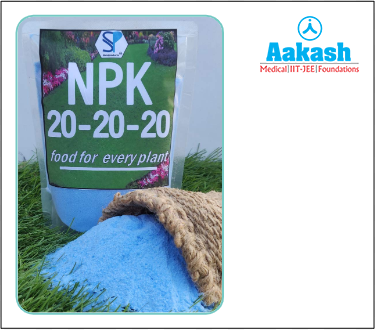
Fig: Fertiliser
Uptake of mineral ions
Just like water, the minerals are also absorbed by the roots of the plants. Minerals are dissolved in water in the soil and they are present in the form of mineral ions. Water uptake is by passive absorption of roots but all minerals cannot be passively absorbed. The reason for this is based on two following factors:
- Charge of the mineral ions
- Concentration of the mineral ions
Minerals are charged particles or ions in the soil, hence they can not move across the cell membrane. Concentration of minerals is higher in the sap of the root hair cells than in the soil. So minerals enter the root epidermis through active absorption against their concentration gradient with the help of transporter proteins present in the membrane of the cells. Energy is needed in the form of ATP for active absorption. But there are some minerals which can be absorbed easily through the passive absorption. Hence both passive and active transport can take the minerals into the root system.
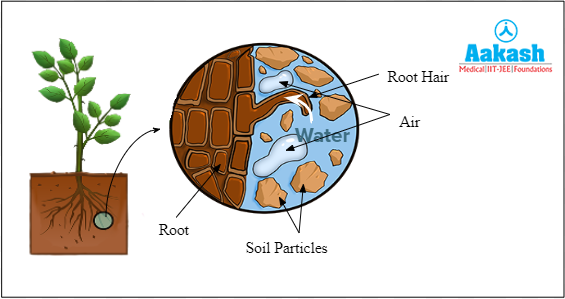
Fig: Absorption of water by root
Passive transport
Some mineral ions can be easily transported across the membrane through passive transport. Minerals are transported along the concentration gradient in passive transport. Here, there is no utilisation of ATP. This however contributes to a small percentage of mineral uptake.
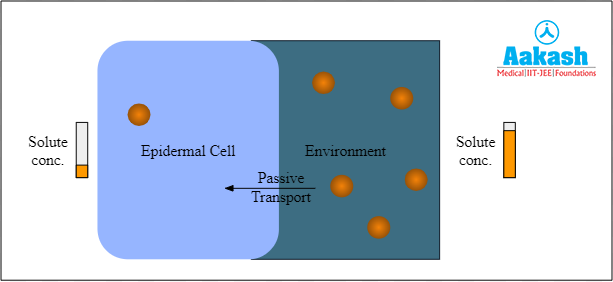
Fig: Passive transport
Passive absorption of mineral ions can occur via different kinds of carriers since ions cannot move across the membrane freely. Hence, they use ion channels which are actually trans membrane proteins that function as selective pores. Passive absorption can take place through the following two methods:
- Simple diffusion
- Facilitated diffusion
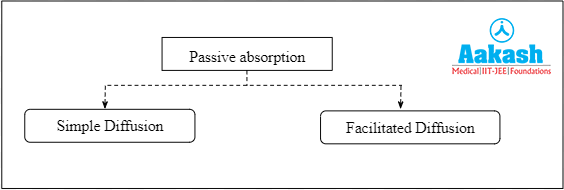
Fig: Types of passive absorption
Simple diffusion
The random movement of molecules from the higher concentration to the lower concentration until they attain equilibrium is known as diffusion. It occurs along the concentration gradient. It is also called simple diffusion.
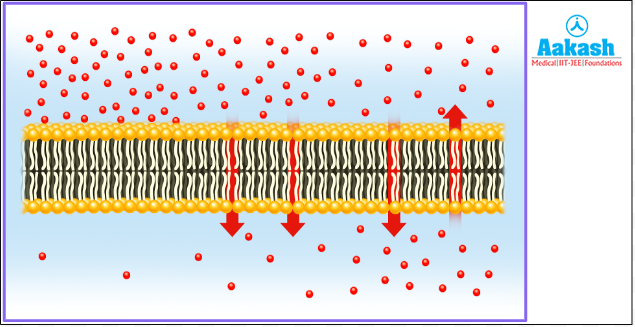
Fig: Diffusion
Facilitated diffusion
The movement of lipid insoluble molecules through the cell membranes with the help of specialised proteins is called facilitated diffusion. There is no expenditure of energy since it is happening along the concentration gradient. The minerals can be transported through channel proteins or carrier proteins. These proteins will be specific to each mineral molecule. The transport of bulk molecules is not possible.

GIF: Facilitated diffusion through GIF: Facilitated diffusion through carrier
channel proteins proteins
Active transport
Majority of the mineral transportation is contributed by active transport. Since roots are constantly absorbing minerals, there is usually a higher concentration of mineral ions in the cell sap of the root hair cells compared to the soil. Hence minerals are transported against concentration (from lower to higher concentration) gradients by utilising energy in the form of ATP. The ATPase enzyme present in the plasma membrane of the epidermal cells helps in breaking down ATP to generate energy. The transport takes place through specialised membrane carrier proteins known as pumps which require energy to transport mineral ions against their concentration gradient from a lower concentration to higher concentration.
Fig: Active transport
GIF: Sodium-potassium pump
Process of mineral uptake by roots
Initially the water potential of the root epidermal cells remains high. This is the condition before the uptake of minerals by roots.
Fig: High water potential inside the root
When the minerals are passively as well as actively absorbed by the root epidermis, the water potential inside the epidermis decreases and as a result the solute concentration increases.
Fig: High solute concentration inside the root
Water will always move from higher to lower water potentials. As the water potential of the epidermal cells decreases, more water is absorbed from soil by the roots through osmosis.
Fig: Absorption of water from soil through osmosis
Path of minerals through cortex
Once the minerals are absorbed at the root hair or epidermal cells, they next have to travel through the cortex and endodermis to finally arrive at the xylem at the centre of the cell.
Fig: Flow of minerals from root to xylem
Water and minerals adopt two pathways through the transport of cortex. They are as follows:
- Apoplast pathway
- Symplast pathway
The transport of ions from the epidermal cells through the cortex and into the endodermal cells occurs along the concentration gradient.
Apoplast pathway
The system of adjacent cell walls that are continuous at most places is called apoplast. It facilitates the transport by a network of tunnel-like structures in plant cells. It occurs only through the intercellular spaces and walls of the cells and it also depends on the gradient. While in apoplast pathway the minerals do not cross any membrane or cytoplasm of the cells.
GIF: Apoplast pathway
Symplast pathway
The system of interconnected protoplasts is called symplasts. It facilitates the transport by interconnected plasmodesmata. Since minerals enter through the cell membrane, the movement through the symplast pathway is slow. Minerals travel through the cytoplasm of intervening cells.
GIF: Symplast pathway
Path of minerals through endodermis
Now that the minerals have passed through the cortex through the apoplast and symplast pathway, they reach the endodermis. Here, the apoplast pathway is interrupted, because of the presence of casparian strips present on the endodermal cell walls. Casparian strips are the water impermeable suberin deposits on the radial cell walls of the endodermis of the root. So the movement of water and ions through the apoplast pathway are blocked in the endodermal cells.
Fig: Casparian strip blocking the apoplast pathway
So what happens to the minerals that reach the endodermis through apoplast pathway? The only way to pass through these cells is the transport proteins present in the endodermal membrane.
Transport protein
The membrane protein which helps in the transport of mineral ions, micro and macro molecules and proteins through the cell membrane is called transport protein. They can decide which solute should pass through the membrane and which should hold back. They help in adjusting the types and quantities of the solutes in the xylem. So here the minerals are selectively transported from the cortex to endodermis and then from endodermis to pericycle through transport proteins present in the membrane of endodermis.
Fig: Transport proteins selecting the solutes
Now from the pericycle the minerals have to be transported to the xylem for translocation to different parts of the plant. The transportation of minerals from pericycle to xylem happens through both the symplast and apoplastic pathway. The inward flow of mineral ions from the endodermal cells to the xylem occurs along the concentration gradient.
Fig: Journey of minerals
Translocation of mineral ions
The long distance transportation of materials through the vascular system of a plant is called translocation. Once the minerals have reached the xylem, they reach all the growing parts of the plants via translocation.
GIF: Translocation
The transportation to all parts of the plants is also aided by a transpiration stream. Transpiration is the process of the loss of excess water in the form of vapour from the aerial parts of the plant. Transpiration creates a transpiration pull and a suction force, which aid in drawing water from the roots to the leaves. Minerals are also carried along with the water.
So translocation helps to get the mineral ions from the root to the growing plant parts like apical and lateral meristems, young leaves, developing flowers, fruits and seeds, and the storage organs. Through diffusion and active uptake, minerals are unloaded at the cells of veins. Minerals like P, S, N, and K undergo remobilisation and move from the senescing or ageing parts of a plant to the young and new growing parts. Remobilisation helps with mineral and nutrient deficiency.
Fig: Translocation of minerals
All minerals undergo remobilisation except Ca, because calcium is the structural component of the plants. Ca is an important component in the cell plate. Hence other mineral contents in the older leaves will be exported to the younger leaves. In deciduous plants, the minerals will be removed to other parts of the plant before the leaves fall.
Fig: Transport of minerals from old leaf to young leaf
Nitrogen mostly travels in the inorganic forms like amino acids and related compounds through xylem. But some of it travel as inorganic ions through xylem. Phosphorus and sulphur are transported as organic compounds through xylem. The translocation of water and minerals through the xylem takes place only in one direction. Hence the translocation is unidirectional in xylem tissues. There is also some exchange of materials between the xylem and phloem.
Practice Problems
1. Which of these pairs correctly represents the absorption methods for water and minerals?
- Water - only passive, minerals - only passive
- Water - only active, minerals - only active
- Water - only passive, minerals - both active and passive
- Water - active as well as passive, minerals - only passive
Solution: The absorption of mineral ions by the root epidermal cells is mostly against the concentration gradient by using ATP. Hence the minerals are actively transported. Some mineral ions can also be absorbed passively along with water. When minerals are transported to the root cells from the soil, the water potential in the soil increases. This difference in the water potential makes the entry of water passively. So water is transported along the concentration gradient without using the ATP, through a process called osmosis. Hence the correct option is c.
2. Which of the following statements are correct?
I. Minerals that are present in the soil have charge.
II. The concentration of minerals in the soil is usually higher than the concentration of minerals in the root.
III. To enter the cytoplasm of epidermal cells, most of the minerals utilise energy.
IV. Majority of the minerals are absorbed through passive transport.
- I and II
- II and IV
- I and III
- II and III
Solution: The concentration of minerals inside the cell sap of root hair cells is usually higher compared to the concentration of minerals in the soil. Hence the absorption of minerals will take place through active transport, against the concentration gradient powered by the utilisation of energy generated by breaking down ATP. Root hairs help in the process of absorption of minerals. Minerals are always present as charged particles known as ions in the soil. As a result they cannot move across the phospholipid bilayer of the cell membrane freely like water does. For the transport of minerals, there are special proteins present on the cell membranes called transporters. Some mineral ions can be easily transported across the membrane through passive transport without the utilisation of ATP. Here the minerals are being transported along the concentration gradient. This only contributes to a small percentage of the uptake of minerals. Hence the correct option is c.
3. Which of the following helps in the passive absorption of minerals?
- simple diffusion
- transmembrane proteins
- ion channels
- All of the above
Solution: Some mineral ions can be easily transported across the membrane through passive transport. Minerals are transported along the concentration gradient during passive transport. Here, there is no utilisation of ATP. This only contributes to a small percentage of the uptake of minerals. Passive absorption can take place through the simple diffusion and facilitated diffusion. The random movement of molecules from the higher concentration to the lower concentration until they attain equilibrium is known as diffusion. It is also called simple diffusion. Ion channels and transmembrane or carrier proteins help in the passive absorption of minerals by facilitated diffusion. Instead of passing through the lipid bilayer, the charged mineral ions pass through carrier proteins or ion channels during facilitated diffusion. Charged mineral particles cannot pass freely through the cell membrane, hence they are transported through the ion channels or transmembrane proteins. Hence the correct option is d.
4. Not every mineral is remobilized in plants. Which of the following options supports the statement?
- Phosphorous
- Sulphur
- Nitrogen
- Calcium
Solution: Even though the soil is the reservoir of nutrients for the plants, there will be fluctuations in the availability of nutrients in the soil. To avoid the mineral and nutrient deficiency, minerals like P, S, N, and K undergo remobilisation and move from the senescing parts of a plant to the young and new growing parts. Sometimes, nutrients like nitrogen and phosphorus are remobilized from the leaves before leaf shedding. Hence, remobilization can also be seasonal. All minerals undergo remobilisation except Ca, because calcium is the structural component of the plants. Ca is an important component in the cell plate. Hence the correct option is d.
FAQs
1. How do mineral deficiencies happen in plants?
Answer: When the growing environment is unfavourable and the plants are unable to absorb the nutrients in the soil, deficiencies can occur in plants. It may be challenging for plants to absorb soil nutrients in extremely acidic or alkaline environments. Dryness and waterlogging are some other factors which make the plants unable to absorb the minerals.
2. Can plants grow without soil?
Answer: Plants can develop without soil. However, they are unable to do so without the nutrients that soil offers. Plants require support, nutrition, protection against extreme temperatures, a consistent supply of moisture, and oxygen surrounding the roots for a healthy growth. A technique known as hydroponics has been developed which allows plants to be grown in an aqueous solution containing all the essential nutrients and minerals in the appropriate amounts as is needed for the growth and development of the plants.
3. What is the most typical sign of nutritional deficiency in plants?
Answer: Chlorosis, altered foliage colour, overall plant stunting, and occasionally necrosis (tissue death) are some of the most typical signs of nutritional shortages. Each one may result from one or more inadequacies.
4. How are minerals formed in the soil?
Answer: Minerals are basically formed when the large rocks break. The most common minerals found in soil are iron, potassium, magnesium, calcium, sulphur etc. Humus also provides the minerals in the soil. Organic compounds created by the decomposition of dead and decaying plants and animals form the humus. It contributes to the soil's fertility
YOUTUBE LINK: [1]
Related Topics
| Means of transport |
| Plant water relations: Water potential, solute potential, pressure potential, osmosis, osmotic pressure and osmotic potential |
| Transpiration |

 Call Now
 Let's Chat
 Share
Share