-
Call Now
1800-102-2727


Gamete Intrafallopian Transfer (GIFT), Practice Problems, and FAQs

We all come from a family. You know that one of life's milestones is starting a family, and for most women and men, the parenting path is a trouble-free one. But some people, however, may face the difficult reality of being unable to conceive. This condition is called infertility. Infertility is the innability to conceive or produce children even after 2 years of unprotected sexual cohabitation. Today, a large number of couples are infertile. Despite unprotected sexual encounters, they are unable to produce babies.
Fig: Infertility
The good news is that infertility, or the inability to have children, is a problem that many couples can overcome with the right diagnosis, medical treatments and procedures, and even alterations in lifestyle. Specialised health care units like infertility clinics could help in diagnosis and corrective treatment of some of these disorders and enable these couples to have children. However, where such corrections are not possible, the couples could be assisted to have children through certain special techniques commonly known as assisted reproductive technologies (ART). Gamete intrafallopian transfer (GIFT) technique is one of the assisted reproductive technologies that can help infertile couples to achieve pregnancy. In this method, the ovum is taken from the donor female placed in one of the fallopian tubes along with sperms to produce a zygote. The blastocyst formed from the zygote by cleavage will get implanted in the uterus and develop into a baby. Let’s take a deep dive into the details of GIFT in this article.
Table of contents
- Gamete intrafallopian transfer
- Process of GIFT
- Beneficiaries of GIFT
- Points to remember for GIFT
- Advantages of GIFT
- Disadvantages of GIFT
- Differences between IVF and GIFT
- Practice Problems
- FAQs
Gamete intrafallopian transfer
This method was first tried in 1984. Steptoe and Edwards first performed this protocol, and later Ricardo Asch pioneered the GIFT technique at the University of Texas Health Sciences Center. In this method the egg (secondary oocyte) taken from the female donor and sperm taken from the male donor or partner are placed for union in one of the fallopian tubes of the recipient female. In this case, fertilisation happens inside the body rather than in a petri dish. The process takes around 4 - 6 weeks to complete.

Fig: GIFT
Process of GIFT
The following steps are involved in GIFT:
Stimulation of ovary
In this step the female will take fertility drugs to trigger the ovulation process. It is called superovulation and in this method drugs are used to allow multiple ovulation per menstrual cycle. The female needs to visit the clinic every two - three days for ultrasounds and blood tests. The doctor will also monitor the development of follicles.
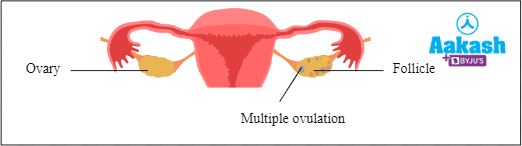
Fig: Stimulation of ovary
Gathering the eggs
On maturation of ovarian follicles, patients are given a minor dose of hCG (human chorionic gonadotropin) hormone, which further escalates progesterone production for the maintenance of pregnancy. Within 36 hours normally the eggs (secondary oocytes) get harvested. Doctor gives anaesthetic and through the vaginal region inserts an ultrasound probe to look at ovaries and identify the healthy follicles. Then the eggs are removed from the healthy follicles using a thin needle inserted through the wall of the vagina. Eight to fifteen eggs are normally retrieved like this.
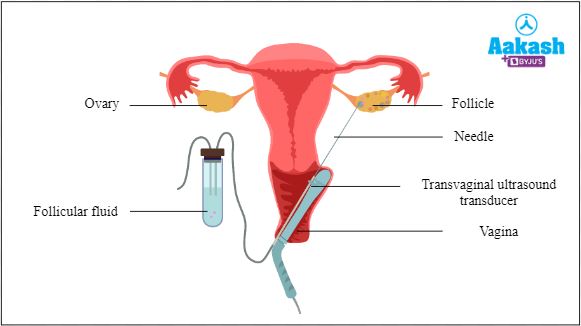
Fig: Gathering the eggs
Sperm collection
Sperm from male is simultaneously collected. The physician obtains sperm from the male in the form of semen. The following methods are used for the collection of sperms.
Collection condom
It allow the sperm to be collected via intercourse to ensure sperm viability and motility are maintained
Surgical method
In case of an obstruction preventing the normal ejaculation of sperm, this method is used.
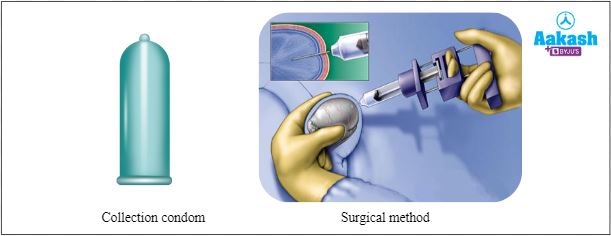
Fig : Extraction of sperm
Fertilisation
Once the eggs are retrieved, eggs and sperms are placed in one of the fallopian tubes of a female with the help of a laparoscope. This step involves surgery. In this step, the sperms and eggs from the catheter are into the fallopian tube. It is done through a small incision in the abdomen. Three to four eggs are normally placed inside the healthy fallopian tube in this way.
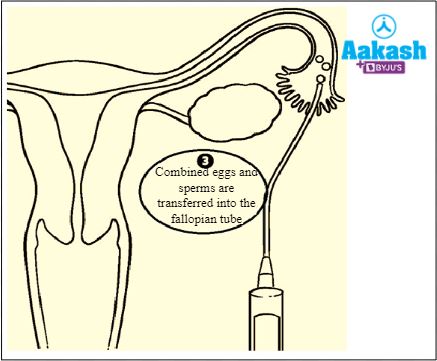
Fig: Fertilisation step in GIFT
Implantation
Once the sperm fertilises the eggs, the zygote is formed. It undergoes cleavage and forms the blastocyst. It gets implanted on the uterus. More than one egg is transferred to increase the chances of pregnancy. But there is a risk of having more babies like twins, triplets etc.
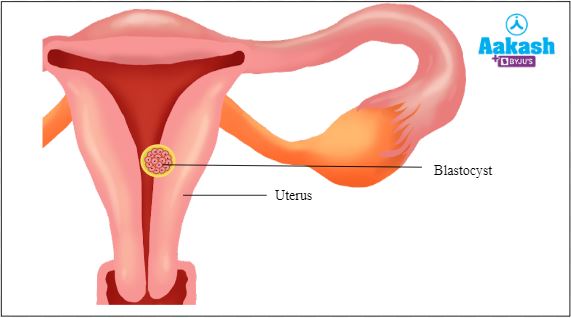
Fig: Implantation
Testing for pregnancy
A pregnancy test is taken about two weeks after the surgery.

Fig: Pregnancy test
Beneficiaries of the GIFT
Many people benefit from GIFT. It include the following:
- People with unexplained infertility.
- People who do not want to go with the IVF technique.
- Couples with ethical concerns and cannot accept IVF.
- Males with low sperm count or reduced motility of sperm.
- Females with healthy fallopian tubes but cannot produce healthy eggs.
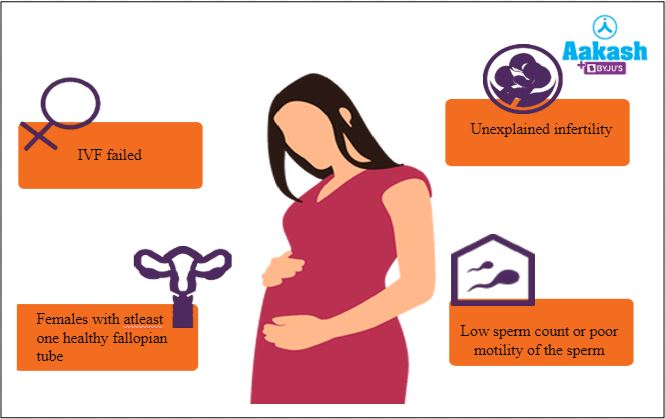
Fig: Beneficiaries of GIFT
Points to remember for GIFT
The below mentioned points need to be remembered before undergoing the GIFT procedure:
- This process is suitable in case of mild male infertility.
- For the GIFT process, at least one of the fallopian tubes should be functional.
- The process should not be confused with In vitro fertilisation as the union of sperm and ovum occurs here inside the fallopian tube.
- The success rate depends on the age of the couple and the quality of the gametes used.
- This process is highly expensive.
Advantages of GIFT
The following are the major advantages of GIFT:
- Fertilisation happens in the natural environment, that means it occurs in the fallopian tube.
- The success rate is high due to internal fertilisation rather than fertilisation in a petri dish like in IVF.
- The protocol requires one day only.
Disadvantages of GIFT
The following are the disadvantages of GIFT:
- Validation of fertilisation is tough in this method.
- Chances of multiple pregnancies are more here as multiple eggs are usually placed in the fallopian tube.
- Ectopic pregnancy risk is high as sometimes the egg gets implanted outside the uterus.
- Chances of developing the ovarian hyperstimulation syndrome or OHSS due to taking fertility drugs.
- Babies produced by GIFT may possess a higher susceptibility to congenital disabilities.
- This process is highly expensive.
- This process requires surgery. The transfer of eggs and sperms to the fallopian tube requires invasive surgery unlike IVF.
Differences between GIFT and IVF
- Instead of fertilising an egg in the fallopian tube as in gamete intrafallopian transfer, in vitro fertilisation involves fertilising an egg in a laboratory.
- If the fallopian tubes are closed or damaged, women can still undergo IVF to conceive.
- Confirmation of fertilisation and evaluation of embryo quality is made possible by in vitro fertilisation.
- Since in vivo fertilisation is involved in GIFT, couples do not have to think about moral considerations when choosing this method.
Practice problems
1. Why is gamete intrafallopian transfer used?
Answer: The latest assisted conception method known as gamete intrafallopian transfer (GIFT) is suitable for women with healthy fallopian tubes. This method, which is easier and more effective than in vitro fertilisation, can cure 60% of infertile patients with normal and closed tubes. This is effective in cases of idiopathic infertility, immunological reasons, male infertility, and endometriosis.
2. What is the duration of the GIFT procedure?
Answer: One cycle of GIFT takes four to six weeks for completion. We need to wait for the development of eggs. Then a woman and her partner spend nearly half a day at the clinic to retrieve the egg and sperm and have it surgically transferred to the fallopian tube. Laparoscopy is considered as a minor surgery, so they can go home on the same day.
3. What is the GIFT success rate?
Answer: GIFT results vary greatly depending on the ages and infertility issues of each couple. Typically, younger women have better eggs and have higher rates of success. During the use of GIFT, the average pregnancy rate is roughly 37% for women aged 38 and under and 24% for women aged 39 and over.
4. What are the limitations of intrafallopian gamete transfer?
Answer: The unavailability of a diagnostic test to determine whether fertilisation has occurred and a higher risk of ectopic pregnancy are the major drawbacks of GIFT. GIFT is one choice for seeking assisted reproductive technologies, despite being generally more invasive than conventional IVF.
5. Which is best, IVF or GIFT?
Answer: Instead of in a petri dish, fertilisation occurs in the fallopian tube in GIFT. But IVF is almost always the favoured option in clinics because GIFT calls for a surgical treatment while IVF does not.
FAQs
1. What are the risks of gamete intrafallopian transfer?
Answer: Laparoscopy, which may be performed to transfer eggs, carries risks such as pelvic infection, internal organ penetration, and general anaesthetic side effects. Ectopic pregnancy risk is high as sometimes the egg gets implanted outside the uterus. There are chances of developing the ovarian hyperstimulation syndrome or OHSS due to the fertility drugs also.
2. In GIFT, where does fertilisation take place?
Answer: The sperm and eggs are combined together before being inserted and the egg (secondary oocyte) will become fertilised inside the fallopian tubes.
3. Is IVF the same as GIFT?
Answer: IVF involves inserting fertilised eggs into the uterus. In contrast, because the eggs are transferred in the fallopian tubes during the GIFT procedure, they mimic normal conception. The sperm and egg are allowed to fertilise inside the fallopian tubes during the GIFT procedure.
4. What benefits do gamete intrafallopian transfers provide over in vitro fertilisation?
Answer: In GIFT or intrafallopian transfer the new embryo gets fed along its passage down the fallopian tube, boosting its chances of being healthy and able to implant in the uterus.
5. Can a woman get pregnant with one tube?
Answer: Pregnancy with GIFT is possible with one fallopian tube, assuming the woman and the solo fallopian tube are healthy.
YOUTUBE LINK: https://www.youtube.com/watch?v=rjbXpM0QS30&t=1s

 Call Now
 Let's Chat
 Share
Share