-
Call Now
1800-102-2727



Endoplasmic Reticulum: Occurrence, Types, Functions, Practice Problems and FAQs
We know that the human body gets its shape, support and structure from the skeletal system. But aren’t we all made up of millions of cells? Then what provides structure and framework to these cells? It is a double membraned cell organelle known as the endoplasmic reticulum (ER) which is a unique feature of eukaryotic cells and is absent in prokaryotic cells. But is that all that this organelle does? No, this organelle has more to it than just being the structural framework of a typical eukaryotic cell.
We know that all our characteristics are influenced by different proteins in the body and proteins also form a bulk of the structural components of our body such as the bones, the muscles, the nails, the hairs, etc. Do you know how these proteins are formed? They are formed through the process called translation of RNA molecules carried out by tiny non-membranous protein factories known as the ribosomes. These ribosomes often attach to the membrane of the endoplasmic reticulum and hence the ER also serves as a site of protein synthesis.
You are aware that functional proteins in our body exist in their secondary, tertiary or quaternary forms which are formed due to folding of the polypeptide chain. Did you know that the ER not only serves as the site for protein synthesis but is also the site for protein folding? The specialised enzymes needed for the folding of a protein are present inside the endoplasmic reticulum. Improper folding of proteins leads to the formation of non-functional or toxic proteins that can cause multiple disorders in the body, some of which can also be fatal. So you can guess the significance of the endoplasmic reticulum within the cell. In this article we are going to discuss more about the endoplasmic reticulum.
Table of contents:
- Cell and endomembrane system
- Endoplasmic reticulum
- Occurrence of ER
- Structure of endoplasmic reticulum
- Types of endoplasmic reticulum
- Functions of endoplasmic reticulum
- Practice Problems
- FAQs
Cell and endomembrane system
Cell is the structural and functional unit of all living organisms. There are two types of cells according to the presence or absence of a well defined nucleus. Cells with well defined nuclei are called eukaryotic cells and those without them are called prokaryotic cells. The prokaryotic cells are simpler than eukaryotic cells and lack all membrane bound organelles. These include bacterial cells.
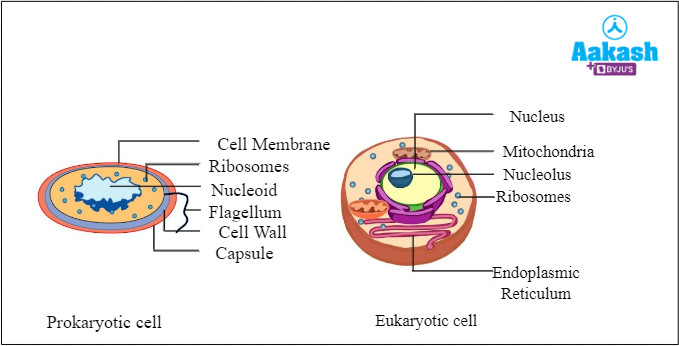
Fig: Prokaryotic and eukaryotic cells
Eukaryotic cells include protists, fungal cells, plant cells and animal cells. These cells are more advanced as they not only possess a well-defined nucleus but they also possess membrane bound organelles such as the endoplasmic reticulum, mitochondria, Golgi bodies, vacuoles, lysosomes, etc. All the membranous components present in the cytoplasm of eukaryotic cells that are in close coordination with one another collectively form the ‘endomembrane system’. The endomembrane system includes the nucleus, endoplasmic reticulum (ER), Golgi complex, lysosomes and vacuoles.
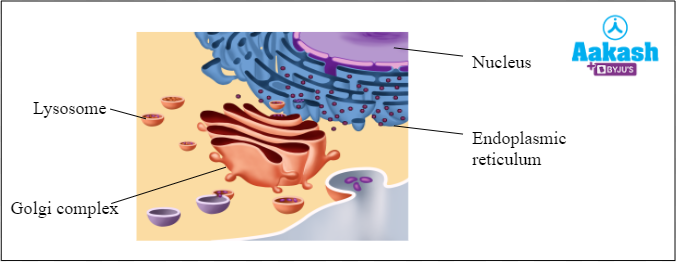
Fig: Endomembrane system
Endoplasmic reticulum or ER
This cell organelle can be observed only under an electron microscope. ‘Endo’ means inside, ‘plasmic’ means cytoplasm and ‘reticulum’ means network. Thus the endoplasmic reticulum is the organelle that forms a network of small tubular structures in the cytoplasm. They are single membrane-bound organelles. Endoplasmic reticulum was first observed by Garnier in 1897 and he coined the term ergastoplasm. The endoplasmic reticulum's lacy membranes were found by Keith R. Porter, Albert Claude, and Ernest F. Fullam in 1945 by using electron microscopy. Porter proposed the name endoplasmic reticulum in 1953.

Fig: Keith Porter
Occurrence of ER
ER is present in all eukaryotic cells except mature RBCs, embryonic cells, resting cells and ovum. Prokaryotic cells also lack ER. The ER is highly organised in cells which are actively synthesising protein and cells which are involved with metabolism of lipids. The ER occupies most of the cytoplasm and increases the internal surface area of the cell 30-40 times when compared to the external surface. ER divides the intracellular space into two compartments:
- Luminal compartment: inside ER
- Extra luminal compartment: outside the ER, which is the cytoplasm
The ER in spermatocytes is in the form of vacuoles and it is in the form of tubules in adipose tissues. Sarcoplasmic reticulum is the ER present in the striated muscle fibres.
Structure of ER
The membrane of the endoplasmic reticulum is continuous with the membrane of the nucleus. There are three membrane bound channels as interconnected systems in the endoplasmic reticulum. They are as follows:
- Cisternae
- Tubules
- Vesicles
The cisternae and tubules are hollow structures, and the space inside them is called lumen.
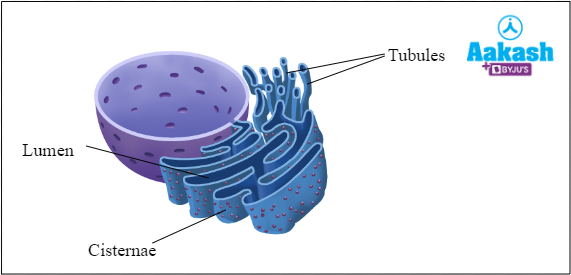
Fig: Structure of ER
Cisternae
The sac-like and flattened structures of the ER that are arranged in stacks are called cisternae. The stacks of cisternae lie parallel to each other and are also interconnected. They have rough structures, since ribosomes are present on them.
Tubules
Irregularly branched, tube-like structures in ER are called tubules. They do not have ribosomes and they may be free or associated with cisternae.
Vesicles
The oval or round sacs that occur isolated in the cytoplasm are called vesicles. They are also devoid of ribosomes.
Types of ER
Endoplasmic reticulum can exist in two forms as follows:
- Rough endoplasmic reticulum (RER)
- Smooth endoplasmic reticulum (SER)
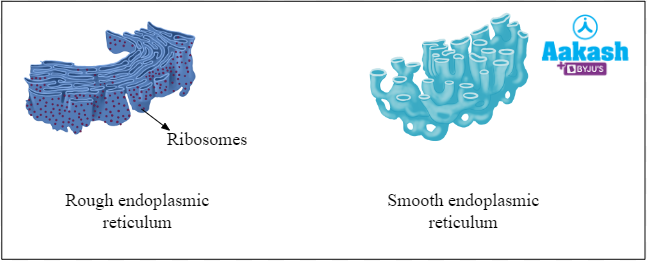
Fig: Types of ER
Rough endoplasmic reticulum
The ER with ribosomes attached to the surface is called a rough endoplasmic reticulum (RER) or granular reticulum. The surface of the RER looks rough and irregular due to the presence of ribosomes. It is continuous with the outer membrane of the nucleus. It mainly consists of cisternae and is involved in protein synthesis. So RER is present in most of the cells where the protein synthesis takes place actively. RER can be seen in the liver cells, pancreas cells, goblet cells, etc. Proteins are transferred to the ER lumen from ribosomes.
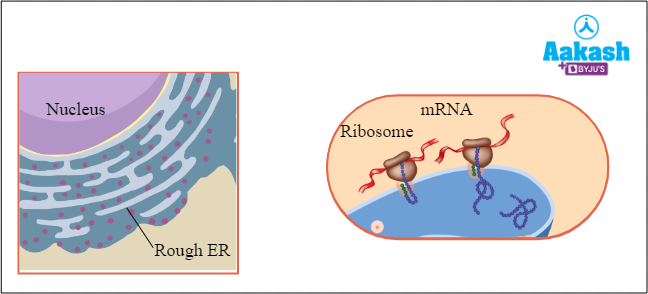
Fig: Rough endoplasmic reticulum
Smooth endoplasmic reticulum
The ER without ribosomes on the surface is called a smooth endoplasmic reticulum (SER) or agranular reticulum. Thus SER looks smooth from outside. It mainly consists of tubules and vesicles. SER is mainly involved in lipid synthesis and occurs in cells which secrete and synthesise steroids and lipids or which carry out glycogen metabolism and lipid synthesis. Hence it is more abundant in cells of adipose tissue, glycogen-storing liver cells, cells of the adrenal cortex, intestinal cells, leucocytes, pancreatic cells, etc. Lipid-like steroidal hormones are synthesised in SER of animal cells. so the function of SER is to synthesise glycogen, lipids and steroids.
The SER is found in combination with RER and is found to be continuous with the RER. It may be derived from the RER. At places the RER is continuous with the SER on one side and the nuclear membrane on the other side. The SER membranes are connected to the membranes of Golgi cisternae or plasma membrane.
Difference between RER and SME
Rough endoplasmic reticulum |
Smooth endoplasmic reticulum |
|
It is mainly composed of cisternae. |
It is mainly composed of tubules and vesicles. |
|
Ribosomes are present on the cytoplasmic surface. |
Ribosomes are absent on the cytoplasmic surface. |
|
It is deep in the cytoplasm. |
It lies near the cell membrane. |
|
It is connected with the nuclear envelope. |
It is connected with the rough endoplasmic reticulum and with the membrane of Golgi cisternae or plasma membrane. |
|
It helps in the synthesis of proteins. |
It helps in the synthesis of glycogen, lipids and steroids. |
|
It arises from the nuclear envelope by outfolding. |
It develops from the RER by the detachment of ribosomes. |
|
It gives rise to organelles like Golgi apparatus, lysosomes and vacuoles. |
It gives rise to spherosomes. |
|
Channels for the transport of proteins out of the cell are formed by this. |
The transmission of impulse from outside to inside the cell is supported by this. |
Functions of endoplasmic reticulum
ER primarily acts as the site for protein synthesis, but it has many other functions as follows:
- Mechanical support
- Isolation of metabolic products
- Intracellular transport
- Intracellular impulse conduction
- Synthesis of proteins and lipoproteins
- Glycogen metabolism
- Detoxification
- Formation of other cytomembrane
Now we will discuss the functions of ER in detail.
Mechanical support
ER maintains the form of the cell by acting as a supporting framework in the cytoplasm due to its extended network-like structure.
Isolation of metabolic products
Osmotic pressure in the internal compartments are maintained by ER and it isolates the intracisternal materials from the cytosol and also allows the exchange of materials between the compartments.
Intracellular transport
ER helps in the import, export and intracellular circulation of various substances from different regions of the cell. Hence ER can be considered as the circulatory system of the cell.
Intracellular impulse conduction
ER of muscles can transmit impulses from the membrane to the internal regions of the muscle. This is made possible by generating ionic gradients and electric potential.
Synthesis of proteins and lipoproteins
The ribosomes of RER synthesise proteins. SER makes space for the association of the lipids with proteins and to form lipoproteins.
Glycogen metabolism
The process of breakdown of glycogen into glucose is called glycogenolysis. SER is associated with this process.
Detoxification
The removal of harmful substances from the cell is called detoxification. SER helps in the detoxification of many endogenous and exogenous compounds.
Formation of other cytomembranes
ER elements accumulate around the chromosomes and fuses during cell division, which leads to the formation of nuclear membranes. The transitional vesicles and cisternae of the Golgi apparatus arise from the ER.
Practice Problems
Q1. Which of the following statements are correct about the endoplasmic reticulum?
- Endoplasmic reticulum was first observed by Porter.
- ER is present in all eukaryotic cells except mature RBCs, embryonic cells and ovum.
- The membrane of the endoplasmic reticulum is continuous with the membrane of the nucleus.
- The cisternae and tubules are hollow structures, and the space inside them is called lumen.
- A, B, C, D
- B, C, D
- A only
- C and D
Solution: The endoplasmic reticulum can be observed only under an electron microscope. ‘Endo’ means inside, ‘plasmic’ means cytoplasm and ‘reticulum’ means network. Thus the endoplasmic reticulum is the organelle that forms a network of small tubular structures in the cytoplasm. Endoplasmic reticulum was first observed by Garnier in 1897 and he coined the term ergastoplasm. Porter, Claude and Fullam first observed the lacy membranes of ER in 1945 and Porter proposed the name endoplasmic reticulum in 1953.
ER is present in all eukaryotic cells except mature RBCs, embryonic cells and ovum. Prokaryotic cells lack ER. It occupies most of the cytoplasm. The membrane of the endoplasmic reticulum is continuous with the membrane of the nucleus. There are three membrane bound channels as interconnected systems in the endoplasmic reticulum. They are cisternae, tubules and vesicles. The cisternae and tubules are hollow structures, and the space inside them is called lumen. Hence the correct option is b.
Q2. Which of the following is synthesised by SER?
- Lipids
- proteins
- steroid hormones
- both a and c
Solution: The membrane bound network extending from the nuclear membrane is called endoplasmic reticulum (ER). There are two forms of endoplasmic reticulum depending on the presence or absence of ribosomes attached to the surface. They are rough endoplasmic reticulum (RER) and smooth endoplasmic reticulum (SER). The ER with ribosomes attached to the surface is called a rough endoplasmic reticulum or granular reticulum. They are involved in protein synthesis. So RER is present in most of the cells which are actively involved in protein synthesis. The ER without ribosomes on the surface is called a smooth endoplasmic reticulum or agranular reticulum. It continues from the rough endoplasmic reticulum. SER is mainly involved in lipid synthesis. Lipid-like steroid hormones are synthesised in SER of animal cells. So the function of SER is to synthesise glycogen, lipids and steroids. Hence the correct option is d.
Q3. Assertion: Endoplasmic reticulum helps in the synthesis of protein.
Reason: RER has ribosomes on the surface.
Which of the following statements are correct about the assertion and reason given above?
- Both assertion and reason are true and reason is the correct explanation of assertion.
- Both assertion and reason are true and reason is not the correct explanation of assertion.
- Assertion is true but the reason is false.
- Both assertion and reason are false.
Solution: The endoplasmic reticulum is the organelle that forms a network of small tubular structures in the cytoplasm. Synthesis of proteins and lipoproteins is the major function of ER. There are two forms of endoplasmic reticulum depending on the presence or absence of ribosomes attached to the surface. They are rough endoplasmic reticulum (RER) and smooth endoplasmic reticulum (SER). The ER with ribosomes attached to the surface is called a rough endoplasmic reticulum or granular reticulum. They are involved in protein synthesis. So RER is present in most of the cells where the protein synthesis takes place actively. Hence the correct option is a.
Q4. Which of the following is/are the correctly matched pairs?
i) Cisternae: Sac-like and flattened structures
ii) Tubules: Irregularly branched and tube-like structures
iii) Vesicles: The oval or round sacs that are isolated in the cytoplasm
- i
- ii
- iii
- All the above
Solution: There are three membrane bound channels as interconnected systems in the endoplasmic reticulum. They are cisternae, tubules and vesicles. The cisternae and tubules are hollow structures, and the space inside them is called lumen. The sac-like and flattened structures of the ER that are arranged in stacks are called cisternae. The stacks of cisternae lie parallel to each other and are also interconnected. They have rough structures, since ribosomes are present on them. Irregularly branched and tube-like structures in ER are called tubules. They do not have ribosomes and they may be free or associated with cisternae. The oval or round sacs that are isolated in the cytoplasm are called vesicles. They are also devoid of ribosomes. Hence the correct option is d.
FAQs
Q1. Is DNA present in the endoplasmic reticulum?
Answer: DNA is not present in the endoplasmic reticulum. Only organelles in eukaryotic cells that have DNA are nucleus, mitochondria and chloroplasts.
Q2. Why do prokaryotes not have endoplasmic reticulum?
Answer: The nuclear region of a prokaryote is not fully developed. Hence it is not bound by the nuclear membrane. According to De Robertis, the invagination of the nucleus resulted in the formation of endoplasmic reticulum. This is the reason why prokaryotes do not have an endoplasmic reticulum.
Q3. Why does RBC not have an ER?
Answer: Mature RBCs do not have nucleus and other cell organelles such as mitochondria, Golgi apparatus and endoplasmic reticulum. This is to accommodate more amounts of haemoglobin in the cells.
Q4. What is unfolded protein response or UPR?
Answer: UPR is a cellular response related to the endoplasmic reticulum. When accumulation of unfolded proteins or misfolded proteins happens inside the ER lumen, the UPR is activated. The restoring of the normal functions of the cell is done by the UPR. It is done through halting the protein translation and degradation of misfolded proteins.

 Call Now
 Let's Chat
 Share
Share