-
Call Now
1800-102-2727


Differences Between Mitosis and Meiosis, Practice Problems and FAQs

Cell being the basic unit of life is an important part of all the organisms. Have you ever wondered how a single cell called zygote multiplies and produces a human being? Cells have the ability to divide which allows them to grow and multiply in huge numbers. It helps in repairing the tissues also.

Fig: Human development

A cell cycle is a set of processes that occur while a cell grows and splits into two daughter cells. In unicellular organisms like bacteria, the reproduction takes place by cell division which produces daughter cells having exact number of chromosomes as the parent cell. But in most multicellular organisms such as humans, two types of cells are present in the body. They are somatic cells or body cells and sex cells or the gametes. Although these cells are present in a single body they are quite different. The somatic cells in the body are diploid (2n) in nature, but the gametes are haploid (n) in nature. How does this happen? Are there different ways by which these cells are produced in the body? Well, mitosis and meiosis are two types of cell division that make this happen.
The process of mitosis and meiosis illustrates the basis of the existence of all living organisms. Let's take a deep dive into the details of differences between mitosis and meiosis in this article.
Table of contents
- Overview of mitosis
- Overview of meiosis
- Differences between mitosis and meiosis
- Practice Problems
- FAQs
Overview of mitosis
It is a type of cell division in which chromosomes replicate and become equally distributed into two daughter cells. In this way both the daughter cells receive the same number and type of chromosomes as that of the parent cell. This was first observed by Strasburger in plant cells. It is also called equational division.
Main events in mitosis
It possesses two main events like karyokinesis and cytokinesis.
Karyokinesis
It is the nuclear division. Here the nucleus passess through various phases. It consists of four phases like prophase, metaphase, anaphase and telophase.
Cytokinesis
It is the division of cytoplasm of the parent cell into two daughter cells. It starts towards the middle of the anaphase and completes with the telophase.

Fig: Mitosis

Meiosis
It is a type of cell division in which a diploid cell gives rise to four haploid cells and nuclei, with each one having half the number of chromosomes as compared to the parent cell. It was first studied by Beneden.
Divisions in meiosis
Meiosis possesses two divisions like meiosis I and meiosis II. Each division has four different phases.

Fig: Phases in meiosis

Fig: Meiosis

Differences between mitosis and meiosis
Mitosis |
Meiosis |
|
Discovery |
It was discovered by Walther Flemming | It was discovered by Oscar Hertwig |
Occurrence |
Except for viruses, all organisms undergo mitosis | Only fungus,animals, and plants go through meiosis |
Types of cells involved |
It occurs in haploid or diploid cells | It occurs only in diploid cells |
Repetition by the cells |
After one mitotic division daughter cells may undergo mitosis | Meiosis cannot be repeated by daughter cells |
Number of cell division |
One cell division takes place which possess 4 stages in total | Two cell divisions take place which possess 8 stages in total |
Cells produced |
Body cells or somatic cells are produced | Gametes or sex cells are produced |
Interphase |
Each mitosis division is preceded by an interphase | The second meiotic division is not preceded by an interphase |
Length of prophase |
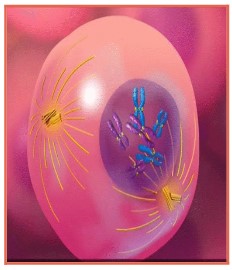
Prophase is short in length
GIF: Prophase |
Prophase I is usually longer with five sub-phases like leptotene, zygotene, pachytene, diplotene and diakinesis
GIF: Prophase I |
Recombination or crossing over |
No recombination or crossing over takes place in prophase | In the pachytene stage of prophase I, recombination or crossing over takes place |
Synaptonemal complex |
It is absent | Present |
Metaphase |
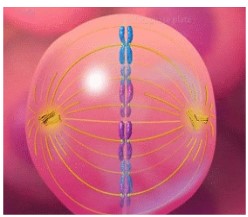
Individual chromosomes align up on the cell's equator during metaphase
GIF: Metaphase |
During metaphase I, chromosome pairs align on the cell's equator.
GIF: Metaphase I |
Metaphase plate |
A single metaphasic plate is formed by all chromosomes | A double metaphase plate is formed by the chromosomes in metaphase I but only one is formed in metaphase II |
Centromere |
The centromere of the chromosome is connected with both the spindle fibres | The centromere of a chromosome is connected to one spindle pole in metaphase I, but with both in metaphase II |
Anaphase |
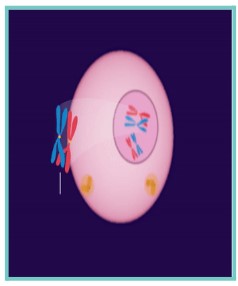
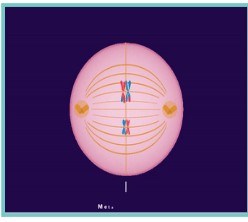
Sister chromatids travel to opposing ends of the cell during anaphase
GIF: Anaphase |
Homologous chromosomes separate and travel to the opposite poles of the same cell during anaphase I
GIF: Anaphase I Sister chromatids are split and move to the opposing ends of the cell during anaphase II
GIF: Anaphase II |
Chromosomes in anaphase |
Similar chromosomes move towards the opposite poles in anaphase | Dissimilar chromosomes move towards the opposite poles |
Number of cells produced |
Two daughter cells are created at the end of mitosis | Four daughter cells are normally formed at the end of meiosis |
Number of chromosomes |
The number of chromosomes in daughter cells is the same as the parent cell and thus, mitosis is called equational division
Fig: Number of chromosomes |
The number of chromosomes is half in the daughter cells and thus, meiosis is also called reduction division
Fig: Number of chromosomes |
Ploidy |
It produces diploid (2n) daughter cells | It produces haploid (n) daughter cells |
Genetics |
The resulting daughter cells are genetically identical | The resulting daughter cells are genetically different |
Function |
Its general functions are growth, repair and asexual reproduction of cells | It functions to create genetic diversity or variation in organisms through sexual reproduction |
Telophase |
It is longer | Telophase I is shorter |
Cytokinesis |
It follows every mitosis | It occur at the end of each division or simultaneously after meiosis II |








Practice Problems
Q 1. Which of the following statements can be considered true regarding mitosis?
1. Recombination or crossing over does not occur.
2. It produces haploid gametes from diploid cells.
3. Two daughter cells are produced.
4. Generates genetic variations in organisms.
a. II and IV
b. II and IV
c. I and II
d. I and III
Answer: Mitosis is a cell division in which a cell divides to form two daughter cells. The daughter cells have the ploidy, same as the parent cell. Mitosis occurs during asexual reproduction of cells in which the recombination or crossing over of chromosomes does not occur. Recombination or crossing over occurs in meiosis during sexual reproduction which generates genetic variations in the organisms. Hence, option d is correct.
Q 2. Match the following:
| Column I | Column II |
| A. Anaphase II | I. Crossing over takes place |
| B. Prophase I | II. Homologous chromosomes are separated |
| C. Metaphase I | III. Chromosome pairs align on the cell's equator |
| D. Anaphase I | IV. Sister chromatids are separated |
a. A - II, B - IV, C - III, D - I
b. A - II, B - III, C - I, D - IV
c. A - IV, B - III, C - II, D - I
d. A - IV, B - I, C - III, D - II
Answer: In the pachytene stage of prophase 1, the non-sister chromatids pair with each other and exchange genetic material. It gives recombinant chromosomes which are linked at the site of the crossing over. In metaphase I, the homologous chromosome pairs align on the equator of the cell. The homologous chromosomes are separated and they move to the opposite poles of the cell during anaphase I. In anaphase II, the sister chromatids separate and move to the opposite poles in the cell. Hence, option d is correct.
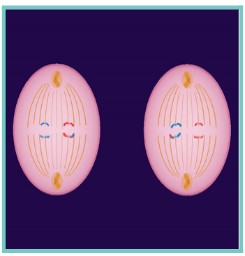
Q 3. Identify the stage of mitosis in the given image. Choose the correct option.


a. Metaphase
b. Prophase
c. Anaphase
d. Telophase
Answer: In the given image, the kinetochores of the chromosomes have attached to the spindle fibres and the chromosomes are aligned on the cell’s equator (metaphase plate) through the spindle. This image depicts the metaphase of mitosis. Hence, option a is correct.
Q 4. If the total number of gametes produced is 48, then how many cells were involved in the meiotic division?
a. 6
b. 8
c. 12
d. 18
Answer: In the process of meiosis, each of the mother cells gives 4 haploid cells or gametes. Since the total number of gametes produced is 48, the number of cells in which the meiotic division has taken place will be 48/4, that is 12 cells. Hence, option c is correct.
FAQs
Q 1. What is the major event that occurs during prophase 1 of meiosis and why is it considered important?
Answer: Prophase I of meiosis emphasises the exchange of DNA between homologous chromosomes via homologous recombination and the crossover of non-sister chromatids at chiasma(ta). This period is critical for increasing genetic variation.
Q 2. Is meiosis I and mitosis the same? Justify your answer.
Answer: Meiosis I is a reductional division, which means that the number of chromosomes in daughter cells is halved. At the end of meiosis, the daughter cells produced are haploid. Mitosis is an equational division in which the number of chromosomes in both the daughter and parent cells remains the same. The daughter cells produced at the end of mitosis are diploid. Thus, meiosis I and mitosis are not completely the same.
Q 3. State the main significance of meiosis over mitosis?
Answer: Meiosis is crucial because it ensures that all sexually reproducing creatures or species formed conserve a specific number of chromosomes across generations. Recombination occurs during meiosis, which results in producing genetic diversity and variations in organisms.
Q 4. State the events that take place in meiosis 1 but not in mitosis?
Answer: Crossing over (exchange of chromosomal segment between non-sister chromatids) and synapsis (pairing of homologous chromosomes) occur in meiosis but not in mitosis.
Related Topics
| Cell Cycle: Introduction,Duration, Phases of cell cycle, Practice Problems and FAQs |
| Mitosis, Practice Problems and FAQs |
| Meiosis: Process, Types and Significance, Practice Problems and FAQs |

 Call Now
 Let's Chat
 Share
Share