-
Call Now
1800-102-2727



Class Amphibia, Practice Problems and FAQs
Centuries ago the Indigenous tribal people of South America found a novel way of hunting animals. They used a long bamboo blowpipe and fit the dart inside the pipe. The force of exhalation or blow of air from the other end pushes the dart. The only limitation of this technique was the stamina of the person who is blowing. Do you know how this small dart kills such huge animals? This was an amazing innovation. right?
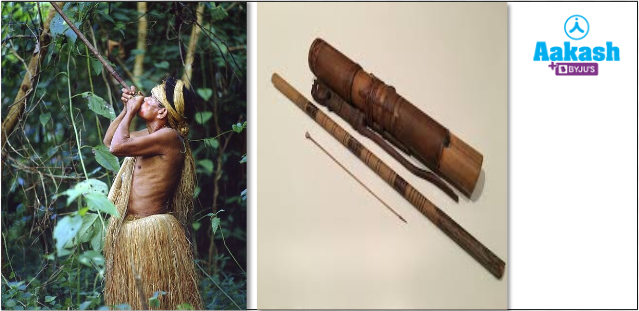
Fig: A tribe using the blowpipe and blowpipe
They used to roll the tip of their darts and arrows over the skin of a live frog. Such an arrow had the potential to paralyse animals of all sizes. Not only against animals, they used these poison arrows against people from enemy tribes and attackers also. Can you believe this poison is obtained from the bodies of small colourful and beautiful frogs! It is difficult to believe that such good looking creatures could potentially kill humans.
The poisons on the surface of their body can paralyse or cause brain and heart failure in humans. But the frogs themselves are immune to their toxins. There is a frog called the golden poison frog. It is only about the size of your little finger. But it has enough poison to kill 10 - 20 men or 2 - 3 elephants! These poisonous beautiful creatures belong to the class Amphibia.
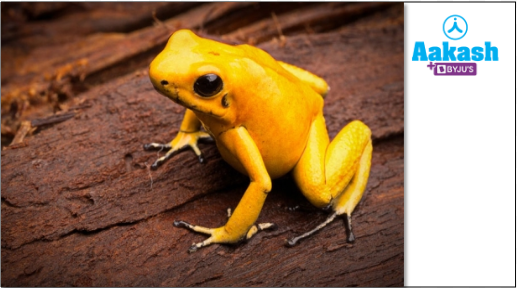
Fig: Golden poison frog
So now we are going to discuss more about the class Amphibia in this article which are the living examples that depict the evolution of organisms from water to land.
Table of contents
- Superclass Tetrapoda
- Class Amphibia
- Classification of Amphibia
- Significance of class Amphibia
- Practice Problems
- FAQs
Superclass Tetrapoda
Tetrapoda is a superclass classified under the Gnathostomata (bearing jaws) division of subphylum Vertebrata. Tetrapoda (tetra - four, podus - foot), as the name suggests, includes animals bearing four limbs for locomotion.
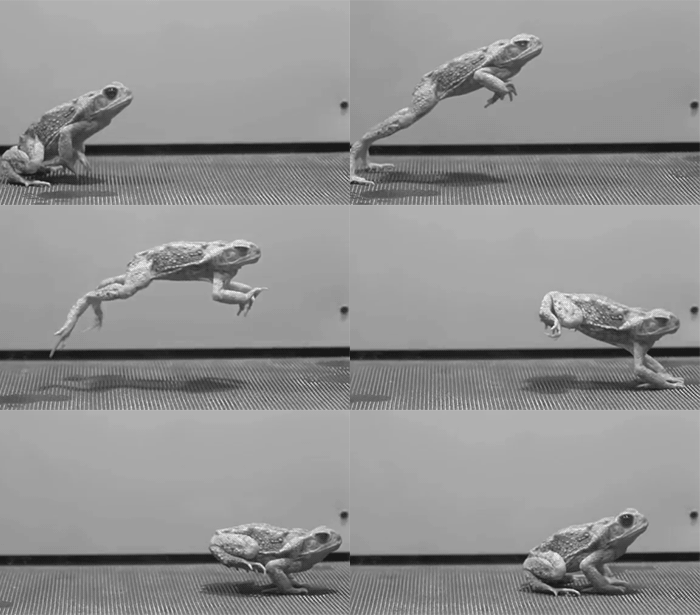
GIF: Superclass Tetrapoda
Snakes and some amphibians which are limbless are the exceptions under this superclass. Tetrapoda is further classified into four classes as follows:
- Class Amphibia
- Class Reptilia
- Class Aves
- Class Mammalia
Class Amphibia
The word ‘Amphibian’ is derived from the words ‘Amphi’ which means dual and ‘bios’ which means life. This indicates that amphibians are land and water animals. Amphibians spend a portion of their life cycle in water while remaining on land, just as the bryophytes do in the world of plants. Now we will discuss some of the general characteristics of class Amphibia.
General characteristics of Class Amphibia
The following are the common characteristics of class Amphibia:
Habitat
As indicated by word root, amphibians are animals that can live on both land and water. They can also live in moist soils and marshy areas. Many climb and live on trees too. So they are the dual life vertebrates.
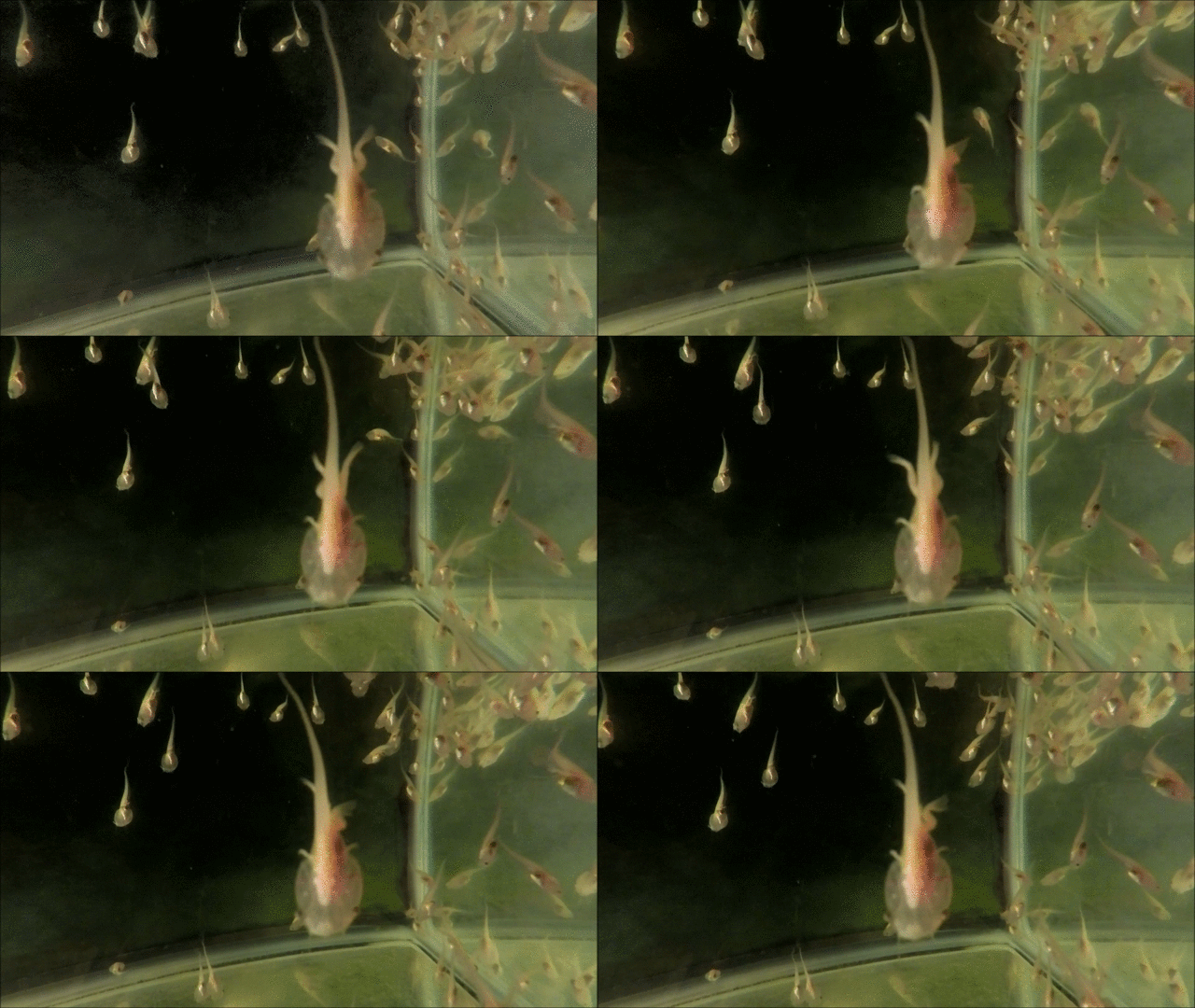
GIF: Amphibians in aquatic habitat
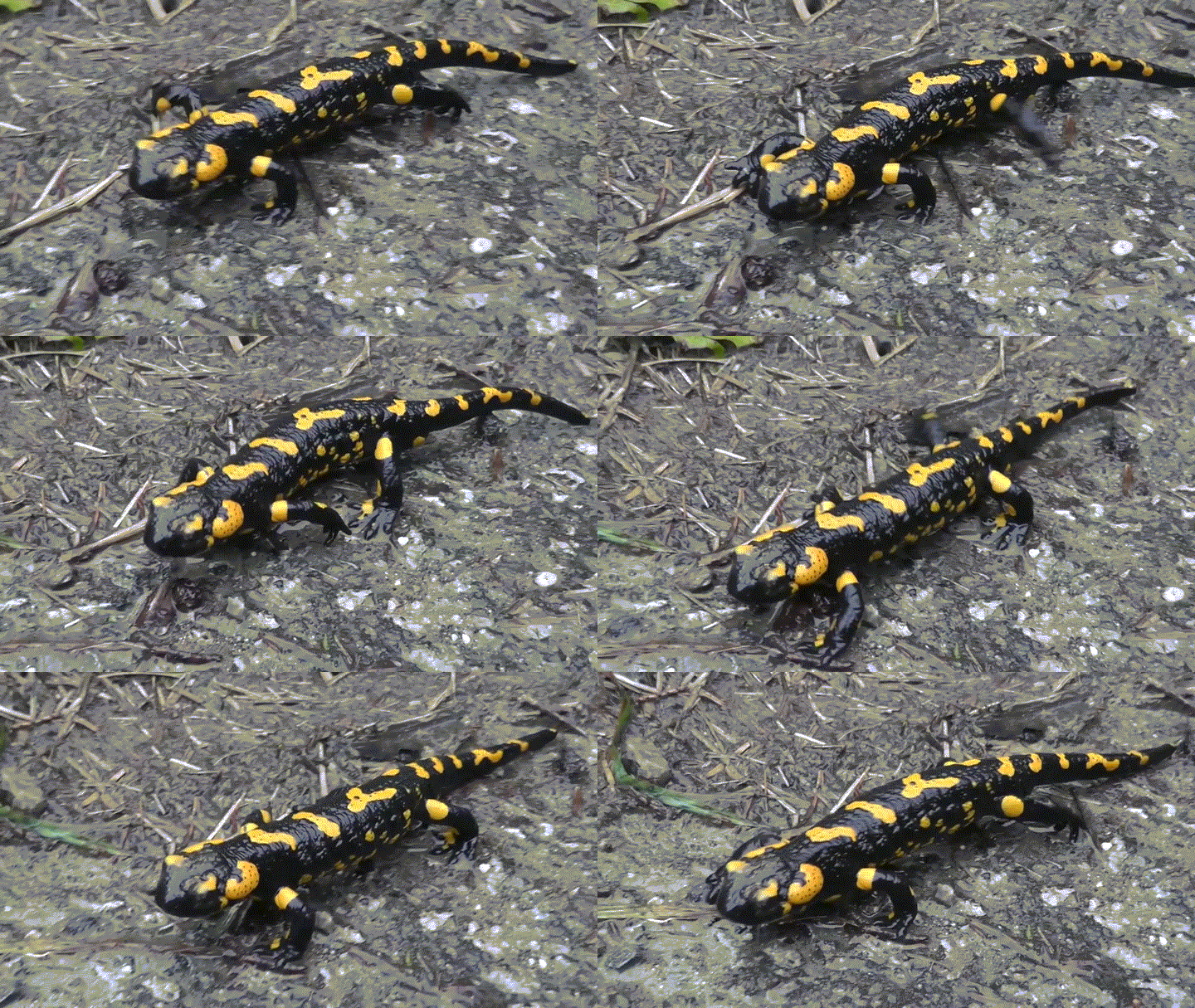
GIF: Amphibians in terrestrial habitat
Dual phases in life
Amphibians generally have two phases in their life cycle as follows:
Tadpole
It is the larval stage. Tadpoles can swim like fish and they have tails. Tadpoles respire with gills.
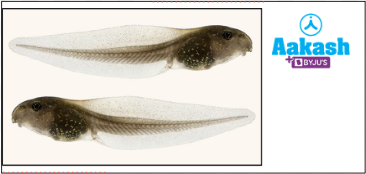
Fig: Tadpole
Adult stage
This stage of amphibians will be terrestrial. They move by using their limbs and respiration happens through lungs and skin mainly.
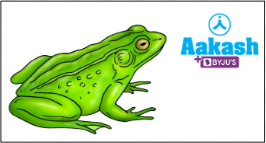
Fig: Adult stage
Feeding habit
They prey on the smaller invertebrates. They mostly consume living invertebrates and slow-moving animals. Caterpillars, earthworms, crayfishes, water beetles, snails, and dragonfly larvae are a few examples. Many amphibians catch their prey with the help of their sticky tongues. They may chew the animal a little to help it pass down their throats, but mostly they will swallow it as a whole.
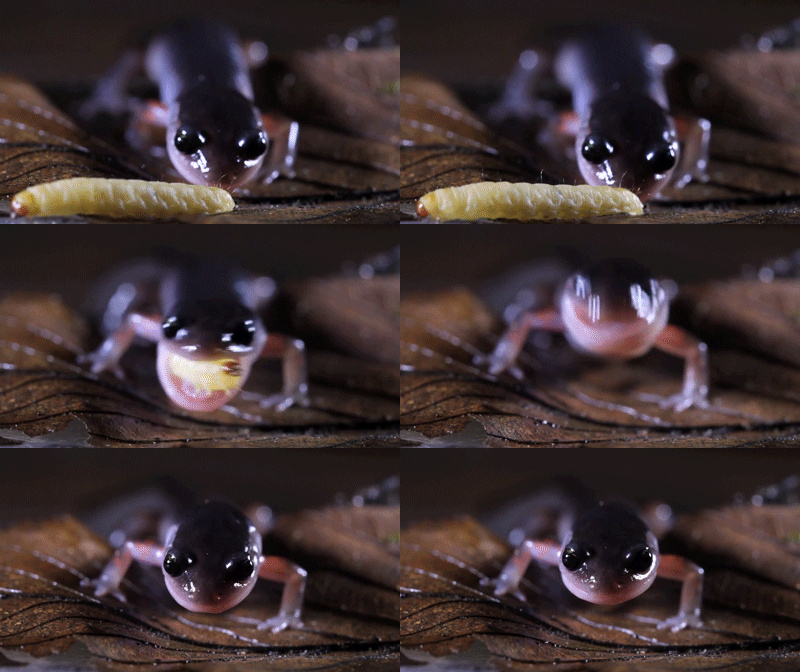
Fig: Predaceous nature shown by amphibians
Body temperature
Amphibians are poikilothermic or cold-blooded animals and are unable to regulate their body temperature when exposed to extremes of environmental conditions. During the summer, they engage in aestivation (summer sleep), and during the winter, they hibernate (winter sleep).
Defence mechanism
Amphibians have the ability to camouflage and hence blend with the environment and use it as a defence mechanism against predators.
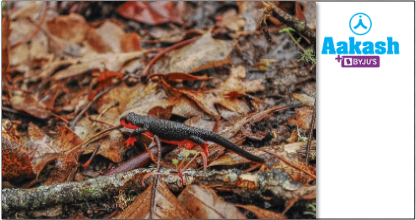
Fig: Camouflage shown by amphibians
Some amphibians also possess poison glands and use it as a defence mechanism against predators. Examples include golden poison frogs.
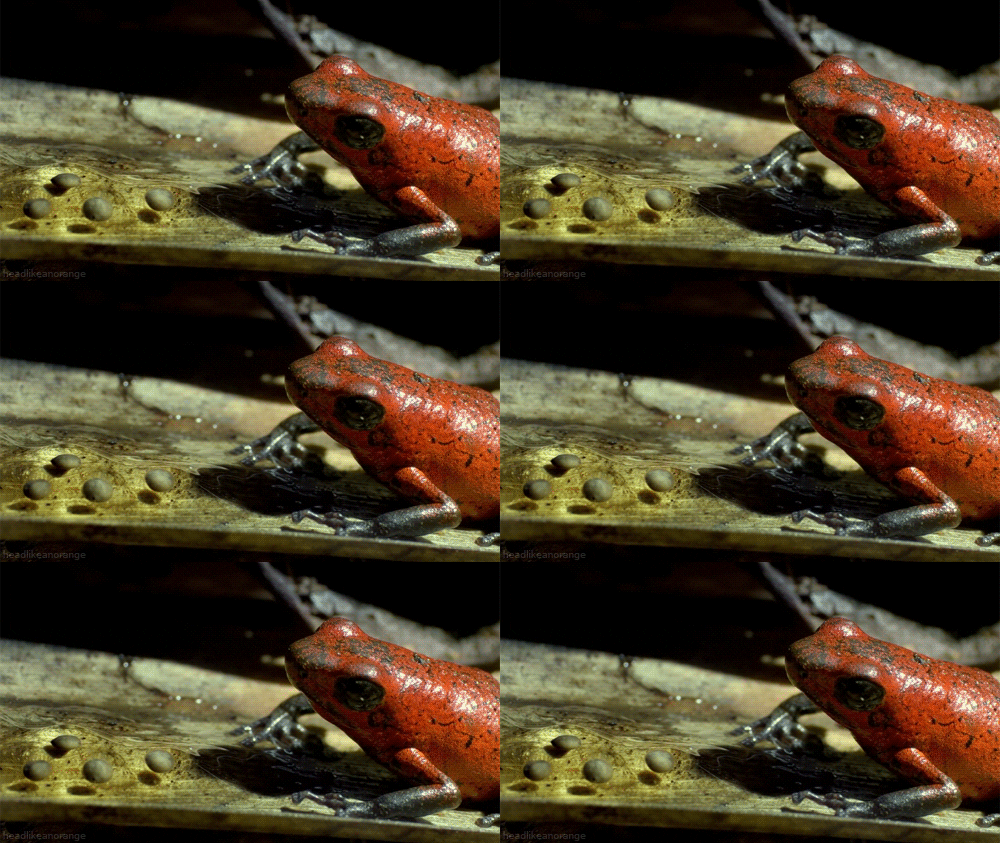
GIF: Frog with poison gland
Body parts and sensory systems in amphibians
The bodies of amphibians may be stout or cylindrical in shape. It is mainly divided into two major parts such as head and trunk. Examples include frogs and toads. Tail is present in few of them. Examples include salamanders.
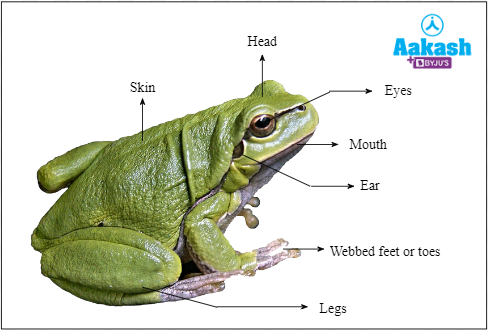
Fig: Different parts of amphibian body
Appendages
They have two sets of limbs, with five toes on their hind limbs and four fingers on their forelimbs. The toes may have webs but lack nails and claws. In frogs and toads hind limbs are long and powerful. These limbs are used in swimming and jumping. In newts and salamanders both the pairs of limbs are of the same size.
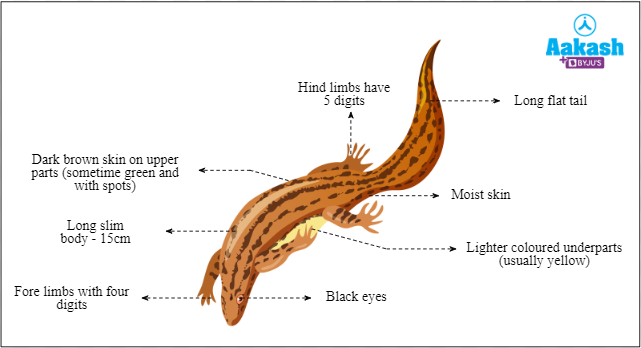
Fig: Body parts of newt
Skin
Amphibians have a moist skin devoid of scales. It contains glands that secrete mucus which has a major role in protection of skin. They lack exoskeletons. Skin is respiratory in function in most cases.
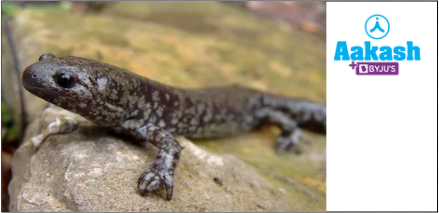
Fig: Moist skin in amphibians
Eyes and vision
Amphibians exhibit coloured vision. They possess movable eyelids. A membrane known as nictitating membrane, also known as the third eyelid, is present in their eyes that protects eyes when they are underwater.
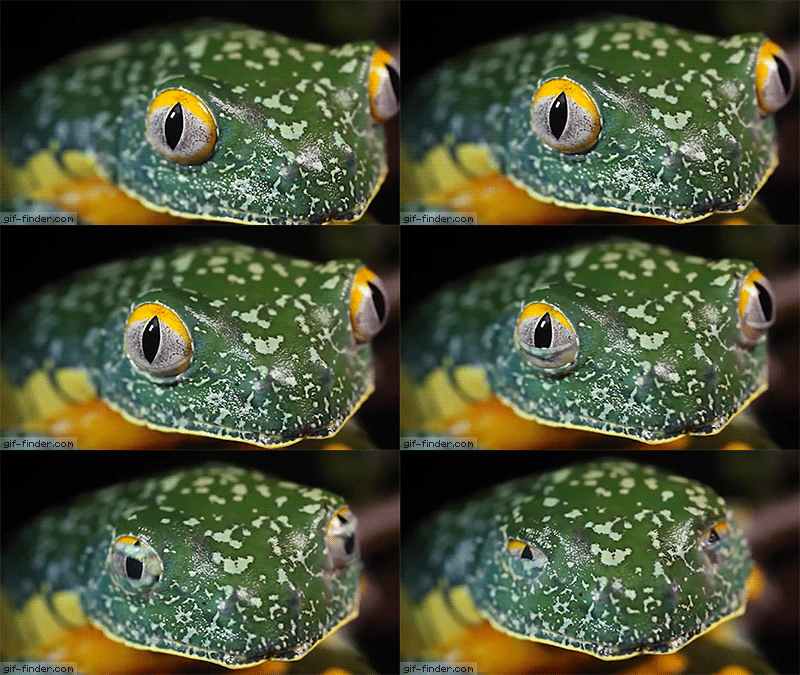
GIF: Nictitating membrane in amphibians
Ear
Amphibians do not have an external ear, instead, a tympanum is present in many that represents the ear.
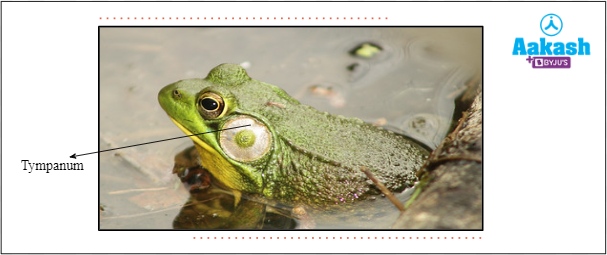
Fig: Tympanum
Respiratory system in Amphibians
Amphibians respire through their skin, gills, lungs, and buccal cavity.
Gills
During the larval stage, amphibians respire through gills. In adults of salamanders gills are retained.
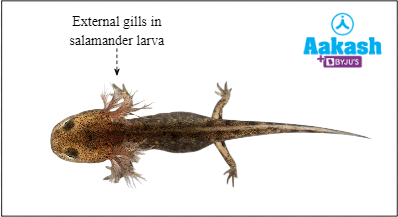
Fig: Gills in larval stage (Axolotl larva)
Skin, buccal cavity and primitive lungs
Adult amphibians have the ability to respire through skin (cutaneous respiration), buccal cavity (buccopharyngeal respiration) and lungs (pulmonary respiration).
Skin
The skin is composed of thin membranous tissue that is quite permeable to water and contains a large network of blood vessels. The thin membranous skin allows the respiratory gases to readily diffuse directly down their gradients between the blood vessels and the surroundings. This respiratory method using skin is called cutaneous respiration
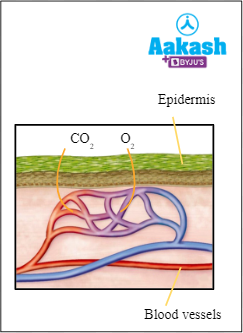
Fig: Cutaneous respiration
Buccal cavity
Here the gaseous exchange occurs across the thin, highly vascular buccopharyngeal membrane, a lining along the mouth. This type of respiration through the lining of the buccal cavity is called buccopharyngeal respiration.
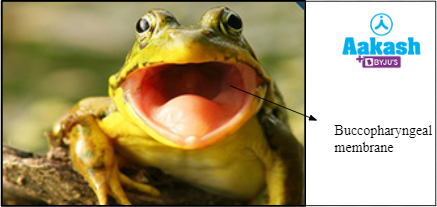
Fig: Buccopharyngeal respiration
Lungs
They possess external and Internal nostrils. Internal nares open into the anterior part of the buccal cavity in them. Gaseous exchange occurs with the help of lungs. This type of respiratory method through lungs is called pulmonary respiration.
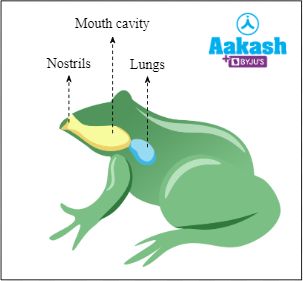
Fig: Pulmonary respiration
Digestive system in amphibians
Wide mouth with teeth on both jaws can be observed in most amphibians. But frogs lack teeth on the lower jaw. The teeth are of acrodont and homodont types. Acrodont dentition means the teeth are firmly anchored to the bone. Homodont dentition means all teeth are of the same type.

Fig: Acrodont dentition
A protrusive and muscular tongue is also present. In frogs and toads, it is joined at the front of the mouth. Alimentary canal consists of the mouth, buccal cavity, pharynx, oesophagus, stomach, small intestine, rectum and cloaca. Alimentary canal, urinary tract and reproductive tract opens to a common chamber called cloaca. It opens outside through an aperture called cloacal aperture.
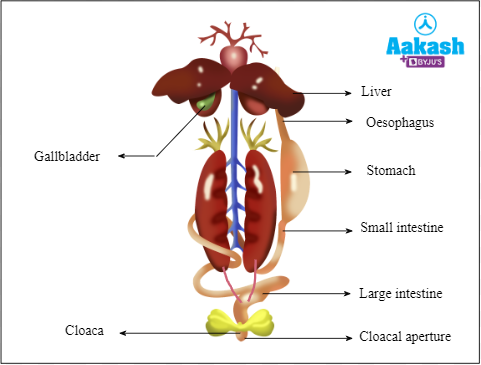
Fig: Digestive system in amphibians
Circulatory system in amphibians
They have a three-chambered heart which consists of two auricles and one ventricle. But in the larval stage it is two chambered. Three aortic arches are also present. They possess a closed circulatory system, i.e. the transport of blood occurs through blood vessels. Pumping occurs from the left and right auricles into the ventricle, where the oxygenated and deoxygenated blood are mixed. All regions of the body receive mixed blood from the ventricle.
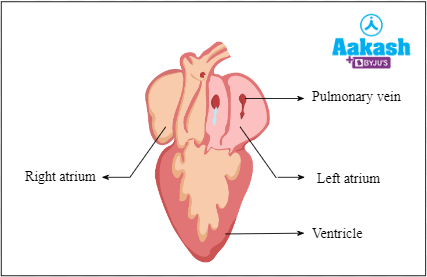
Fig: Three-chambered heart in amphibians
Excretory system in amphibians
Amphibians execute excretion with the help of mesonephric kidney. It is named after its origin from nephrotome, a part of mesoderm that forms the kidney. Frogs and toads excrete waste in the form of urea. Hence they are ureotelic. But the larvae of amphibians excrete waste in the form of ammonia. Hence they are ammonotelic.
Cloaca
Alimentary canal, reproductive tract and urinary tract open into a common organ called cloaca that opens to the exterior of the amphibian body through the cloacal aperture..

Fig: Excretory system in Amphibians
Nervous system in Amphibians
They possess a central brain, a spinal cord, and nerves running throughout the body. The brain is less developed than that of birds, reptiles, and mammals. Brain is functionally and morphologically similar to the brain of fishes. They possess ten pairs of cranial nerves.
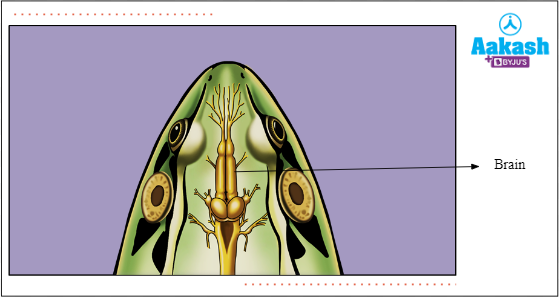
Fig: Brain in amphibians
Lateral line sensory system
Aquatic forms and larval stages of amphibians possess a lateral line sensory system. This system is formed of discrete sense organs called the neuromasts normally arranged on the head and body in specific patterns. The arrangement is species specific.
Jacobson’s organ
It is found in amphibians, reptiles and many mammals. This is a mass of specialised cells which are responsible for olfaction or sense of smell. The patch of specialised sensory cells can detect heavy moisture borne particles.
Sexual dimorphism in Amphibians
Amphibians are dioecious or unisexual in nature, i.e.,they have separate sexes.
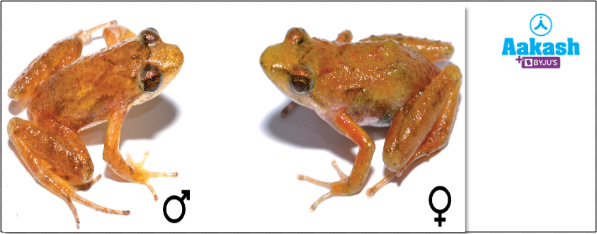
Fig: Male and female frog
Mating call
Frogs and toads produce mating calls by crocking with vocal sacs during the breeding season. The males frogs are more vocal and louder than the female frogs.
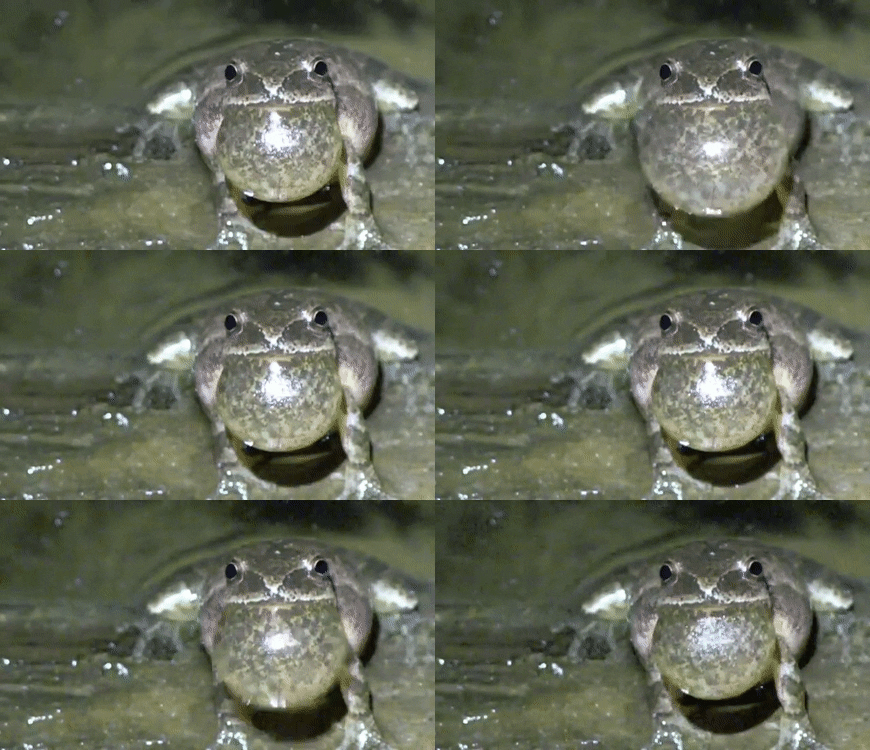
GIF: Male frog making mating calls
Mode of reproduction and development of amphibians
Fertilisation is external except in caecilians.
Mode of birth
They are oviparous. Females lay fertilised or unfertilised eggs instead of giving birth to younger ones. Eggs are laid in water within a protective mucilage covering. Eggs laid by amphibians do not have amniotic covering and can dry out if it is laid on land.
Type of fertilisation
External fertilisation present. Fusion of the male gamete and female gamete occurs outside the female body with the exception of salamander and Ichthyophis which show internal fertilisation.
Type of development
Indirect development present. It occurs through intervening larval stages which are morphologically different from the adults. A fish like aquatic larva (tadpole) is present and it undergoes metamorphosis to become an adult.
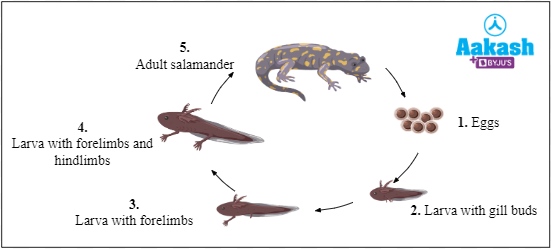
Fig: Life cycle showing indirect development in salamander
Parental care in amphibians
Some frog and toad species exhibit a primitive type of parental care for their offspring. The adult female Surinam toad carries the tadpoles until they develop into little frogs in designated pits on its back. Tadpoles are carried by the tree frog up the tree to water sources on its back. Until the tadpoles are ready to hatch, the male midwife toad carries the egg on its hind legs.
Classification of Amphibia
Class Amphibia can be classified into six orders. They are as follows:
- Lepospondyli
- Phyllospondyli
- Labyrinthodontia
- Anura
- Urodela
- Apoda
Out of these six orders, the first three orders of animals are extinct. Now let’s see what are the characters of the remaining three order of organisms included under class Amphibia.
Anura
The tailless amphibians are included in the order Anura. They have limbs. Examples include frogs and toads. They are the most well known amphibians because they are widely distributed. The forelimbs are short in them. Larynx is well developed. The larval stage is called tadpole.
Rana tigrina
It is the common Indian frog. It is located around and in freshwater bodies. It jumps on land and swims in water. It is a carnivore that uses its anteriorly fixed, protruding tongue to catch insects. It aestivates in the summer and hibernates in the winter. Additionally, it uses metachrosis as a defence mechanism (development of protective colouration). The male frog develops an amplexusory pad or nuptial pad on the first finger of each forelimb to properly hold the female during copulation. In addition to this they have a pair of vocal sacs for croaking during breeding season. It is an oviparous frog with external fertilisation. Aquatic tadpole larvae are present in the life cycle. The larva undergoes metamorphosis to form the adults.

Fig: Rana tigrina
Bufo melanostictus
It is the Indian toad. It is a terrestrial amphibian that lives in damp, shaded areas. It is a carnivore that only feeds at night. Its skin is warty, dry, and harsh. It enters the water bodies to reproduce and lays its eggs in strings. An aquatic tadpole larval stage is present in the life cycle.
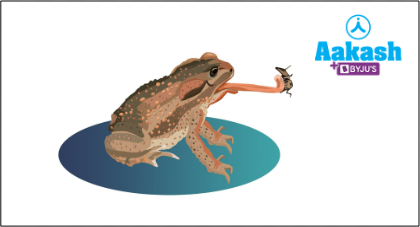
Fig: Bufo melanostictus
Urodela
They are tailed amphibians with limbs. Both pairs of limbs are short and weak in them. Fins and external gills are frequently seen in some of the adults. Tympanum is absent. Examples include salamanders and newts.
Salamander
They are tailed amphibians and resemble semi-terrestrial lizards. They reside in crevices and beneath the stones. Its body is black and covered in yellow dots. It eats living things. Some of the members show neoteny, that means they attain sexual maturity even while retaining the larval characters. Examples include axolotl larva. Low temperature of the higher altitude is mainly responsible for this phenomenon. This occurs due to low iodine levels and less thyroxine production in their body. Common example of salamander is Ambystoma tigrinum (tiger salamander).
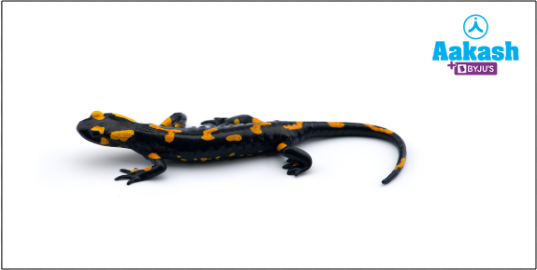
Fig: Salamander
Mud puppy
Mud puppies (Necturus maculosus) are a type of salamanders that have bushy, red external gills. These gills grow in the larval stages and are never lost. Skin and lung respiration is not sufficient for them and hence, they rely on feathery external gills for gaseous exchange.
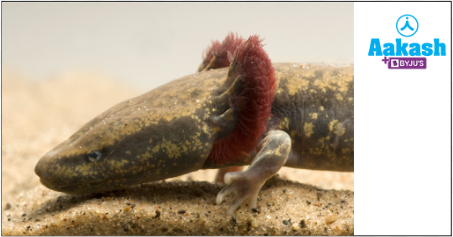
Fig: Mud puppy
Apoda
They are limbless amphibians with short tails. ‘A’ means absence and ‘poda’ means ‘those having feet’ in Biology. Hence ‘Apoda’ means ‘absence of feet’. They are commonly called caecilians. They appear like worms. They possess minute dermal scales embedded in the skin. Eyes are small in them. Retractile sensory tentacles are present near the eyes. Skull is compact and helps in burrowing. Males possess copulatory organs. Fertilisation is internal and shows parental care. Examples include Ichthyophis.
Ichthyophis
It is commonly called the Caelian blind worm. It is a limbless burrowing amphibian. It has a cylindrical snake-like body which may be up to 30 cm in length. It has dermal scales which are embedded in the skin. Fertilisation is internal. Female coils herself around the eggs to protect them, till they hatch into tadpoles.
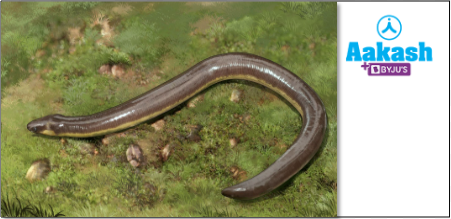
Fig: Ichthyophis
Extinct amphibians
Amphibians made their appearance in the Devonian Period of the Palaeozic era. These primitive amphibians are included in the three orders Lepospondyli, Phyllospondyli and Labyrinthodontia. Examples include Crassigyrinus. This name means ‘thick tadpole’.
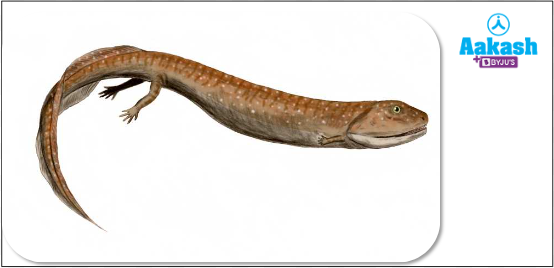
Fig: Crassigyrinus
Phyllospondyli
They were like salamanders. They are considered as the ancestors of all modern amphibians except caecilians.
Lepospondyli
They are considered as the ancestors of caecilians.
Labyrinthodontia
It is believed that the first group of reptiles evolved from this order of amphibians. They had large teeth with an infolded enamel layer. Cacops and Eryops are common examples.
Eryops
For about 100 million years, amphibians were the dominant terrestrial animals on the Earth. Example is a classic amphibian called Eryops, which measured about six feet (about two metres) from head to tail and weighed about 200 pounds (90 kilograms). They used to live in swamps. They were present during the Permian period. They were meat-eaters. They had a stout body with a strong spine, very wide ribs, four strong short legs and a short tail. They had a big head with a wide and elongated skull. They had many sharp teeth too.
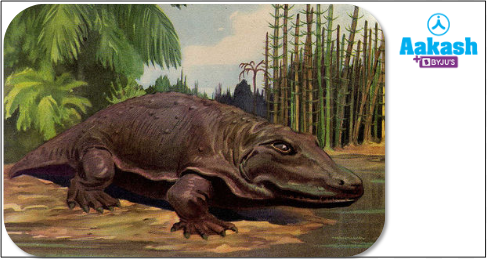
Fig: Eryops
Significance of class Amphibia
The following are the main significances of class Amphibia:
- They are widely used in laboratories for various experiments and research purposes. For example, frogs are used to perform pregnancy tests, study muscle functions, and perform cloning experiments.
- Researchers are trying to isolate germ-fighting chemicals from the skin of frogs to develop antibiotics from them.
- They are used as bait for snakes, turtles, birds and fishes.
- They are very sensitive to changes in the environment. If the number of amphibians is reduced in an ecosystem it indicates some damage has happened to the ecosystem.
- Secretions from the skin and parotid glands of frogs, their bones and muscle tissues are used as remedies for some infections, bites, allergies, haemorrhages, pain and inflammations by many local populations from ancient times.
- Order Anura are economically important in reducing the number of those insects that destroy crops like grasshoppers or transmit diseases like mosquitoes. Examples include frogs and toads.
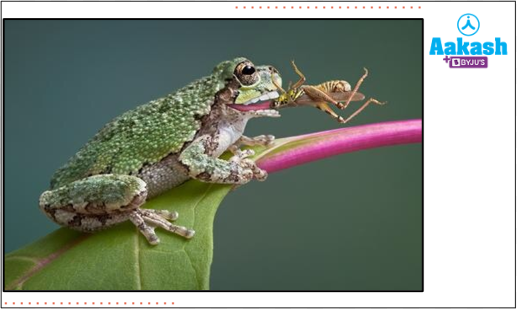
Fig: Frog feeding on grasshopper
- Frogs are commonly exploited as food in many countries. They are used widely in making soups.
- Frogs are used for local consumption and also used for export. Thousands of tons of legs of frogs are harvested annually for export.

Fig: Frog used as food
- They are part of the food webs in various ecosystems. They act as one of the middle players in food webs and food chains.
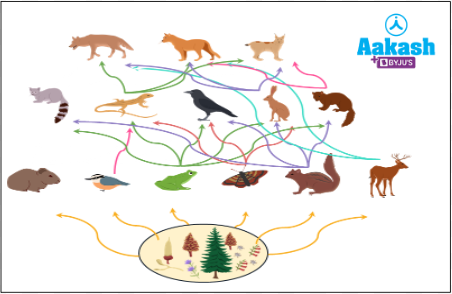
Fig: Frog as part of food webs
Practice Problems
Q1. The three chambered heart of the frog is considered less effective than the four chambered heart of humans. Identify the reason for this from the options given below.
A. Blood that has been oxygenated and blood that has been deoxygenated combine here
B. Blood is not effectively pumped by the ventricle
C. It can not store nearly enough blood
D. The heart's muscles are weak
Solution: All amphibians and the majority of reptiles (except crocodiles) have three chambered hearts. One ventricle and two atria are present in them. Blood veins that deliver oxygenated blood to the left atrium and those that deliver deoxygenated blood to the right atrium are different. But the blood is jumbled up because both right and left atria empty into the same ventricle.
Deoxygenated blood and oxygenated blood are kept in separate chambers and are not mixed in a four chambered heart like the one seen in humans. Therefore, a four chambered heart (with two auricles and two ventricles) pumps blood with more oxygen than a three chambered heart. So the three chambered heart of the frog is considered less effective than the four chambered heart of humans. Hence the correct option is a.
Q2. Which of the following is an example of a cold-blooded, ectothermic animal?
A. Penguin
B. Lemur
C. Owl
D. Frog
Solution: Ectotherms are cold-blooded animals that can not regulate their body temperature. The temperature of the environment normally has an impact on the body temperature of this organism. They rely primarily on their external environment such as sunlight or a heated rock surface to regulate the temperature of the body. They are commonly called poikilotherms. Mammals and birds are warm-blooded or homeotherms. They are able to regulate their body temperatures by the production of heat within the body. Amphibians like frogs and reptiles like lizards are cold-blooded. Lemurs are mammals, while penguins and owls are aves (birds). Hence the correct option is d.
Q3. Find out the process by which a tadpole's tail dissolves and it transforms into an adult.
A. Fertilisation
B. Embryogenesis
C. Metamorphosis
D. Regeneration
Solution: In sexually reproducing organisms, fertilisation the process of combining of the male and female gametes to create a diploid zygote. The process of developing an embryo from a zygote after fertilisation is known as embryogenesis. In both plants and animals, regeneration is the process of replacing lost or damaged cells, tissues, organs, or even complete body parts. Metamorphosis is the biological process by which an organism entirely different from the adult develops into an adult organism after birth or hatching. It involves abrupt change in the body structure due to cell growth and differentiation. Apoptosis or programmed cell death plays an important role in this process. Hence the correct option is c.
Q4. Which of the following is not an amphibian-specific trait?
A. Requirement of water for reproduction
B. Amniotic eggs
C. Moist skin without scales
D. Cutaneous respiration
Solution: Amphibians lack an exoskeleton and have moist skin. With the aid of this wet skin, they can breathe (cutaneous respiration). Eggs laid by amphibians do not have amniotic covering and can dry out if it is laid on land. Amphibians need water for reproduction since they lay their eggs in water medium and fertilisation of their eggs also occurs here. Until the adult stage is reached, the tadpole (larva) stage also lives in water. Hence the correct option is b.
Q5. In amphibians, the alimentary canal, urinary system, and reproductive tract all open into a single chamber known as the _________________.
A. oesophagus
B. anus
C. cloaca
D. stomach
Solution: In birds, reptiles, amphibians, and the majority of fishes, the alimentary, urinary, and reproductive tracts discharge into the cloaca, which is a shared chamber. This acts as the area where sperms are deposited during copulation in females. It opens outside through the cloacal aperture. Hence the correct option is c.
FAQs
Question 1. Which are the largest and smallest amphibians?
Answer: A frog named Paedophryne amauensis is considered the smallest amphibian. For a number of reasons, the 2012 discovery of the Paedophryne amauensis frog from Papua New Guinea was revolutionary. This species is not only the ‘world's smallest frog,’ but it is also the smallest vertebrate ever discovered. It is a narrow-mouthed frog or microhylid frog. Its length is about 7.7 millimetres.
Fig: Paedophryne amauensis
The appropriately titled Chinese giant salamander (Andrias davidianus) is the largest species of amphibian in the world at present. The size of a typical adult is 1.8 metres long, or about 5'9" feet and weighs 50 kilograms.
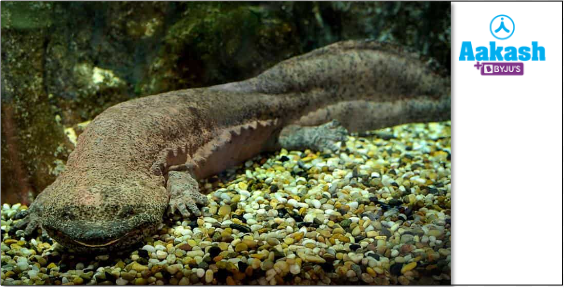
Fig: Chinese giant salamander (Andrias davidianus)
Question 2. Which amphibian lacks a tongue?
Answer: The adult African clawed toad (Xenopus laevis) lacks a tongue, it leads mostly an aquatic lifestyle. They normally use their forelimbs to shove food in their mouths. The powerful legs and large claws present on their feet help them to tear food stuffs.
Question 3. How do amphibians drink water?
Answer: An amphibian never drinks water through their mouths. Their skin allows them to absorb water from the surroundings. A conspicuous patch of skin on the abdomen of some amphibians serves as a water intake.
Question 4. What distinguishes Trichobatrachus robustus from other species?
Answer: Trichobatrachus robustus is a strange, hairy frog with cat-like extensible claws. It is also called Wolverine frog or the horror frog. When threatened, these frogs actively fracture its own bones to develop claws that pierce through the frog's toe pads.
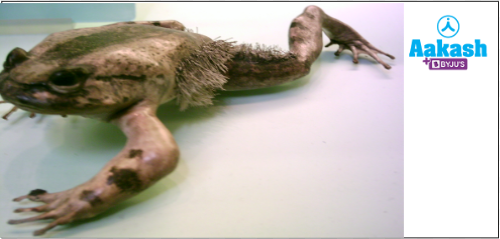
Fig: Trichobatrachus robustus (Wolverine frog)
Related Topics
|
Basis of Classification: Levels of organisation, Practice Problems and FAQs |
|---|
|
Basis of Classification: Symmetry, Germ layer organisation, Coelom, Practice Problems and FAQs |
|
Basis of Classification: Body plan, Segmentation, Notochord, Broad classification of Kingdom Animalia, Practice Problems and FAQs |
|
Phylum Chordata, Practice Problems and FAQs |

 Call Now
 Let's Chat
 Share
Share