-
Call Now
1800-102-2727


Prokaryotic Cells: Cell Appendages, Ribosomes, Inclusion Bodies, and Staining Properties

You must be aware that prokaryotic cells are one of the earliest living organisms to have appeared on planet Earth and are the simplest organisms. Can you tell the biggest difference between a Prokaryotic and a Eukaryotic cell? Yes, it’s the difference in the type of nucleus and organelles they possess. While prokaryotic cells do not have a defined nucleus and membrane-bound organelles, eukaryotic cells do.
But can you name a few organelles which might be present in both prokaryotic and eukaryotic cells? You can have a clue. One of these is a non-membrane-bound organelle involved in protein synthesis. Yes, you are correct! It is the Ribosome. Another similarity is the presence of flagella. Just like some eukaryotic cells have flagella for locomotion, prokaryotic cells, like that of bacteria, also contain flagella for locomotion. But, do you think these structures in prokaryotes are identical to the ones found in eukaryotes?? No, they are not.
In fact Prokaryotic cells also contain some inorganic compounds, in addition to the living organelles which perform different functions in the cells. These are known as the inclusion bodies. Come, let us learn some more about these structures.
Another interesting feature about prokaryotic bacterial cells is that not all of them take up stains the similar way and hence based on how they stain, they appear differently under a microscope. We will also venture into this aspect, so keep reading!
Table of Contents
- Cell appendages of cell membrane
- Ribosomes and inclusion bodies
- Staining properties
- Practice problems
- FAQs
Cell Appendages of Cell Membrane
Appendages arising from the cell membrane of a prokaryotic cell can be of three types -
- Flagella
- Pili
- Fimbriae
Flagella confers motility to the cell but pili and fimbriae have no roles to play in motility.
Flagella
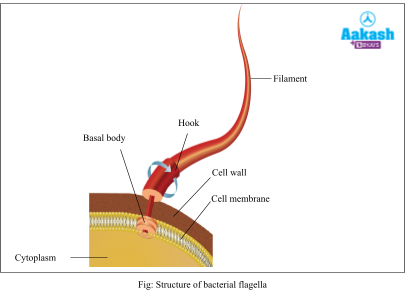
Flagella (sing. flagellum) are present in motile bacteria and function as locomotory organs for the cell. Flagellum is a simple structure made up of many intertwined chains of flagellin protein. The main parts include the basal body, hook and filament. Basal body is the most complex part of the flagella. The filament is the longest portion of flagella. The hook and the filament extend out from the cell surface whereas the basal body remains embedded in the cell membrane. The basal body and hook permit the filament to rotate 360 degrees.
Pili
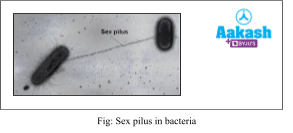
Pili are short tubular non-motile processes on the cell surface. These are made up of pilin proteins. They are used by bacteria for attachment to the recipient cell and formation of a conjugation tube (sex pili) during the process of conjugation (method of para sexual reproduction in bacteria).

Fimbriae
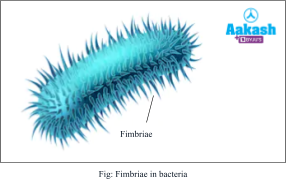
Fimbriae are the small bristle-like fibres which emerge out of the cell surface. Their main function is to help attach the bacteria to substrata such as rocks in streams and to the host tissues. Fimbriae are abundantly distributed in a bacterial cell.
Ribosomes and Inclusion bodies
Ribosomes
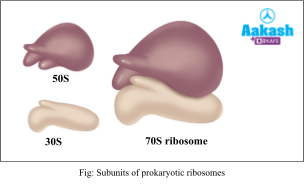
Ribosomes are the only cell organelles composed of rRNA and proteins found in the prokaryotic cytoplasm. They are smaller than that of eukaryotic cells. Unlike the 80S ribosome found in eukaryotic cells, ribosomes in prokaryotes are of the 70S type composed of two subunits:
- Larger 50S subunit
- Smaller 30S subunit
Ribosomes may occur singly in the cytoplasm or found in rows of many. These rows are called Polyribosomes or polysomes. They serve as the site of protein synthesis.
Inclusion bodies
The cytoplasm of the prokaryotes contains a variety of inorganic and organic substances which are stored in some reservoirs known as inclusion bodies. The inclusion bodies can be of the following types:
- Gas vacuoles: Storehouse of gases to maintain buoyancy
- Inorganic inclusions: Volutin granules (phosphate reserve), sulphur granules (sulphur reserve), magnetosomes (reserve of iron compounds)
- Food reserves: Lipid globules, cyanophycean starch, protein granules
Staining properties
Bacteria are stained using the Gram staining method which was developed by Hans Christian. Gram stain is the weakly alkaline solution of crystal violet or gentian violet dye.
This method helps to distinguish bacteria based on their cell wall composition.
Gram staining method
- The bacteria is heat-fixed onto the slide and a primary stain (crystal violet) is applied onto it.
- The stained bacteria is treated with iodine solution (KI). The iodine binds to crystal violet and traps the stain in the cell.
- After staining, the slide is washed with water and finally with acetone or ethyl alcohol.
- The bacteria are treated with a counterstain, i.e., safranin.
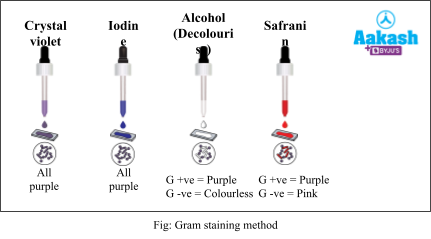
- The bacteria that retain the primary stain are termed as Gram-positive bacteria.
- The bacteria which lose the primary stain and take up the counterstain are termed Gram-negative bacteria.
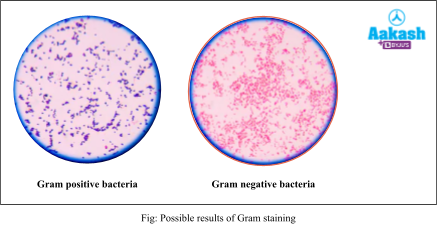
Structural differences between Gram positive and Gram negative bacteria
|
Gram positive bacteria |
Gram negative bacteria |
|
Outer membrane surrounding the cell wall is absent. |
Outer membrane surrounding the cell wall is present. |
|
Lipid content of the cell wall is low. |
Lipid content of the cell wall is comparatively significant. |
|
Murein/ mucopeptide/ peptidoglycan content of the cell wall is high. |
Murein/ mucopeptide/ peptidoglycan content of the cell wall is much lower. |
|
Teichoic acid is present in the cell wall. |
Teichoic acid is absent in the cell wall. |
|
Susceptibility to antibiotics is high. |
Susceptibility to antibiotics is comparatively lower. |
Practice problems of Prokaryotic Cells
Question 1. A teacher gave students two bacterial cultures ‘A’ and ‘B’ and asked them to perform gram staining on it. At the end, bacteria from culture A were purple coloured when observed under microscope while bacteria from culture showed red colour. Which of the following statements hold true for this observation?
a. Cells in culture A took up the secondary stain as they were Gram negative.
b. Cells in culture A took up the primary stain as they were Gram positive.
c. Cells in culture B up the secondary stain as they were Gram positive.
d. Cells in culture B up the primary stain as they were Gram positive.
Solution: Gram positive bacteria have a thick peptidoglycan layer with very less lipid concentration. Thus, they retain the violet colour of crystal violet and appear violet or purple after performing gram staining. Hence, cells in culture A are gram positive bacteria which have taken up the primary stain.
Gram negative bacteria have a thin peptidoglycan layer and thick lipid layer. Thus, they do not retain crystal violet colour during the alcohol wash and take the secondary stain. Therefore, they appear red. Hence, bacterial culture B has gram negative bacteria.
Thus, the correct option is b.
Question 2. Which of the following statements are true for Gram negative bacteria?
a. Lipid content of the cell wall is low.
b. Teichoic acid is present in the cell wall.
c. Susceptibility to antibiotics is high.
d. Peptidoglycan content of the cell wall is much lower.
Solution: The characteristics of Gram negative bacteria are -
- Outer membrane surrounding the cell wall is present.
- Lipid content of the cell wall is comparatively significant.
- Murein/ mucopeptide/ peptidoglycan content of the cell wall is much lower.
- Teichoic acid is absent in the cell wall.
- Susceptibility to antibiotics is comparatively lower.
Thus, the correct option is d.
Question 3. Which of these is not a surface structure in bacteria?
a. Flagella
b. Pili
c. Mesosome
d. Fimbriae
Solution: Mesosomes are formed by the infoldings of the plasma membrane. They bear respiratory enzymes. They are not surface structures. Flagella, pili and fimbriae are surface structures of bacterial cells.
Thus, the correct option is c.
FAQs of Prokaryotic Cells
Question 1. What is the function of ribosomes in prokaryotic cells?
Answer: Ribosomes found in prokaryotic cells are of 70S type and are responsible for protein synthesis in the cell.
Question 2. What is the bacterial flagella composed of?
Answer: Bacterial flagellum is made up of many intertwined chains of flagellin protein. The main parts include the basal body, hook and filament. The hook and the filament extend out from the cell surface whereas the basal body remains embedded in the cell membrane.
Question 3. Write down the function of inclusion bodies in prokaryotic cells.
Answer: In prokaryotic cells, inclusion bodies have the main role of storing reserve materials. The inclusion bodies can be of different types based on the function they perform:
- Gas vacuoles: Storehouse of gases to maintain buoyancy
- Inorganic inclusions: Volutin granules (phosphate reserve), sulphur granules (sulphur reserve), magnetosomes (reserve of iron compounds)
- Food reserves: Lipid globules, cyanophycean starch, protein granules
Question 4. What is the principle of Gram staining?
Answer: Gram staining process helps to distinguish between bacteria based on their cell wall structure. The process involves staining the mounted bacterial culture with a purple/blue primary stain such as crystal violet or methylene blue. After letting the stain sit for a minute, it is washed with alcohol and then stained again with a red secondary stain such as safranin. The mounted culture is then viewed under a microscope.
Gram positive bacteria have very less lipids in their cell wall, hence the cell wall structure is not disturbed by the alcohol wash. Thus they retain the primary stain and appear blue under the microscope.
Gram negative bacteria have a thick outer layer composed of lipopolysaccharides which is washed off during the alcohol wash. Thus, they are unable to retain the primary stain and get stained with the secondary stain and appear red.
Question 5. What are the features of Gram negative bacteria?
Answer: The features of Gram negative bacteria are -
- Outer membrane surrounding the cell wall is present.
- Lipid content of the cell wall is comparatively significant.
- Murein/ mucopeptide/ peptidoglycan content of the cell wall is much lower.
- Teichoic acid is absent in the cell wall.
- Susceptibility to antibiotics is comparatively lower.

 Call Now
 Let's Chat
 Share
Share