-
Call Now
1800-102-2727


Animal Tissues - Their Types and Functions

What is the smallest unit of a living thing? Yes, Cells. The cells are grouped under tissues when they show similar structures and functionalities. Every plant and animal has different types of tissues that help them with different functions. Animal tissues are divided based on various categories. Let us explore this in detail.
Table of Contents:
- What is Animal Tissue?
- Epithelial Tissue
- Connective Tissue
- Muscle Tissues
- Nervous Tissue
- MCQs
- Frequently Asked Questions
What is Animal Tissue?
Animal tissues are formed by grouping similar animal cells together. The animal tissues vary in origin, structure and function. Generally, based on their performance, they are divided into Epithelial, Connective, Muscular and Nervous tissues.

Source: Antelope.Beauty
Epithelial Tissue
Epithelial tissues are layers of tightly packed cells which form the protective covering of the inner lining of the body. The function of epithelial tissue includes absorption, secretion and protection of the body surface. They are found in the lining of the digestive system, mouth, nose and skin.
Characteristics of Epithelial Tissues
- Epithelial Tissues can be in single or multiple layers.
- It has the capability to regenerate.
- Its plasma membrane is specialised into cilia, flagella and microvilli.
Types of Epithelial Tissues
-
- Simple Squamous Epithelium: They are thin, and a flat layer forms a delicate lining. They are present in the mouth and oesophagus.
- Stratified Squamous Epithelium: They are arranged in many layers to protect the body from tears. Skin is made up of stratified squamous tissue.
- Columnar Epithelium: They are heightened pillar-like epithelial cell structure in which absorption and secretion take place. It is present in the inner lining of the intestine.
- Ciliated Columnar Epithelium: These tissues have cilia, a hair-like structure found in the respiratory tract, kidney tubules, and trachea. Its function is to move the material in the required direction.
- Cuboidal Epithelium: They are cube-like structures arranged in many layers. It is found in the lining of kidney tubules and salivary glands.
- Glandular Epithelium: Its main function is to secrete substances of the epithelial surface and is found in sweat and tear glands.

Source: The Nurse Page
Connective Tissue
Connective tissues are made up of three components: cells, collagen fibres and intercellular matrix. These tissues help to connect, bind and support other various tissues of the body. They are arranged freely or in matrixes inside the body. These tissues prevent organs from mechanical shocks and help in defence.
Types of Connective Tissues
- Blood: It is composed of red blood cells (RBC), white blood cells (WBC) and platelets along with plasma. It helps in the transportation of food, gas, and waste materials to various parts of the body.
- Bones: These form the skeleton system of the body. It is rich in calcium and fibre. It anchors the muscle and protects vital organs of the body.
- Cartilage: They are present in the ear, nose, vertebral column, bronchial tubes and larynx of the body. It smoothes the surface of the bone at joints.
- Adipose Tissues: It is found under the skin that stores fat. It provides support and repair of the tissues.
- Areolar Connective Tissues: It is present between the skin and muscles and also in the bone marrow. It supports the internal organs.
Muscle Tissues
Muscle tissues are present in animals for the function of movement and applying force to the body. It helps in the contraction and relaxation of the body. Muscle fibres are thin and elongated cells that comprise muscle tissues. Some of the important functions of muscle tissue are as follows:
- Elasticity - the ability to stretch beyond
- Contractibility - the ability to shorten
- Excitability - the ability to respond
Types of Muscle Tissues
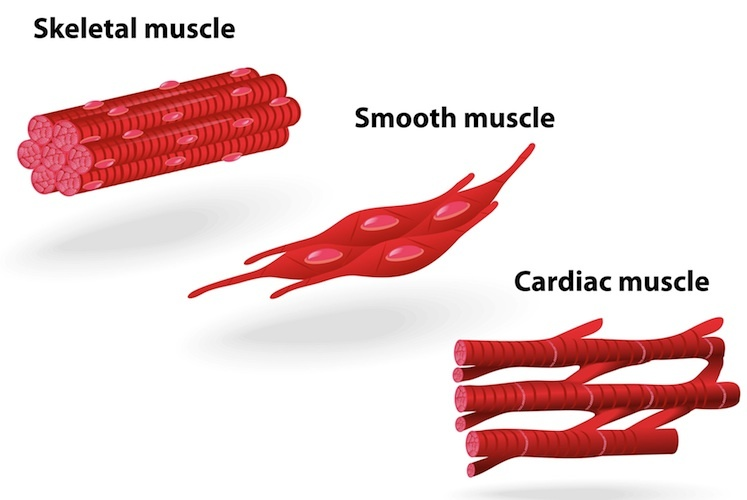
- Skeletal Muscle Tissues: It is a voluntary muscle arranged in bundles. They help in skeletal movements like postures and locomotion.
- Smooth Muscle Tissues: They are involuntary muscles which have tapered ends. They help in the transportation of food. They are present in blood vessels, the trachea, the digestive system and the urinary tract.
- Cardiac Muscle Tissues: They are involuntary and strained muscles, branched out irregularly. They are majorly present in the heart.
Source: Science learning hub
Nervous Tissue
Nervous tissues play an important role in forming the central and peripheral nervous system. They help in the formation of the spinal cord and the brain. They help transmit signals to various parts of the body. Axons often send impulses, and dendrites receive impulses. Nervous tissue includes three main components they are:
- Neurons: It is the structural and functional unit of the nervous system. It includes axons, dendrites and cell bodies.
- Neuroglia: It is present in the brain and spinal cord to support the neurons.
- Neurosecretory Cells: They produce chemicals directly in the blood and act as endocrine organs.
Animal Tissues - MCQs
Q1. Which Epithelium cell is responsible for secreting substances?
A. Simple Squamous Epithelium
B. Cuboidal Epithelium
C. Glandular Epithelium
D. Ciliated Columnar Epithelium
Answer: C. Glandular Epithelium
Explanation: Glandular Epithelium's main function is to secrete substances from the epithelial surface and is found in sweat and tear glands.
Q2. Which of these is responsible for smoothening the bone surface?
A. Blood
B. RBC
C. Bone Marrow
D. Cartilage
Answer: D. Cartilage
Explanation: Cartilage smoothes the surface of the bone at joints.
Q3. Which of the following is made up of pillar-like epithelial cell structures?
A. Columnar Epithelium
B. Ciliated Columnar Epithelium
C. Cuboidal Epithelium
D. Simple Squamous Epithelium
Answer: A. Columnar Epithelium is a heightened pillar-like epithelial cell structure in the intestine's inner lining.
Frequently Asked Questions
Q1. How many cells are present in the human body?
Answer: The human body is composed of billions of cells. However, there is no exact cell count. Each cell performs various functions of the body. They together form the tissues.
Q2. How important is epithelial tissue?
Answer: Epithelial tissues protect many parts of the body. They act like a guardian by covering the surface of the body.
Q3. What are the three types of protein fibers present in connective tissue?
Answer: Collagen fibers, elastic fibers and reticular fibers are the three types of protein fibers present in the connective tissue.

 Call Now
 Let's Chat
 Share
Share