-
Call Now
1800-102-2727


Absorption and Assimilation of Digested Products: Absorption in The Small Intestine, Buccal Cavity, Stomach and Large Intestine, Assimilation, Egestion, Calorific Value, Practice Problems and FAQs

You have seen high rising buildings. We always look at them and wonder how these engineers are designing such tall buildings. A lot of components in the right proportion are required for this process like bricks, cement, iron rods etc.
Fig: Construction site
But have you ever wondered about our body? Our body is also growing. It also requires a variety of components for its growth.
We have a variety of foodstuffs. Our body makes use of them and helps in growth and development. This occurs by a process called absorption and assimilation. After taking a shower we wipe our body with a towel. We know that the towel will absorb the water. In our body, the food we eat is broken down into simpler molecules. Why do they need to break down into small molecules?
Yes, the answer is that they can be absorbed easily and smoothly once it is broken down. The digested food molecules are absorbed by the blood and lymph vessels from different regions in our body. You know blood is the liquid medium that transports these absorbed molecules to different parts of the body for tissue growth and repair work. This process is called assimilation. Let's understand the absorption and assimilation process in depth in this article.
Table of contents:
- Absorption in the small intestine
- Mechanism of membrane transport
- Mechanism of absorption in the small intestine
- Absorption in buccal cavity
- Absorption in stomach
- Absorption in large intestine
- Assimilation
- Egestion
- Calorific value
- Practice Problems
- FAQs
Absorption in the small intestine
Absorption is the process by which the end products of digestion pass through the intestinal mucosa into the lymph and blood. Most of the absorption takes place in the small intestine. The nutrients absorbed in the small intestine are glycerol, fatty acids, fructose, glucose and amino acids. The absorption in the small intestine takes place due to the presence of villi and microvilli.
Villi
Intestinal villi are the finger-like projections that increase the surface area for absorption. They are considered as the site of absorption.
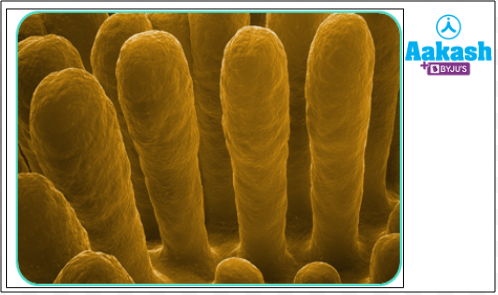
Fig: Villi in small intestine
Intestinal villi is made up of mucosa layers. It increases surface area for absorption. It is covered by epithelium. Villi possess lacteal (lymph vessel) and blood capillaries (a vein and an artery).
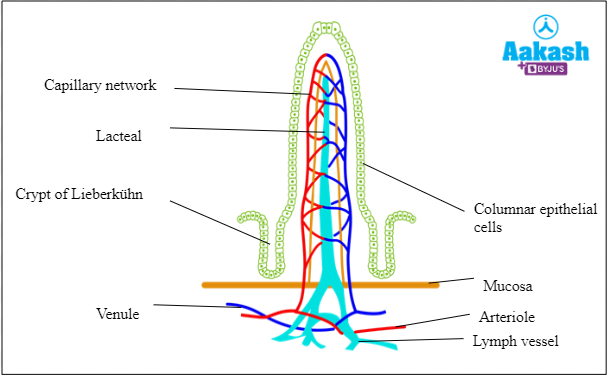
Fig: Structure of villi
Microvilli
Microvilli are microscopic projections present in a single villus. They collectively give a brush border appearance. They increase the surface area for absorption of food. These structures are absent on Peyer’s patches. Blood vessels and lacteals are situated close to the microvilli. The nutrients from the microvilli are transported to the blood vessels and lacteals.
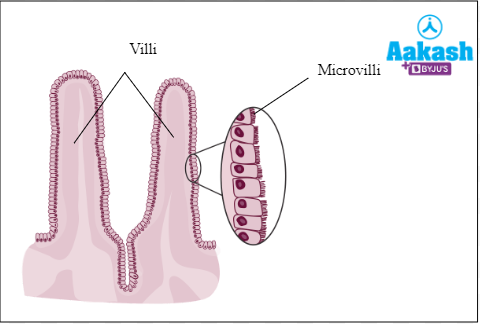
Fig: Structure of microvilli
Types of nutrients that are absorbed
Nutrients that are absorbed in the intestine include monosaccharides (glucose and fructose), amino acids, fatty acids, glycerol, electrolytes, vitamins and water.
Mechanism of membrane transport
Absorption of nutrients across cellular membranes occur with the help of the following mechanisms:
- Simple diffusion
- Facilitated diffusion
- Osmosis
- Active transport
Simple diffusion
In simple diffusion, movement of substances occurs from higher concentration to lower concentration. It continues to occur until equilibrium is reached. It is a passive transport and does not require energy. It occurs as per the concentration gradient.
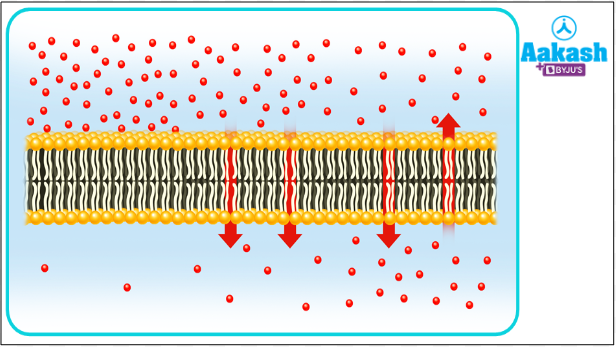
Fig: Simple diffusion
Facilitated diffusion
It involves the movement of substances along the concentration gradient. Facilitated diffusion needs specialised proteins. This process does not require energy and it is a passive transport. It is a selective process as the membrane allows the movements of selected molecules.
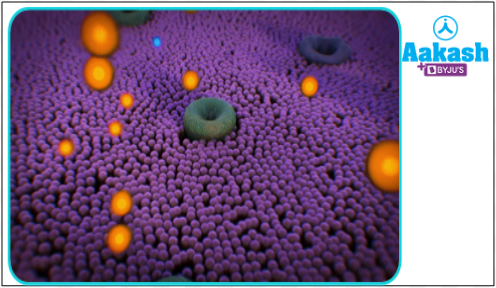
Fig: Facilitated diffusion
Active transport
Active transport is also known as uphill transport. It involves the movement of substances against the concentration gradient. It occurs with the help of specialised proteins that are highly specific to the substances they transport. Active transport requires ATP molecules that provide energy.
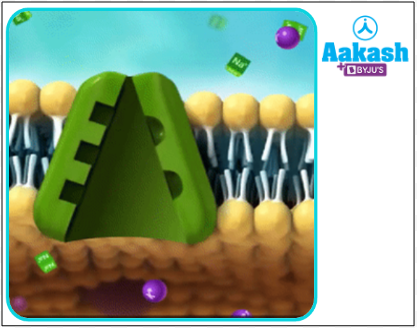
Fig: Active transport
Mechanism of absorption in the small intestine
Different types of nutrients are absorbed through different mechanisms in the small intestine. These are discussed below:
|
Nutrients |
Transportation from the intestinal lumen to the intestinal epithelial cells |
Transportation from the intestinal cells to the blood vessels or lacteal |
|
|
Carbohydrates |
Fructose |
Facilitated diffusion |
Facilitated diffusion into the blood vessels |
|
Glucose Galactose |
Active transport coupled with transport of sodium ions |
Facilitated diffusion into the blood vessels |
|
|
Amino acids |
Active transport with the transport of sodium ions |
Simple diffusion |
|
|
Fatty acids and glycerol |
In the lumen, lipid droplets (containing fatty acids and glycerol) combine with bile salts to form micelles. Micelles enter epithelial cells by simple diffusion. |
Inside the cells, the micelles form small protein-coated fat globules known as chylomicrons, which are released into the lacteals. |
|
Mechanism of absorption in other parts of the alimentary canal
Absorption of nutrients also occurs from other parts of the digestive system. These are as follows:
- Buccal cavity
- Stomach
- Large intestine
Absorption in buccal cavity
Comparatively little absorption occurs in the buccal cavity. When certain drugs come in contact with the mucosa of the mouth and lower side of the tongue they get absorbed into the blood capillaries lining them. Examples include aspirin.
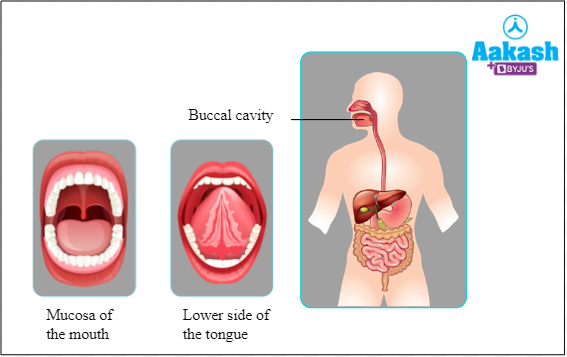
Fig: Absorption from buccal cavity
Absorption in Stomach
Absorption also occurs in the stomach. In the stomach, the following substances are absorbed:
- Alcohol
- Water
- Simple sugars
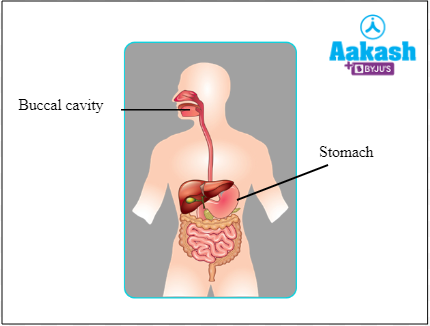
Fig: Absorption from stomach
Absorption in Large intestine
In the large intestine, the following substances are absorbed:
- Water
- Minerals
- Some drugs
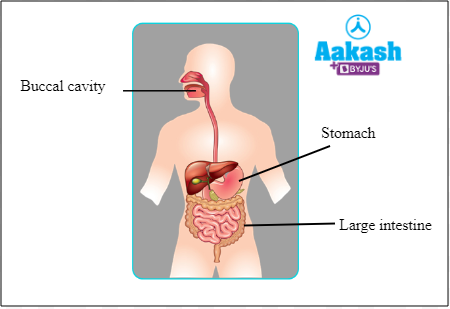
Fig: Absorption from large intestine
Assimilation
Assimilation is a process through which absorbed substances reach tissues in the body. Tissues utilise them in carrying out various functions. Assimilation of various substances are discussed below:
Proteins and amino acids
Amino acids are the monomers of proteins. The absorbed amino acids reach their location, that is, the liver through the hepatic portal vein. These amino acids are then used for making proteins by the body cells. Proteins contribute to growth and repair in the body. Most of the enzymes are proteinaceous in nature. In some cases, deaminated amino acids enter the pathways of glucose metabolism. Amino acids are deaminated in the liver. Deamination occurs when more protein is consumed which results in the removal of an amine group. It is then converted into ammonia and expelled through urination.
Fats
Fats are used as reserve material. They are stored in adipose tissue under the skin, liver, bone etc. Stored fats provide thermal insulation. Fats act as packaging material too. It gives contour to the body. In the liver cells fats are converted into amino acids and carbohydrates. Phospholipids also can be from the fats in the liver cells.
Carbohydrates
Excess carbohydrates like glucose, fructose and galactose are stored in the liver and muscles in the form of glycogen. They produce energy. Glycogen is converted into glucose by glycogenolysis. Glucose also gets converted into fat and stored.
Egestion
Egestion or defecation is a process through which undigested wastes are removed from the body. As chyme passes through the large intestine, it gets converted into the semi-solid faeces that enter the rectum through the sigmoid colon.
Mechanism of egestion
The rectum opens into the anus. The opening is guarded by the internal and external anal sphincters. Faces can remain in the colon for about 30 hours. As the faeces reach the rectum, they cause a movement of the rectal wall. This initiates a neural reflex known as the defecation reflex. This causes an urge or desire for its removal. The involuntary relaxation of the internal anal sphincter and a voluntary relaxation of the external anal sphincter causes defecation. It occurs with the help of a mass peristaltic movement.
In newborn babies, the sphincters are not under voluntary control. Hence, they have no control over the defecation reflex. This ability to exercise voluntary control over the defecation reflex with the help of anal sphincters only develops after a few months in babies.
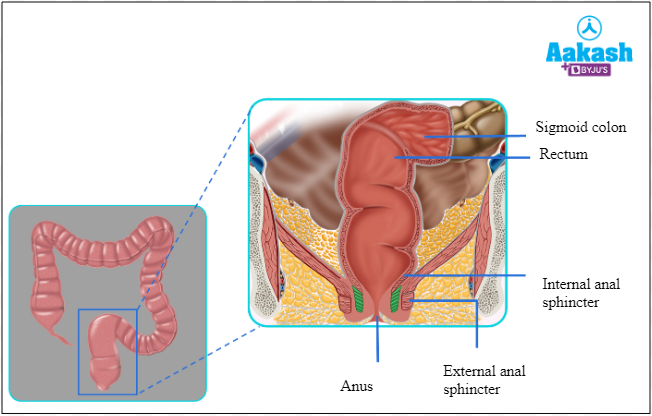
Fig: Structures involved in egestion
Constituents of faeces
The faeces consists of the following constituents:
It possesses 75% water and 25% solid matter. Solid matter includes bacteria, 10 - 20% fat, 2 - 3% proteins, 30% roughage and dry constituents. It also possesses inorganic matter, undigested matter and dry constituents of digestive juices. Brown colour of faeces is due to the presence of the pigments like stercobilin and stercobilinogen, which are derived from bilirubin. Faeces have a particular odour due to the presence of aromatic substances like indole, skatole etc. It also has gases like hydrogen sulphide.
Calorific value
Calorific value is the total amount of energy that the body could generate during the metabolism of food. It is expressed in the units of calorie (cal) or joule (J). One calorie or one joule is the amount of heat energy required to raise the temperature of 1 g of water by 1℃. It is also expressed in kilocalorie (kcal/calorie) or kilojoule (kJ/joule). This is done as the calorific value is very small. One kilocalorie is the amount of energy required to raise the temperature of 1 kg of water by 1°C.
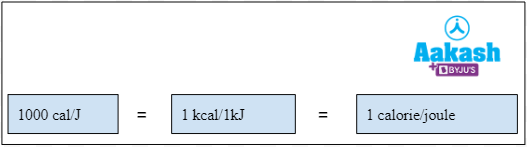
Fig: Calorific value
The actual amount of energy of combustion of 1 g of food is the physiologic value of food.
Calorific value of macronutrients
|
Macronutrients |
Gross calorific value in kcal/g |
Physiologic value in kcal/g |
|
Carbohydrates |
4.1 |
4.0 |
|
Fats |
9.45 |
9 |
|
Protein |
5.65 |
4.0 |
Practice Problems
Q1. There is a common drug called nitroglycerine which is absorbed when administered in the mouth. Identify the site of absorption of nitroglycerine drug.
A. Oral mucosa
B. Lower side of tongue
C. Stomach
D. Large intestine
Solution: Nitroglycerine is one of the most common drugs which is administered through the mouth. When it comes in contact with the mucus of the oral cavity, the absorption starts. It gets absorbed into the blood capillaries that line the mucus secreting cells. Hence, the correct option is a.
Q2. Have you noticed that newborn babies poop out very frequently? Why do you think this happens?
A. Sphincters are not under voluntary control
B. No control over defecation reflex
C. Due to presence of colostrum in mother’s milk
D. Both a and b are correct
Solution: In newborn babies, the sphincters are not under voluntary control. Hence, they have no control over the defecation reflex. This ability to exercise voluntary control over the defecation reflex with the help of anal sphincters only develops after a few months in babies. Therefore, they poop very frequently. Hence, the correct option is d.
Q3. As you have seen, some people consume alcohol. The person shows alcohol effects for sometime and then vanishes. Identify the site of alcohol absorption?
A. Small intestine
B. Buccal cavity
C. Oesophagus
D. Large intestine
Solution: Major portion of alcohol is absorbed in the small intestine and the rest of it is absorbed in the stomach. Hence, the correct option is a.
Q4. How can a person differentiate between absorption and assimilation?
Answer:
|
Absorption |
Assimilation |
|
Absorption is the process through which the end products of digestion pass into the blood or lymph through intestinal mucosa. |
Assimilation is a process through which absorbed substances reach tissues in the body. Tissues utilise them in carrying out various functions. |
|
Absorption occurs with the help of various forms of transport, such as active or passive transport. |
Assimilation of food products does not require any transport mechanism. |
Q5. Name the structure that is primarily responsible for absorption in the small intestine?
Answer: Villi and microvilli are two structures that are primarily involved in the absorption from the small intestine. Intestinal villi are the finger-like projections that increase the surface area for absorption. Microvilli are microscopic projections present in a single villus. They collectively give a brush border appearance. They increase the surface area for absorption of food.
Q6. Explain the concept of absorption in the small intestine.
Answer: Most of the absorption of nutrients takes place in the small intestine. Examples of the nutrients absorbed in the small intestine include glycerol, fatty acids, fructose, glucose and amino acid. The absorption in the small intestine takes place due to the presence of villi and microvilli. The absorption occurs by three types of membrane transport mechanisms. These are as follows:
- Simple diffusion
- Facilitated diffusion
- Active transport
Q7. How are fatty acids and glycerol absorbed in the small intestine?
Answer: In the lumen, lipid droplets (containing fatty acids and glycerol) combine with bile salts to form micelles. Micelles enter epithelial cells by simple diffusion. Inside the cells, the micelles form small protein-coated fat globules known as chylomicrons, which are released into the lacteals.
FAQs
Q1. Is assimilation an anabolic or catabolic process?
Answer: Assimilation is a catabolic process in which complex food particles are broken down into smaller ones. These small particles are easily absorbed by the tissues.
Q2. Can a person absorb nutrients through the skin?
Answer: There are spaces between the skin cells from where the nutrients go deeper into the skin. The outer layer of the skin absorbs nutrients from the sheet masks, such as it absorbs vitamin C, vitamin E, and hyaluronic acid.
Q3. Does long hair absorb more nutrients from the body?
Answer: The hairs are the dead cells, so when hair grows, dead cells are formed. This means that keratinocytes are not able to metabolise and they do not have the ability to drain nutrients from the body.
Q4. How much percentage of the nutrients are absorbed from the food we eat?
Answer: From the food we eat, the body absorbs less than 10% to greater than 90% of nutrients.

NEET Related Links
JEE MAIN Related Links
JEE Advanced Related Links
JEE Advanced Eligibility Criteria
JEE Advanced Chemistry Syllabus
JEE Advanced Registration Dates
CUET Related Links
Important Topics
Anemometer : Measurement of Wind Speed
Angular Acceleration Atomic Theory Audible and Inaudible Sound Average Speed and Average Velocity Average Velocity Avogadros Number Avogadros Hypothesis Azimuthal Quantum Number Balanced Force Bar Magnet Biconvex Lens Boyles Law Buoyancy Calorimeter Carnot Engine Celestial Bodies Centripetal And Centrifugal Force Concave and Convex Lenses Concave Convex Mirrors Contact and Non Contact Force Controlled Thermonuclear Fusion Convection Currents Convex Lens Convex Mirror Destructive Interference Difference Between Conduction Convection and Radiation Difference Between Electric Field and Magnetic Field Difference Between Heat And Temperature Difference Between Series And Parallel Circuits Differences Between Acceleration And Velocity Distance and Displacement Distance Time Graph Electrical Force : Electric Forces and Their Types Electromagnetic Waves : Definition, Equation and Properties of Electromagnetic Waves Electromagnetism Electron Spin Fluid Flow : Bernoullis Equation Derivation and Fluid Mechanics Fluid Friction : Types and Factors of Fluid Friction Frames of Reference : Inertial and Non- Inertial Frame of Reference Frequency and Wavelength Frictional Force Importance of Hydrosphere Instantaneous Speed and Velocity Introduction to Motion Kinetic and Potential Energy Difference Law Of Conservation of Energy Layers of the Earth Light Energy Light Sources List of physics scientists and Their inventionsLoudness of Sound
Magnetic Dipole Moment Magnetic Field Non - Contact Force Non - Renewable Energy Ohms Law Optics P Wave Physics Symbols Plane Mirrors Poissons Ratio Projectile Motion Properties of Water : Anomalous Expansion of Water Radius of Gyration Reflection of Light Reflection of Waves Relative Density Resonance Reverberation Rolling Friction Rotation and Revolution Screw Gauge Semiconductors and Insulators Sliding Friction Speed Time Graphs Static Friction Stefan Boltzmann Law Stress Tension Tension Force Thermometer: Clinical Laboratory Thermometer Types of Rocks Types of Waves Uniform Motion and Non Uniform Motion Unit of Voltage Uses of Convex Lens Uses Of Convex Mirror Uses of Electromagnet Uses of Optical Fibre Wave Wavelength of Light What is Scattering of Light Working of Electric Bell Conventional and Non-conventional Sources of Energy Buoyant Force Bulk Modulus of Elasticity Bernoulli’s Principle Angular Momentum Difference Between Speed And Velocity ForceUnit of Heat
Difference between Distance and Displacement Simple Microscope Derivation Of Equation Of Motion Thermometer: Clinical & Laboratory Thermometer Difference between Concave and Convex LensDerivation Of Lens Maker Formula
Unit Of Pressure Velocity Uses of Plane Mirror
Wave Theory of Light
Unit of Density Unit of Light Unit of Force Unit of Magnetic Field Unit of wavelength Unit of Viscosity Uses of Electroplating Young's Modulus
What is the Scattering of Light
Lenz Law Space Wave Propagation Schrodinger Wave Equation Relation between Fahrenheit and Celsius Refractive Index Potentiometer Working Pascal Law Oscillatory Motion Optical Instruments Newton's Laws of Motion - First Law Modulation and Demodulation Magnetic Flux Lens Formula and Magnification Kaleidoscope Faradays Law Epsilon Naught Value Energy Bands Electrostatics Electroscope AC Generator Unit of Current Lithosphere Bending Equation Derivation Difference Between Pound and Kilogram Semiconductor Devices OTEC - Ocean Thermal Energy Conversion Hall Effect Rectilinear Propagation of Light Difference Between Ammeter and Voltmeter Coefficient of Linear Expansion Ampere’s Law Cyclone and Thunderstorm Save The Environment From Pollution Particle Nature of Light Types of DC Motor Uses Of Transistor Derivation of Phase Rule Unit of Humidity

 Call Now
 Let's Chat
 Share
Share