-
Call Now
1800-102-2727


Spring potential energy - definition, formula, practice problems, FAQs

Imagine a rainbow spring toy placed flat on the floor. You pull the toy with your hand, it stretches, and once you release it, it regains its original position. At the physics lab, your physics teacher instructs you to measure the weight of a steel bob using a spring balance; which has a stiff spring and a hook attached to its bottom. When the bob is hooked onto the spring, it elongates; when the bob is detached from the spring; the spring returns to its original state. In both the cases of the rainbow toy and the spring balance, when the spring was stretched, elastic potential energy is said to have been stored in it.
Table of contents
- What is spring potential energy?
- What is spring force?
- Expression for spring potential energy
- Practice problems
- FAQs
What is spring potential energy?
The energy stored in a spring when it is stretched or compressed from its initial position to a different position is called spring potential energy.
What is spring force?
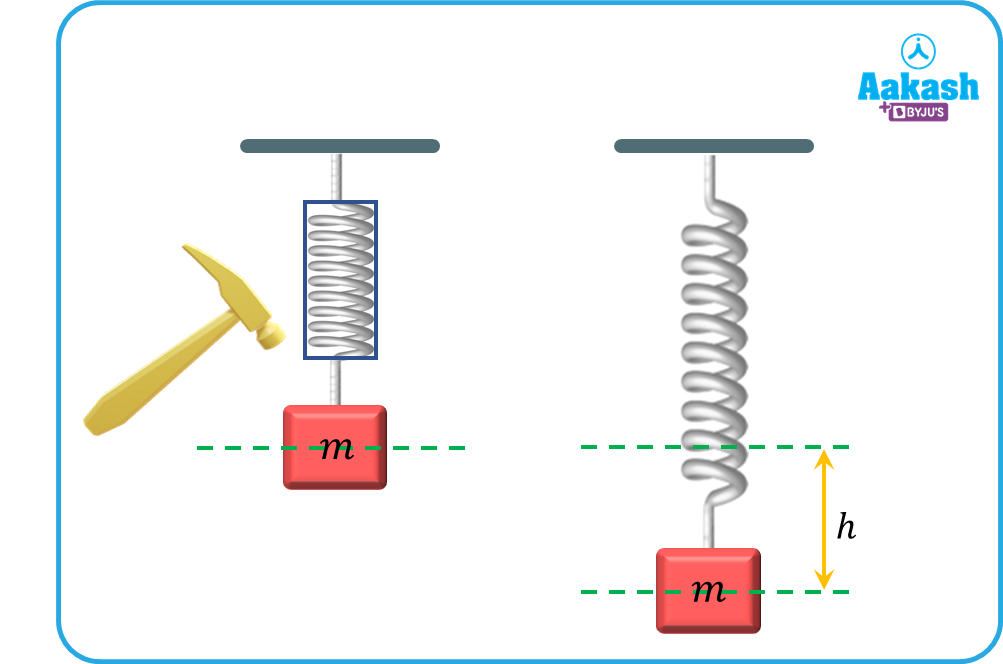
Restoring force or spring force is the force acting in the opposite direction when the spring is stretched or compressed from its equilibrium position. It is a conservative force, meaning the work done by it does not depend upon the path taken by it. Consider the following scenario where a block connected from a spring in a gravity free space was initially at equilibrium in its mean position; when struck with a hammer, it stretches by a distance h. Then the restoring force can be written as F=-kh;(-ve sign indicates that the restoring force is directed opposite to the direction of displacement) where k is the stiffness constant of the spring. It carries a unit of N/m.
Expression for spring potential energy
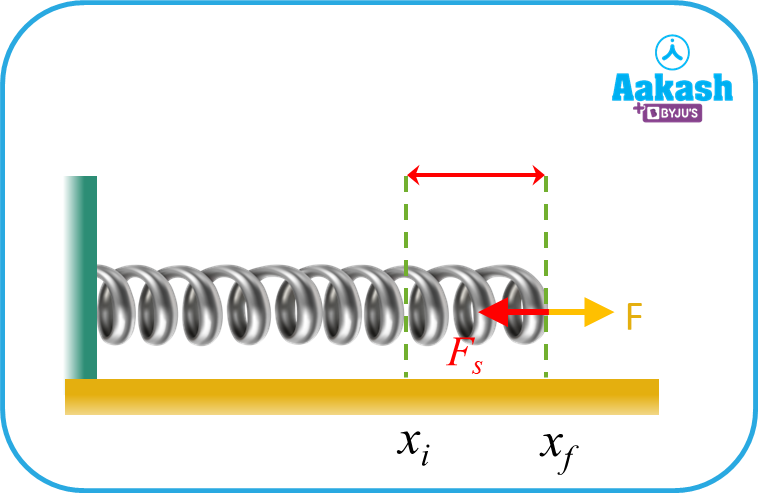
The elastic potential energy stored in a spring is the negative of the work done by the conservative spring force when it is stretched or compressed from its initial to final position. Imagine a spring which is stretched by a elemental distance dx against the restoring force F. If Ui and Uf are the initial and final potential energies of the spring, Wspring indicates the work done by conservative forces, then
Here xi and xf denote the initial and final positions of the spring.
Setting xi=0 (the natural length of the spring), Ui=0 and xf=x.
Video explanation
https://www.youtube.com/watch?v=gf7xr8SFUUg
Practice problems
1) A spring with stiffness constant k is fixed on a table. A ball of mass m at a height h above the upper end of the spring falls vertically on the spring, compressing it by a distance d. Calculate the work done on the mass.
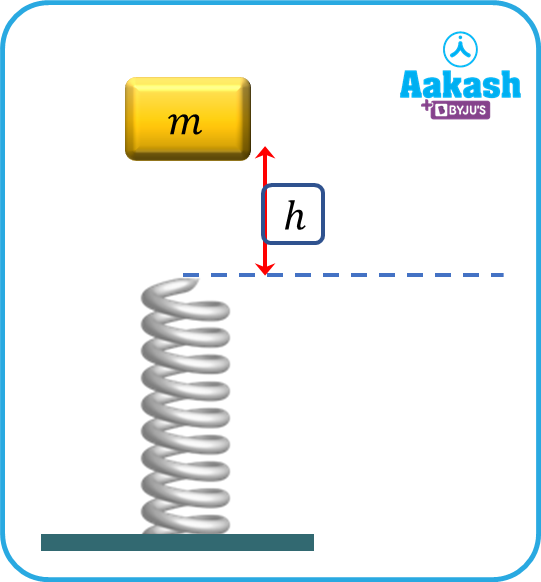
Solution)
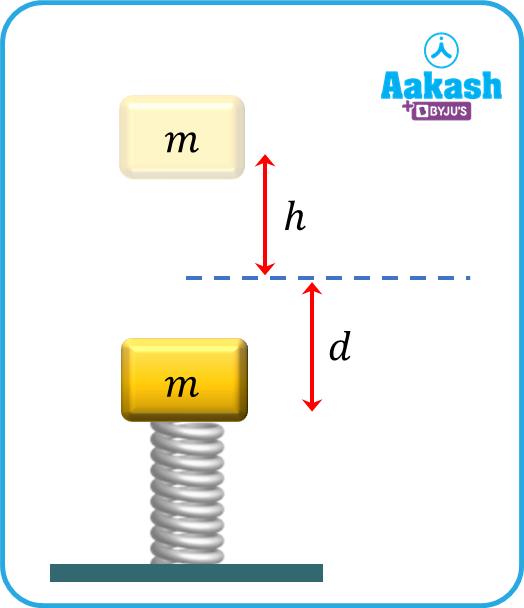
Work done by gravity
Spring potential energy stored in the spring
Net work done
2) Two springs A and B having spring constant KA and KB(KA=2KB) are stretched by applying force of equal magnitude. If the energy stored in the first spring is EA, then energy stored in B will be?
(a) 2EA (b)EA4 (c) EA2 (d)4EA
Solution) a
Given,
KA=2KB
Since they are stretched by the same force ; where xA and xB indicate elongations in the springs A and B.
3) A spring has a force constant of 800 N/m. The energy stored when it is stretched by a distance of 0.1 m is?
(a) 0.4 J (b) 4 J (c) 0.8 J (d) 0.2 J
Solution) b
Energy stored
4)A block of mass M is suspended at the end of a vertical light spring. The spring is hung from the ceiling. The force constant of the spring is K. The mass is released from rest and is allowed to execute oscillations. What is the maximum elongation produced in the spring?
(b) (c) (d)
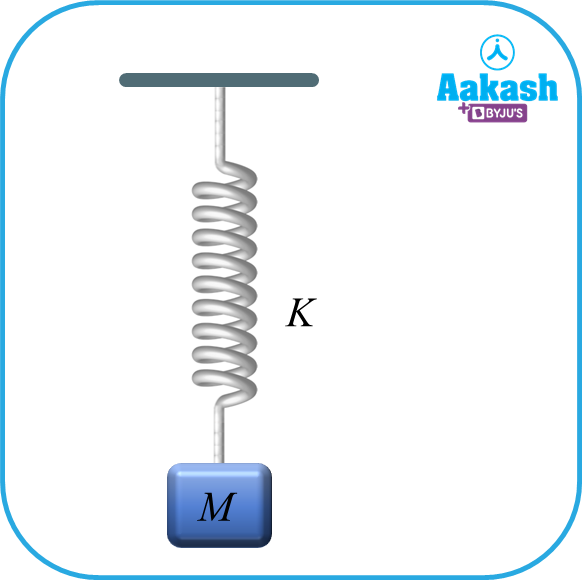
Solution)
Let x be the natural elongation of the spring. Then , gravitational potential energy of the block=potential energy stored in the spring
FAQs
Q. What does the potential energy of a spring depend upon?
Ans) The potential energy of a spring depends on the stiffness constant and the square of the extension or compression produced in it. Higher the stiffness constant or higher the extension produced in it, higher would be the energy stored in it.
Q. Why do springs lose energy?
Ans) Springs do not store the same value of potential energy when elastic fatigue occurs due to repetitive winding or unwinding of the spring. This leads to some amount of energy being dissipated as heat.
Q. Is spring force a conservative force?
Ans) Yes, since work done by spring force does not depend upon the path taken by it. It only depends upon the initial and final positions of the spring.
Q. Is the motion of a spring block system simple harmonic?
Ans) Yes, the motion of a spring block system is simple harmonic since F=-kx.
When a block is attached to the end, it will execute back and forth motions about its equilibrium position. A restoring force will try to bring the spring back to its equilibrium position.

 Call Now
 Let's Chat
 Share
Share