-
Call Now
1800-102-2727


Spring block system in SHM, practice problem, FAQs

Have you ever done bungee jumping? It is too dangerous. In bungee jumping a person bound the elastic rope on his feet and jumped from a hill. He starts falling freely due to gravity. As He reaches a depth equal to the natural length of rope, the expansion in the rope will begin and a force in upward direction will be applied on the person. As the force is in the opposite direction it will reduce the speed of the person and bring him to rest. Now the force is still acting, so the person will start moving in an upward direction and so on. We can analyze this motion by considering a person as a block and rope as spring.
Table of content
- Spring block system
- Time period of spring-block system
- Vertical spring- block system
- Practice problem
- FAQs
Spring block system
Consider a block of mass m attached to a spring at its natural length (i.e., neither stretched nor compressed).
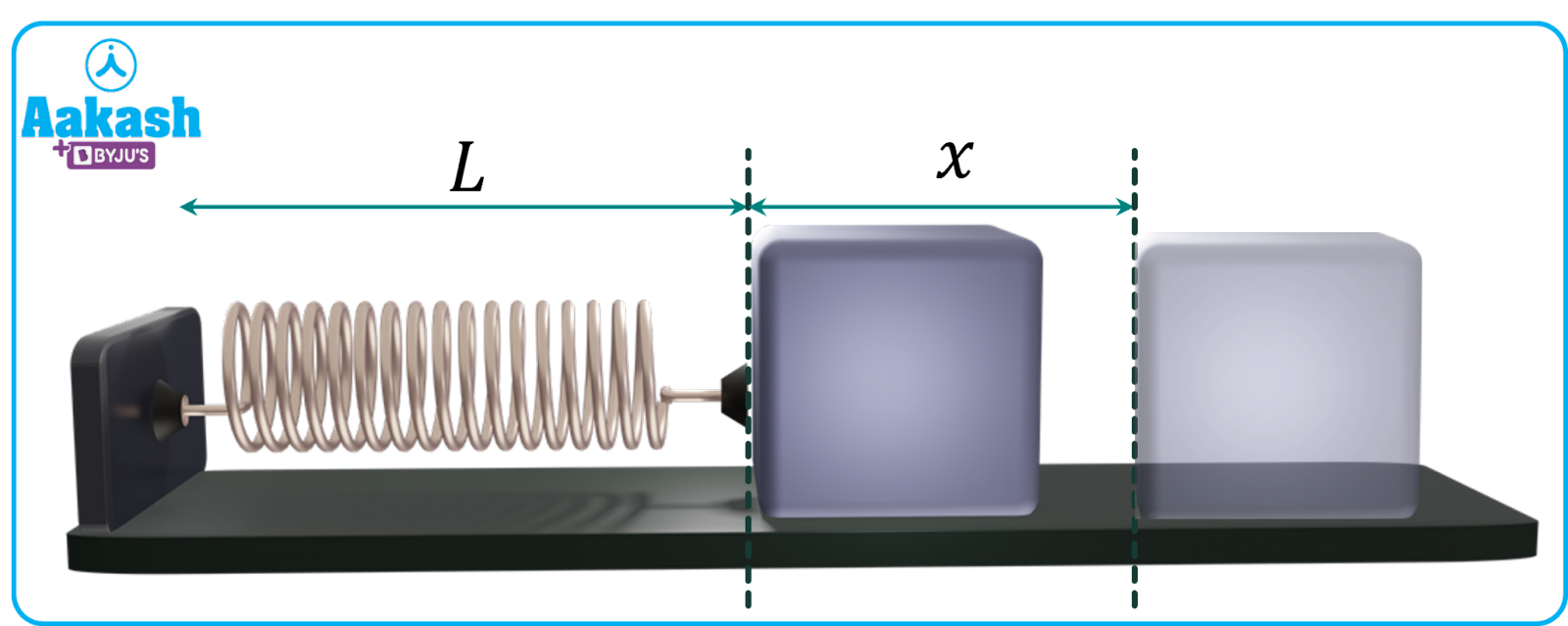
If the spring is stretched or compressed by an amount x from its natural length, then a restoring force develops in the spring. It is the same force which is responsible for the SHM of the block. The force acted upon the block is directly proportional to the displacement of the block.
The negative sign in the force equation shows the displacement which takes place opposite to the applied force.
Where k is the spring constant, which is also known as the force constant.The stiffness of the spring decides the value of the spring constant k. Higher the stiffness, the tougher it is to bring change in the spring. If the stiffness is lower, it is easy to make changes to the spring. It means that if the value of k is more, one needs more force to stretch or compress it.
Time period of spring-block system
If the block is displaced from the equilibrium position to x. The net force on the block is
If m is the mass of block and a is the acceleration, then Fnet=ma
Therefore, angular frequency,
And the time period,
From the equation, it is clear that the time period of oscillation of the block is directly proportional to the square root of m (mass) and inversely proportional to the square root of k (spring constant).
Vertical spring- block system
Consider, a block is hanging by a spring vertically, the constant gravitational force mg acts downwards on the block, which pulls the block y0 downwards. Because of this extension in the spring, there will be a restoring force Fr=ky0 acting upwards on the block.
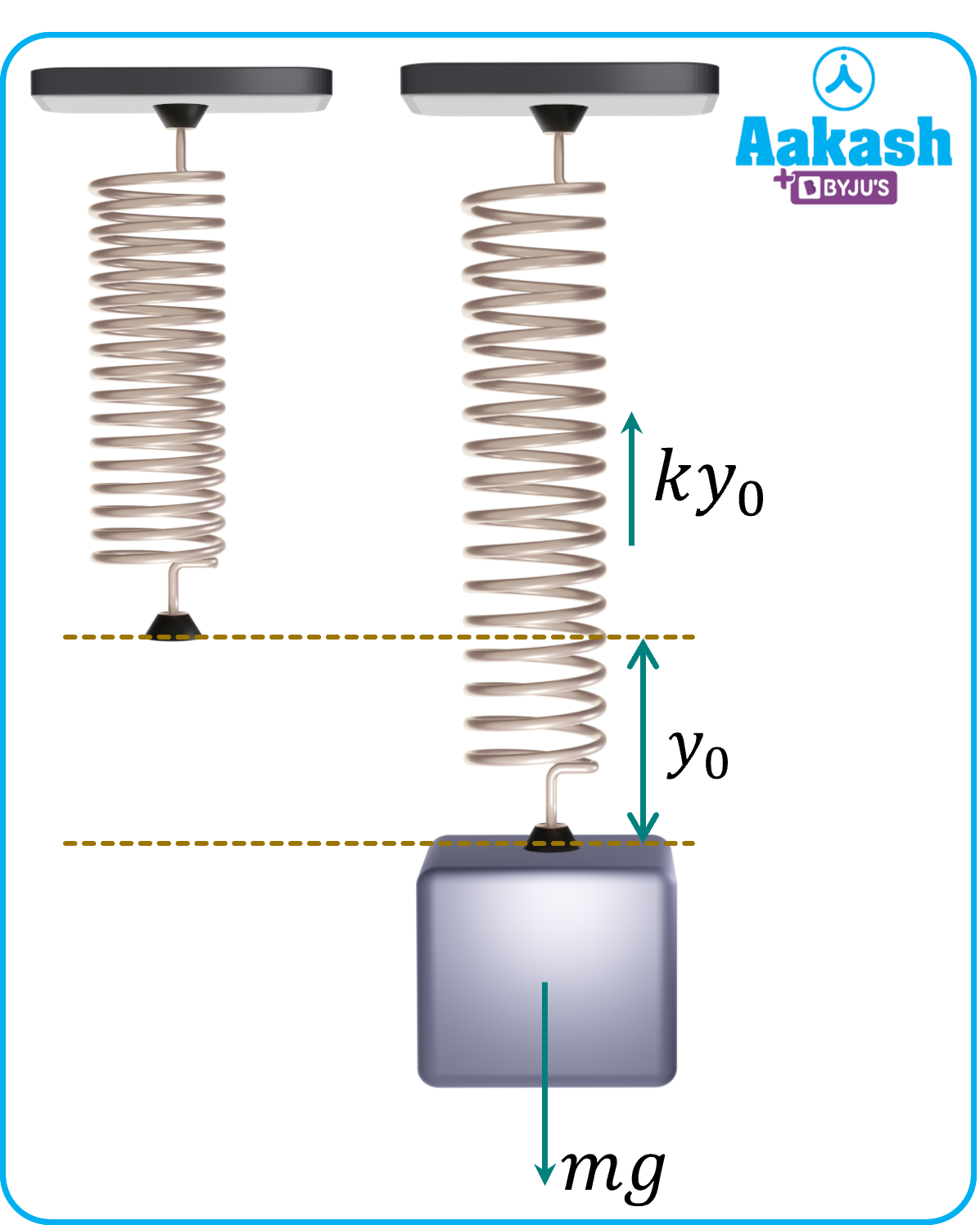
Balancing the forces acting on the block, we get,
Now, if the spring is stretched through a distance y, then the net force on the block is,
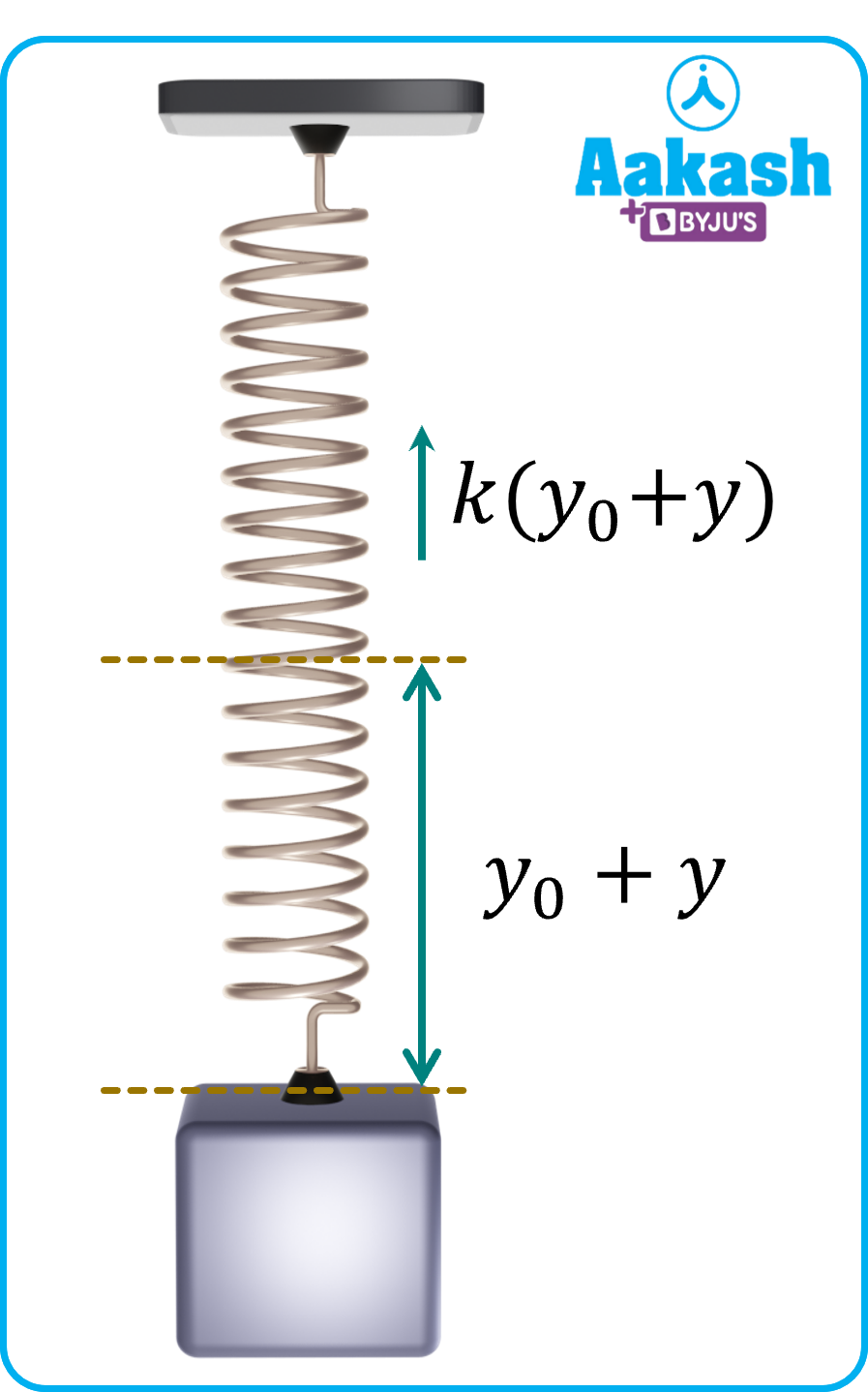
The net force on the block is
From eq (i) we know ky0= mg, hence net force
If m is the mass of block and a is the acceleration, then Fnet can be written as,
Where ,
Therefore, angular frequency,
And the time period,
Which is similar to the case of horizontal spring mass system
Form eq
So the time period
So, for constant force, the time period of oscillation can be calculated even if we know the extension in the spring.
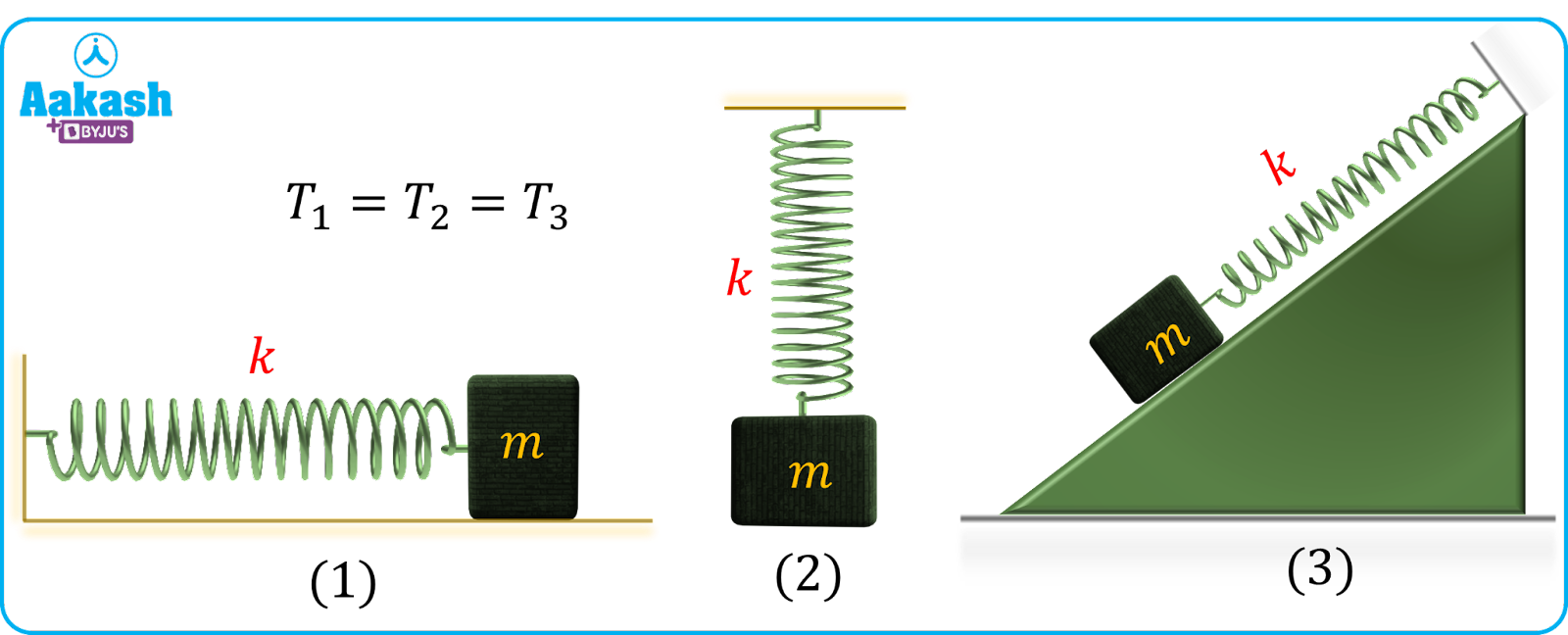
Hence from the above discussion we can conclude that the time period of a same spring block is the same in every condition either is it horizontal, vertical or on an inclined plane or placed on other planets like mars etc.
Spring-Block with pulley
Now consider a spring block with a pulley as shown in the first figure.
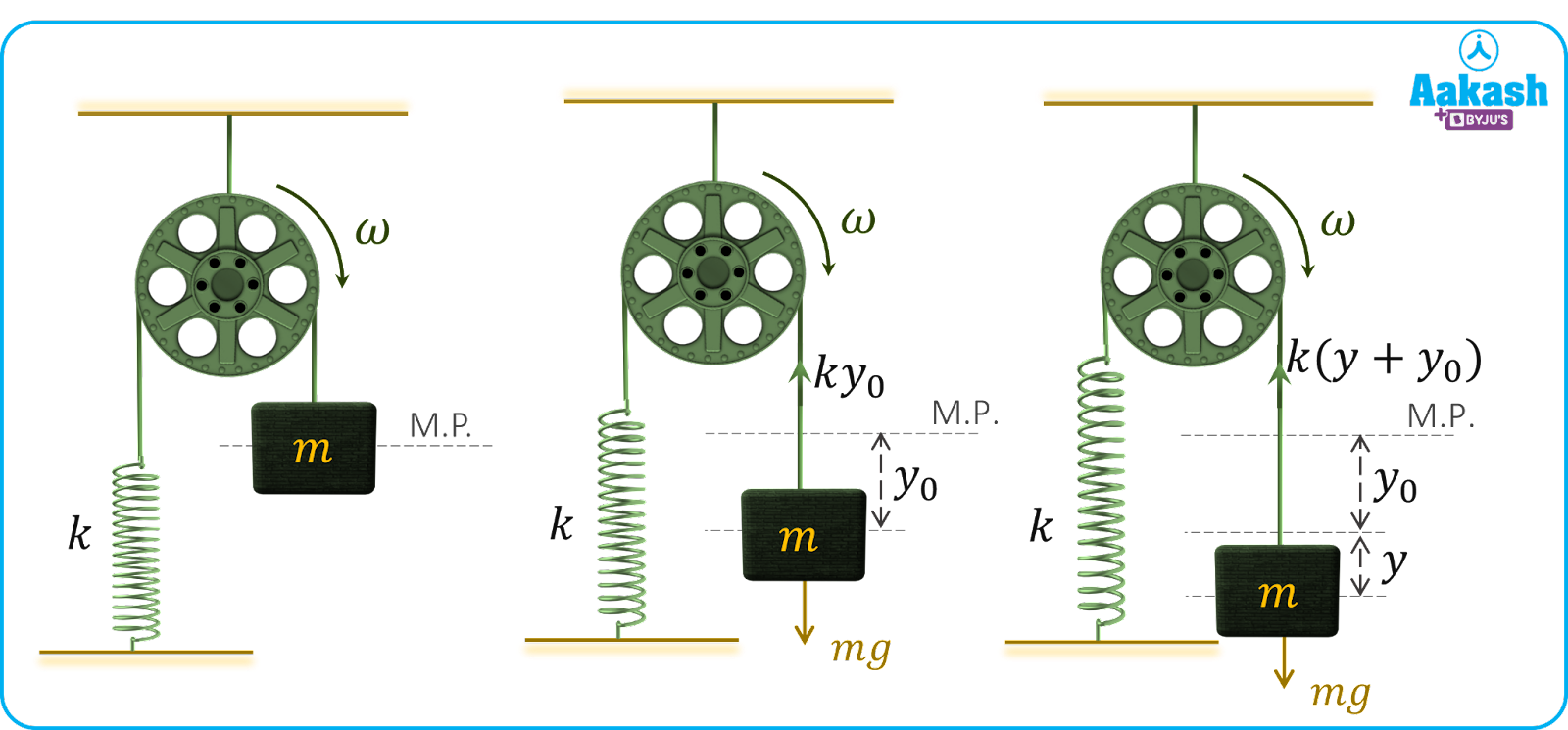
When the system is released, Lets at equilibrium the extension in the spring is yo , The tension force in the string F is
And the gravitational force mg will act in a downward direction (fig 2). Therefore,
Now displace the block by a distance y in downward direction, Then the net force on the block will be toward the mean potion (fig 3)
From equation
If m is the mass of block and a is the acceleration, then Fnet can be written as,
Where ,
Therefore, angular frequency,
And the time period,
Hence for this case also the time period will be same as the horizontal and vertical case.
Practice problem
Q. A spring block system having mass 3 kg and force constant 1200 N/m is executing simple harmonic motion. Find the frequency of oscillation.
A.
Given m=3 kg
k=1200 N/m
Frequency of oscillation is given as
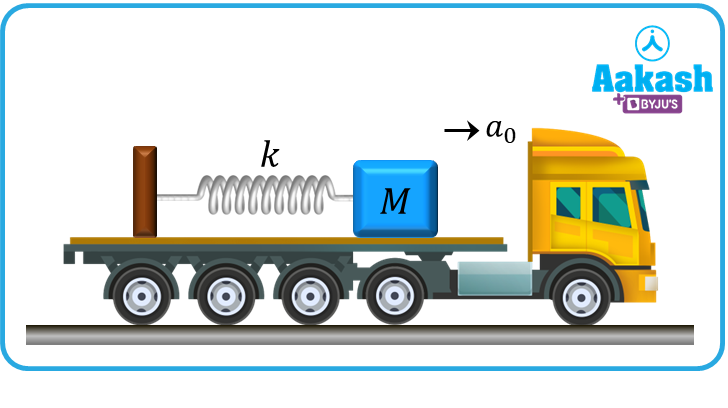
Q. A block of mass 2 kg is kept horizontally on the floor of a truck as shown in the figure. If the truck starts moving with the acceleration 6 m/s2, What is the amplitude of oscillation of block? The force constant of spring is 100 N/m.
A.
Let x0 is the compression in spring at equilibrium.
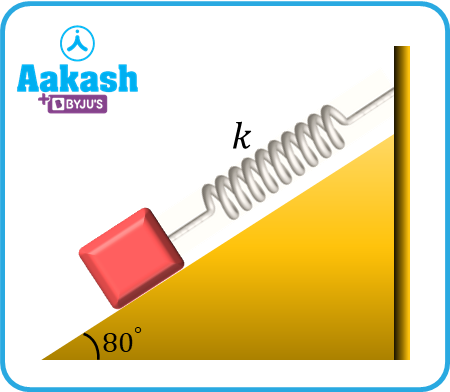
Q. A block of mass 0.1 kg is in simple harmonic motion on an inclined surface as shown in figure. If the force constant of spring is 160 N/m, find the period of oscillation. Take g=10 m/s2.
A.
Given m=0.1 kg
k=160 N/m
In this case the gravitational force parallel to the incline plane will cancel the spring force due to static deflection, Hence the time period will be the same as the vertical spring block system.
So Time period
Q. A cart of mass 4 kg is attached with the spring of force constant k=300 N/m . Let the cart is displaced by some distance from the equilibrium position and released, Find the frequency of oscillation
A.
Frequency of oscillation,
FAQs
Q. Is the frequency of the spring block system dependent on gravity?
A. No, gravity just changes the equilibrium point not the frequency.
Q. What is the effect on the time period of the spring block if the natural length of spring becomes 4 times?
A. As the length becomes 4 times, the force constant will be 1/4 times , so the time period will be 2 times.
Q. How does the amplitude affect the time period of the spring mass system?
A. There is no effect of amplitude on the time period.
Q. How does the mass affect the frequency of the spring block system?
A. frequency is inversely proportional to the square root of the mass of the block.

 Call Now
 Let's Chat
 Share
Share