-
Call Now
1800-102-2727


Solar Cell- Solar Energy, Practice Problems, FAQs

We know that fossil fuel sources are limited and they are vanishing day by day. It is suggested that we make use of renewable energy. How do you think we store solar energy? So to do that we use solar cells. You must have seen some watches or calculators that work on solar cells. So when sometimes cells get discharged we have to keep them under sunlight. In this article we will be studying about solar cells and its advantages as well as disadvantages in detail.
Table of Contents
- Solar Power and Energy
- Solar Cell
- Advantages of Solar Cell
- Disadvantages of Solar Energy
- Practice Problems
- FAQs
Solar Power and Energy
Given that the sun has been and will continue to emit an estimated 5000 trillion kWh of energy over the course of billions of years, solar power is an infinitely renewable source of energy. Cookers, water heaters, and other appliances are all powered by solar energy. The main drawback of solar energy is that it cannot be generated when there is no sunlight. Solar cells, which transform solar energy into electrical energy, are used to get around this restriction. Solar energy is the radiating light and heat from the sun that is captured and transformed into other forms of energy, such as electrical energy and heat, utilising tools like heaters, solar cookers, and photovoltaic cells.
Solar Cell
A junction diode, or solar cell, transforms light energy into electrical energy. A big junction with no external biassing makes up a P-N junction solar cell.
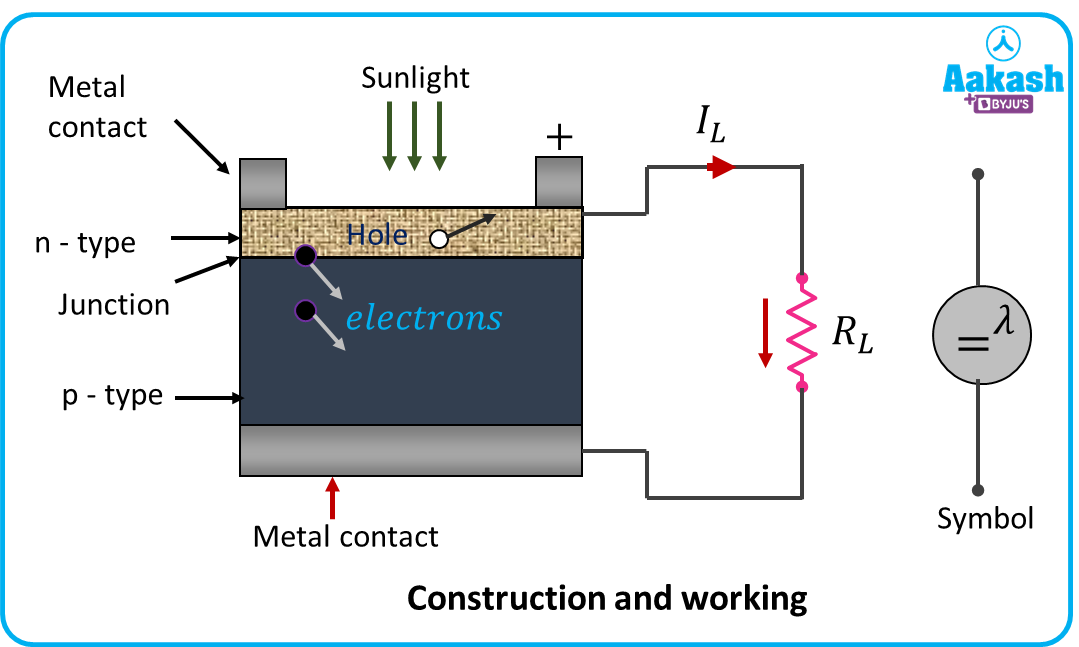
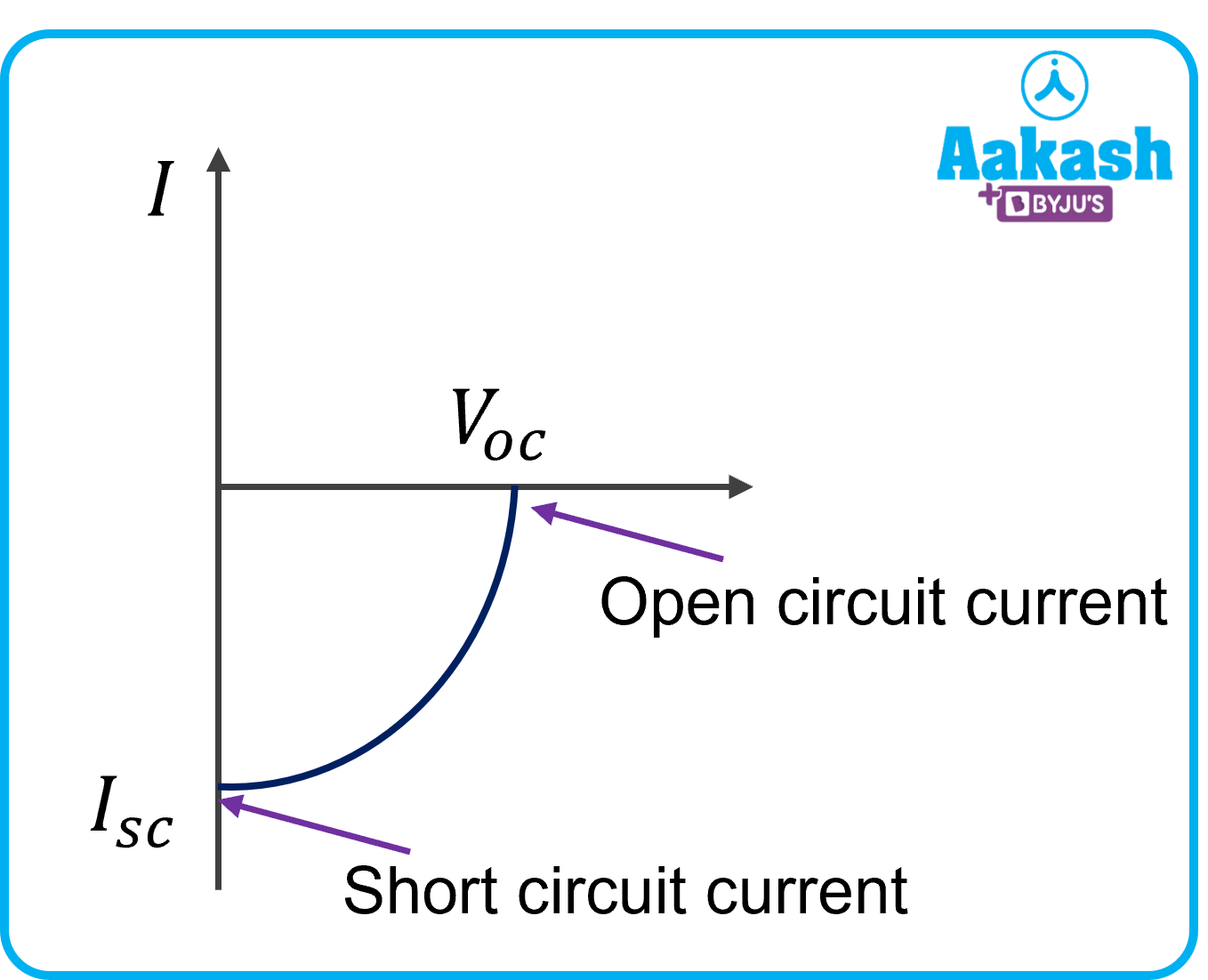
In order for incident photons to readily pass through and reach the junction, which is in the active zone, the surface layer of the P-region is engineered to be very thin. Materials appropriate for photocells include silicon (Si), gallium arsenide (GaAs), cadmium sulphide (CdS), and cadmium selenide in a photovoltaic operation (i.e., creation of voltage due to bombardment of optical photons) (CdSe). When photons with energies above the band gap energy (hν>Eg) strike the junction, electronhole pairs are formed that move in opposition to one another as a result of the junction field. Photocurrent is created when they are gathered at the junction's two sides, creating photovoltage. The characteristic curve of a solar cell is shown in figure below. Solar cells are used in satellites to recharge their batteries.
Advantages of Solar Cell
- Environmental Sustainability: Solar cells produce clean, green energy because they don't create any hazardous gases like CO2, NOX, etc. Additionally, they don't pollute with noise, which makes them perfect for use in residential settings.
- Accessible: When compared to traditional transmission lines, solar panels are less expensive to install and can be made available in remote or poorly populated places. They are simple to install and cause no disruption to daily living in the home.
- Cost: Aside from some extremely sophisticated sunlight tracking mechanical bases, solar panels do not have any mechanically moving parts. As a result, the cost of maintaining and repairing solar panels is minimal.
- Renewable: Natural sources of energy are cheap and plentiful.
Disadvantages of Solar Energy
- Compared to other renewable energy sources, solar panels have a low efficiency.
- Only when there is sunlight is it possible to capture the sun's intermittent and erratic energy. Additionally, when it is foggy outside, less energy is produced.
- Solar energy cannot be efficiently or safely transmitted over long distances. The generated current is DC in nature, and extra machinery like inverters is required to convert DC power to AC current.
- Solar photovoltaic panels are brittle and readily broken. To ensure a protection for the investments, additional insurance payments are necessary.
Practice Problems
Q. How do solar cells function?
A. A solar panel generates energy by allowing light particles, or photons, to dislodge electrons from atoms.
Q. Solar Cell is
- N-type semiconductor
- P-type semiconductor
- Intrinsic semiconductor
- P-N junction
A. (d) solar cells are P-N junctions.
Q. Which of the following characteristics should not be possessed by solar cell material?
- High energy band
- High availability
- High absorption
- High conductivity
A. (a) The semiconductor's Energy Band shouldn't be too high. In order for the incident solar radiation to generate electron-hole pairs, it should be around 1.5 eV.
Q. Which of the following materials can not be used in solar cells?
- Si
- GaAs
- CdS
- PbS
A. (d) The majority of solar radiation will be absorbed on the top layer of the solar cell if PbS is used as the material for the solar cell and will not enter the depletion zone.
FAQs
Q. Can solar cells be used to generate solar power when the sun isn't shining?
A. No, it can only be used when there is sunlight.
Q. What components make up the solar cell?
A. A crystalline silicon solar panel, which is made up of numerous linked silicon cells connected to one another to create a circuit, makes up a solar cell.
Q. In which quadrant I-V characteristics of solar cells exists?
A. I-V characteristics of solar cells exist in the fourth quadrant.
Q. Is the working principle of photodiodes and solar cells the same?
A. Yes. With the exception of no external bias and a significantly bigger junction area, the solar cell operates on the same principles as a photodiode.

 Call Now
 Let's Chat
 Share
Share