-
Call Now
1800-102-2727


Newton's Laws of Motion - FBD, Equilibrium, Practice Problems, FAQs

There are many physical phenomena that happen around us that can be explained by Newton’s laws of motion. Like we are able to walk effortlessly on the rough horizontal surface but if it is smooth it's hard. How two objects of different masses dropped from top of the building have the same acceleration. In this article we will briefly understand three laws of motion and then solve some examples.
Table Of Contents
- What is Force? (The Simple Version)
- Newton’s First Law of Motion
- Newton’s Second Law of Motion
- Newton’s Third Law Of Motion
- System
- Free Body Diagram (FBD)
- Net Force
- Equilibrium
- Practice Problems
- FAQs
What is Force? (The Simple Version)
Before diving into Newton’s laws of motion, let’s understand the "hero" of our story: Force. In simple terms, a force is just a push or a pull on an object.
Effects of Force
A force can do more than just move things. It can:
• Change the speed of an object (making it go faster or slower).
• Change the direction of a moving object (like a cricketer hitting a ball to the boundary).
• Change the shape or size of an object (like squeezing a sponge).
Key Term: Force is a vector quantity, meaning it has both a value (magnitude) and a specific direction. Its SI unit is the Newton (N).
Newton’s First Law of Motion
You've probably seen in movies that when someone jumps out of a moving car, they invariably fall in the direction of the moving vehicle. Newton's first law of motion provides an explanation for this circumstance.
It states that a body remains in the state of rest or uniform motion in a straight line unless and until an external force acts on it.
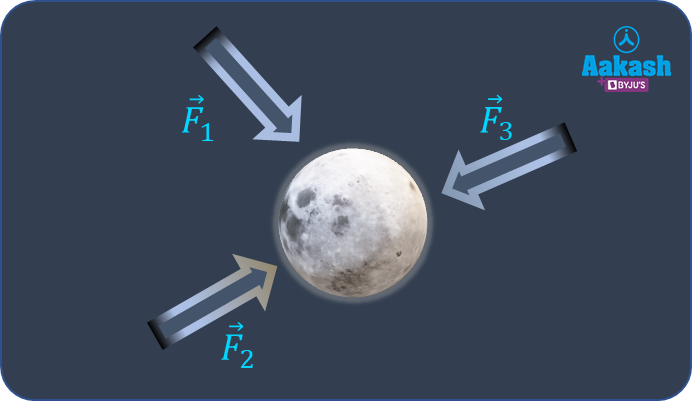
The item does not accelerate in the illustration below because the resultant force is zero.
Net force on object can be expressed as,
But,
According to Newton's first law of motion, a body won't begin to move unless and until an outside force acts on it. It cannot stop or adjust its speed after it has started moving unless another force acts on it.
The first law is additionally referred to as the law of inertia.
Inertia: The resistance of a particle to change its state of rest or of uniform motion along a straight line is called inertia.
There are three types of inertia:
- Inertia of rest - resistance of a particle to change its state of rest
- Inertia of motion - resistance of a particle to change its state of motion
- Inertia of direction - resistance of a particle to change its direction of motion.
Newton’s Second Law of Motion
In contrast to the first law of motion, the second law of motion deals with the behavior of objects when forces are acting on them. The more precise second rule of motion is frequently employed to determine what happens when a force is present.
Newton’s second law of motion states that the acceleration of a particle as measured from an inertial frame is given by the vector sum of all the forces acting on the particle divided by its mass.
Mathematically we can write,
Here a : acceleration of object
F : net force on object
m : mass of object
The second law is frequently referred to as the momentum law.
It can be stated as the rate of change of momentum of an object is equal to the net external force and in the direction of net force.
Momentum (P ) is expressed as,
Here V : velocity of object
……….Considering constant mass
Newton’s Third Law Of Motion
You must have seen the Iron Man movie if you're an Avengers fan. You must have questioned Tony Stark's ability to fly while donning the suit. By applying Newton's third law of motion, you may comprehend this.
Newton’s third law of motion states that to every action, there is an equal and opposite reaction. That means if a body A exerts a force F on another body B, then B exerts a force -F on A, the two forces acting along the line joining the bodies.
- Magnitude of opposing forces is equal.
- Direction of forces is opposite of each other.
From the two examples you can understand how two bodies interact with each other.
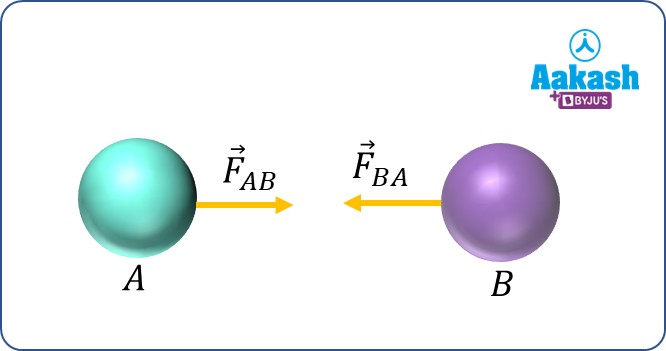
Here
Force on A by B
Force on B by A
Note: The two forces in Newton's third law are called the action – reaction pair.
Examples:
- As the rocket lifts the burned fuel ejects down onto the ground, it is propelled into space.
- The swimmer pushes the water backward, and the water pushes the swimmer forward.
Conditions of Action- Reaction pair:
Following are the conditions for the forces to be action-reaction pair:
- Both forces must occur simultaneously.
- Forces must act in the opposite direction.
- Forces must act along the same line.
- Forces must act on different objects.
- Forces must be of the same magnitude and nature.
System
A system is composed of two or more objects. Ex- ball -earth, man - suitcase etc.
Internal and external forces
It is classified as an internal force if the action-reaction pair is present in the system under consideration; otherwise, it is known as an external force. Both the action and the reaction forces are present inside system 1 as depicted in the given image. The forces are hence referred to as internal forces.
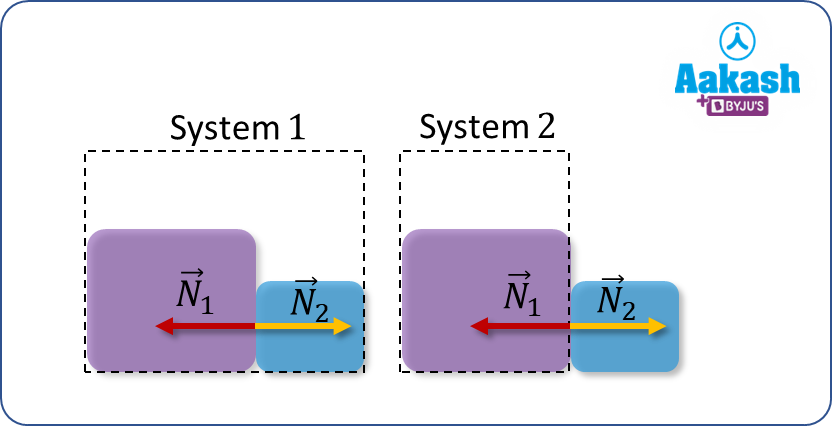
In system 2, the reaction force is outside the system. Hence, force N1 is known as external force, whereas N2 force is not considered as it is not inside the system.
Free Body Diagram (FBD)
The diagrammatic representation of a body that is isolated from its surroundings, showing all the external forces acting on it, is known as the free-body diagram (FBD).
Steps while drawing the FBD
- Isolate the body free from surrounded objects.
- Draw all external forces acting on the body.
- Choose X and Y axes and resolve the forces.
Note: On a body that is regarded as a point, the entirety of Newtonian mechanics is applied. So, in drawing forces in FBD, always start with the body as a point. The body can be represented graphically by any shape.
Net Force
The net force operating on an object is represented as the vector sum of all external forces acting on that object.
According to the figure, the body is being subjected to a number of forces that vary in strength and direction, which will have an overall impact on the outcome.
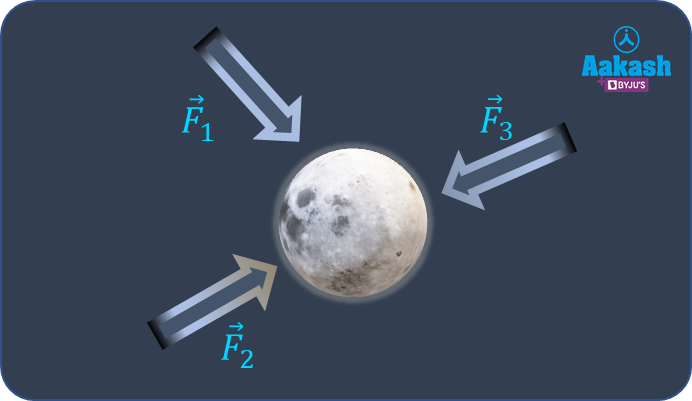
From figure,
Equilibrium
When the net external force on an object is zero, then the object is said to be in a state of translational equilibrium.
Mathematically,
Which means net force along each axis should be zero.
So,
Video Explanation: 1) Newton's 2nd Law
Practice Problems
Q. A 15 kg block is kept on a floor that is smooth. At t=0, a 30 N force is exerted on it. Find the block's acceleration.
A. There is no friction in this area because the floor is smooth. Mass will therefore accelerate as a result of applied force.
We know,
Therefore the acceleration of block is 2 ms-2.
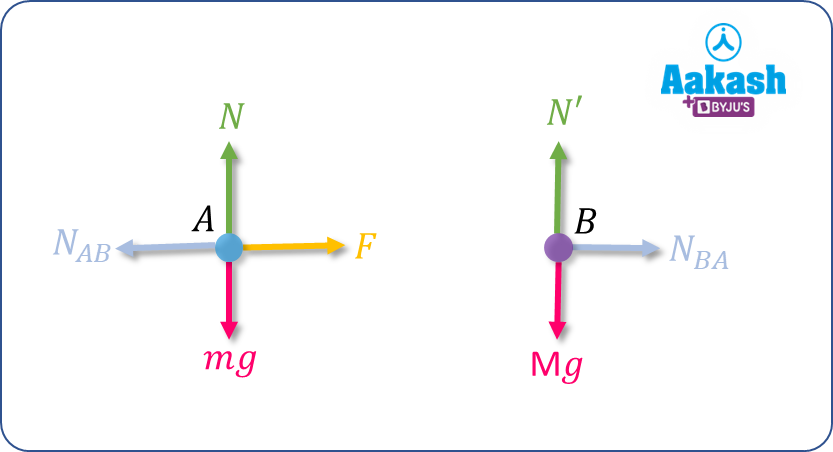
Q. A force F is pushing two bodies A and B with masses m and M, respectively, in the direction of the positive x-axis. Draw FBD.
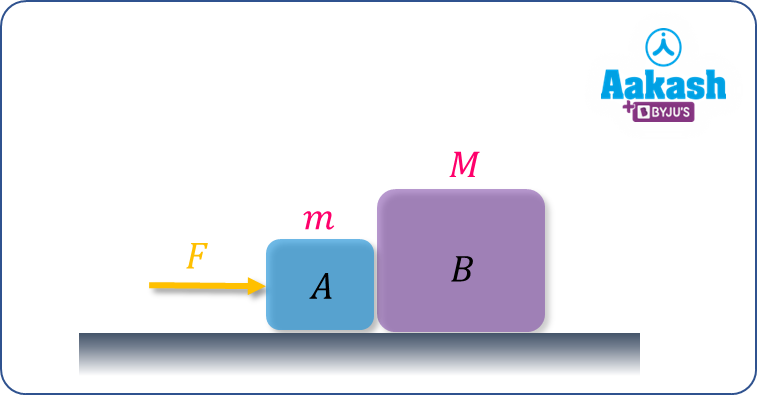
A. Following is the free body diagram of A and B.
Q. If the force applied on the object is doubled and mass is halved what will be the ratio of new acceleration and previous acceleration?
Options: (A) 1 (B) 2 (C) 4 (D) 8
A. (C).
From newton's second law F=ma
Then and
Therefore
Q. The momentum of a particle moving in straight line is given as Find the force on the particle at t=3 sec.
A. From newton's second law,
At t=3 sec
FAQs
Q. What are the characteristics of normal force?
A. It is a force that always acts perpendicular to the surface of contact. It is a perpendicular component of contact force.
Q. What is meant by an action-reaction pair?
A. The force exerted on an object is the action force, and the force experienced by the object as a consequence of Newton's third law is the reaction. These forces are equal in magnitude but opposite in direction.
Q. What is Net Force ?
A. The vector sum of all the external forces that are acting on a system represents the net force on that system.
Q. Do weight and normal force acting on a block placed on a flat surface are action-reaction pairs?
A. No, because both forces are acting on the same body. Also for action reaction pair forces need to be of the same nature. But it's not true in the case of weight and normal force.
Q: Why don't Action and Reaction forces cancel each other out?
Although Newton’s Third Law states that action and reaction forces are equal and opposite, they never act on the same body. Because they act on different objects, they do not cancel each other out and must be drawn on separate Free Body Diagrams.
Q: What is the difference between mass and momentum?
Mass is a measure of an object's inertia, while linear momentum is the "quantity of motion" an object possesses. Momentum is calculated as the product of an object's mass and its velocity (p=mv)

NEET Related Links
JEE MAIN Related Links
JEE Advanced Related Links
JEE Advanced Eligibility Criteria
JEE Advanced Chemistry Syllabus
JEE Advanced Registration Dates
CUET Related Links
Important Topics
Anemometer : Measurement of Wind Speed
Angular Acceleration Atomic Theory Audible and Inaudible Sound Average Speed and Average Velocity Average Velocity Avogadros Number Avogadros Hypothesis Azimuthal Quantum Number Balanced Force Bar Magnet Biconvex Lens Boyles Law Buoyancy Calorimeter Carnot Engine Celestial Bodies Centripetal And Centrifugal Force Concave and Convex Lenses Concave Convex Mirrors Contact and Non Contact Force Controlled Thermonuclear Fusion Convection Currents Convex Lens Convex Mirror Destructive Interference Difference Between Conduction Convection and Radiation Difference Between Electric Field and Magnetic Field Difference Between Heat And Temperature Difference Between Series And Parallel Circuits Differences Between Acceleration And Velocity Distance and Displacement Distance Time Graph Electrical Force : Electric Forces and Their Types Electromagnetic Waves : Definition, Equation and Properties of Electromagnetic Waves Electromagnetism Electron Spin Fluid Flow : Bernoullis Equation Derivation and Fluid Mechanics Fluid Friction : Types and Factors of Fluid Friction Frames of Reference : Inertial and Non- Inertial Frame of Reference Frequency and Wavelength Frictional Force Importance of Hydrosphere Instantaneous Speed and Velocity Introduction to Motion Kinetic and Potential Energy Difference Law Of Conservation of Energy Layers of the Earth Light Energy Light Sources List of physics scientists and Their inventionsLoudness of Sound
Magnetic Dipole Moment Magnetic Field Non - Contact Force Non - Renewable Energy Ohms Law Optics P Wave Physics Symbols Plane Mirrors Poissons Ratio Projectile Motion Properties of Water : Anomalous Expansion of Water Radius of Gyration Reflection of Light Reflection of Waves Relative Density Resonance Reverberation Rolling Friction Rotation and Revolution Screw Gauge Semiconductors and Insulators Sliding Friction Speed Time Graphs Static Friction Stefan Boltzmann Law Stress Tension Tension Force Thermometer: Clinical Laboratory Thermometer Types of Rocks Types of Waves Uniform Motion and Non Uniform Motion Unit of Voltage Uses of Convex Lens Uses Of Convex Mirror Uses of Electromagnet Uses of Optical Fibre Wave Wavelength of Light What is Scattering of Light Working of Electric Bell Conventional and Non-conventional Sources of Energy Buoyant Force Bulk Modulus of Elasticity Bernoulli’s Principle Angular Momentum Difference Between Speed And Velocity ForceUnit of Heat
Difference between Distance and Displacement Simple Microscope Derivation Of Equation Of Motion Thermometer: Clinical & Laboratory Thermometer Difference between Concave and Convex LensDerivation Of Lens Maker Formula
Unit Of Pressure Velocity Uses of Plane Mirror
Wave Theory of Light
Unit of Density Unit of Light Unit of Force Unit of Magnetic Field Unit of wavelength Unit of Viscosity Uses of Electroplating Young's Modulus
What is the Scattering of Light
Lenz Law Space Wave Propagation Schrodinger Wave Equation Relation between Fahrenheit and Celsius Refractive Index Potentiometer Working Pascal Law Oscillatory Motion Optical Instruments Newton's Laws of Motion - First Law Modulation and Demodulation Magnetic Flux Lens Formula and Magnification Kaleidoscope Faradays Law Epsilon Naught Value Energy Bands Electrostatics Electroscope AC Generator Unit of Current Lithosphere Bending Equation Derivation Difference Between Pound and Kilogram Semiconductor Devices OTEC - Ocean Thermal Energy Conversion Hall Effect Rectilinear Propagation of Light Difference Between Ammeter and Voltmeter Coefficient of Linear Expansion Ampere’s Law Cyclone and Thunderstorm Save The Environment From Pollution Particle Nature of Light Types of DC Motor Uses Of Transistor Derivation of Phase Rule Unit of Humidity

 Call Now
 Let's Chat
 Share
Share