-
Call Now
1800-102-2727


Nature of physical laws, conservation laws, FAQs

Laws of Physics are well-defined facts by nature which have been derived and inferred based on experimental observations. Simply put, physical laws are a way of classifying the working of the world around us.
Table of contents
- Nature of physical laws
- Conservation laws
- Conservation of energy
- Conservation of linear momentum
- Conservation of angular momentum
- Quiz
Nature of physical laws
Investigations done by the physicist range from particles that are smaller than atoms in size to stars that are very far away on the basis of scientific processes. They try to outline these investigations by discovering the laws with the help of experimentation and observation.
Systems that do not interact with its environment in any way, some of their mechanical properties do not change. "Constants of the motion" is another name that is used to refer to these properties. These quantities are said to be "conserved" and the conservation laws are the one whose result can be considered to be the most fundamental principles of mechanics.
Conservation laws
A hypothesis, based on observations and experiments, states the conservation laws. It is significant to remember that a conservation law cannot be proved. It can only be verified, or disproved, by experiments.
We will discuss some of the most useful laws of conservations that we are going to study in the upcoming chapters that are given below:
- Conservation of energy
- Conservation of linear momentum
- Conservation of angular momentum
- Conservation of charge.
- Conservation of energy
- The capacity for doing work is called energy. The law states that "Energy can neither be created nor destroyed". The total energy of an isolated system remains constant is just another approach to the above statement.
- In the upcoming chapters, there will be primary equations which can be seen as just an appropriate reformulation of the principle of conservation of energy. Some few examples are given in chart
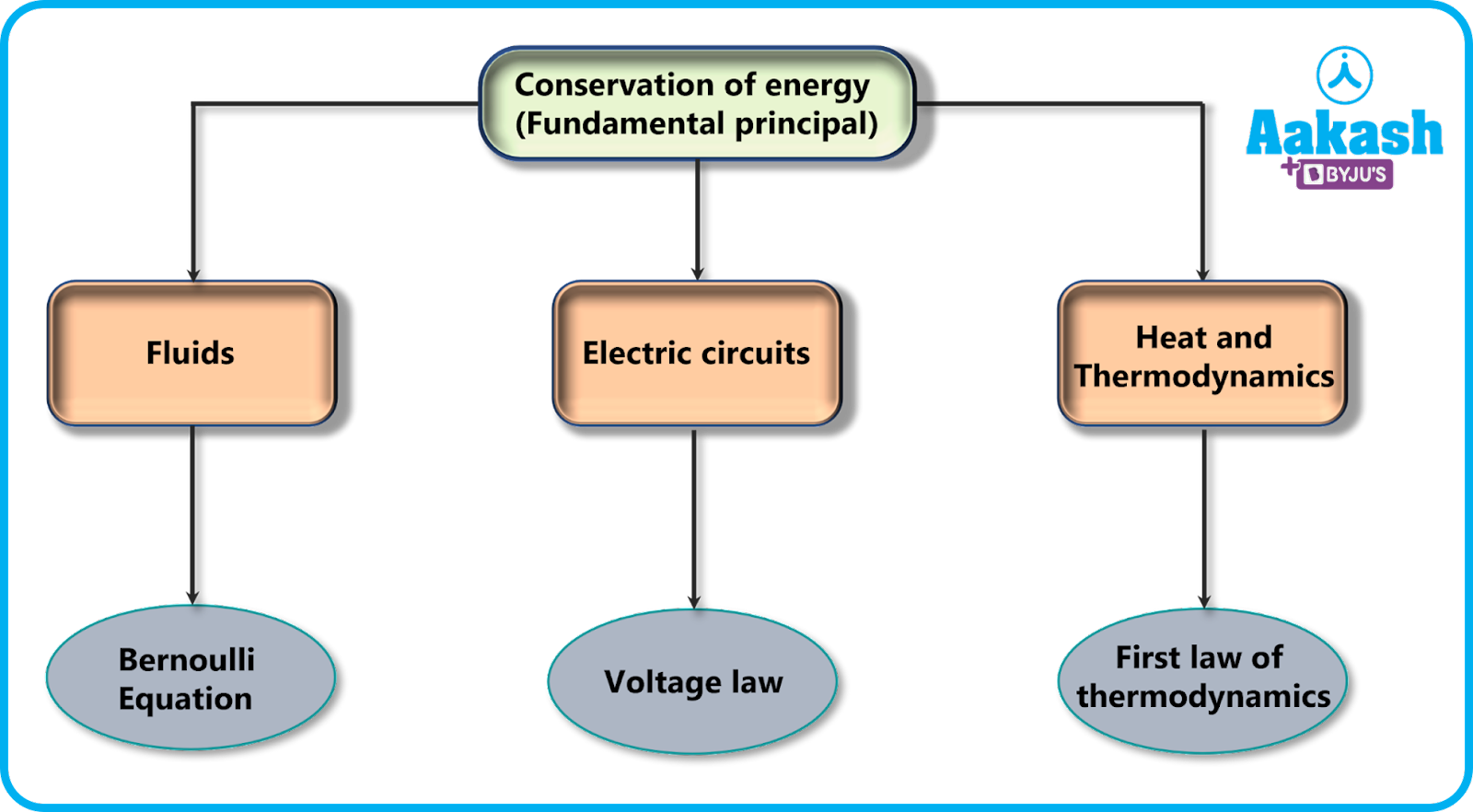
- From the microscopic to the macroscopic, the law of conservation of energy is thought to be valid across all domains of nature.
- Conservation of linear momentum
- The principal states that “the momentum of an isolated system is constant”.
- This law can be derived from Newton’s laws of motion in mechanics. But their validity goes beyond mechanics.
- One of the most commonly used examples of conservation of linear momentum is recoiling of guns. When a bullet is fired from a gun, the gun recoils or it moves in the direction opposite to that of the bullet.
- Conservation of angular momentum
- The product of the moment of inertia and the angular velocity gives the magnitude of angular momentum.
- The principal states that “the angular momentum of an isolated system remains constant in both magnitude and direction”.
- Conservation of angular momentum is an absolute symmetry of nature. There is no evidence of anything in nature that violates it.
- A ballet dancer executing a spin, as shown in is a classic example of conservation of angular momentum.
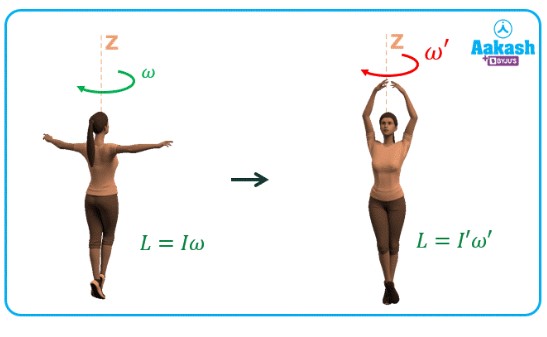
It can be seen that her rate of spin increases as soon as she pulls in her arms, decreasing the moment of inertia.
The laws discussed above are connected with the symmetry of nature i.e. no matter when you perform or where you perform the experiments to validate these laws of nature, the results are bound to be the same.
Conservation of charge
- Charge can neither be created nor be destroyed.
- Charge is very fundamental in nature a particle cannot exist without charge it can be electrically neutral but charge will be there.
- Charge is non relativistic also means with any frame of reference the charge is absolute for any object. The charge on electron is e for the electron at rest or moving with a very high velocity
FAQ
Q. The law of conservation of energy implies that the:
A) Total mechanical energy is conserved
B) Total kinetic energy is conserved
C) Total potential energy is conserved
D) Summation of all kinds of energies is conserved
Ans. D
The law of conservation of energy states that for an isolated system, the total energy always remains constant.
Q. Explain how the law of conservation of energy applies to a torch?
Ans. In a torch, the chemical energy of the batteries is converted into electrical energy, which is converted into light and heat energy.
Q. When fighting fires, a firefighter must use great caution to hold a hose that emits large amounts of water at high speeds. Why would such a task be difficult?
Ans. The hose is pushing lots of water (large mass) forward at a high speed which means that the water has a large forward momentum. Due to conservation of momentum, in turn, the hose must have an equally large backwards momentum, making it difficult for the firefighters to manage.
Q. If a ball is projected upward from the ground with ten units of momentum, what is the momentum of the recoil of the Earth? Do we feel this? Explain.
Ans. The earth recoils with 10 units of momentum. This is not felt by Earth's occupants. Due to the significantly large mass of the Earth, the recoil velocity of the Earth is extremely small and therefore not felt.
Q. If angular momentum is conserved, what must be true about an object's initial angular momentum and final angular momentum?
- Final angular momentum is less than initial angular momentum.
- Final angular momentum is greater than initial angular momentum.
- Final angular momentum is equal to initial angular momentum.
- The final angular momentum is less than zero while the initial angular momentum is greater than zero.
Ans. c
Since the angular momentum remains conserved, it means initial angular momentum is equal to final angular momentum.

 Call Now
 Let's Chat
 Share
Share