-
Call Now
1800-102-2727


Laws of Reflection - Definition, Types, Practice problems, FAQs

When you stand in front of a pool of water, you would be able to see your image in the water. When you hold a torch in front of you and shine it on a mirror, the light flashes back in your face. When the current goes off, and someone shines a torch from one end of the room, the light reaches all corners of the room. All of these are possible due to one phenomenon called reflection. Reflection is a phenomenon that also proves that light travels in straight lines called rays. In this article, we will explore reflection and its laws in detail.
Table of contents
- Reflection and Laws of reflection
- Types of reflection
- Rotation produced in incident ray due to rotation of mirror
- Image formed by a plane mirror
- Deviation produced by a plane mirror
- Practice problems
- FAQs
Reflection and Laws of reflection
When a ray of light is incident on a polished surface, then most of the light returns back to the same medium. This phenomenon of light bouncing back to the same medium is called reflection.
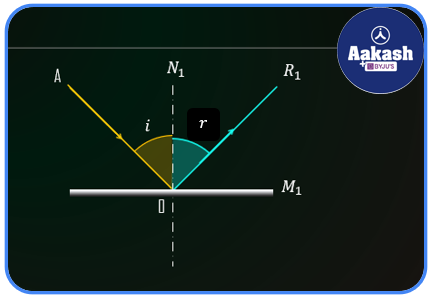

Let us consider the above example where an incident ray of light AO is incident on a reflecting polished mirror M1. The reflected ray is R1. Let i be the angle of incidence and r be the angle of reflection. The line N1 is called the normal. The angle between the incident ray and the normal is called angle of incidence i. The angle between the reflected ray and the normal is called angle of reflection r.
The following are the two laws of reflection
(i)First law -The angle of incidence is equal to the angle of reflection i.e i=r.
(ii)Second law-The incident ray, reflected ray and the normal drawn at the point of intersection of the three rays all lie on the same plane.
Types of reflection
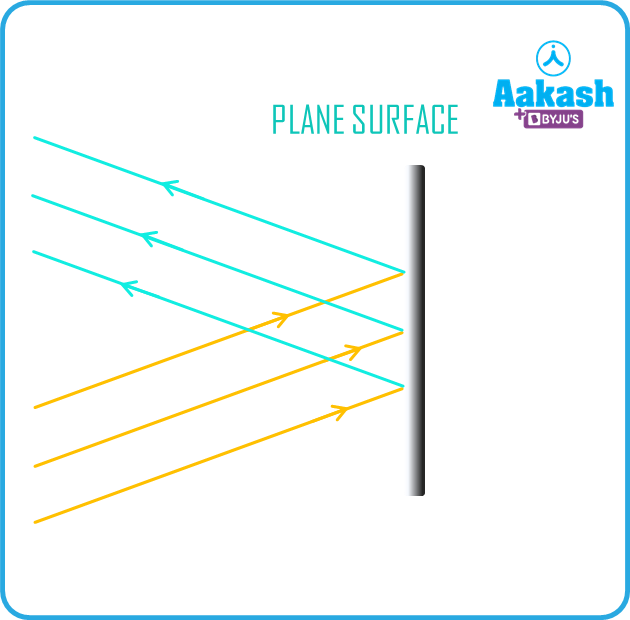
1)Regular reflection-Reflected rays are parallel to that of the incident light rays. It occurs when light is incident on smooth polished surfaces.The reflection pattern is uniform.
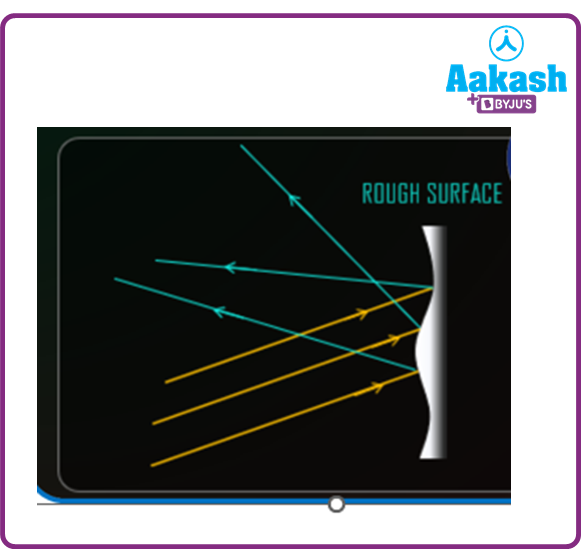
2)Diffused reflection-Diffused reflection refers to reflected light rays being scattered in different directions as that of the incident light rays. The reflection is not uniform.
Rotation produced in incident ray due to rotation of mirror
For a given incident ray, if the mirror is kept fixed and the plane mirror is rotated through an angle , the reflected ray turns through an angle 2.
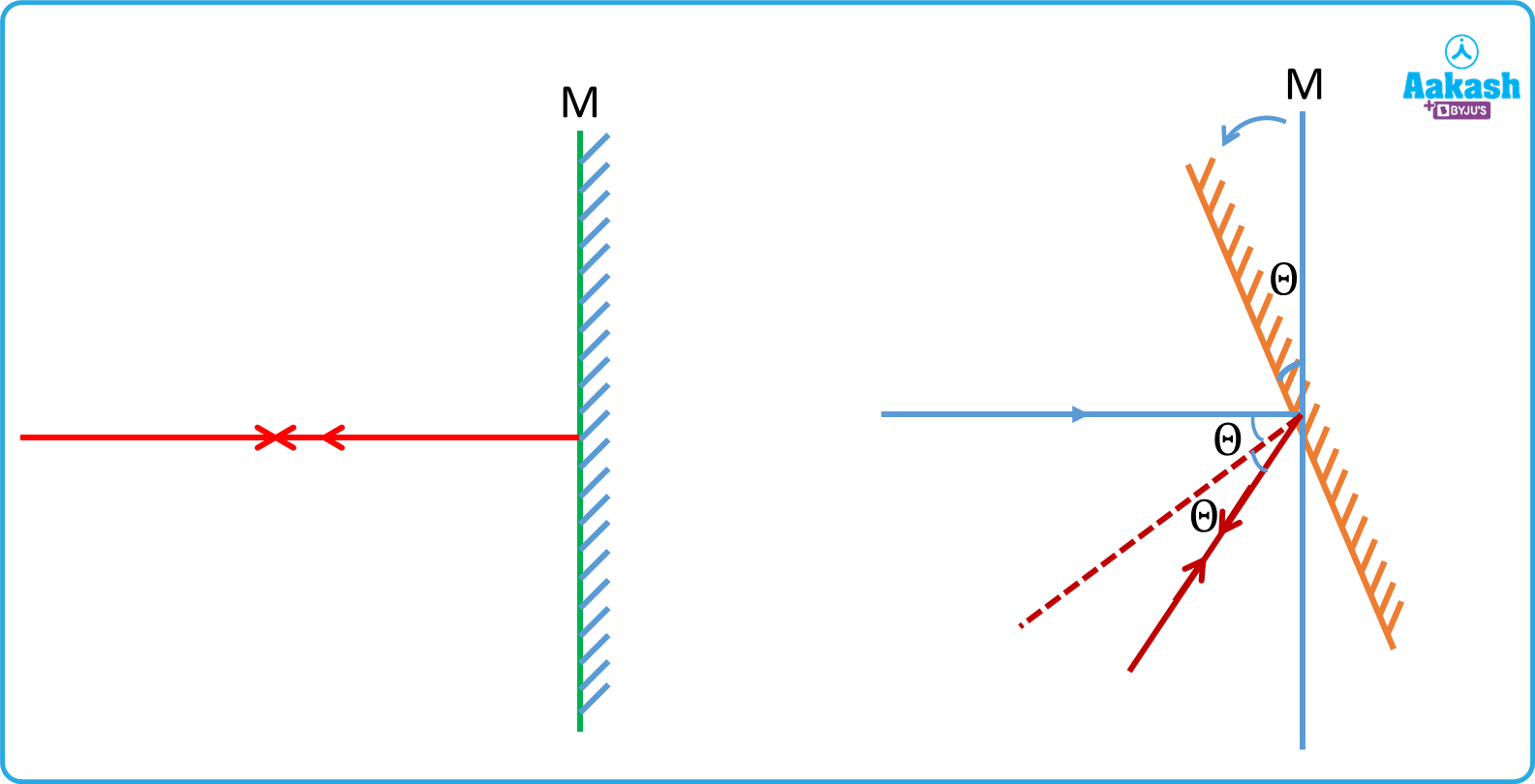
Image formed by a plane mirror
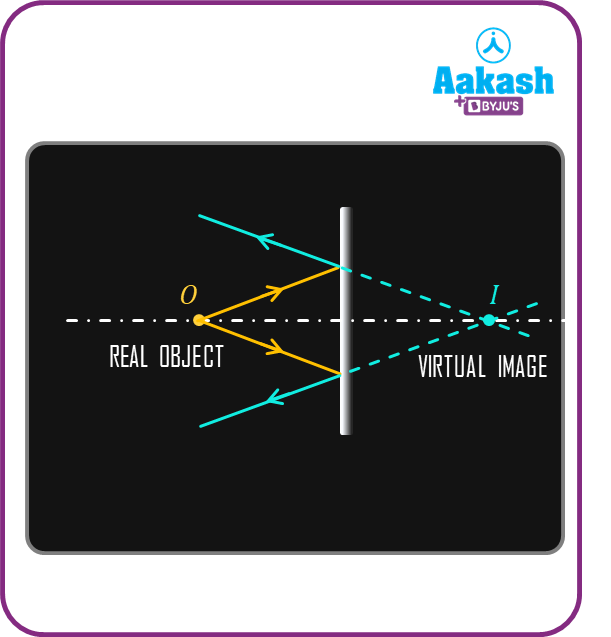
The image produced by a plane mirror is virtual, erect and the same size as that of the object. The image is formed behind the mirror.
In the following example, the real object is O. The virtual image is formed at I.
Deviation produced by a plane mirror
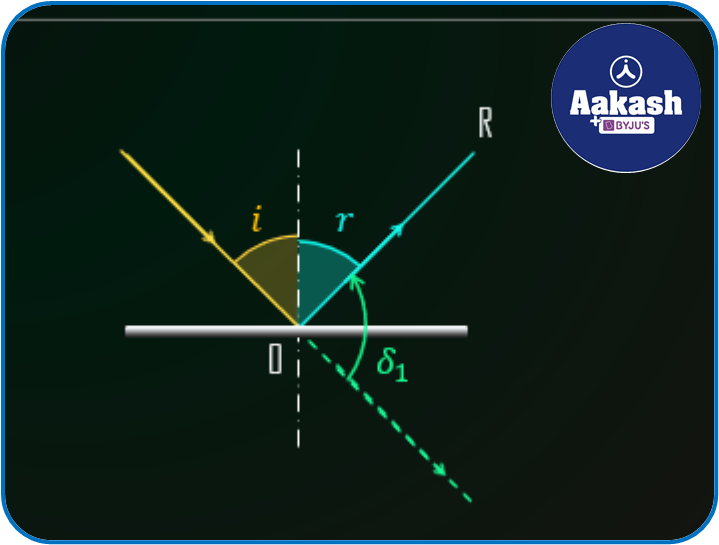
The angle between the reflected ray and the line formed when the incident ray is extended further is called the angle of deviation(1). From the following figure,
i+r+1=1800;
1=1800-2i (i=r)
Video explanation
https://www.youtube.com/watch?v=Q-scEk7rRGw
Practice problems
Q.A ray of light is incident on a plane mirror. If the deviation produced by the mirror is 1200, then find the angle of incidence and angle of reflection.
A. Given, 1=1200;i=r=?
Deviation,
1=1800-2i
1200=1800-2 i; i=300
Hence, i=r=300
Q.A ray of light is incident at an angle of 300 on a plane mirror. Calculate the angle of reflection.
A. According to the first law of reflection, the angle of incidence is equal to the angle of reflection. Hence, the angle of reflection is equal to 300.
Q. An object is placed at a distance of 12 cm in front of the plane mirror. Calculate where the image would be formed.?Also discuss the nature of the image?
A. When an object is placed in front of a plane mirror, the image is formed at the same distance as that of the object from the mirror (12 cm). The image is located behind the mirror, and it is virtual, erect and of the same size as that of the object.
Q.A ray of light is incident normally on a plane mirror. If the plane mirror is rotated about an angle 200, the incident ray would be rotated through an angle of ?
A. Here, if the mirror is rotated through an angle of 200, the incident ray would be rotated through an angle of 2(200)=400.
FAQs
Q. What are the 2 laws of reflection?
A. The two laws of reflection are (i)The incident ray, reflected ray, the normal all lie on the same plane(ii)The angle of incidence is equal to the angle of reflection.
Q. Give one difference between reflection and refraction?
A. Reflection refers to bouncing off of light in the same medium. Refraction refers to the bending of a light ray when it travels from one medium to another.
Q. Does the speed of a light ray change when it undergoes reflection?
A. No. The speed of light does not change during reflection, since the light does not change its medium. The speed changes only during refraction, when it changes medium-the refractive index of the medium is responsible for changing the speed.
Q. What are the 3 types of reflection?
A. Regular reflection, diffused reflection and multiple reflection. When the deviation of the light rays is less, it is called regular reflection. On the other hand, when the deviation is huge, it is called diffused reflection. When many reflections are obtained using multiple reflections, it is called multiple reflection.

 Call Now
 Let's Chat
 Share
Share