-
Call Now
1800-102-2727


Huygens’s principle - wavefront, primary and secondary wave front, practice problems, FAQs

Do an experiment, take two rectangular sheets of an opaque material and make tiny holes in it, place them vertically such that the holes should not be concentric, switch off light of the room and place a light source in front of the first hole. From geometrical optics, we know that the light ray travels in a straight line path, hence the light should not cross the second sheet and there should be dark behind the second sheet, but in actuality there is light behind the second sheet. But how is it possible? This can be explained by Huygens's principle. As the light passes the first sheet, spreads all round and reaches to the hole in the second sheet, the hole in the second sheet behaves as a light source and it spreads light behind the second sheet. Let’s discuss the various aspects of Huygens's principle here.
Table of content
- Huygens’s Principle
- Wave front
- Primary and secondary wave front
- Reflection of light using huygens’s principle
- Refraction of light using huygens’s principle
- Practice problems
- FAQs
Huygens’s Principle
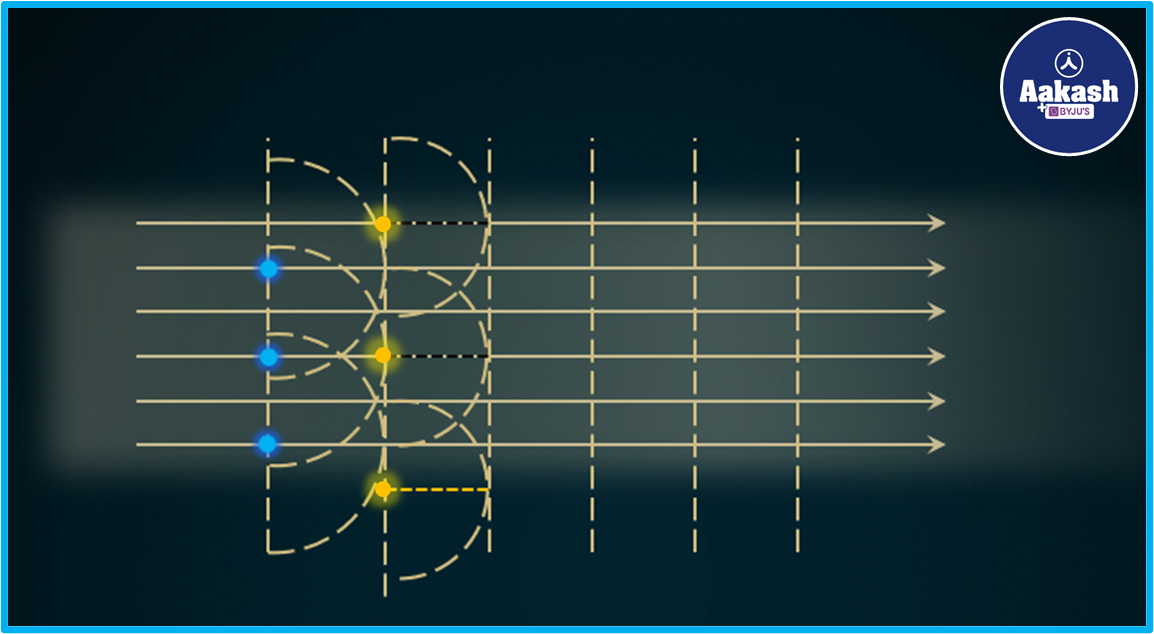
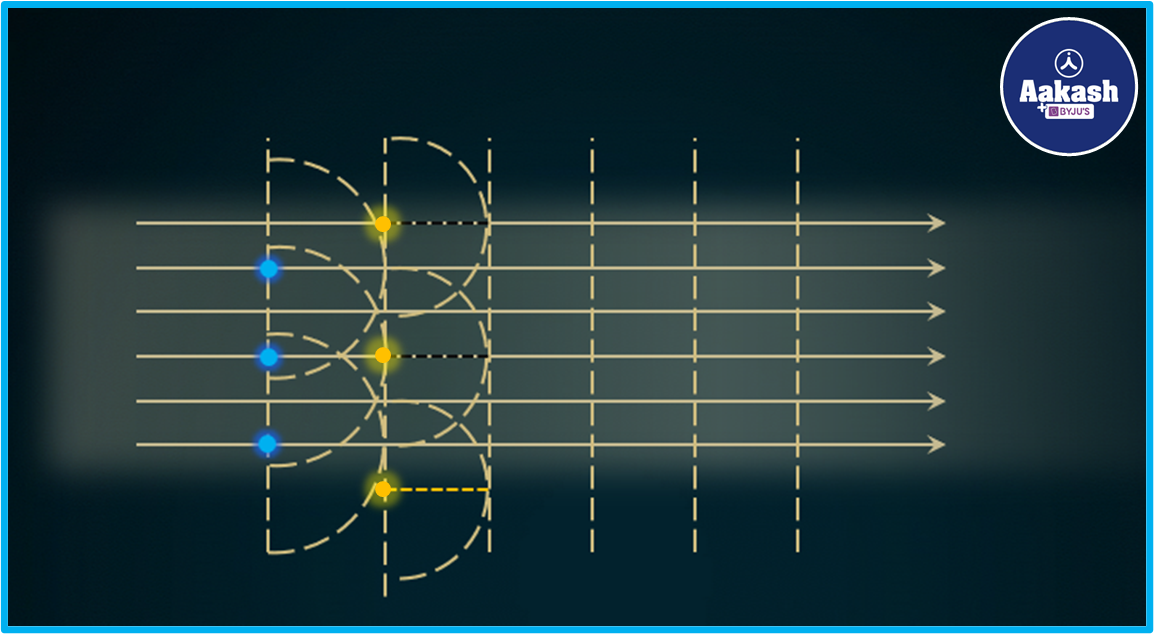
According to Huygens’s principle, every point on the wavefront is the source of a secondary disturbance and the wavelets originate from these points spread out in all directions with the speed of the wave. The wavelets originating from the wavefront are usually referred to as secondary wavelets and if we draw a common tangent to all these spheres, we obtain the new position of the wavefront at that time.The following figure well explains Huygens's principle.

Wave front
The locus of all points at which the wave disturbance is in the same phase is known as wave front.
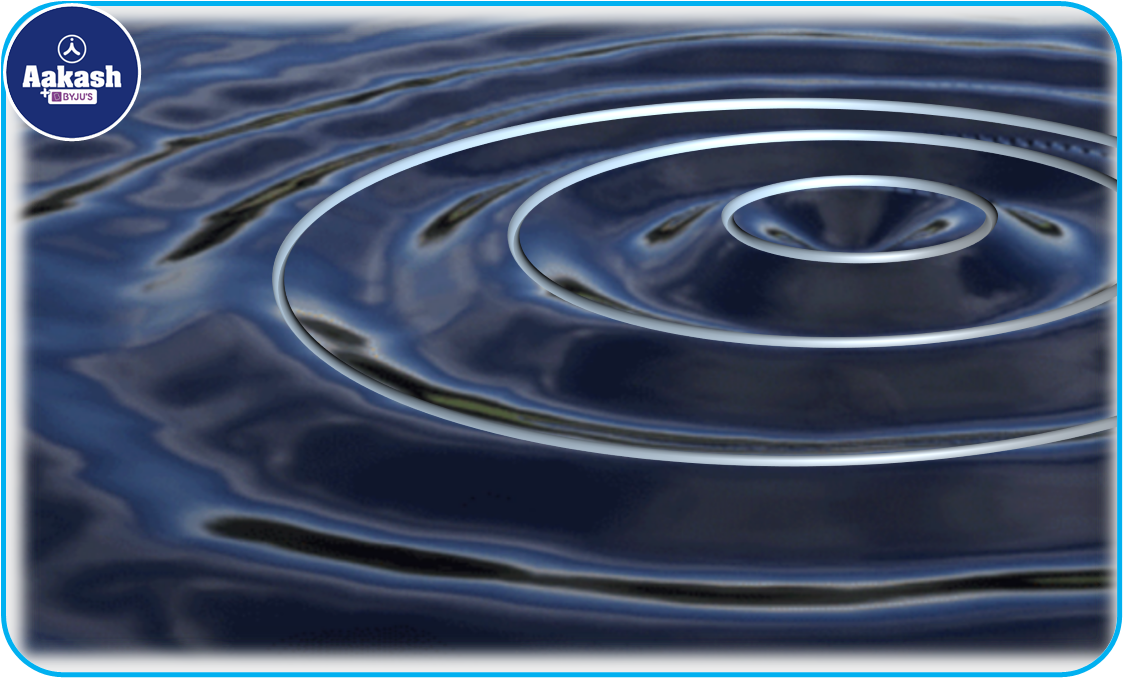
Let's say a small stone is dropped in still water, it produces circular disturbances in all directions as shown in the figure and the stone acts as the point source of producing the disturbances. All the points which are at the same distance from the source are in the same phase. Such a locus of points, which oscillate in phase, is called a wavefront.The wavefront for this case is circular wavefront.
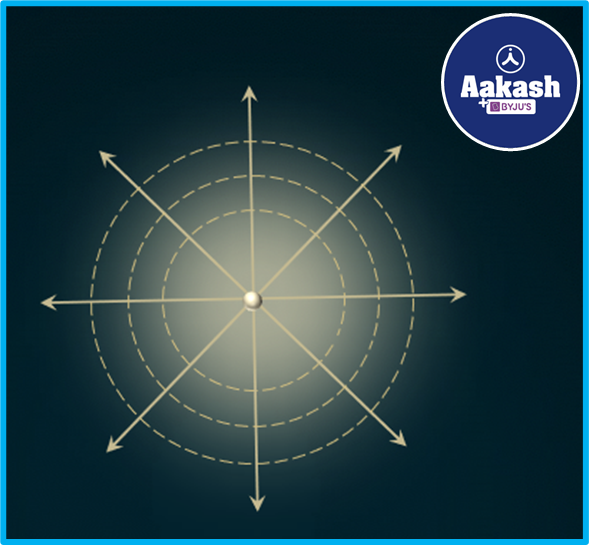
Now consider a point source of light placed in space. As the wave from the light source will travel in 3 dimensions, so the wavefront for this case will be a spherical wavefront.
If the source is at infinity, the wave front will be a planar wave front and the distance between the consecutive wavefront is the radius of spherical wavelets.
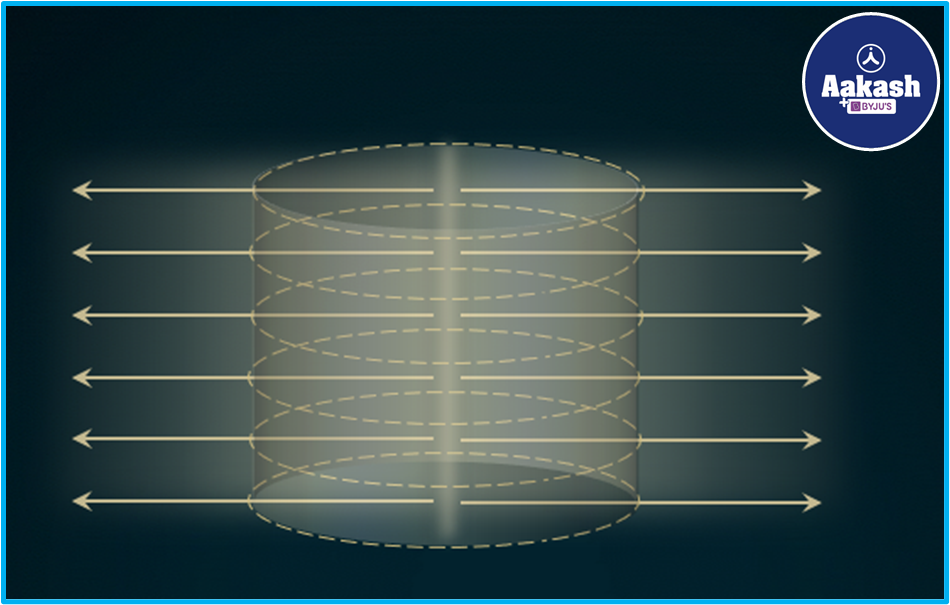
If the source is linear, the wave front will be a Cylindrical Wave front.
Primary and secondary wave front
If we join the locus of all the waves which are in the same phase, then it will represent the primary wave front. Now each point on the primary wavefront will act as a source of light and will produce the secondary wavelets. The envelope on these secondary wavelets in forward direction will give the secondary wavefront. The primary and secondary wavefronts are shown in this figure which is explained above.
Reflection of light using huygens’s principle
Consider a parallel beam of light incident on a reflecting surface at an angle of incident i. The wavefront associated with this beam of light is AB. When it reaches to the surface at point A', it is a source of secondary wavefront. As waves reflect in the same medium, so the speed of the wave will be the same. When the ray reaches from the point A' to D, in the same time the ray will travel from B' to C. And after the reflection the wavefront of the reflecting wave is CD.
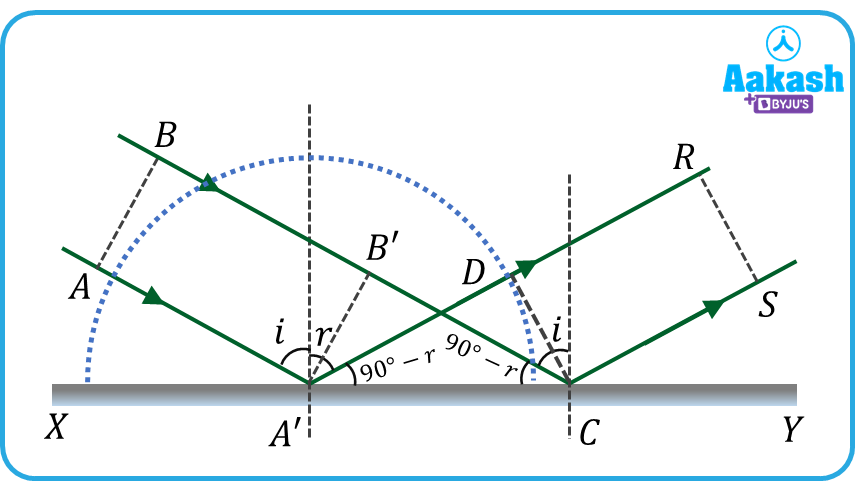
Now, time from A' to D = time from B' to C
A'D=B'C
A'C sin i=A'C sin r
i=r
Hence the angle of incidence is equal to the angle of reflection. This is the condition we obtain from the first law of reflection.
Refraction of light using huygens’s principle
Consider a wavefront AB when incident on a refracting surface XY, a refracting wavefront CB1 is obtained. When wavefront incident at a point A1 at an angle of incidence i, it will act as a source for the secondary wavefront. As the wave is refracted from air to glass the velocity of the wave will change. If the velocity of the wave in the air is v1 and velocity of the wave in the glass is v2 , then time taken to travel A1C will be equal to time taken to travel B'B1.
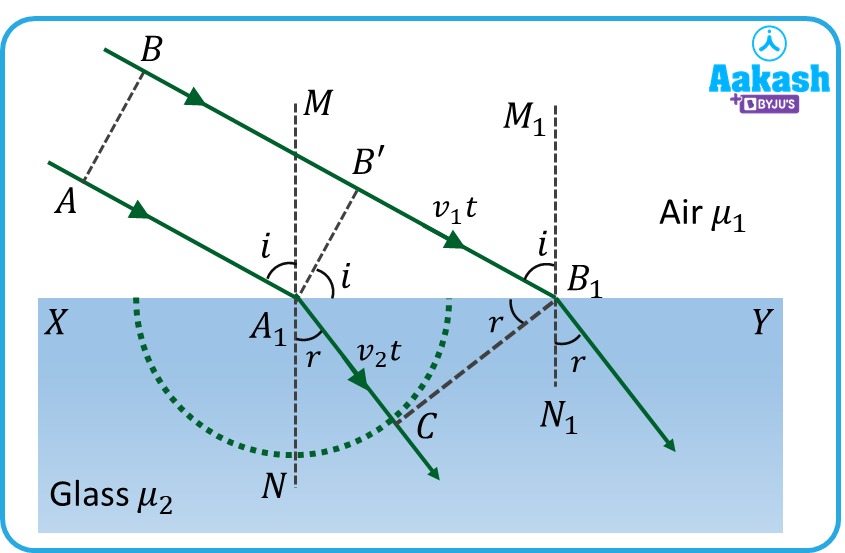
Hence time from A1 to C = time from B' to B1
This is the expression for the snell's law of the refraction of light.
Hence Huygens's principle explains both the phenomenon of reflection and refraction of light.
Practice problems
Q. What is the importance of Huygens's principle ?
A. Huygens’s principle helps in understanding the classical wave propagation of light. It also describes the various phenomena like reflection, refraction, bending of light at the sharp edges, diffraction of light, interference of light etc.
Q.As of Huygens’s principle, the ether medium pervading entire universe is:
- Not elastic
- Less elastic and denser
- High elastic and less denser
- Much denser
A. According to Huygens, light needs a medium called ether to propagate which is highly elastic and less dense. This is a hypothesis and has no proof. Hence, option (C) is correct.
Q. How does the sound bend around the corner of a building while light does not?
A. As the wavelength of the visible light is in the order of 0.5 microns, due to which light will only diffract when going through very narrow openings. Now the sound waves have a wavelength of the order 1 meter and diffract very easily.
Q. What are the various limitations of Huygens’s principle?
A. Huygens’s principle fails to explain the rectilinear propagation of light, concept of polarization, emission of light and absorption of light.
FAQs
Q. Huygens’s principle of the secondary wave
- Helps to find the focal length of the thick lens
- Is a geometrical method to find the wavelength
- Helps to determine velocity of light
- Helps to explain polarization
A. (B)
A new wave front is a tangential surface to all these secondary wavelets, so it is a geometrical method to find the wavelength.
Q. Huygens’s principle is applicable to radar waves, true or false?
A. It is a universal principle relating to wavefront formation, so applicable to radar waves also, hence true.
Q. Light coming from a half opened window spreads into the whole room can be explained by which principle?
A. It can be explained by Huygens’s principle. Each point on the wavefront acts as a secondary source and thus spreads the light.
Q. Why huygens’s principle cannot explain the photoelectric effect?
A. In photoelectric effect light is not considered as wave but considered to have particle nature.

 Call Now
 Let's Chat
 Share
Share