-
Call Now
1800-102-2727


Friction

A ball begins to move with some velocity when we throw a ball on the ground. However, in an ideal condition, there must be no forces exerting in the direction of motion, and the ball must continue rolling as per Newton’s first law, but it does not occur. Instead, the ball stops after moving a specific distance, determining the existence of external (pushing) force. This force is known as friction.
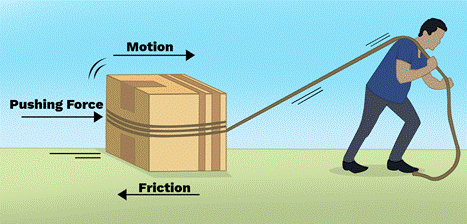
Image: Friction
Table of Contents:
- What is Friction?
- Types of Friction
- Factors Affecting Friction
- Significance of Friction
- Friction and Energy Loss
- Real-Life Applications of Friction
What is Friction?
The resistance provided by the surface when the object or body comes in contact during motion is called friction. To walk without being slipped, traction is supplied by friction. In most cases, friction is beneficial. However, they offer a huge amount of opposition to the motion. Furthermore, automobile engines utilise approximately 20 per cent of their power to overcome frictional forces in the moving parts.
The irregularities on the two surfaces that are in contact can cause friction. Thus, these surface irregularities become entangled if one object slides over another, leading to conflict. The higher the roughness, the more irregularities resulting in a higher friction rate.
Types of Friction
Friction is categorised into four types. They are as follows.
a. Sliding Friction
The force exerted on a moving object or body when it slides over the surface is known as sliding friction. You must have noticed sliding furniture becomes easier while shifting than the first time you initiated moving it. It happens because sliding friction is weaker than static friction. It includes-
- Friction exerted between brake pads and bike rims.
- Speedy car.
- Two cards are sliding over one another.
- Sliding objects across the floor.
- Opening the sliding doors or windows.
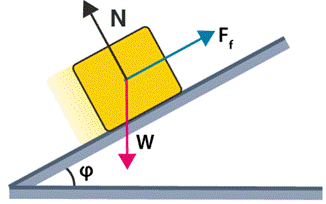
Image: Sliding Friction
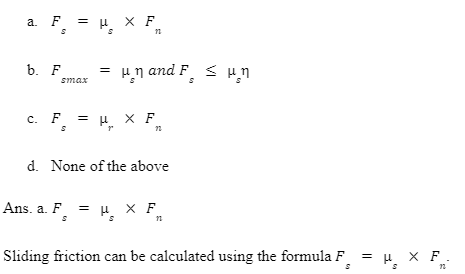
Coefficient of Sliding Friction: The formula for the coefficient of sliding friction can be illustrated as

Where Fs represents the sliding friction,
 denotes the coefficient of sliding friction, and
Fn determines the normal force.
b. Fluid Friction
When a body or an object moves through the fluid, the fluid exerts pressure against the body. The friction is called fluid friction. For example,
- Friction felt by the swimmer while moving forward in the water.
- The pen’s ink flow.
- Opening hands under the water flow
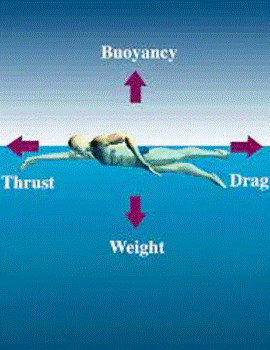
Image: Fluid Friction
c. Static Friction
Static friction is the resistance that exerts between two static surfaces when they are at rest. The amount of static force equals the opposite direction when a limited amount of force is applied to the body or object. When the force rises, the static force can often reach the saturation point. Examples of static friction include
- A lamp on the table
- Using paint rollers while painting the walls.
- When rubbing hands, heat is generated due to static friction.
- When hiking, static force exerts between shoes and the road.
- Ice skiing
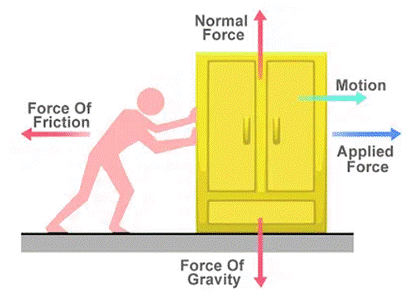
Image: Static Friction
Coefficient of Static Friction: Static friction value ranges from zero to the minimum force required to stop the body's motion. The minimum force required to begin the motion or control static friction is always greater or equal to the force required to overcome kinetic friction or retain motion. It can be expressed as

Where  represents the maximum static frictional force,
V denotes the normal forces exerted on the body,
is the static friction coefficient, and
Fs determines the static frictional force.
d. Rolling friction
The least effective form of friction, rolling friction, generates little friction between the surfaces. Thus, rolling friction is weak. You must have seen a bicycle, skates, and coasters employ wheels exerting less frictional force while in motion. Its weakness is mainly due to the energy loss while the object twists. For example,
- The rolling of logs on the floor.
- Automobiles while in motion.
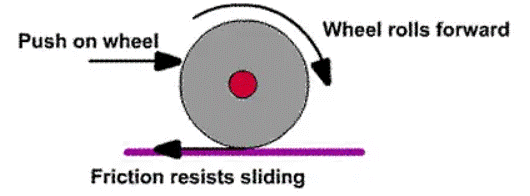
Image: Rolling Friction
Coefficient of Rolling Friction: The formula for the rolling friction can be expressed as

Where Fs denotes the coefficient of rolling friction,
 is the rolling frictional force, and
Fn represents the normal force.
Factors Affecting Friction
Frictional force relies on external factors. Mainly the two factors include-
a. Nature of two contact surfaces
The two surfaces in contact with each other indicate if friction will occur. If the surface is smooth, there will be weak interlocking of the irregularities that lowers the friction between the two surfaces. However, the more the rough surface, the higher the friction.
b. Force exerted on the surfaces
When force and irregularities are applied to the object, friction increases.
Significance of Friction
Friction is significantly important because of the following reasons:
- It aids in maintaining balance while walking.
- Helpful in gripping objects.
- Beneficial in writing and enabling us to hold the pen.
- Crucial in applying brakes to avoid accidents.
Friction and Energy Loss
It is important to keep in mind that friction also can have disadvantages. It can lead to energy loss through heat energy converted from kinetic energy. The energy loss causes surface wear and tear, deteriorating the efficiency of the system and machines. Thus, scientists and engineers strive to decrease friction and enhance performance and energy conservation.
Real-Life Applications of Friction
There are several real-life examples of friction. Some include-
- Sports
- Safety
- Drawing and writing
- Vehicle brakes
- Transportation
- Climbing and trekking
- Holding objects
Practice Problems
Q1. The correct formula for sliding friction is-
Q2. Static friction is _____ than sliding friction. Fill in the blank.
a. Weaker
b. Stronger
c. Less
d. None of the above
Ans b. Stronger
Static friction tends to be stronger than sliding friction.
Q3. Friction is
a. Vector quantity
b. Scalar quantity
c. Either a or b
d. None of the above
Ans. a. Vector quantity
Friction is a vector quantity possessing both magnitude and direction.
Frequently Asked Questions
Q1. State the difference between dry and lubricated friction.
Answer: Two solid surfaces in contact resist in their relative lateral motion due to dry friction. But a lubricating fluid disintegrates the two surfaces in the lubricated friction. They are the types of fluid friction.
Q2.State the difference between skin and internal friction
Answer: Both are two other forms of fluid friction. In drag, the force preventing fluid from smooth motion across the objects or body surfaces occurs due to skin friction. On the other hand, when a solid substance deforms, the internal friction world is a force that inhibits motion between the elements.
Q3. Is there any friction in space?
Answer: Friction, as we know it on Earth, does not exist in space since there is no atmosphere. There is no significant resistance or friction that things would encounter as they move through space in the absence of air or another medium. However, leftover gas particles or the gravitational forces of astronomical bodies can cause very minor friction, but these effects are exceedingly small in most cases.

 Call Now
 Let's Chat
 Share
Share