-
Call Now
1800-102-2727


Electric Generator-Diagram, Types, Practice problems, FAQs

Everyone feels the discomfort when power goes off. In order to have a constant source of power once electricity goes off, one needs to install generators in their houses. They were invented by Charles F Brush who used an electric lamp which supplies a constant voltage and thereby, a constant load current for running appliances. Generators are of two types, AC and DC. The latter supplies a constant current, also known as direct current – by which we mean a current which does not change polarity with time. On the other hand, AC generators use a time varying current with ever changing polarity called the alternating current. Depending upon the need, generators have different ratings. For instance, small business can run on AC generators which are rated 50 Volt Amperes. For larger power requirements like school buildings or malls, generators rated at 20 kiloVolt are required. The simplest form of generator one can imagine is the dynamo attached to bicycle tyres. It generates small electricity which can be used to run small appliances like bulbs attached to the bicycle. In this article, we will explore electric generators in detail.
Table of contents
- What is an electric generator?
- Principle of AC generator
- Construction and working of AC generator
- DC generator
- Practice problems
- FAQs
What is an electric generator?
A generator is a device that is used for converting mechanical energy into electrical energy. The input mechanical energy is supplied by turbines or engines–that are usually run by natural gas or diesel fed into the combustion chamber.
Principle of AC generator
An AC generator works on the principle of Faraday’s laws of electromagnetic induction. When a coil is rotated in a magnetic field, the magnetic flux linked to the coil changes with rotation (that cuts the coil at different angles). This in turn produces an emf in the coil causing a current to flow. The induced current is transferred onto the windings which supplies current to the rest of the external circuit.
Construction and working of AC generator
An AC generator produces a changing magnetic flux linked with the coil by rotating the coil in a static magnetic field or rotating magnetic field in a stationary conductor. We use AC generators in our everyday life. They are capable of supplying current at 220 V, 50 Hz. A typical AC generator consists of the following parts:
1) Magnetic field
The necessary magnetic field is provided by horseshoe magnets. It consists of two horse-shoe magnets which supply a strong magnetic field which starts radially from the North pole and ends in the South Pole.
2) Armature
Armature is a rectangular coil with many turns wound over a soft-iron core. The soft iron core provides the necessary support for the armature. The axis of rotation of the coil is perpendicular to the magnetic field.
3) Rotor
The rotating component of a generator is called its rotor.
4) Stator
The stationary part of a generator is called its stator. It does not move. It is laminated to protect against eddy currents losses.
5) Slip rings
Slip rings are used to transmit electrical energy from the armature coil to the brushes.
6) Brushes
Carbon brushes are made of graphite. They are permanently in contact with the slip rings and they are connected to the external circuit.

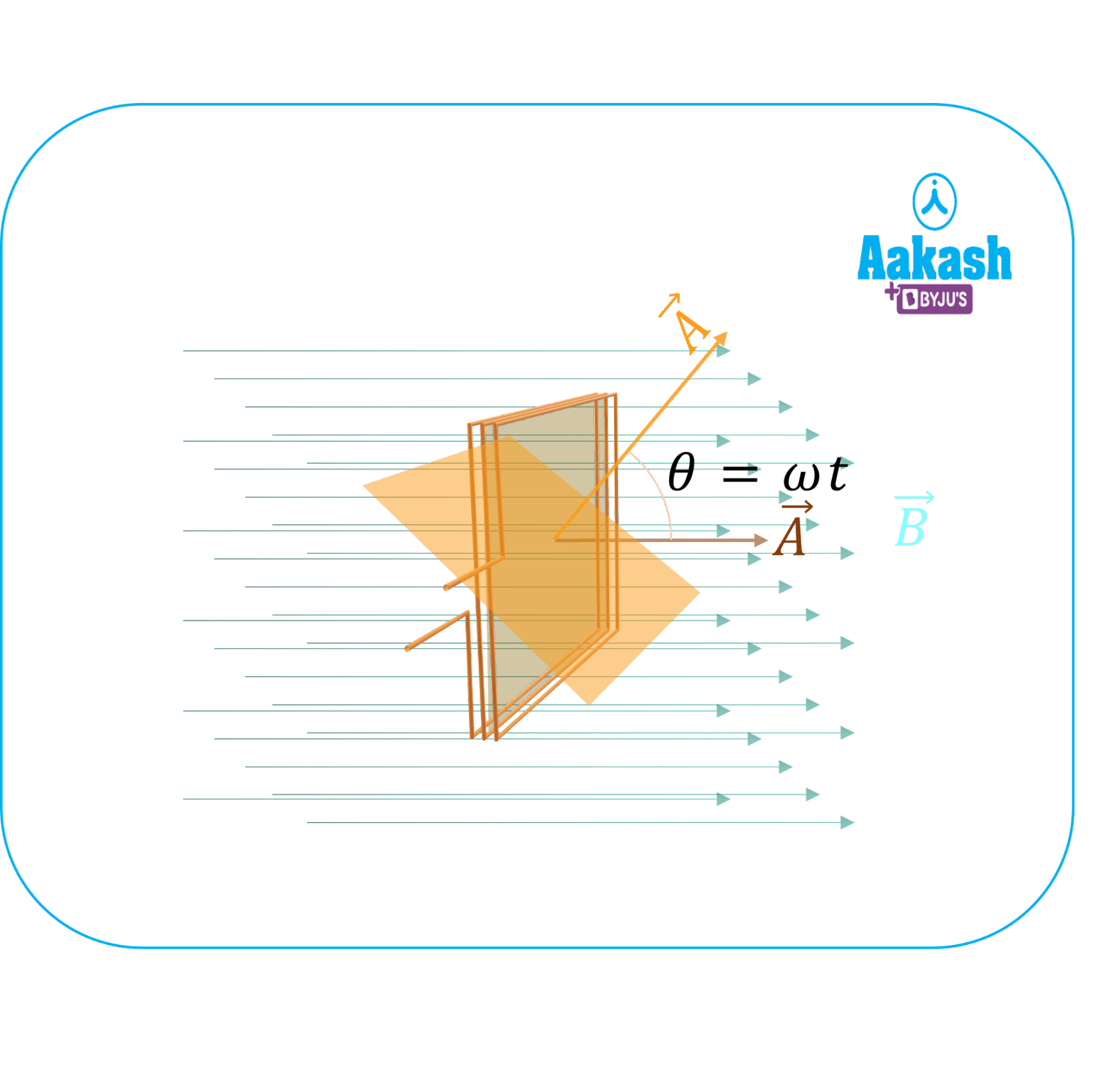
Let us consider an armature coil having N turns placed in a magnetic field B.. The area of cross section of the coil is A. Upon rotation, the coil makes an angle with the area vector of the coil. Here w is the angular velocity of the coil.
When the armature coil rotates, the flux lined with it can be written as
Now according to Faraday’s law, the induced emf can be written as,
indicates the maximum value of emf.
Equation (i) shows that the induced emf varies sinusoidally with time.
The maximum value of induced current
Where R indicates the resistance of the armature coil.
where T indicates the time period of the coil rotation in seconds. It is the time taken for one full rotation. is the frequency of rotation (in Hz).
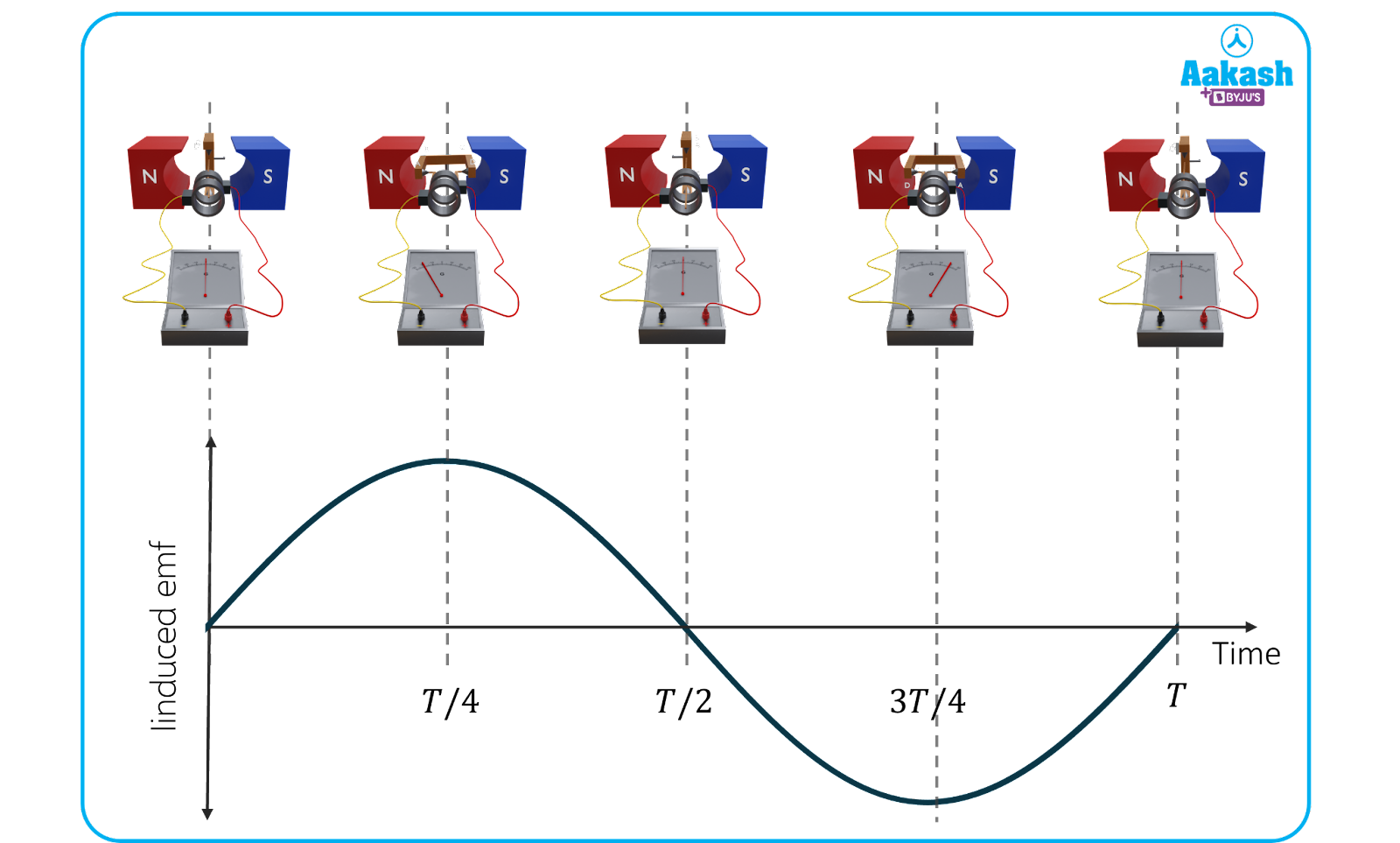
The induced emf can be written as
When , emf is minimum, hence there will be no induced current.
When …. emf will be maximum. So, there will be maximum induced current.
DC generator
The DC generator is also used to convert mechanical energy into electrical energy. They produce a unidirectional current called direct current. Unlike an AC current, it does not change polarity with time. In other words, it is not bidirectional. DC generators do not contain slip rings like AC generators have. Instead they use commutators to convert a bidirectional current into a unidirectional current. Additionally, the brushes used in DC generators wear out much quicker unlike AC generators.

1) Stator
It is the stationary part consisting of many windings. It supplies the necessary magnetic fields for the coil.
2) Rotor
It is the rotating part which consists of an armature, commutator and a shaft. It is moveable – and rotates in the magnetic field produced by the stator.
3) Bearings
It is used for minimising the friction between the stationary and the rotating parts of the machine. It is usually made up of carbon steel. This also provides support to the system.
Practice problems
Q1. In a region where the magnetic field has a value of 10-3 T, a circular coil of radius 60 cm and resistance is rotated about an axis which is perpendicular to the magnetic field. If the speed of rotation of the coil is 250 rpm, the amplitude of the alternating current induced in the coil is,
(a) 1 A (b) 2 A (c) 3 A (d) None of these
Answer. c
Given
r=0.6 m
R=
N=1
=250 rpm=
Area of the coil
Max. emf
Induced current,
Q2. The magnetic flux between the poles of a horse magnet varies with time t as . Calculate the induced emf at time t=2 s.
(a) 14 V
(b) 12 V
(c) 10 V
(d) None of these
Answer.
|
At
Q3. A rectangular loop having area 600 cm2 and resistance 10 is used in an AC generator. A magnetic field of 0.20 T exists between the poles. The angular velocity with which it is rotated is The number of turns in the coil is 100. What is the maximum current produced in the coil during this interval?
(a) 3 A
(b) 4 A
(c) 1 A
(d) None of these
Answer. a
Area
N=100
B=0.2 T
Maximum induced current i0=
Q4. The magnetic field in the armature coil of a AC generator varies with time according to the relation 0 is a positive constant. If r denote the radius of the coil, then calculate the induced emf as a function of time. Consider the coil as stationery.
(a)
(b)
(c)
(d)None of these
Answer. a
Area of the coil,
Since the magnetic field varies with time,
Induced emf
FAQs
Q1. Write three advantages of AC over DC.
Answer. AC can be transmitted over long distances compared to DC. AC undergoes lesser power losses in comparison to DC.
Q2. Which rule is used to find induced emf in a generator?
Answer. Fleming’s Right hand rule is used to find direction of induced current in a generator. Stretch the three fingers of your right hand mutually perpendicular to each other, the forefinger indicates the direction of magnetic field, the middle finger indicates the direction of induced current, and the thumb indicates the direction of force on the conductor.
Q3. Why is DC not used in homes?
Answer. For the same value of voltage, DC is more dangerous than AC, since it never reaches a zero value at any instant of time. Having an unidirectional nature, it is prone to cause more damage than DC.
Q4. Mention 3 mistakes one should never make with a DC generator.
Answer. The three mistakes could be,
1) For a liquid fuel power generator for home use, we should not fuel up the generator while operating.
2) Improper powering on and off can damage the armature coil.
3) Using poor quality fuel can reduce the life of the generator as the carbon content of the fuel can even create a short circuit in the spark plug.

NEET Related Links
JEE MAIN Related Links
JEE Advanced Related Links
JEE Advanced Eligibility Criteria
JEE Advanced Chemistry Syllabus
JEE Advanced Registration Dates
CUET Related Links
Important Topics
Anemometer : Measurement of Wind Speed
Angular Acceleration Atomic Theory Audible and Inaudible Sound Average Speed and Average Velocity Average Velocity Avogadros Number Avogadros Hypothesis Azimuthal Quantum Number Balanced Force Bar Magnet Biconvex Lens Boyles Law Buoyancy Calorimeter Carnot Engine Celestial Bodies Centripetal And Centrifugal Force Concave and Convex Lenses Concave Convex Mirrors Contact and Non Contact Force Controlled Thermonuclear Fusion Convection Currents Convex Lens Convex Mirror Destructive Interference Difference Between Conduction Convection and Radiation Difference Between Electric Field and Magnetic Field Difference Between Heat And Temperature Difference Between Series And Parallel Circuits Differences Between Acceleration And Velocity Distance and Displacement Distance Time Graph Electrical Force : Electric Forces and Their Types Electromagnetic Waves : Definition, Equation and Properties of Electromagnetic Waves Electromagnetism Electron Spin Fluid Flow : Bernoullis Equation Derivation and Fluid Mechanics Fluid Friction : Types and Factors of Fluid Friction Frames of Reference : Inertial and Non- Inertial Frame of Reference Frequency and Wavelength Frictional Force Importance of Hydrosphere Instantaneous Speed and Velocity Introduction to Motion Kinetic and Potential Energy Difference Law Of Conservation of Energy Layers of the Earth Light Energy Light Sources List of physics scientists and Their inventionsLoudness of Sound
Magnetic Dipole Moment Magnetic Field Non - Contact Force Non - Renewable Energy Ohms Law Optics P Wave Physics Symbols Plane Mirrors Poissons Ratio Projectile Motion Properties of Water : Anomalous Expansion of Water Radius of Gyration Reflection of Light Reflection of Waves Relative Density Resonance Reverberation Rolling Friction Rotation and Revolution Screw Gauge Semiconductors and Insulators Sliding Friction Speed Time Graphs Static Friction Stefan Boltzmann Law Stress Tension Tension Force Thermometer: Clinical Laboratory Thermometer Types of Rocks Types of Waves Uniform Motion and Non Uniform Motion Unit of Voltage Uses of Convex Lens Uses Of Convex Mirror Uses of Electromagnet Uses of Optical Fibre Wave Wavelength of Light What is Scattering of Light Working of Electric Bell Conventional and Non-conventional Sources of Energy Buoyant Force Bulk Modulus of Elasticity Bernoulli’s Principle Angular Momentum Difference Between Speed And Velocity ForceUnit of Heat
Difference between Distance and Displacement Simple Microscope Derivation Of Equation Of Motion Thermometer: Clinical & Laboratory Thermometer Difference between Concave and Convex LensDerivation Of Lens Maker Formula
Unit Of Pressure Velocity Uses of Plane Mirror
Wave Theory of Light
Unit of Density Unit of Light Unit of Force Unit of Magnetic Field Unit of wavelength Unit of Viscosity Uses of Electroplating Young's Modulus
What is the Scattering of Light
Lenz Law Space Wave Propagation Schrodinger Wave Equation Relation between Fahrenheit and Celsius Refractive Index Potentiometer Working Pascal Law Oscillatory Motion Optical Instruments Newton's Laws of Motion - First Law Modulation and Demodulation Magnetic Flux Lens Formula and Magnification Kaleidoscope Faradays Law Epsilon Naught Value Energy Bands Electrostatics Electroscope AC Generator Unit of Current Lithosphere Bending Equation Derivation Difference Between Pound and Kilogram Semiconductor Devices OTEC - Ocean Thermal Energy Conversion Hall Effect Rectilinear Propagation of Light Difference Between Ammeter and Voltmeter Coefficient of Linear Expansion Ampere’s Law Cyclone and Thunderstorm Save The Environment From Pollution Particle Nature of Light Types of DC Motor Uses Of Transistor Derivation of Phase Rule Unit of Humidity

 Call Now
 Let's Chat
 Share
Share