-
Call Now
1800-102-2727


Electric field - Electric field lines, Variation of Electric field intensity (E) with Distance (r), Dimension of electric field intensity, Practice Problems, FAQs

When a stream of water flows in a river or in a passage, we can feel the current. Even a particle when put in the water gets carried with it. The same happens with an electric field. It is like a stream of water flowing in a region. When a positively charged particle is put in the stream, it gets carried away in that direction.
Have you ever thought of how a charged particle will affect another charged particle? Will it attract or repel? Even if it does, how does the force of attraction or repulsion vary? This can be understood with the help of the concept of electric field and field lines.
Table of content:
- Electric field
- Electric field lines
- Variation of Electric field (E) with Distance (r)
- Unit of electric field intensity
- Practice Problems
- FAQs
Electric field
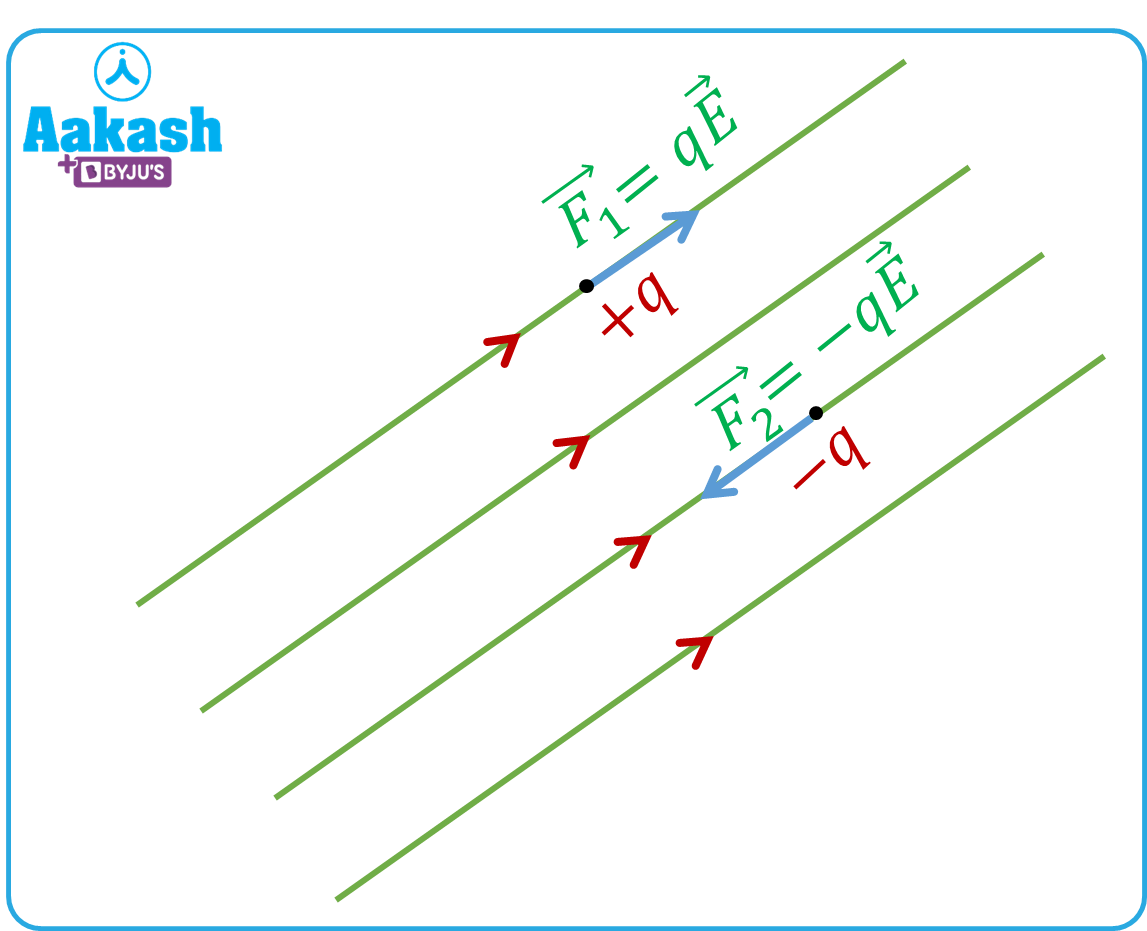
Electric field intensity is defined as the force experienced by a unit charge placed in the field.
If a positive charge is placed in the field the force will be in the direction of the field and in case of a negative charge the force will be in the opposite direction.
An electric field exists in those regions where an electric charge experiences electrostatic force.
When a charged particle is placed in an electric field, it experiences an electrostatic force. In the electric field of a positive charge, if another unit positively charged particle is placed, then it experiences a repulsive force in that electric field.
On the other hand, if a unit negatively charged particle is placed in the electric field of a positive charge, then the unit negative charge will experience an attractive force towards the positive charge.
The force of attraction or repulsion can be derived from the formula,
F=qE where q is the charge of the body under consideration and E is the electric field.
Electric field lines
To visualize the electric field, Michael Faraday introduced the concept of electric field lines or electric lines of force. The electric field lines emerge radially outward from a positive charge. However, the electric field lines go radially inward in case of a negative charge.
When one positive and one negative charge are placed close to each other, the electric field lines appear to be coming out from the positive charge and going into the negative charge.
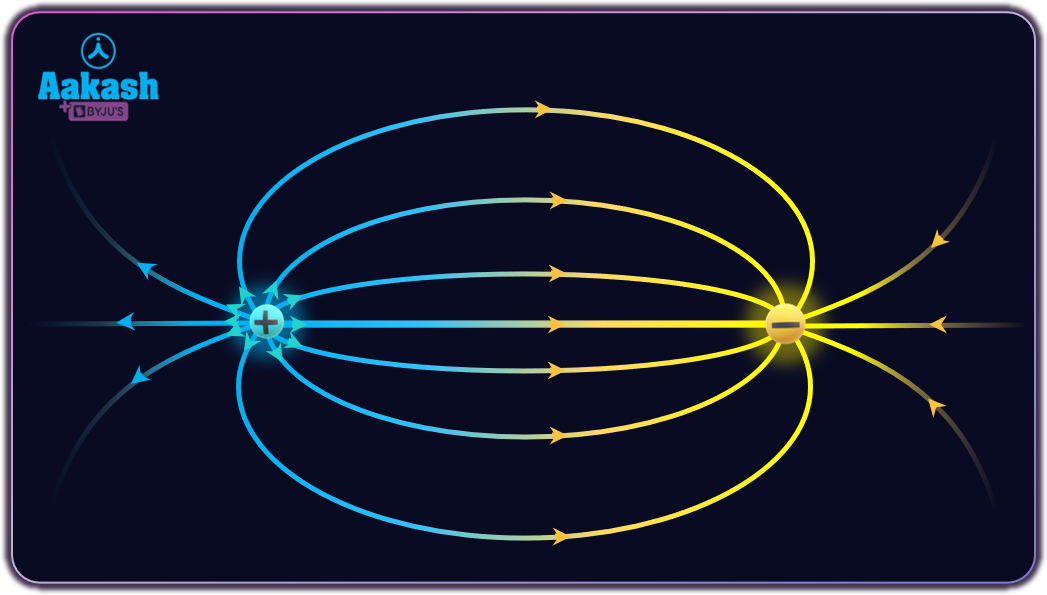
At any point, the electric field intensity is the force experienced by a unit positive charge placed at that point.
Let, a positive charge which is the source charge and a positive charge +qo which is a test charge. When the positive test charge is brought to the electric field of the source charge, it will experience an electrostatic force. The direction of the force experienced by the positive test charge gives the direction of the electric field.
As the source charge is positive, the direction of the electric field is radially outward.
Variation of Electric field (E) with Distance (r):
The intensity of the electric field is given by
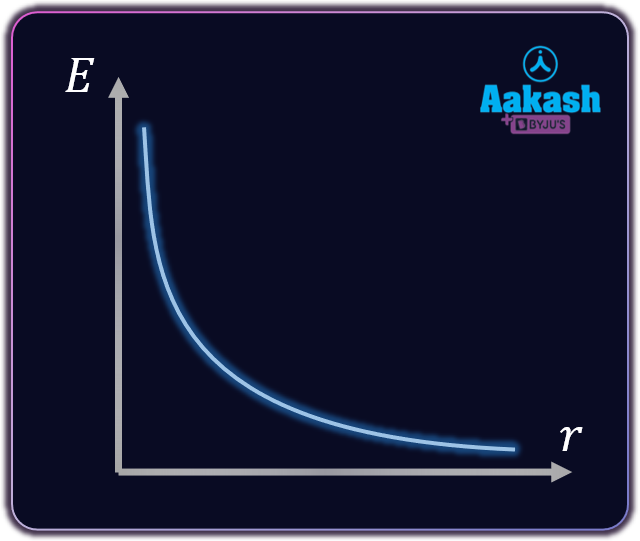
From the equation, we can observe that the electric field intensity is inversely proportional to the square of the distance between them.
The electric field is independent of the test charge but depends on the source charge.
E ∝ q
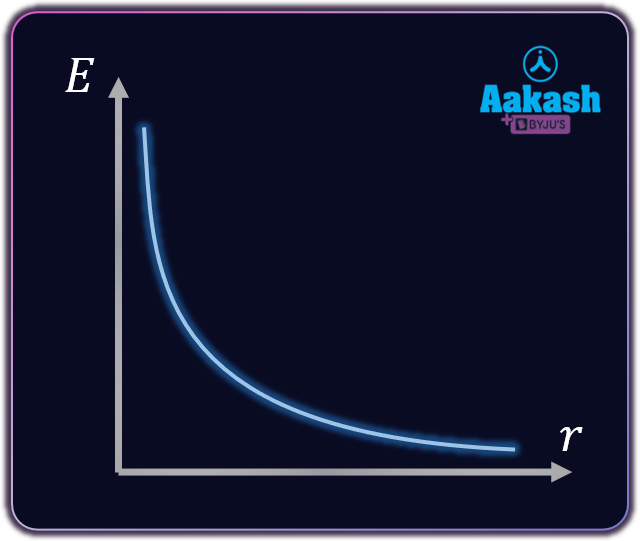
The graph between the electric field (E) and distance (r) for a positive point charge, will look like,
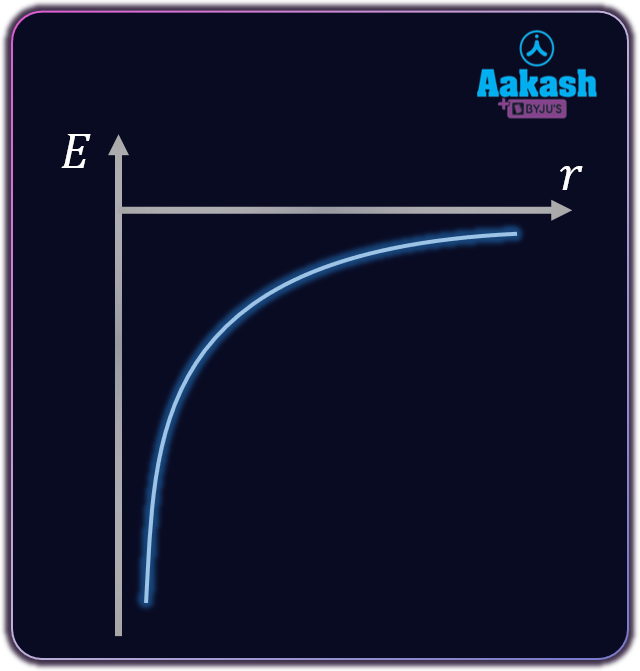
Now consider a positive test charge +qo is placed at distance r from the source charge –q.
The electric field intensity is given by,
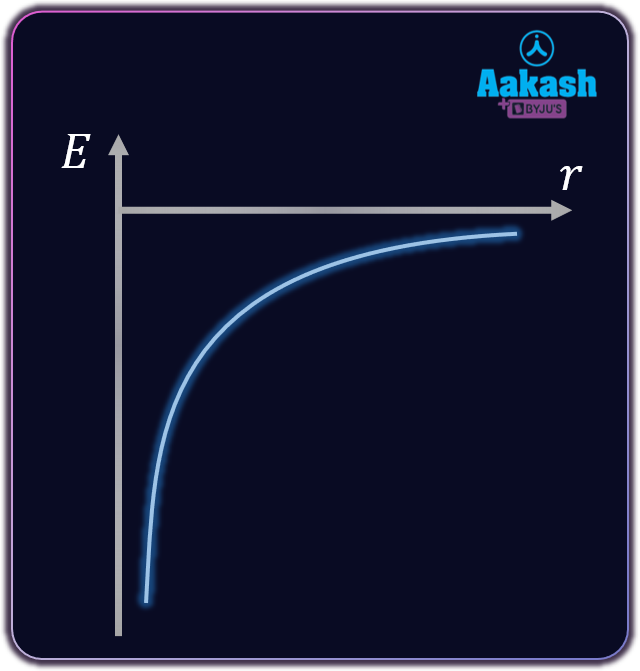
The graph between the electric field (E) and distance (r) for a negative point charge, will look like,
Unit of electric field intensity
The unit for field intensity in SI system of unit is NC-1
Practice Problems:
Q. What will be the electric field at a distance of 3 m from a point charge of +3 C ?
A. The electric field,
Q. What will be the electric field at a distance of 10 m from a point charge of -2 C ?
A. The electric field,
Q. At a particular point the electric field is 4 NC-1 . What will be the acceleration induced to a charged particle of mass 1 g carrying charge +1 C ?
A. The force experienced by the charged particle will be,
The acceleration will be,
Q. Deduce the dimension of the electric field intensity.
A. Electric field intensity can be quantified as the electrical force experienced per unit test charge.
So,
The dimension of force (unit N) is [MLT-2]
The dimension of charge (unit C) is [AT]
So,
FAQs
Q. For an isolated negative charge from where do the field lines come inside it ?
A. In case of an isolated negative charge, the field lines originate from infinity and end on the negative charge itself. These are just imaginary lines to visualize what would have been the direction of force on a positive charge due to this charge.
Q. What will be the direction of electric field lines from a positive point charge?
A. The electric field lines come out radially from a positive point charge. In case of an isolated positive point charge, the electric field lines will emerge from the point charge as if it is a source and go in all directions, radially.
Q. What will be the direction of electric field lines from a negative point charge?
A. The electric field lines go radially into a negative point charge. In case of an isolated negative point charge, the electric field lines will go inward into the point charge as if it is a sink and go inwards from all directions, radially.
Q. Draw a graph showing the variation of electric field intensity with distance from a positive charge.
A. For a positive point charge q, the electric field at a distance r is
where the test charge q0 is under the influence of that charge q
And
So, the graph will be as bellow
Q. Draw a graph showing the variation of electric field with distance from a negative charge.
A. For a negative point charge -q, the electric field at a distance r is
where the test charge q0 is under the influence of that charge q
And
So, the graph will be as bellow

 Call Now
 Let's Chat
 Share
Share