-
Call Now
1800-102-2727


Earth’s magnetism, magnetic declination, angle of dip, neutral points, practice problems, FAQs

Once Vasco de Gama found that the Atlantic ocean and Indian ocean were connected, he started his exploration for India to trade spices, silk, gold etc and reached India in less than a year. But what made the exploration efficient was the navigational instruments like compass. To know about how the compass led the seafarer like him to steer the right course through such vast oceans, you might want to know its working first.
one of the oldest navigation instruments called a magnetic compass. Magnetic compass uses Earth’s magnetic field and thus helps the seafarer to steer the right course.
Table of contents
- Earth’s Magnetism
- Magnetic poles
- Magnetic declination
- Angle of dip(inclination)
- Components of Earth’s magnetic field
- Neutral points
- Practice problems
- FAQs
Earth’s Magnetism
- Earth has magma inside its core which contains charged particles in the convection currents of molten metals like nickel and iron. These materials move and rotate with the rotation of Earth. Thus, forming the effect of a magnetic field due to the current carrying loop. This is one of the possible explanations for the earth’s magnetic field.
- For simplicity in understanding we consider that there’s a large magnet inside the earth that is responsible for the earth’s magnetic field.
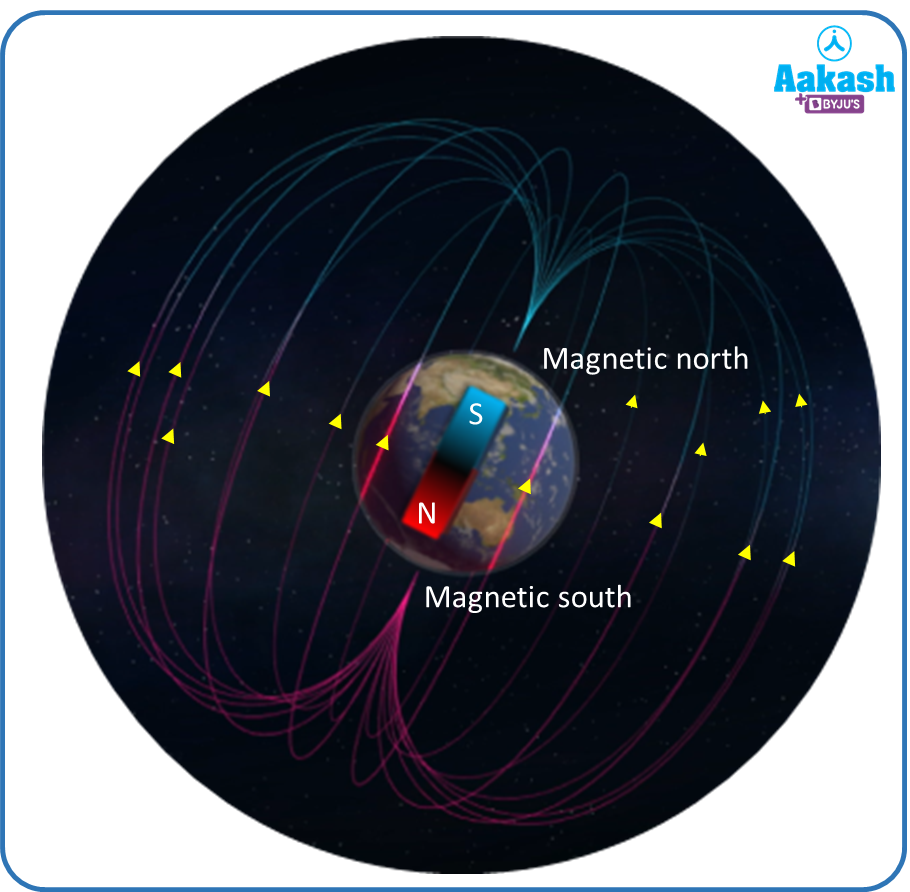
- Earth’s magnetic field saves us from solar storms. The magnetic field deflects solar wind from the sun which would otherwise affect the ozone layer which is responsible for protecting the earth from UV radiation.
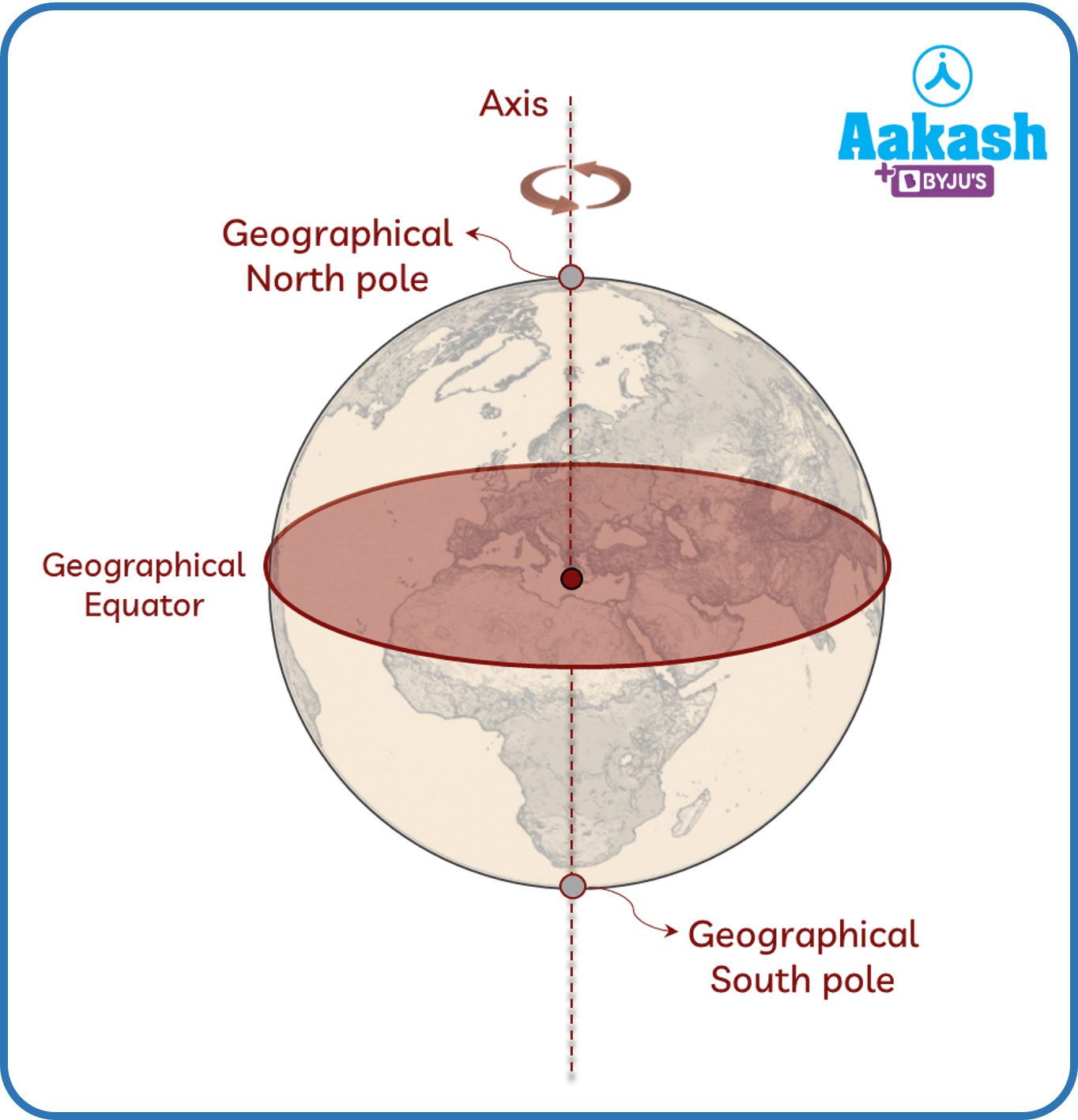
- The imaginary line joining the geographical north pole and south pole is called the axis of the earth.
- Geographic meridian : It is a vertical plane passing through the geographic north-south direction. It consists of longitude circle and axis of rotation of the earth.
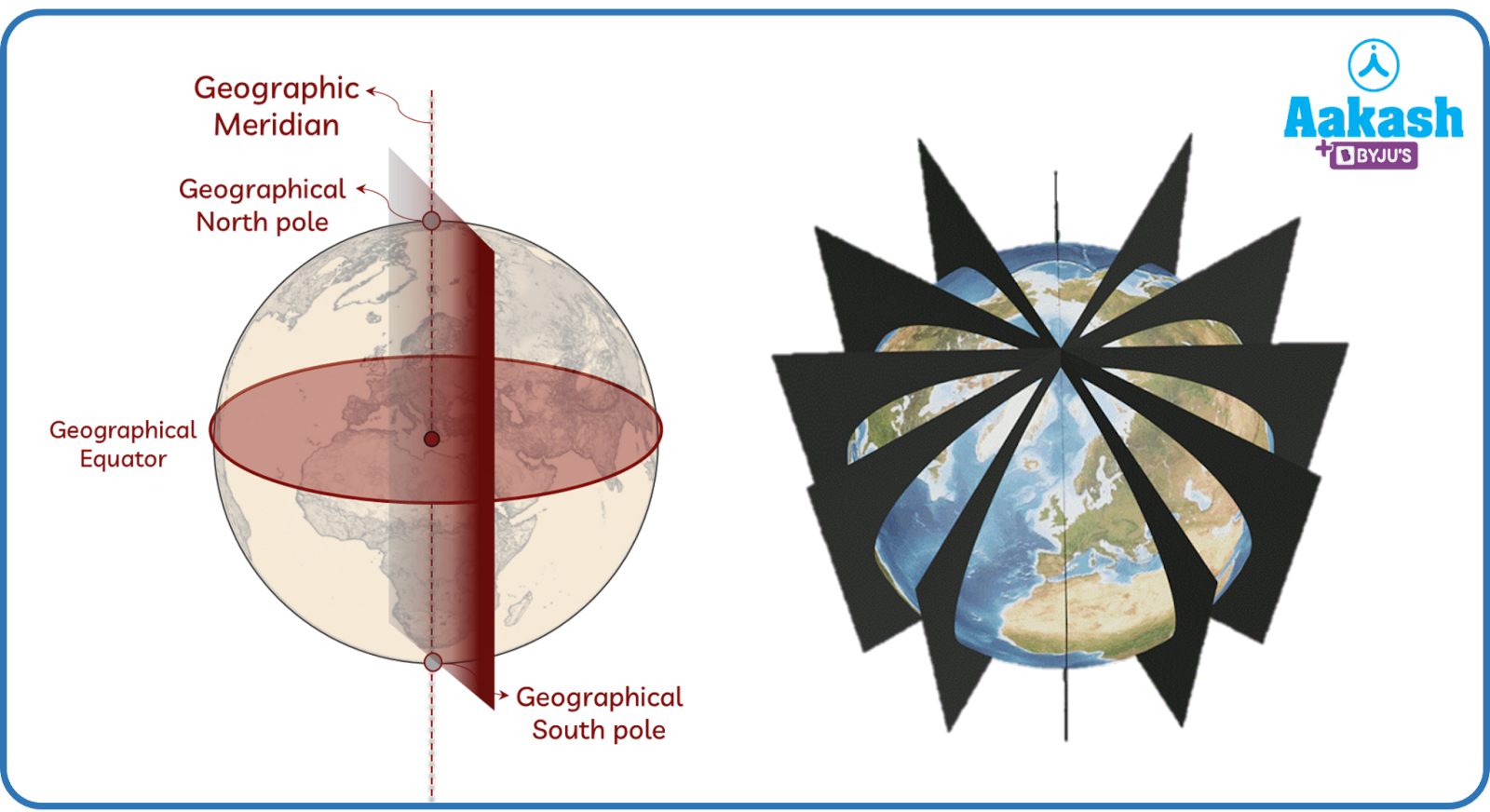
(ketan dhamodey Please show the Geographic meridian arrow towards the vertical plane)
As shown in the image above, Earth can be divided into many such geographic meridians, i.e., the plane containing the axis at the centre.
- Horizontal planes are called the geographical equator.
- Earth’s magnetic field can be approximated by a giant bar magnet (magnetic dipole) of magnetic moment 8 1022 J /T located at its centre.
Magnetic poles
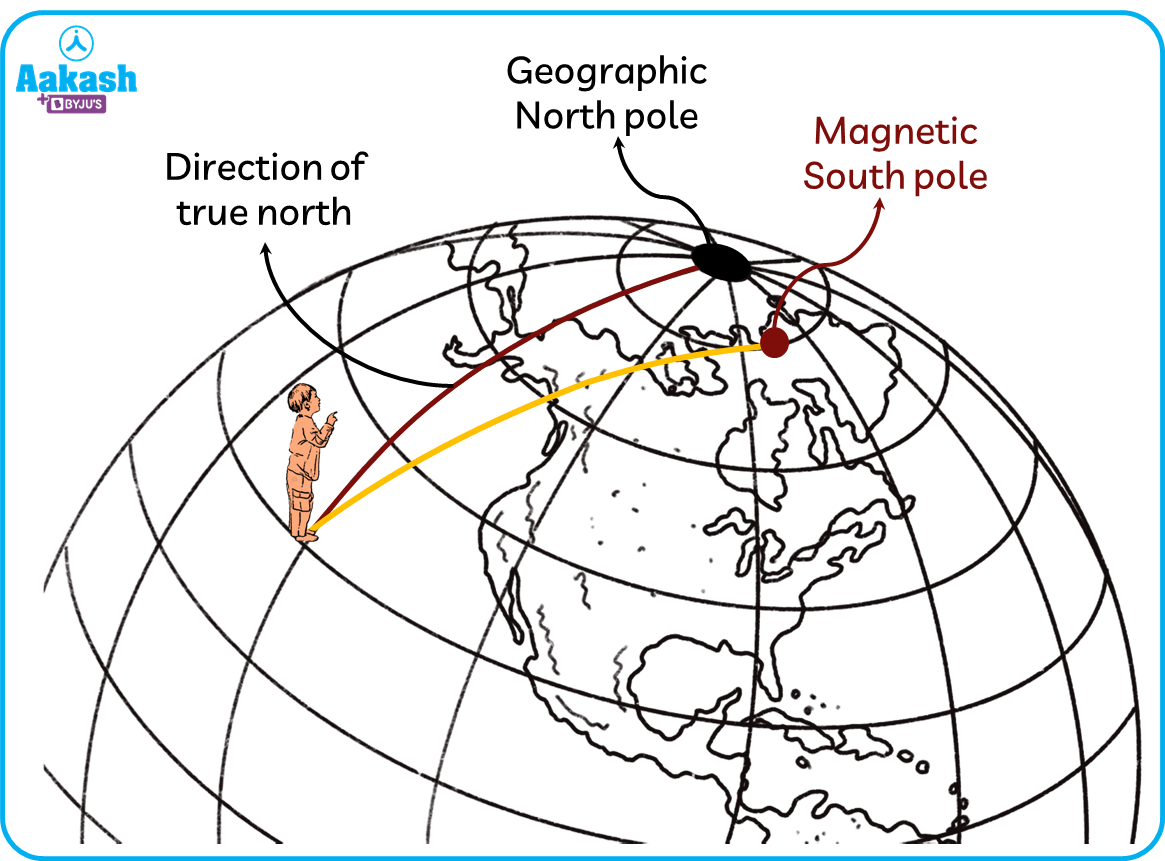
- A magnetic compass does not point to the geographic north pole.
- A magnetic compass points to the earth's magnetic poles, which are not the same as earth's geographic poles.
- Poles of Earth’s magnet are opposite to the magnetic pole and geographic pole of the earth.
- Towards the geographic North pole the magnetic South pole is there. That's why the north of the free magnet points towards the arctic because there is an earth magnetic South pole. Since in ancient times the North of the magnet pointed towards arctic we called it as North pole
- The north magnetic pole is located at a latitude of 79.74° N and a longitude of 71.8° W, a place near north Canada. The magnetic south pole is at 79.74° S and 108.22° E in Antarctica.
- The magnetic axis makes an angle of 11.5° with the Axis of Rotation.
- The magnetic meridian is a line joining the magnetic north pole with the magnetic south pole inside the earth. The magnetic field at any point on the surface of the Earth is in the plane of the ‘magnetic meridian’ at that point. The angle is the angle of declination.

Magnetic Declination
- The angle made by the magnetic meridian at a point with the geographical meridian is called Declination at that point. Its value is more at higher latitude and smaller near the equator.
- As we move closer to the pole, the gap between the meridians increases and therefore the magnetic declination increases.
- The declination in India is small. It is 0°41' E at Delhi and 0°58' at Mumbai. It means here the compass needle tells true north quite accurately.
Angle of Dip (Inclination)
- If we hold a bar magnet in a horizontal plane at any point on the surface of the earth it will rotate to align itself to the magnetic north pole of the earth due to horizontal component of earth’s magnetic field.
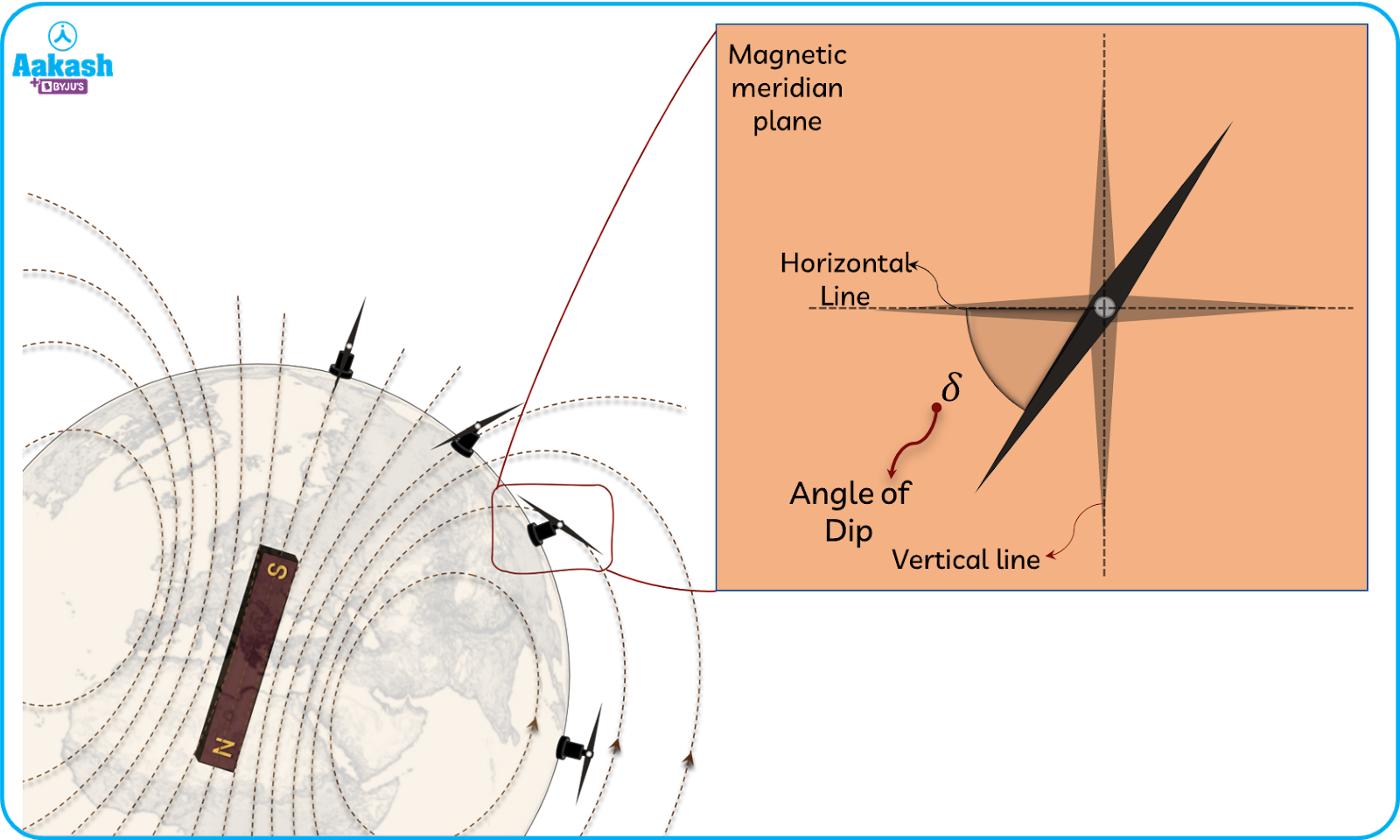
- Angle of dip is the angle made by the earth’s magnetic field lines with the horizontal.
(Remove the markings and I from the image)
- When the needle is allowed to rotate in a magnetic meridian plane, the angle made by the needle with the horizontal is known as the angle of dip.
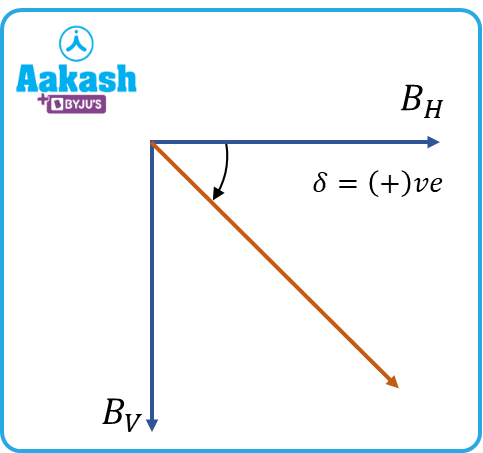
- Dip is positive at any point in the northern hemisphere of the earth whereas it is negative in the southern hemisphere.
In the northern hemisphere,
In the southern hemisphere,
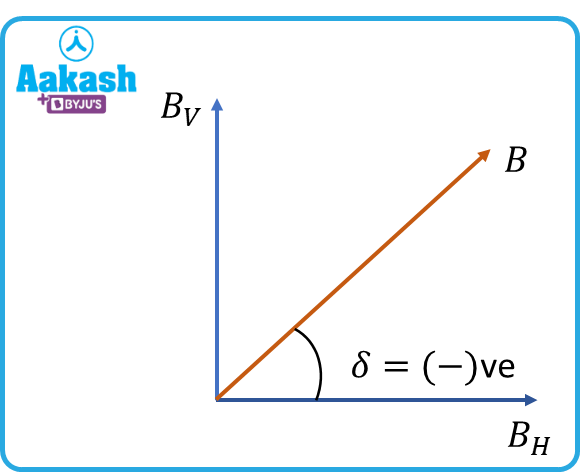
- At the magnetic equator: =0o and at magnetic poles =90o, (since magnetic field lines become vertical and terminate at the poles).
- Dip metre is an instrument used to measure the angle of dip by measuring the angle made by the magnetic needle with the horizontal. The plane of the dipmeter should be in the plane of the magnetic meridian plane.

Components of Earth’s magnetic field
- The component of Earth’s magnetic field (BE) along the vertical is called the vertical component(BH).
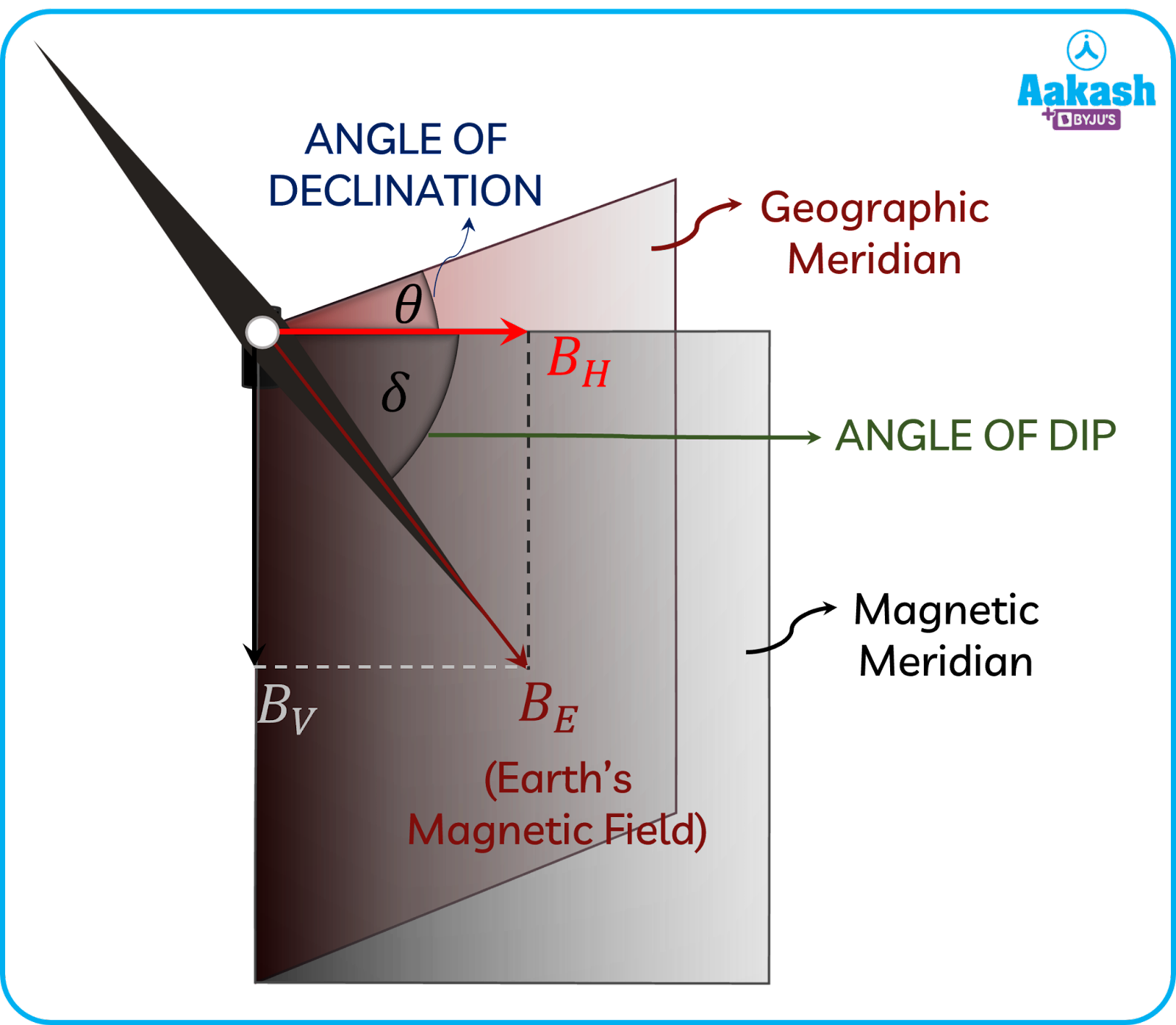
Horizontal component of earth’s magnetic field, BH=𝐵E ...........(i)
- The component of Earth’s magnetic field (BE) along the vertical is called the vertical component(BV).
Vertical component of earth’s magnetic field, BV=𝐵E ...........(ii)
Also dividing equation (ii) by (i),
A magnetic compass shows true dip angle in the magnetic meridian. If the needle is deflected from the magnetic meridian by some angle (say ) the dip angle changes. The dip at this position is called the apparent angle of '.
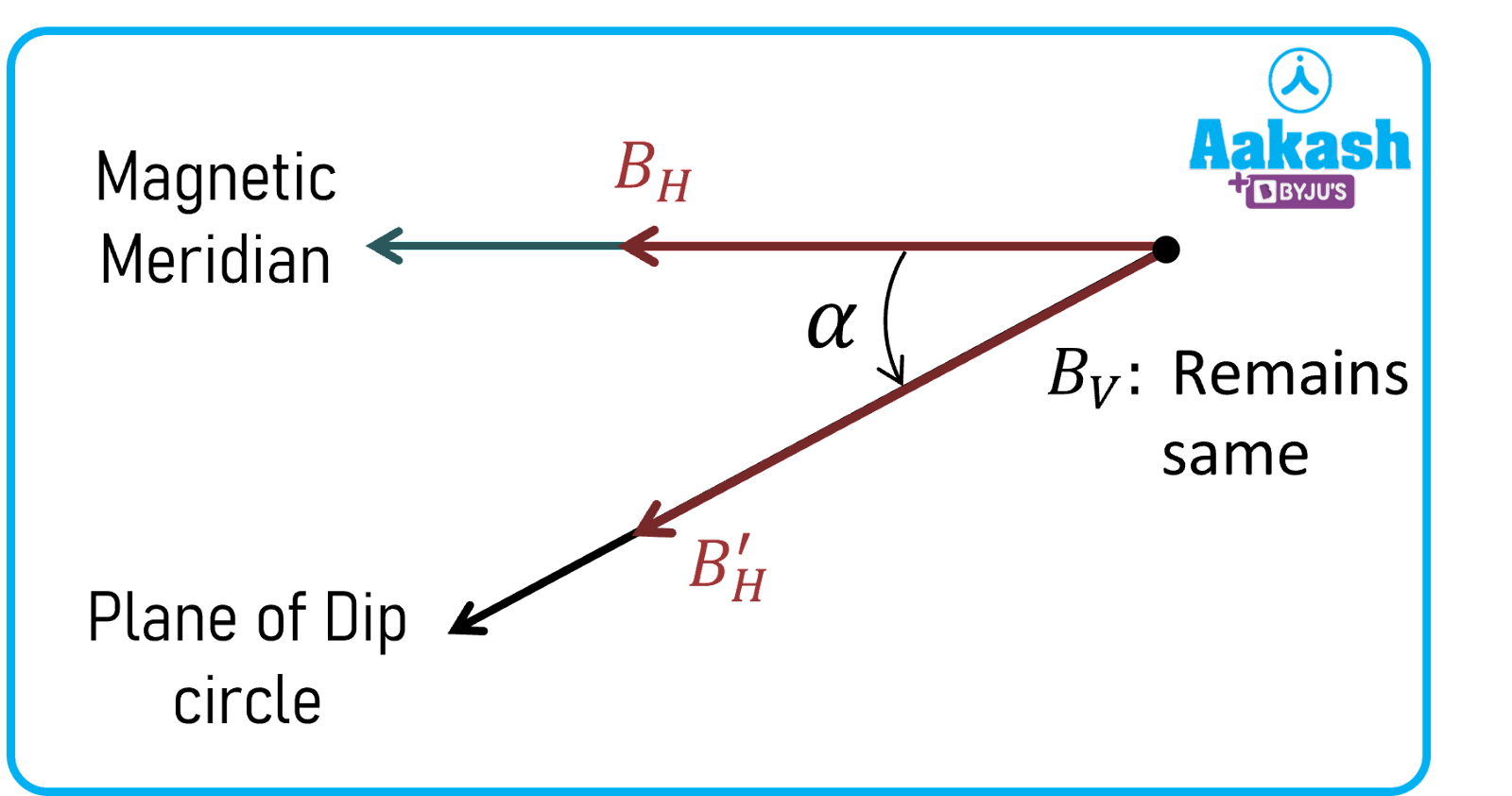
The vertical component of earth 's magnetic field remains constant.
True dip,
Apparent dip, '
Since
The apparent dip ', true dip and angle are related as
Neutral points
The point where two magnetic fields neutralise each other such that the resultant magnetic field intensity is zero at that point.
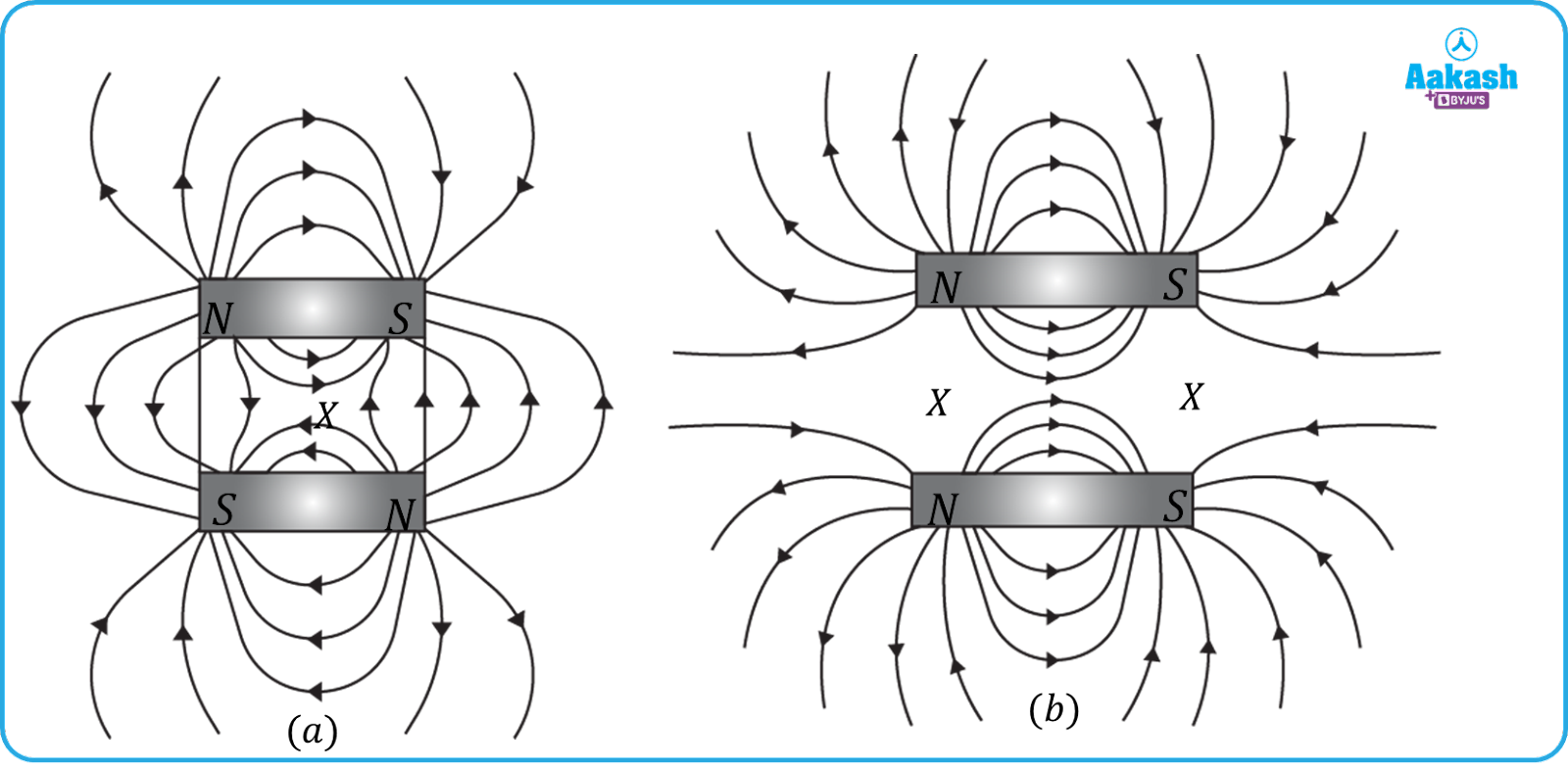
The point marked X represents the possible positions of neutral points when two bar magnets are placed close to each other.
The point where the magnetic field due to a bar magnet is completely neutralised by the horizontal component of Earth’s magnetic field is also known as the neutral point.
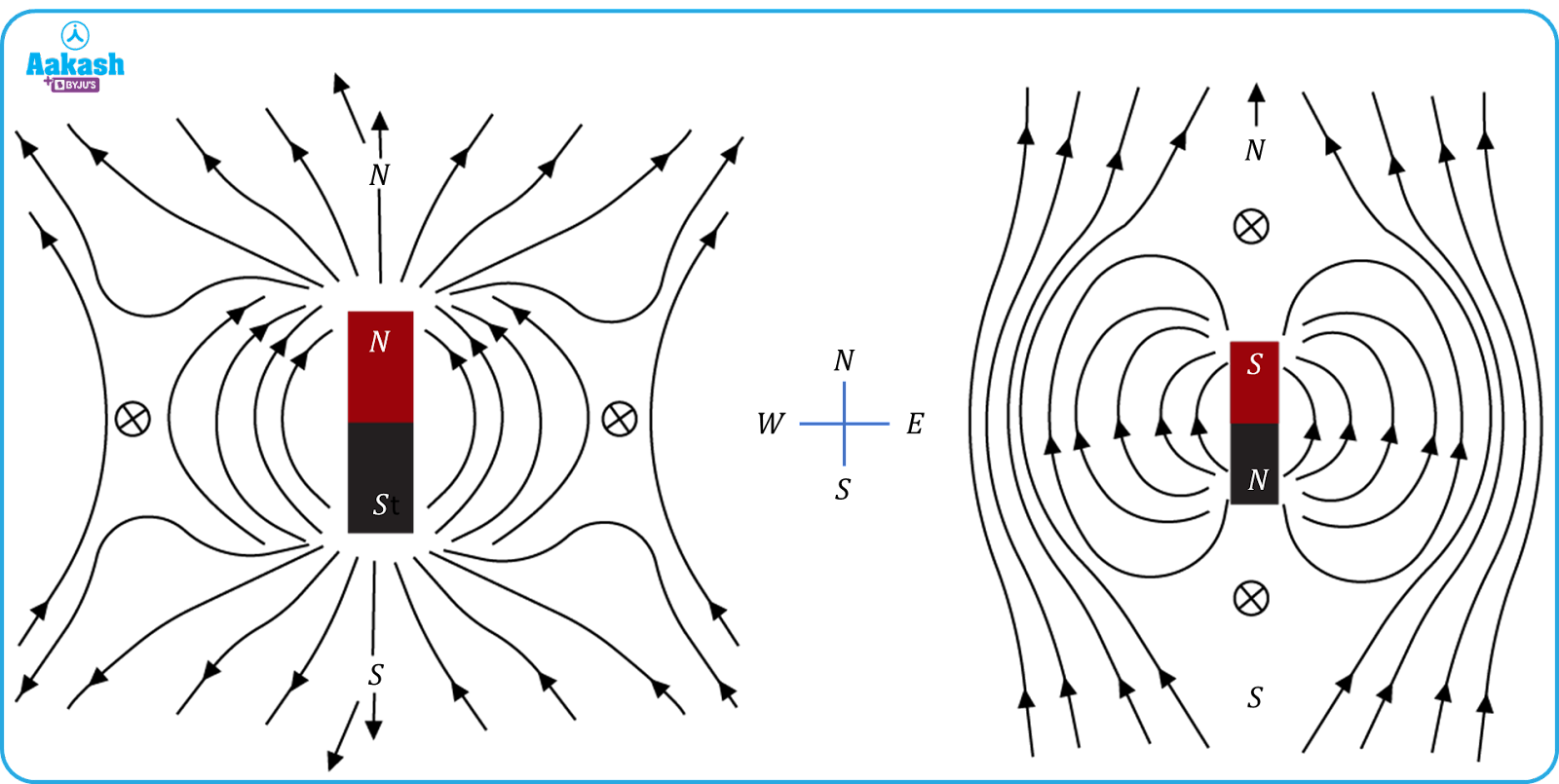
- If the north pole of a magnet points south, the fields of the magnet and the earth will point in opposite directions along the axis of the magnet; so two neutral points are obtained which are equidistant from the magnet on its axis and the equation used will be
- If the north pole of the magnet points north, the fields of the magnet and the earth will point in opposite directions along the equatorial circle of the magnet and there will be infinite neutral points. The equation used will be to
Practice problems
Q. If the apparent value of dip at a place in two perpendicular vertical planes are respectively 30o and 45o, then find the true angle of dip at that place.
A. Given:
Let,
BH= horizontal component of magnetic field, and
BV= vertical component of magnetic field

(Recreated)
From the given diagram,
As we know, the vertical component of the magnetic field due to all dip remains the same.
So,
Let BH and BV be the horizontal and vertical components of the magnetic field for the true dip.

Since, planes BC and BD are perpendicular.
Q. A short bar magnet is placed in the magnetic meridian of the earth with the north pole pointing north. Neutral points are found at a distance of 30 cm from the magnet on the east - west line, drawn through the middle point of the magnet. The magnetic moment of the magnet in Am2 is close to
(Given in SI units and BH = Horizontal component of earth's magnetic field = 3.610-5 T)
A.
As we know, the magnetic field along the equatorial axis of the short bar magnet of magnetic moment M is given by
At the neutral point,
Q. The true value of dip angle at a place is 45o. If the dip circle is rotated by 45o out of the meridian, then what will be the tangent of the angle of apparent dip at the place?
A.
Given,
When the dip circle is in magnetic meridian, angle of dip is
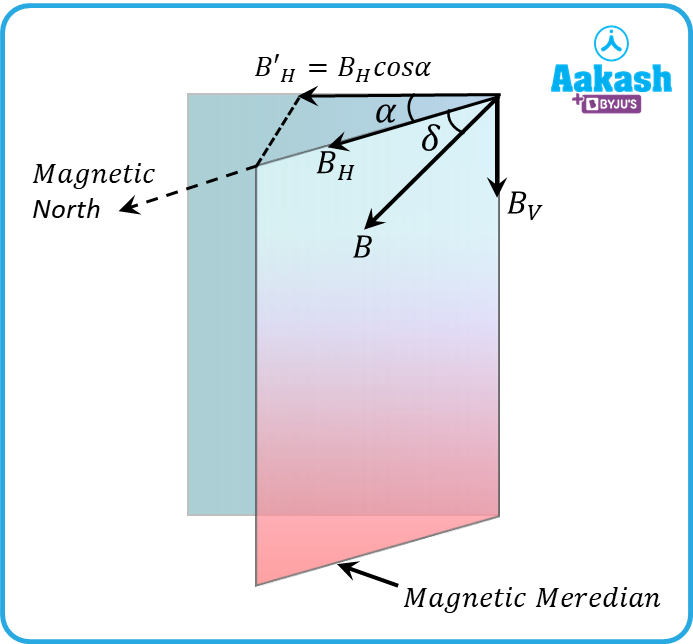
When dip is rotated through an angle , then the horizontal component of the earth's magnetic field becomes
Since, the vertical component does not change, so apparent dip will be,
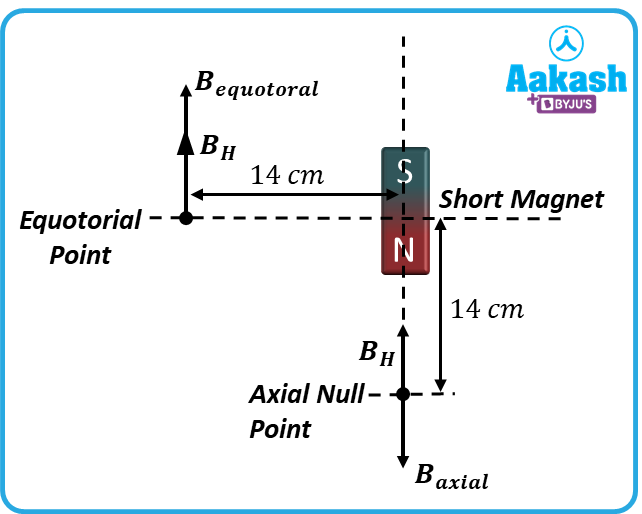
Q. A short bar magnet placed in a horizontal plane has its axis aligned along the magnetic north-south direction. At 14 cm on the axis of the magnet from the centre of the magnet, null points are found. The earth's magnetic field at the place is 0.36 G and the angle of dip is zero. What is the total magnetic field on the normal bisector of the magnet at the same distance as the null-point (i.e. 14 cm) from the centre of the magnet?
A.
Since, dip angle =0o thus, the horizontal component of the Earth's magnetic field at the given place will be equal to the total Earth's magnetic field,i.e,
BH=0.36 G
At the neutral point (along the axis), bar's magnetic field and earth's magnetic field are opposite in direction.
Where,
Baxial= external magnetic field due to bar magnet
BH= horizontal component of earth's magnetic field
Thus, the magnetic field at the axial point of the bar magnet is given by,
Using equations (i) and (ii),
Magnetic field due to a short bar magnet at a point on the axial line is twice the magnetic field at a point on the equatorial line of the magnet at the same distance. So,
(Recreated)
At the equatorial line, the directions of the magnetic field due to the bar magnet and Earth's magnetic field are the same.
So, the total magnetic field is,
Hence, the magnetic field is 0.54 G in the direction of earth's magnetic field.
FAQs
Q. What would happen if a compass needle which is allowed to move in a horizontal plane is taken to a geomagnetic pole?
A. The field lines will be vertical at geomagnetic poles. But the plane of the needle is horizontal. At the poles, the horizontal component of the field = 0 and the vertical component will not affect the needle.
So, there will be no driving torque acting on the needle and it will stay in its position and exhibit no movement.
Q. What is an isoclinic line?
A. An imaginary line connecting points on the earth's surface having equal magnetic dip.
Q. A magnetic needle is fixed to a cork, which is floating in a still lake, in the Northern Hemisphere. The cork and the needle have negligibly small mass. How will the needle move?
A. A magnetic needle is nothing but a magnetic dipole which is placed in Earth's magnetic field. Around the needle the Earth's magnetic field is uniform so that the needle will not experience any net force but will experience a torque. It will align the needle in the direction of Earth's magnetic field, and it will remain in that position.
Q. As we go from the magnetic equator towards the geographical north pole, what happens with the angle of the dip?
A. As we move from the equator to the Geographical north pole (which is near the magnetic north pole), the vertical component of earth's magnetic field increases, and hence, angle of dip goes on increasing. At the two magnetic poles, the magnetic needle rests vertically, such that the angle of dip at two poles is 90o.
On the magnetic equator, the magnetic needle rests horizontally, such that the angle of dip is 0o

 Call Now
 Let's Chat
 Share
Share