-
Call Now
1800-102-2727


Circular Motion - Definition, Examples, Practice problems, FAQs

Dewansh was growing bored sitting in class, so she started looking here and there to distract herself. She looks at the ceiling fan above her; it is revolving with a constant angular speed sweeping equal angles. She also notices her watch and notices the needle ticking uniformly. So how is the motion of the needle or the ceiling fan different from that of the conventional 1 dimensional motion? The answer is: they are examples of circular motion. In a 1 D motion, the object moves in a rectilinear path, with a constant or varying velocity. For instance, it would make sense to say that a car moves North in a straight path with a uniform velocity of 40 km/hr. On the other hand, to describe the motion of the needle or the fan, we need two velocities to describe their motion. Circular motion could be uniform or non-uniform depending upon whether the speed remains constant or not. In this article, we will explore circular motion in detail.
Table of contents
- Definition of circular motion
- Uniform circular motion
- Parameters in circular motion
- Non-uniform circular motion
- Practice problems
- FAQs
Definition of circular motion
When a body moves in a circular path, then such a motion is called circular motion.
Uniform circular motion
When the body is moving in a circular path with a constant speed, such a motion is called a uniform circular motion. Examples would be the motion of a ferris wheel or a car going about a round turn at constant speed.
Parameters in circular motion
1)Angular displacement
The angular displacement () is defined as the angle swept by the object in a given time. It carries a unit of radian (rad) and a dimensional formula of
If 2 and 1 indicate the final and initial angular positions, then
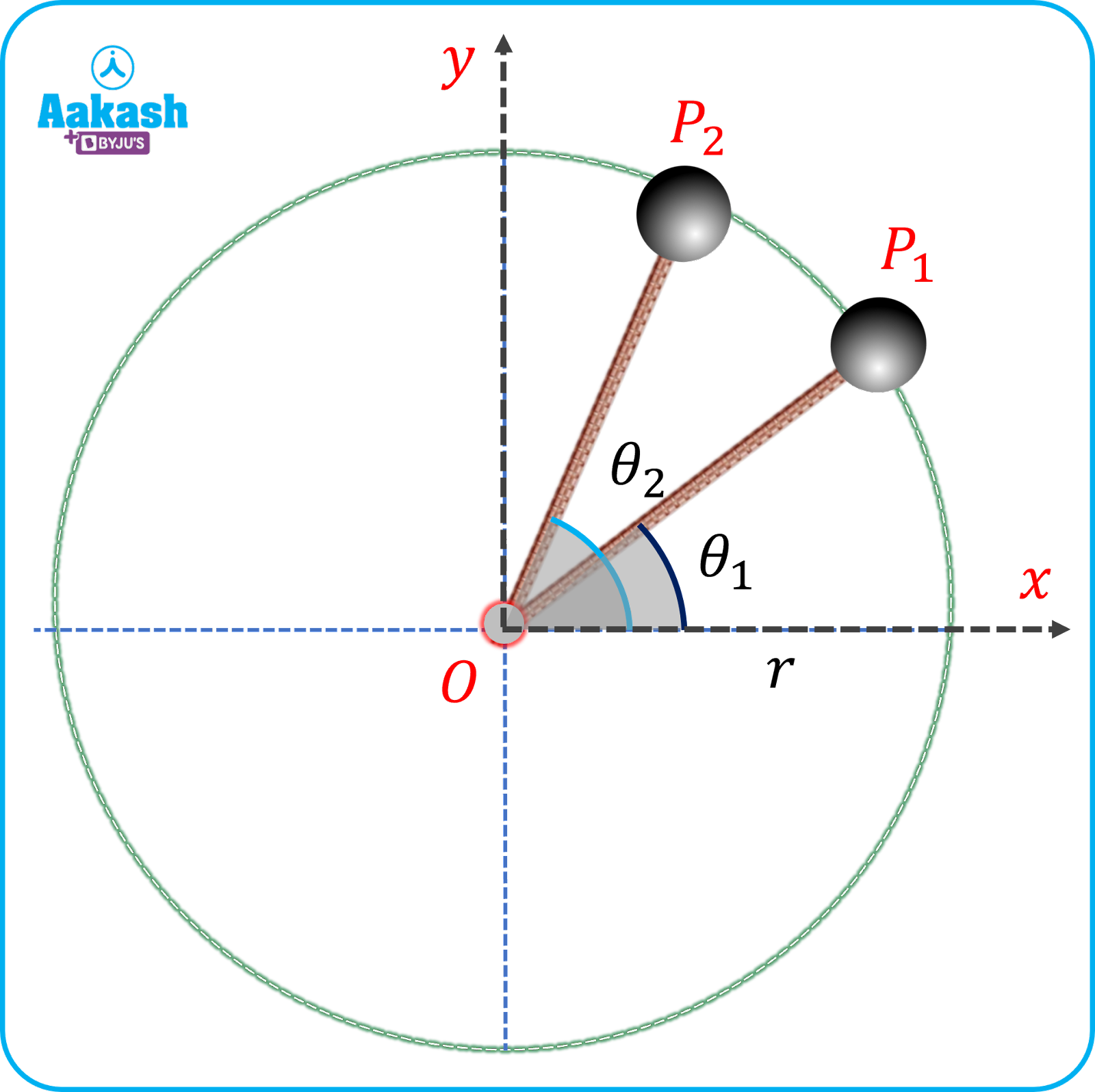
Note:
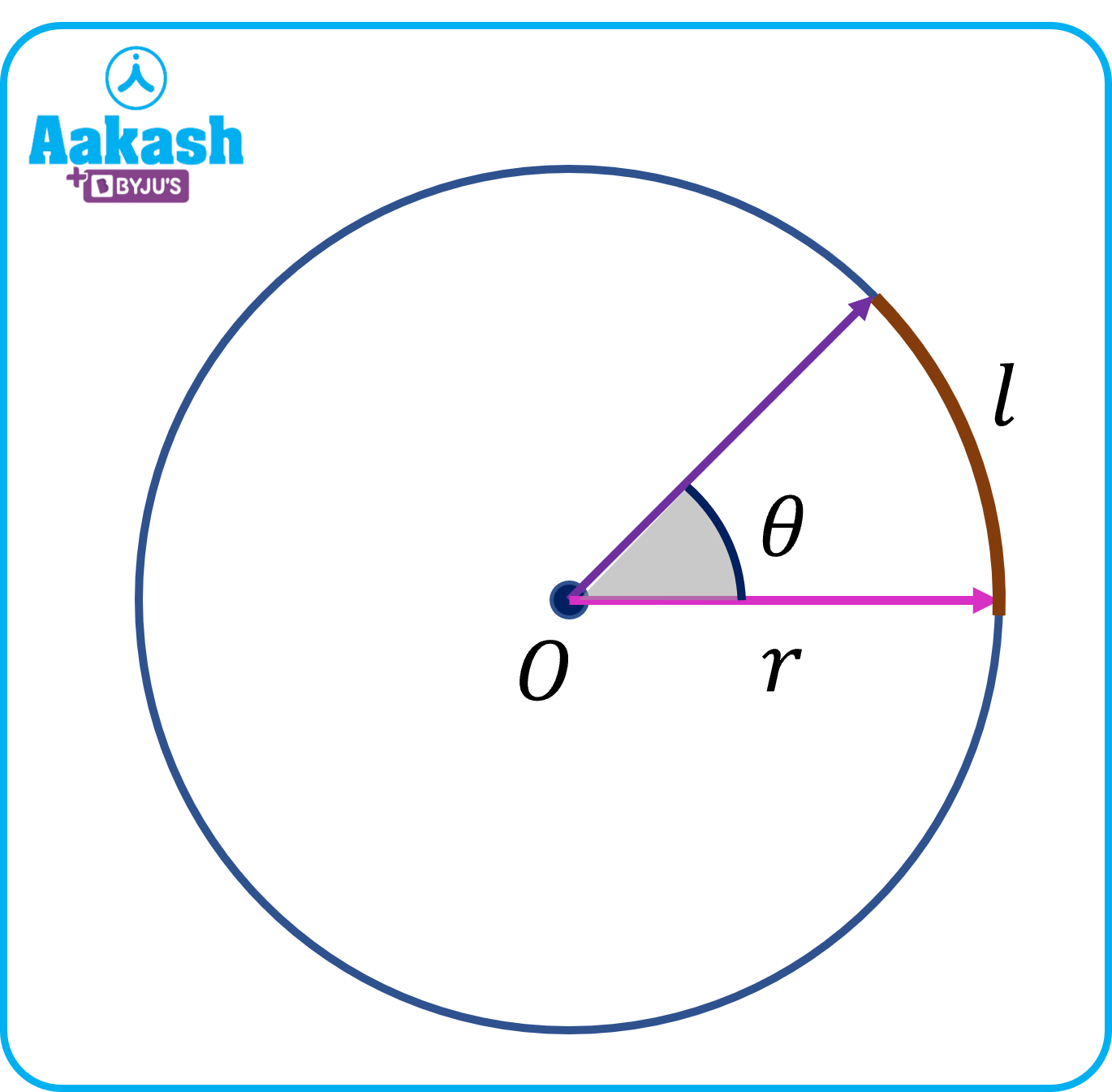
The length l traveled along the circumference of a circle of radius r can be written as,
l=r.
2) Angular velocity
Average Angular velocity
The total angular displacement () divided by the total time taken (t) is called average angular velocity ().
Instantaneous Angular velocity
The instantaneous angular velocity inst is defined as the change in angular displacement d divided by time dt, where dt is infinitesimally small.
Its unit is rad s-1. Its dimensional formula is [T-1].
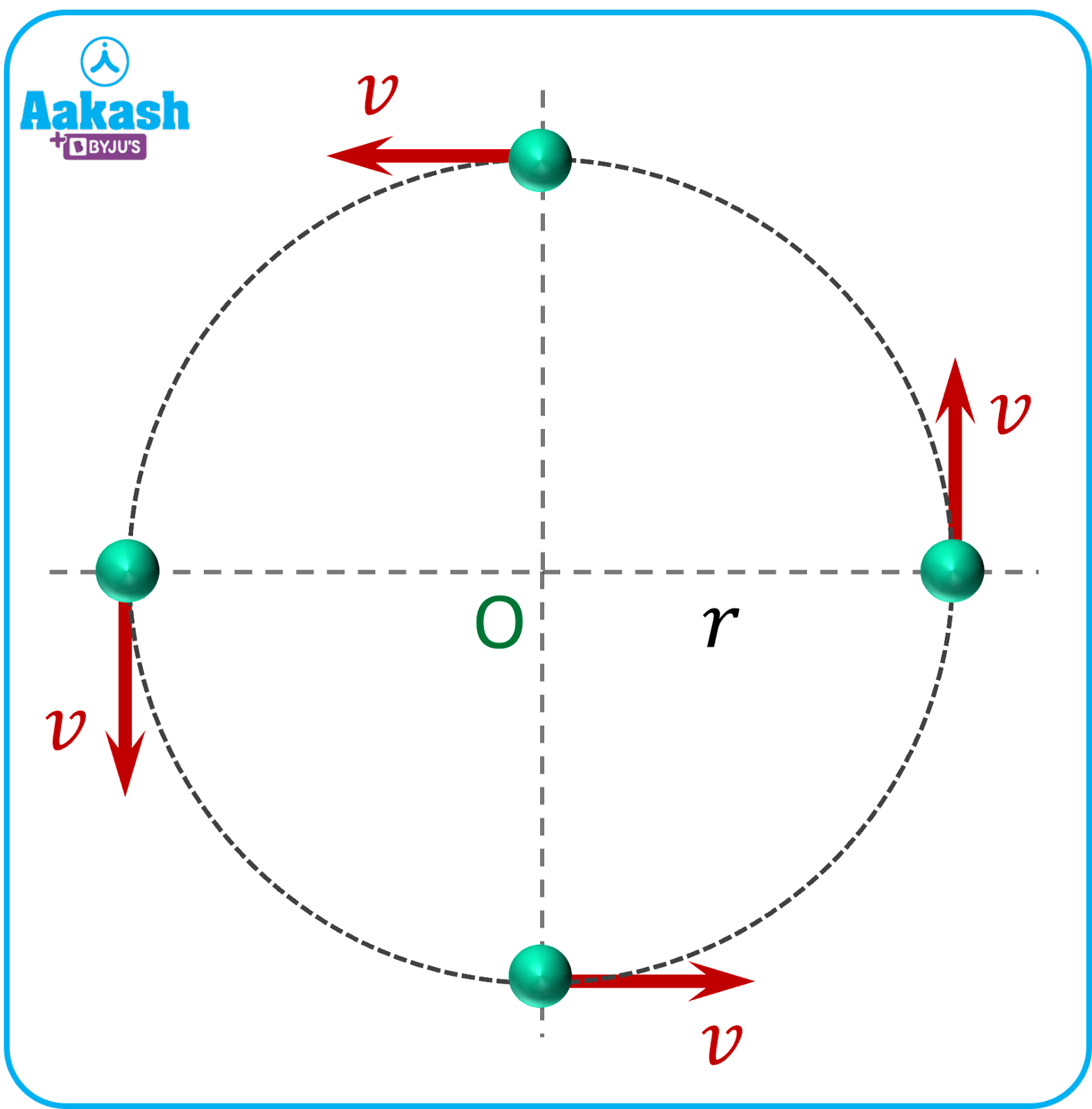
3)Linear velocity(v)
Linear velocity(v) is perpendicular to radius r, while angular velocity is along the direction of rotation. They are connected by v=r .
In vector notation,
The unit of linear velocity is m/s and its dimensional formula is [LT-1].
Non-uniform circular motion
When both the speed and velocity are varying, such a motion is called non-uniform circular motion. Examples of such motion would be the motion of a bob in a vertical circle.
The force needed to keep the body in circular motion is called centripetal force.
It is directed inward.
According to Newton’s second law, this must be equal to mac, where ac is the centripetal or radial acceleration.
ac can also be represented by ar.
Also, there is a tangential acceleration at directed perpendicular to the radius vector.
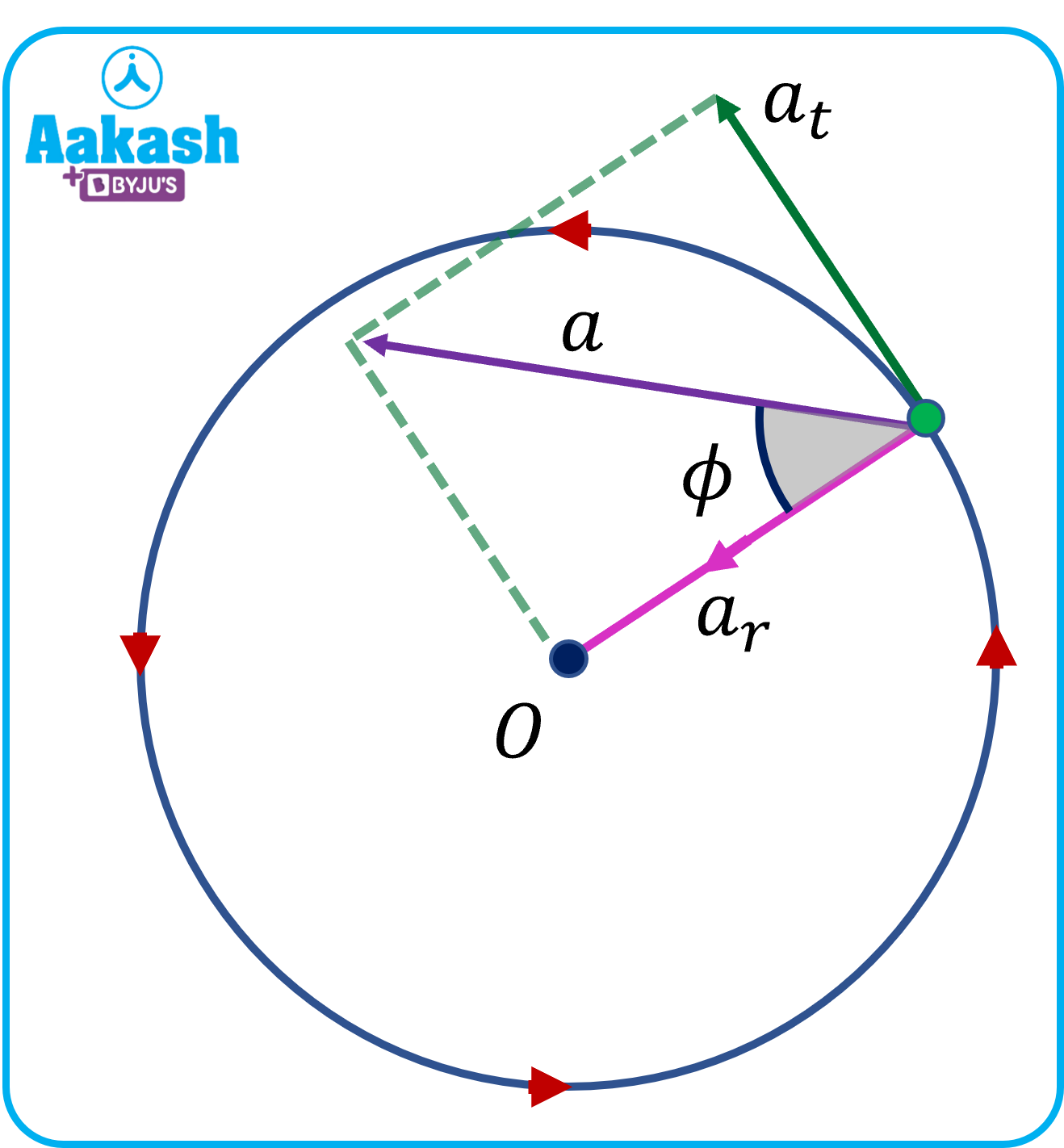
Net acceleration
- angular acceleration.
Magnitude of the net acceleration,
Practice problems
Q. An athlete completes a half circle around a 440 m circular track. What is his linear displacement from the starting point?
(a)125 m (b)140 m (c) 150 m (d)220 m
A. b
Given, circumference of the track 2 r=440
Now
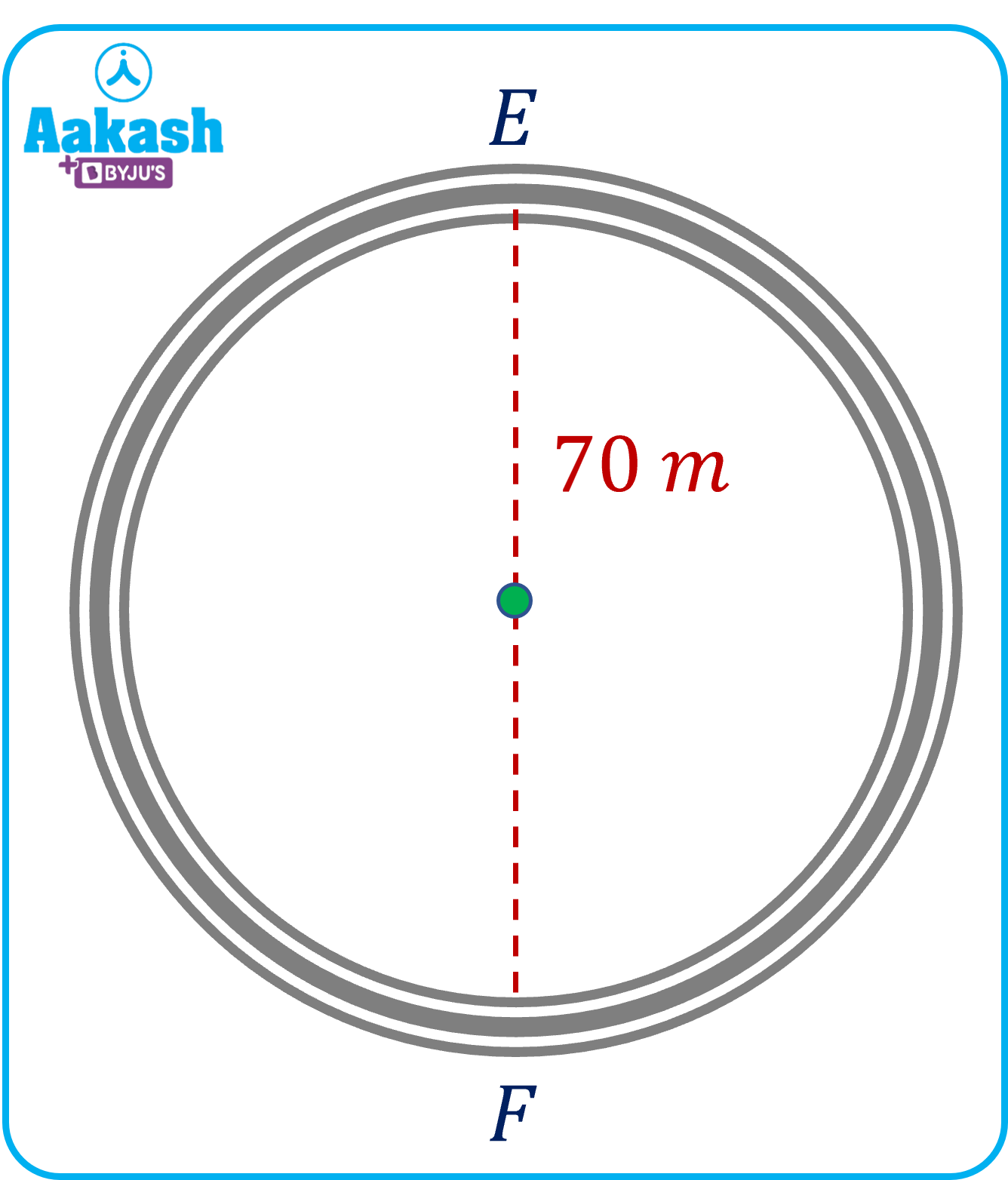
Total displacement
Q.A student runs 40 m around a circular track having a radius of 50 m. Calculate his angular displacement.
(a)0.6 rad (b)0.8 rad (c) 1.0 rad (d)1.2 rad
A. b
Given, l= 40 m, r= 50 m, =?
We know that
l=r ;
Q.The angular position of a body as a function of time is given by =a-bt+ct2;
Calculate its angular velocity.
(a)-b+2ct (b)b+ct (c) b-2 c t (d)-b+ c t
A. a
Given,
=a-bt+ct2
Instantaneous angular velocity inst;
Q. The speed of a particle moving in a circle having radius 2 m is given by v=t2, where t is in second and v in m/s. Calculate the (i) radial (ii)tangential (iii) net acceleration at t=2 s.
A.
Given, v=t2.
The linear speed at time t=2 s would be v=(2)2=4 m/s.
(i)Radial acceleration
(ii)Tangential acceleration
Net acceleration
FAQs
Q. Give one example of circular motion.
A. The motion of the satellite around the earth is an example of circular motion.
Q. What factors affect the centripetal force acting on an object?
A. Mass of the object, speed and the radius of the circle affect the centripetal force acting on an object in circular motion.
Q. What are the necessary conditions for circular motion?
A. There must be a centripetal force acting inwards.
Q. What is the time period of circular motion?
A. The time taken to complete one full revolution is called the time period of circular motion.

 Call Now
 Let's Chat
 Share
Share