-
Call Now
1800-102-2727


Disc - centre of mass, moment of inertia, radius of gyration, practice problems, FAQs

You might have encountered pulley problems while dealing with Newton’s laws of motion. If you remember carefully, pulleys in those problems were given as massless. But we all know that is not the case we encounter practically. So if the pulleys carry some mass, would it change the way you dealt with the same problems? There will be a slight change, that is we will be using the same law for rotational motion which includes dealing with moment of inertia of the pulley. Now the pulley itself is a complex shape to analyse, thus to reduce the effort we consider it as a disc. Thus we will be discussing such important properties of the disc.
To analyse the plate like objects such as pulleys, we need to analyse an object that is much easier to analyse such as a disc. Thus it becomes important to know the properties of a disc and hence this topic will cover some of its basic properties.
Table of contents
- Centre of mass of uniform circular disc
- Moment of Inertia of a Uniform Disc
- Centre of Mass of a Semicircular Disc
- Radius of gyration of a Circular Disc
- Practice problems
- FAQs
Centre of mass of uniform circular disc
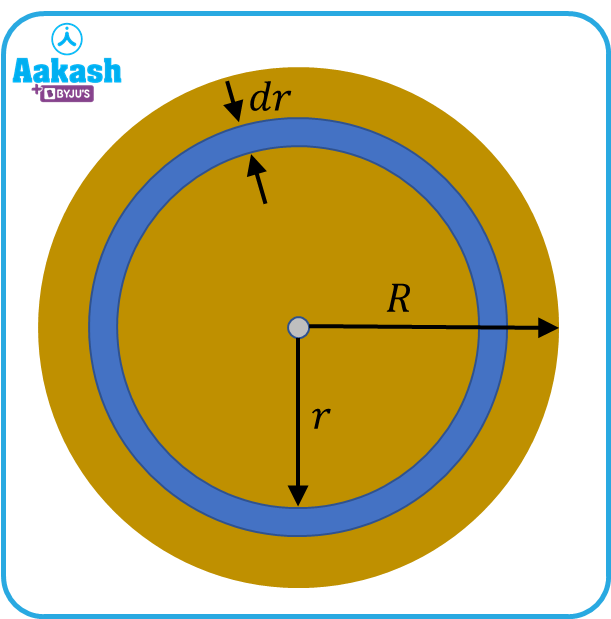
To find the centre of mass of a uniform disc, we assume that the disc is made up of several uniform rings. One of them has a radius r and thickness dr as shown in the figure.
For a continuous body, the position of centre of mass can be found using,


We know that the centre of mass of a thin uniform circular ring lies at its centre.

Similarly,

Thus, the centre of mass of a uniform circular disc lies at its centre.
Moment of Inertia of a Uniform Disc
The moment of inertia of a uniform disc of mass M and radius R about the centroidal axis perpendicular to the plane of the disc.

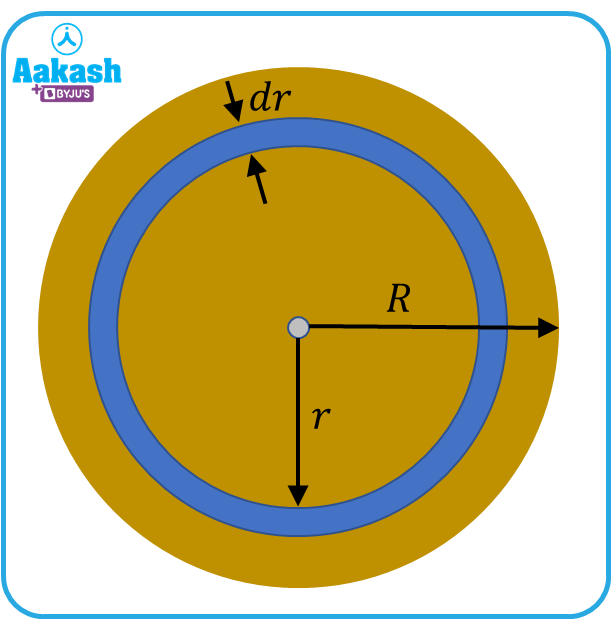
To find the moment of inertia of a uniform disc, we assume that the disc is made up of several uniform rings. One of them has a radius r and thickness dr as shown in the figure.


Centre of Mass of a Semicircular Disc
Consider a uniform semicircular disc of radius R and mass M as shown in the figure.
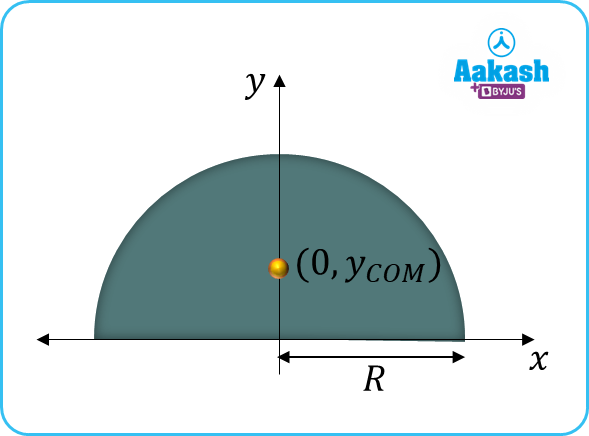
As the disc is symmetrical about the y-axis, the centre of mass will lie along the y-axis.
Let the coordinate of the centre of mass be (0, ycom).
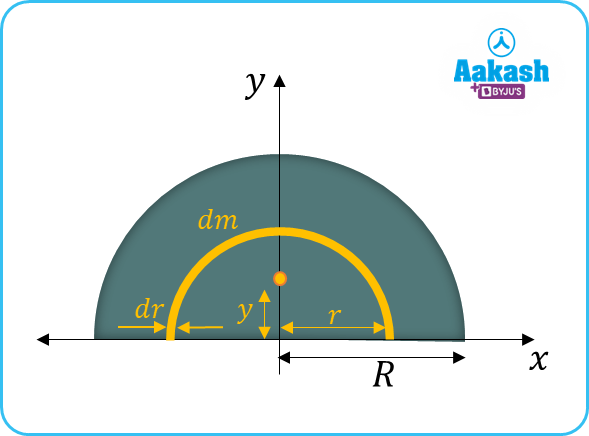
Consider a thin circular element of thickness dr and mass dm at radius r from the centre as shown in the figure.
Area of the element,


Ignoring  as it is very small, we get,
Mass of the element,

Now, the y-coordinate of the centre of mass is given by,

Here, 


Therefore, the coordinates of the centre of mass (0, ycom) is 
Radius of gyration of a Circular Disc
The moment of inertia of a continuous body in terms of radius of gyration(k) can be given as,
I = Mk2
k = effective distance from the axis of rotation where the whole mass of the system is assumed to be concentrated
Comparing the above equation with the moment of inertia of the disc,
Practice problems
Q. A semicircular disc of radius 6 has a hole of radius 2 cm made at a distance 8 cm from the centre C of the disc. Find the distance of the centre of mass of this system from point C.
(COM of semi disc of radius R is at distance from the base)
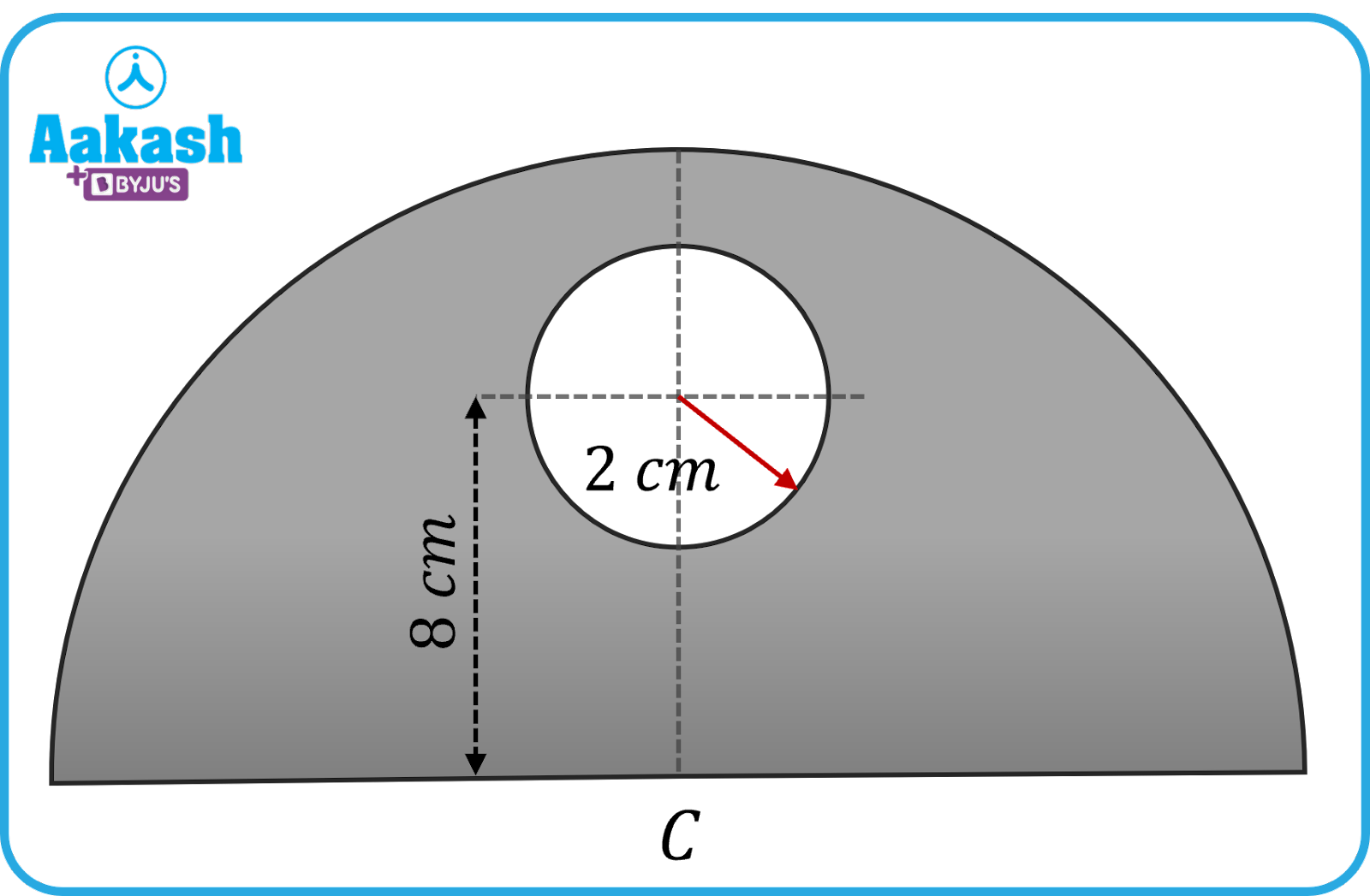
A. Point C is assumed to be the origin.
We know that:
y coordinate of COM of the half disc
y coordinate of COM of the hole y2 = 8 cm which coincides with y1.
There will be no change in the position of centre of mass since there is uniform mass removal in all directions w.r.t original COM ( i.e. the COM of the half disc ). It will still be at (0,8 cm) which is at 8 cm from point C.
Q. A circular disc of radius 1 m is rotating about an axis passing through its COM and perpendicular to its plane. The moment of inertia about this axis is given by Icom =2 kg m2. If the disc is rotated about an axis along its diameter, then the moment of inertia along that axis is Idia. Find the value of (Icom - Idia).
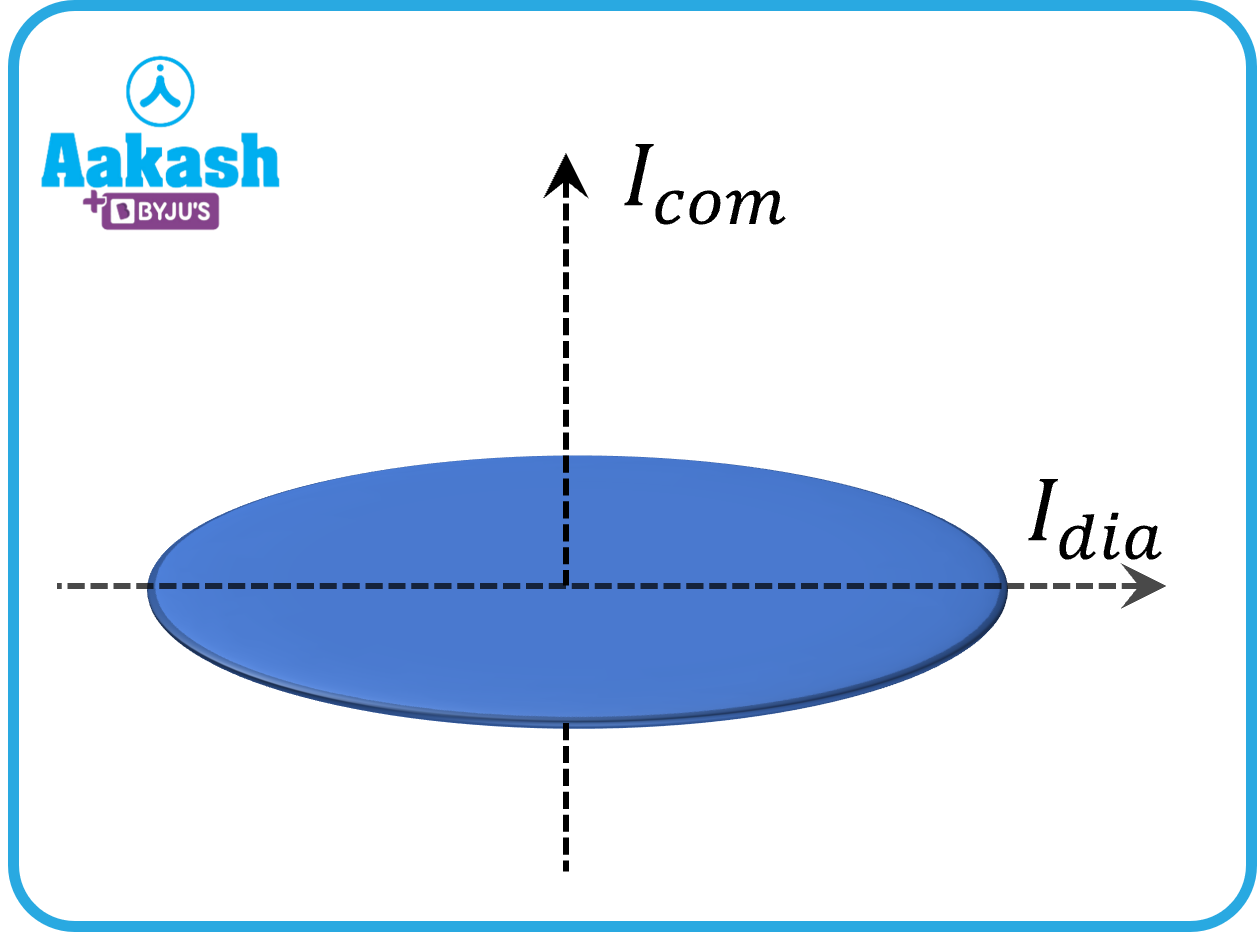
A. Given, radius of disc r = 1 m
Moment of inertia about axis passing through COM and perpendicular to the plane of the disc, Icom = 2 kg m2 (given)
From definition, Icom =
We get,
From perpendicular axis theorem,
Idia1 + Idia2 = Icom
Where Idia1 ,Idia2 are the moment of inertia of the disc about its two mutually perpendicular diameters. So, Idia1 + Idia2 = Idia
Hence,
Q. A point object of mass m, moving horizontally with velocity v, hits a disc and sticks to the disc having mass 4 m as shown in the figure. What will be the angular velocity of the system after the point object hits the disc. The disc pivoted at point O is resting on a horizontal frictionless surface.
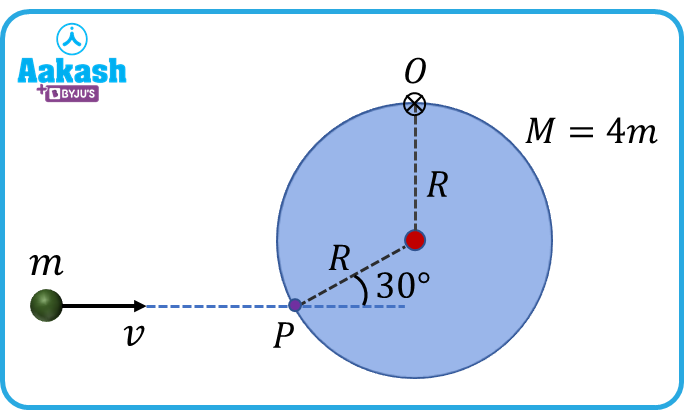
A. Given, Mass of particle = m
Mass of disc M = 4m
Speed of particle = v
Initially (before hit) the angular momentum


So,
Hence, 
After hitting, the angular momentum will be
where  (using parallel axis theorem)
Here, 

Hence
Hence,  (∵
(∵  )
)

From angular momentum conservation:


Q. A constant force F acts tangentially at the highest point of a uniform disc of mass m kept on a rough horizontal surface as shown in figure. Calculate the acceleration of the centre C and points A and B on the disc, if the disc rolls without slipping.
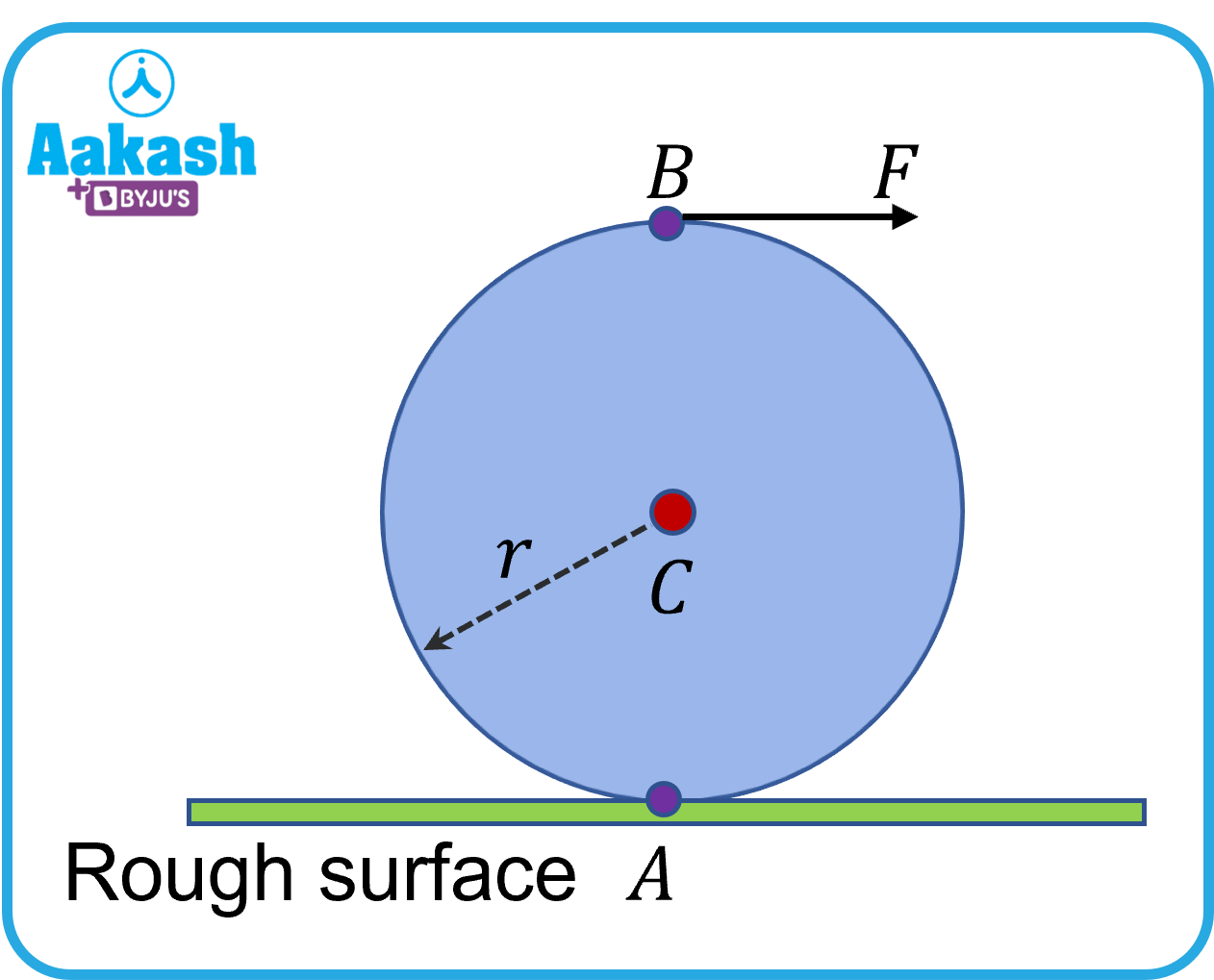
A.
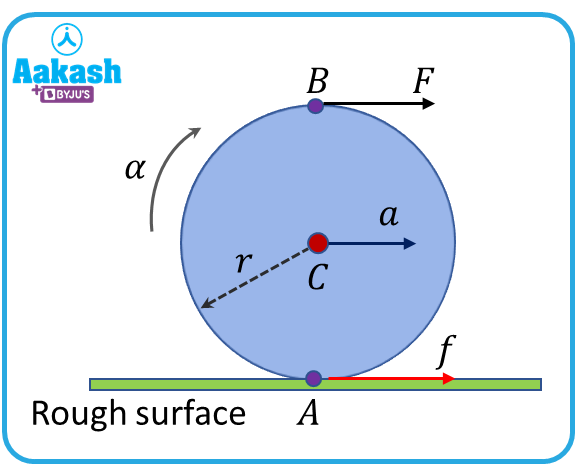
The point of contact has a tendency to slip towards left as the force F rotates the disc and the static friction on the disc will act towards the right.
As there is no slipping, acceleration of point A, 
and angular acceleration of disc 
(Here,
For the linear motion of the centre, 

For the rotational motion about the centre,


From (i) and (ii),
 or
or 

Acceleration of point B,


FAQs
Q. Which body shape has the same result of moment of inertia as disc?
A. A solid cylinder has the same result and is actually a thick disc.
Q. Does friction always act in backward direction on a rolling disc?
A. It can act in both the forward and backward directions depending on the direction and point of application of other forces. Friction just has the tendency of opposing relative slipping between the point of contact of the disc and the surface on which it is rolling.
Q. If a disc is rolling without slipping on a rough plane, what will be the velocity of the point of contact of disc and plane?
A. The translational velocity of the point of contact will be zero. The velocity at a point on the periphery is R wrt centre of the disc, where is the angular velocity of the disc about its centre and R is the radius.
If we consider the velocity of the point of contact of the disc as vP, then at the time of rolling vp= v - R = 0 where v is the velocity of the centre of the disc.
Q. What kind of acceleration a disc will achieve on a smooth surface, if force is applied at its centre of mass?
A. Only linear acceleration. Since no other force is mentioned to be acting on the disc, with respect to its axis, it won’t get any change in angular acceleration.

 Call Now
 Let's Chat
 Share
Share