-
Call Now
1800-102-2727


Thermal Stability of s-Block Compounds - Thermal Stability of Carbonates, Bicarbonates, Sulphates, Nitrates, Hydrides, and Hydroxides of s-block Elements

When summer arrives, we know it's time to get out there and sweat in the sweltering heat. We often hear the obligatory remark, "What a hot day it was, eh?"
However, there are more general definitions of "hot." Let's be honest, a hotter one!
Surprisingly, the average temperature on the Sun's surface has been deduced to be 10,000 degrees Fahrenheit. The cauldron inside the sun, on the other hand, nearly boils at around 27 million degrees Fahrenheit. The heat of a pepper is measured in Scovilles, and there is a competition to see who can out-heat the next pepper. The famous ghost pepper has a Scoville heat index of just over a million.

As a result, our goal today is to comprehend the effects of heating specific compounds (present on earth, categorically.) To be more specific, we will try to determine how strongly compounds of s-block elements can resist changes in their chemical composition when heated, as well as the impact of heating. Thermal stability is used to explain this property. It is critical to understand where and in what form these compounds can be used based on their thermal stability.
TABLE OF CONTENTS
- Thermal Stability of Alkali Metals
- Thermal Stability of Alkali Metal Carbonates
- Thermal Stability of Alkali Metal Bicarbonates
- Thermal Stability of Alkali Metal Nitrates
- Thermal Stability of Alkali Metal Hydrides
- Thermal Stability of Alkali Metal Hydroxides
- Thermal Stability of Alkali Metal Oxides
- Thermal Stability of Alkaline Earth Metals
- Thermal Stability of Alkaline Earth Metal Hydroxides
- Thermal Stability of Alkaline Earth Metal Sulphates
- Thermal Stability of Alkaline Earth Metal Nitrates
- Thermal Stability of Alkaline Earth Metal Carbonates
- Thermal Stability of Alkaline Earth Metal Bicarbonates
- Practice Problems
- Frequently Asked Questions - FAQ
Thermal Stability of Alkali Metals
It refers to the material's heat resistance and the object's ability to resist chemical deformation under the influence of temperature; the smaller the deformation, the higher the stability.
Thermal stability reflects the difficulty of chemical decomposition reactions on the application of heat.
The term "thermal stability" refers to how long a compound can last before breaking down into its constituents or other elementary compounds.
Alkali metals are very reactive and hence are not found in free state in nature. Group 1 sulphates are thermally stable at even high temperatures.
Thermal stability depends on two factors:
% Ionic character: The increase in % ionic character signifies the increase in strength of the ionic bond.
bond between the cation and anion of a salt. It means that more energy is required to break the
crystal lattice of an ionic salt. So, the higher the percentage of ionic character, the higher is the stability of
salts of the oxoacids of alkali metals.
Cation to anion radius ratio: This should be nearly equal to one. In other words, the cation and
anion should be of similar size so that the lattice obtained is strong.
Thermal Stability of Alkali Metal Carbonates
A material is thermally stable if it does not decompose under the influence of temperature. Alkali metal carbonates, M2CO3, are highly stable to heat, where M is alkali metal.
In general, metal carbonates decompose to give metal oxide and carbon dioxide.
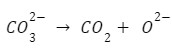 (On Heating)

- The thermal stability of the alkali metal carbonate increases on moving down the group in the order:
Li2CO3< Na2CO3 < K2CO3 <Rb2CO3 < Cs2CO3
- As the electropositive character (from Li to Cs) increases due to increase in ionic radii, so does the ionic character of the metal carbonates, and hence the thermal stability of carbonates also increases. stability of salts of the oxoacids of alkali metals.
- On moving down the group, the size of the cation increases and the polarising power decreases. Hence, the stability of carbonate increases.
- Exceptionally, on heating, lithium carbonate quite easily decomposes to give lithium oxide (Li2O) and carbon dioxide (CO2).
- Li+ ion has a high charge density (charge/volume) due to its small size. So, it has a high polarising power and can not stabilise the large polarizable CO32- ion. That is why it is unstable and readily decomposes on heating.

Thermal Stability of Alkali Metal Bicarbonates
Alkali metal bicarbonates decompose at relatively low temperatures to produce alkali metal carbonates, water, and CO2. As the electropositive character increases down the group, the stability of the hydrogen carbonates increases, as the more the electropositive character of the metal, the more is the ionic character and hence, the more is the stability.
- Small and highly charged metal ions possess more polarising power and hence facilitate the decomposition of carbonate ions into carbon dioxide and oxide ions.
 (On Heating)

- The decomposition of bicarbonates produces carbonates, water and carbon dioxide.
- The thermal stability of alkali metal bicarbonates increases down the group as the polarising power of the metal ion decreases due to the increase in atomic radii.
- For the same reason, carbonates of alkali metals are more stable than those of alkaline earth metals.
- LiHCO3 does not exist in solid form due to the high polarising power of Li+ (due to small size of Li+).

Thermal Stability of Alkali Metal Nitrates
When heated, alkali metal nitrates decompose to give the corresponding nitrites and liberate oxygen gas. The thermal stability of group 1 metal nitrates increases on going down the group due to the increase in the atomic size of metals.

Only lithium nitrate (LiNO3) gives lithium oxide (Li2O), nitrogen dioxide (NO2) and oxygen gas on heating. This is because Li+ due to its smallest ionic radii among all other metal nitrates, cannot stabilise the large nitrate ion.


Thermal Stability of Alkali Metal Hydrides
Alkali metals react with H2 to form ionic hydrides, MH (M = An alkali metal). The reaction of alkali metals with H2 to form hydrides is given as follows:
2M + H2 ⟶ 2M+H- ; M = an alkali metal
- The formation of lithium hydride (LiH) is given as follows:
2Li + H2 ⟶ 2M+H-
- The thermal stability of these hydrides decreases down the group from Li to Cs.
LiH>NaH> KH >RbH>CsH
- As the size of the alkali metal cation increases down the group, the ionic M+H- bond becomes weaker due to large incompatibility between the large-sized cation and the smaller hydride ion. Hence, the thermal stability of alkali metal hydrides decreases down the group.
Thermal Stability of Alkali Metal Hydroxides
The change in enthalpy that occurs when an ionic compound forms from gaseous ions is known as lattice enthalpy. The higher a compound's lattice enthalpy, the more stable it is.
- The correct order of the thermal stability of alkali metal hydroxides is LiOH<NaOH<KOH<RbOH<CsOH
- The lattice enthalpy and thermal stability increase as the size of the alkali metal ions increases.
- When metal hydroxide is heated, it produces metal oxide and H2O.
2NaOH (aq)Na2O(s) +H2O(l)
Thermal stability of Alkali Metal Oxides
Larger cations are stabilised by large anions. The order of increasing anion size is oxide, peroxide, and superoxide. The stability of oxide, peroxide and superoxide varies from moving down in the group of the periodic table depending on the counter metal cation sizes.

- The formula of oxide is O2-. As we move down the group, the stability of oxides decreases. So, the most stable metal oxide will be lithium.
- The formula of peroxide is O22-. The stability of peroxide varies as we move from top to bottom in the group. At first, it increases, and then it decreases as it moves down in the group. Sodium peroxide is the most stable of the metal peroxides. This is because the size of the peroxide anion is large and is comparable to sodium. Beyond that, the size of cations exceeds that of the anion, so stability decreases.
- The formula of superoxide is O2-. In superoxide, the stability decreases as we move down in the group due to the increase in the atomic size of alkali metals. The most stable superoxides are potassium and caesium. Thus, the stability order of oxide, peroxide and superoxide of alkali metal is
Oxide (O2-) > Peroxide (O22-) > Superoxide (O2-)
- With an increase in the size of the alkali metal, the lattice enthalpy increases and thermal stability increases.
- The correct order of the thermal stability of alkali metal peroxides is:
Na2O2<K2O2<Rb2O2<Cs2O2
- The correct order of thermal stability is:
NaO2>KO2<RbO2<CsO2
Thermal Stability of Alkaline Earth Metals
Alkaline earth metals form compounds that are predominantly ionic, but less ionic than the corresponding compounds of alkali metals. This is due to the increased nuclear charge and smaller size (Fajans' rule).
The oxides and other compounds of Be and Mg are more covalent than those formed by the heavier members because down the group, size increases and the effective nuclear charge decreases.
Alkaline earth metals burn in oxygen to form monoxide (MO). They are covalent in nature, while the oxides of other elements are ionic in nature. All the oxides of alkaline earth metals are basic in nature, except BeO. The enthalpy of formation of these oxides is quite high, and hence they are very stable to heat.
Thermal Stability of Alkaline Earth Metal Hydroxides
- Oxides of alkaline earth metals except BeO react with water to form sparingly soluble hydroxides.
MO + H2O ⟶ M(OH)2
- The order of thermal stabilities of group 2 hydroxides is
Mg(OH)2< Ca(OH)2 < Sr(OH)2 < Ba(OH)2
- The polarising power of the cation decreases due to the increase in the size of the ion. Thereby more will be the ionic character leading to high thermal stability down the group.
Thermal Stability of Alkaline Earth Metal Sulphates
- Alkaline earth metal sulphates are less stable than alkali metals. The sulphates of alkaline earth metals are mostly white solids and stable to heat.
- On moving down the group, thermal stability increases due to the larger size of cations. The order of thermal stability is:
BeSO4< MgSO4 < CaSO4< SrSO4< BaSO4.
- Sulphate decomposition produces:

Thermal Stability of Alkaline Earth Metal Nitrates
- Nitrates decompose on heating to give the corresponding oxides with the evolution of a mixture of nitrogen dioxide and oxygen.
- The thermal stability of nitrates of alkaline earth metals increases down the group.
Be(NO3)2< Mg(NO3)2 < Ca(NO3)2< Sr(NO3)2< Ba(NO3)2

Thermal Stability of Alkaline Earth Metal Carbonates
- Thermal stabilities of carbonates of alkali metals is greater than that of alkaline earth metals.
- The thermal stability of carbonates of alkaline earth metals increases with increasing cationic size or decreasing polarising power of the cation.
- All carbonates decompose on heating to give carbon dioxide and metal oxide, except BaCO3.
Example:

- The thermal stability increases with increasing cationic size, i.e., the order of thermal stability is:
BeCO3 < MgCO3 < CaCO3 < SrCO3 < BaCO3
- Beryllium carbonate is unstable (because of the large size difference between Be and CO3 2- and can be kept only in the atmosphere of CO2.
Thermal Stability of Alkaline Earth Metal Bicarbonates
The bicarbonates of alkaline earth metals do not exist in solid-state, but they are known to exist in a solution. These bicarbonates decompose on heating to give carbonates, CO2 , and H2O. Calcium and magnesium bicarbonates are responsible for the temporary hardness of water.

Practice Problems
Q 1. Which of the following carbonates of alkali metals has the highest thermal stability?
a. Li2CO3
b. Na2CO3
c. K2CO3
d. Rb2CO3
Answer: As the electropositive character increases down the group, the stability of the carbonates and hydrogen carbonates increases. More the electropositive character of the metal more is the ionic character and hence, more is the stability of carbonates of alkali metals.
The order of thermal stability of the carbonates is Li2CO3< Na2CO3< K2CO3 <Rb2CO3 .
Therefore, Rb2CO3 has the highest thermal stability.
So, option D) is the correct answer.
Q 2. When washing soda is heated at 373 K, the compound formed is Na2CO3 .xH2O. Find the value of 6x.
a. 6
b. 5
c. 16
d. 0
Answer: When washing soda (Na2CO3 .10H2O) is heated at 373 K, the compound formed is Na2CO3 .10H2O (it loses nine molecules of water of crystallisation to form a monohydrate).

Therefore, x = 1 and 6x = 6.
So, option A) is the correct answer.
Q 3. Arrange K2CO3, MgCO3, CaCO3, and BeCO3 in the increasing order of thermal stability?
a. BeCO3 < MgCO3 < CaCO3< K2CO3
b. MgCO3< BeCO3< CaCO3 < K2CO3
c. K2CO3< MgCO3< CaCO3< BeCO3
d. BeCO3< MgCO3< K2CO3< CaCO3
Answer: On moving down the group, the thermal stability of the carbonates of alkaline earth metals increases. Alkali metals have higher thermal stability than the corresponding alkaline earth metal carbonates. Thus, the correct order of thermal stability is BeCO3 < MgCO3 < CaCO3 < K2CO3.
So, option A) is the correct answer.
Q 4. On heating, which of the following releases CO2 most easily?
a. Na2CO3
b. MgCO3
c. CaCO3
d. K2CO3
Answer: Due to the highest polarising power of magnesium among the cations of the given compound, magnesium carbonate decomposes easily to give CO2 .
So, option B) is the correct answer.
Frequently Asked Questions - FAQ
Q 1. What does thermal stability depend on?
Answer: Thermal stability is determined by the atomic size and bond strength. The bond dissociation energy increases as the size of the atom decreases, and thus the thermal stability increases, and vice versa, i.e. it is inversely proportional to the size of the atom.
Q 2. How do you determine the thermal stability of a compound?
Answer: A TGA (thermogravimetric analyzer) is one method of determining a substance's thermal stability. The thermal stability of a material is defined as the "temperature at which the material begins to decompose or react, as well as the extent of mass change determined using thermogravimetry," according to the standard method.
Q 3. Which detector performance is stable with respect to temperature?
Answer: The resistance temperature detector (RTD) is a platinum-based thin-film temperature sensor. It is extremely stable, accurate, and repeatable.
Q 4. What is the importance of highly thermally stable compounds?
Answer: High thermal stability is an important property of compounds with high dielectric constant. These kinds of high dielectric polymer materials having high thermal stability, also possess high-density electric energy storage applications owing to the increasing requirements of cutting-edge technologies such as aeronautical and space, new energy, electric and electronic industries, etc.
Related Topics
|
Sodium Chloride |
Alkali Metals |
|
Sodium Hydroxide |
Sodium Carbonate |
|
Potassium |
Calcium Carbonate |

NEET Related Links
JEE MAIN Related Links
JEE Advanced Related Links
JEE Advanced Eligibility Criteria
JEE Advanced Chemistry Syllabus
JEE Advanced Registration Dates
CUET Related Links
Important Topics
Anemometer : Measurement of Wind Speed
Angular Acceleration Atomic Theory Audible and Inaudible Sound Average Speed and Average Velocity Average Velocity Avogadros Number Avogadros Hypothesis Azimuthal Quantum Number Balanced Force Bar Magnet Biconvex Lens Boyles Law Buoyancy Calorimeter Carnot Engine Celestial Bodies Centripetal And Centrifugal Force Concave and Convex Lenses Concave Convex Mirrors Contact and Non Contact Force Controlled Thermonuclear Fusion Convection Currents Convex Lens Convex Mirror Destructive Interference Difference Between Conduction Convection and Radiation Difference Between Electric Field and Magnetic Field Difference Between Heat And Temperature Difference Between Series And Parallel Circuits Differences Between Acceleration And Velocity Distance and Displacement Distance Time Graph Electrical Force : Electric Forces and Their Types Electromagnetic Waves : Definition, Equation and Properties of Electromagnetic Waves Electromagnetism Electron Spin Fluid Flow : Bernoullis Equation Derivation and Fluid Mechanics Fluid Friction : Types and Factors of Fluid Friction Frames of Reference : Inertial and Non- Inertial Frame of Reference Frequency and Wavelength Frictional Force Importance of Hydrosphere Instantaneous Speed and Velocity Introduction to Motion Kinetic and Potential Energy Difference Law Of Conservation of Energy Layers of the Earth Light Energy Light Sources List of physics scientists and Their inventionsLoudness of Sound
Magnetic Dipole Moment Magnetic Field Non - Contact Force Non - Renewable Energy Ohms Law Optics P Wave Physics Symbols Plane Mirrors Poissons Ratio Projectile Motion Properties of Water : Anomalous Expansion of Water Radius of Gyration Reflection of Light Reflection of Waves Relative Density Resonance Reverberation Rolling Friction Rotation and Revolution Screw Gauge Semiconductors and Insulators Sliding Friction Speed Time Graphs Static Friction Stefan Boltzmann Law Stress Tension Tension Force Thermometer: Clinical Laboratory Thermometer Types of Rocks Types of Waves Uniform Motion and Non Uniform Motion Unit of Voltage Uses of Convex Lens Uses Of Convex Mirror Uses of Electromagnet Uses of Optical Fibre Wave Wavelength of Light What is Scattering of Light Working of Electric Bell Conventional and Non-conventional Sources of Energy Buoyant Force Bulk Modulus of Elasticity Bernoulli’s Principle Angular Momentum Difference Between Speed And Velocity ForceUnit of Heat
Difference between Distance and Displacement Simple Microscope Derivation Of Equation Of Motion Thermometer: Clinical & Laboratory Thermometer Difference between Concave and Convex LensDerivation Of Lens Maker Formula
Unit Of Pressure Velocity Uses of Plane Mirror
Wave Theory of Light
Unit of Density Unit of Light Unit of Force Unit of Magnetic Field Unit of wavelength Unit of Viscosity Uses of Electroplating Young's Modulus
What is the Scattering of Light
Lenz Law Space Wave Propagation Schrodinger Wave Equation Relation between Fahrenheit and Celsius Refractive Index Potentiometer Working Pascal Law Oscillatory Motion Optical Instruments Newton's Laws of Motion - First Law Modulation and Demodulation Magnetic Flux Lens Formula and Magnification Kaleidoscope Faradays Law Epsilon Naught Value Energy Bands Electrostatics Electroscope AC Generator Unit of Current Lithosphere Bending Equation Derivation Difference Between Pound and Kilogram Semiconductor Devices OTEC - Ocean Thermal Energy Conversion Hall Effect Rectilinear Propagation of Light Difference Between Ammeter and Voltmeter Coefficient of Linear Expansion Ampere’s Law Cyclone and Thunderstorm Save The Environment From Pollution Particle Nature of Light Types of DC Motor Uses Of Transistor Derivation of Phase Rule Unit of Humidity

 Call Now
 Let's Chat
 Share
Share