-
Call Now
1800-102-2727


Radius of Hydration - Hydrated Radii, Hydration Enthalpy & Ionic Mobility, Practice Problems and FAQ

Have you ever seen dancing raisins? Give it a shot!
If you drop some raisins into carbonated water, the raisins start going to the bottom and then eventually they rise up and at times go down again!
This lovely raisin dancing is caused by an increase in buoyant force triumphing over gravitational force, which is caused by carbon dioxide molecules surrounding the raisins and making it less dense than the raisin itself!

I would rather want your attention to stick to how the bubbles surround the raisin!
Carbon dioxide molecules present in soda, surrounded the raisins from all around. In the very same manner, when ionic compounds are dissolved in water, the ions are attracted by the water molecules and the water molecules surround the ions! This is what we term ‘hydration’! There are multiple factors that determine hydration and hydration radii.
Let’s find out more about hydration and hydration radii!
TABLE OF CONTENTS
- Hydration of Ions
- Enthalpy of Hydration and Lattice Enthalpy
- What is Radius of Hydration?
- Hydration Enthalpy and Solubility of Metal Ions
- Hydrated Radii and Ionic Mobility
- Practice Problems
- Frequently Asked Questions - FAQ
Hydration of Ions
When you dissolve salt (sodium chloride) in a glass of water, you notice a clear solution, but where do the crystals of salt go? There are many ionic compounds (solids) that are soluble in water. But what does this exactly mean?
A continuous or regular patterned framework of ions makes up ionic solids. This is the crystalline lattice that makes the solid. These ions are arranged in a predictable fashion. In order for an ionic solid to have no net charge, it must include both positive and negative ions, known as cations and anions. When these substances are submerged in water, they disintegrate. Hence, the ions from the lattice are carried into water.
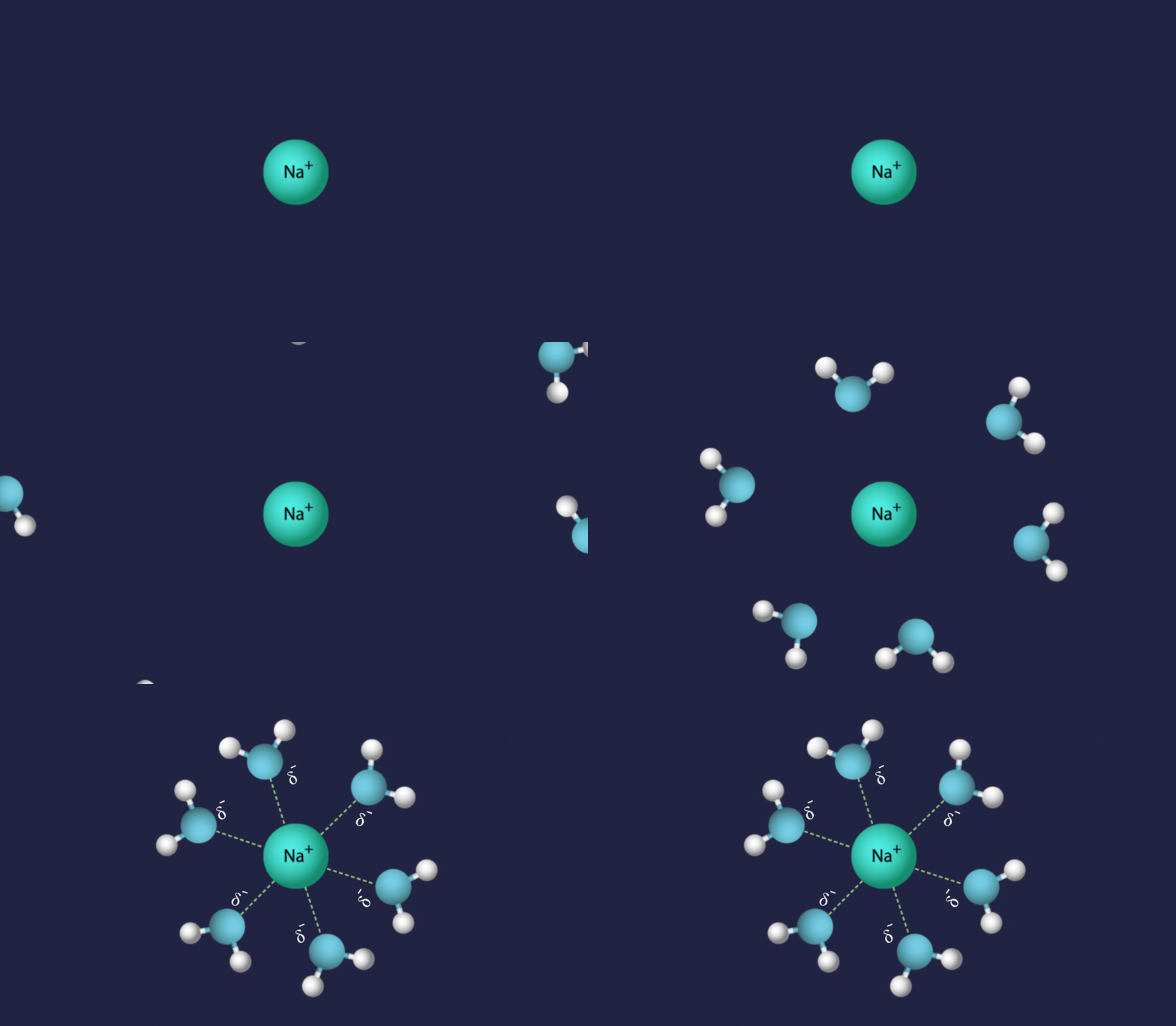
- Water is a polar solvent. Since oxygen is strongly electronegative, it develops a partial negative charge. On the other hand, hydrogens in a water molecule develop a partial positive charge.
- When an ionic solid is dissolved in a polar solvent such as water, the oxygen and hydrogen in the water attract the ionic solids cations and anions, respectively.
- As a result, each ion is surrounded by a large number of water molecules, resulting in the formation of a hydrated ion. Hydration of ions is the name given to this exothermic process.
- The degree of hydration is determined by an ion's charge density. As the size of the ion rises, the degree of hydration decreases.
Enthalpy of Hydration and Lattice Enthalpy
When ions are dissolved in water, they attract and hold a large number of dipolar water molecules around them. Any positive ion in the solution attracts the negative (oxygen) side of a dipolar water molecule. Water molecules cluster around positive ions due to the ion-dipole interactions. Similarly, negative ions attract the positive (hydrogen) ends of water molecules. Hydration is the process by which a positive or negative ion draws water molecules to their immediate proximity.
The potential energy of microscopic particles is reduced when water molecules migrate closer to the ions under the effect of their mutual attraction. This reduces the potential energy increase that occurs when ions are detached from a crystal lattice due to their attraction to other ions.
As a result, the dissolution of an ionic solid can be divided into two hypothetical processes. First, the crystalline salt is separated into the constituent gaseous ions. The lattice enthalpy is the heat energy absorbed when the ions are separated in this manner (or sometimes the lattice energy). The ions are then placed in solution, which means that water molecules are allowed to surround them. For this process, the enthalpy change is called hydration enthalpy.
If the lattice energy is smaller than the hydration energy, an ionic solid dissolves quickly in water.

What is the Radius of Hydration?
The radius of an ion and closely linked water molecules surrounding it is known as the hydrated radius or radius of hydration.
- Larger and lower-charged ions grip water molecules less firmly, resulting in a smaller hydrated radius.
- Smaller ions with a higher charge density bind water molecules more firmly and have a greater hydrated radius than larger ions with a lower charge.
- From top to bottom of a group, the ionic radius increases while the hydrated radius drops.
- The increasing order of ionic radii of alkali metals is .
- The decreasing order of hydrated radii of alkali metal ions is .

Hydration Enthalpy and Solubility of Metal Ions
- Hydration enthalpy is defined as the amount of the energy released when one mole of gaseous ions dissolves in a large amount of water i.e. infinitely diluted.
- Hydration energy is released after attaining stability because of the electrostatic attraction between water molecules and metal cations (ion-dipole interaction). The more the electrostatic attraction between the metal cation and the water molecules, the more the hydration energy.
- Hydration and solubility decrease with increasing atomic radii of metal ions. So, Cs+ion is the least water-soluble alkali metal ion.
- Smaller ions have a higher charge density and can be hydrated by more water molecules. This releases a higher enthalpy of hydration and makes the hydrated ions more stable.
- The smaller the ion, the higher the charge density, the stronger the electrostatic attraction between water molecules and metal cations, and the higher the hydration enthalpy.
- The correct order of the hydration energy of alkali metals is .
- Li+ has the maximum degree of hydration or is the most soluble. For this reason, lithium salts are mostly hydrated.
Example: LiCl.2H2O.
- Hydration enthalpies of Group II metals (alkaline earth metals) are greater in magnitude with respect to Group I metals (alkali metals).
- Hence, Group II metal ions have greater tendencies to form hydrated salts than Group I metal ions.
Example: Magnesium chloride and Calcium chloride exists as and
- So, the higher the hydration enthalpy, the more will be the solubility of metal ions in water.
Hydrated Radii and Ionic Mobility
The radius of hydration for elements decreases with increase in size, down the group. We know that as more shells are added to a group, the size rises. Since ionic radii and hydrated radii are inversely proportional, there is a decrease in the hydrated radius down the group. As a result, the uppermost element has the smallest size and the greatest hydrated radius. We know that ionic mobility refers to how easily or quickly an ion can travel in a solution. To this, we can add that heavily solvated ions have a huge number of solvent molecules surrounding them, reducing their mobility. As a result, hydrated radius is also inversely related to ionic mobility.
- As the size of the cation decreases, the charge density of the cation increases and the degree of hydration increases.
- As the degree of hydration increases, the hydrated ionic radius increases and the ionic mobility of the metal ions decreases.
- As the ionic mobility of the metal ions decreases, the molar conductance and the conductivity of the solution decrease.
- For alkali metals, the decreasing order of the hydrated radii of alkali metal ions is
- The correct order of conductance for the alkali metals is .
Practice Problems
Q. 1. How many water molecules surround one magnesium ion in a solution of Epsom salt?
A. Four
B. Seven
C. Eight
D. Five
Answer: Epsom salt is a hydrated magnesium salt, which is a Group II (alkaline earth) metal. The formula is magnesium sulphate heptahydrate, that is MgSO4.7H2O. So, seven water molecules surround one Mg2+ ion.
So, option B) is the correct answer.
Q. 2. What is the correct order of radius of hydration for alkaline earth metals?
Answer: Hydration enthalpies of Group II elements (alkaline earth metals) decrease with increasing ionic radii, down the group. Hence, the order of hydration enthalpies as well as that of radius of hydration of alkaline earth metal cations is
Q. 3. What kind of interaction exists between water molecules and positively charged metal ions in a solution?
A. Hydrogen Bonding
B. Covalent Bonding
C. Dative Bond
D. Ion-Dipole interaction
Answer: Any positive ion in solution attracts the negative (oxygen) side of a dipolar water molecule. Water molecules cluster around positive ions due to the ion-dipole interactions.
So, option D) is the correct answer.
Q. 4. An ionic solid is soluble if:
A. Lattice energy is greater than hydration enthalpy
B. Hydration energy greater than Lattice energy
C. Ionisation enthalpy is lower than Lattice energy
D. None of the above
Answer: The ionic compound is less soluble if the lattice enthalpy is higher than that of hydration energy released. The chemical is extremely soluble in water if the hydration enthalpy is higher than lattice energy. Both of these parameters are in opposition to one another, and the resultant of these factors determines an ionic compound's solubility in water.
So, option B) is the correct answer.
Frequently Asked Questions - FAQ
Q1. What is the size of a hydrated ion?
Answer: There is a theory that helped in devising the size of hydrated ions. Gouy-Chapman theory is an electrostatic model of the spatial distribution of ions adsorbed, but not immobilised, by a charged particle surface reacting with an aqueous electrolyte solution.
The most crucial correction to the Gouy–Chapman theory is to account for the size of hydrated ions, which typically have sizes of less than 0.5 nm.
Q2. How are hydrated radius and hydration enthalpy dependent on each other?
Answer: Hydration energy is the energy released when an ion gets surrounded by polar water molecules (H2O) and becomes hydrated. Because a smaller ion may accept more water molecules, its hydration energy increases as hydrated radius increases, and vice versa. So they are both directly proportional.
Q3. What is the significance of hydrated radii in purification technology?
Answer: The hydrated radius and strength of the hydration shells are important parameters that influence how ions are transported and removed during nanofiltration through membrane activities. Because ions with greater ionic radii (such as K+ and Na+) have thinner hydration shells, they may be able to separate from their hydration layer while passing through the nanofiltration membrane.
Q4. Which is more hydrated Li+ or Rb+?
Answer: The size of lithium is smaller than that of Rubidium which lies lower in Group 1. Hence, more water molecules will surround Li+ions. Therefore Li+ will be more hydrated than Rb+.

 Call Now
 Let's Chat
 Share
Share