-
Call Now
1800-102-2727


Phosphine - Hybridisation, Structure, Preparation, Physical and Chemical Properties, Reactions, Uses, Practice Problems and FAQ

Since the discovery of Phosphine gas clouds on Venus in 2020, the possibility of extraterrestrial life on Earth's nearest neighbor has been the most discussed topic.
The anaerobic degradation of organic matter on Earth produces phosphine. And it is this intriguing compound that is the focus of our attention today. It has the formula PH3.

Did you know that phosphorus and hydrogen aren't typically best friends?
In fact, they do not have a natural lovey-dovey relationship. On rocky planets with atmospheres, such as Earth, phosphine cannot be produced spontaneously. Phosphorous prefers to interact with oxygen in its oxidised form, i.e., phosphates, rather than in its reduced form, i.e., phosphine.
Then what is it that generates this bond between the two?
External energy is required to separate oxygen and phosphorus, which results in a much happier couple and brings the two, phosphorus and hydrogen, closer together. In some cases, this extra energy comes from outside sources, such as lightning strikes or bacterial enzymes that can survive in an oxygen-deficient atmosphere.
The minimal amounts of phosphine found on Earth are in places like sludges, quagmire, swampy solids etc. where anaerobic decay occurs.

TABLE OF CONTENT
- What is Phosphine?
- Structure and Hybridisation of Phosphine
- Preparation of Phosphine
- Physical Properties of Phosphine
- Chemical Properties of Phosphine
- Uses of Phosphine
- Practice Problems
- Frequently Asked Questions - FAQ
What is Phosphine (PH3)?
Phosphine (IUPAC name: Phosphane) was first obtained by Philippe Gengembre in the year 1783. He obtained phosphine by supplying heat to phosphorus in an aqueous solution of potassium carbonate. It is classified under the section of organophosphorus compounds. It is also known as Hydrogen phosphide, Phosphorus trihydride.
It plays an important role in the biochemical phosphorus cycle. Phosphine is present in human tissues, saliva, blood, urine etc.
Structure and Hybridisation of Phosphine
Phosphine does not undergo hybridisation at all. This can be justified by Drago’s rule. This rule states that hybridisation will not take place if:
- Central atom belongs to the third or higher period.
- The central atom has one lone pair.
- The electronegativity of the terminal atom is less than carbon.
In phosphine, pure p- orbitals overlap with the lone pair on the central atom. The orthogonal 3p orbitals overlap with the 1s orbital of H. On observing the bond angle data, it shows that the p-orbitals have an angle of 90°. Looking at its Lewis structure, we can state that the molecular geometry of PH3 is trigonal pyramidal.
Due to the presence of lone pair on P atom, it is considered as a Lewis base. Its bond length is 1.42 Å . The bond angle of H-P-H bonds is 93.5o.

Preparation of Phosphine
- Calcium phosphide is mixed with water or dilute HCl to produce phosphine gas.
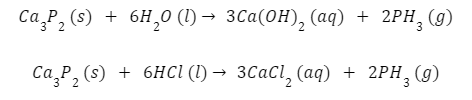
- On heating phosphorus acid, it decomposes to give off phosphine.

- In the laboratory, heating P4(white phosphorus) with concentrated NaOH solution in an inert atmosphere of CO2 produces phosphine.

- Purification of phosphine is therefore done by absorbing the gas obtained in HI, to form phosphonium iodide (PH4I), which when treated with KOH gives off phosphine.

Physical Properties of Phosphine
- It is a colourless and highly poisonous gas.
- It has rotten fish or garlicky odour.
|
Critical Temperature (°F) |
124.9 |
|
Density of the gas at 70°F 1 atm (lb/ft3) |
0.0885 |
|
Specific Gravity |
1.203 |
|
Melting Point (°F) |
208.8 |
|
Boiling Point (°F) |
126.0 |
|
Molar Mass |
33.99 g mol-1 |
|
Critical Pressure (Pc) |
947.9 |
|
Liquid Density @ 70°F (lb/ft3) |
35.50 |
Chemical properties of Phosphine
- The solution of PH3 in water decomposes in the presence of light to give red phosphorus and hydrogen gas.

- When absorbed in copper sulphate or mercuric chloride solutions, the corresponding phosphides are obtained.

- In pure state, phosphine is non-flammable, but in an impure state, it is highly flammable due to presence of impurities like diphosphine and traces of P4 vapours. It is majorly found in impure forms.

- Under normal conditions, it is a non-combustible gas, but when heated it catches fire which results in the formation of phosphoric acid. The temperature condition for this reaction to occur is around 150C

- It explodes on contact with traces of oxidising agents like HNO3 , Cl2, and Br2 vapours.
- Phosphine exhibits high dissolution property in certain solvents but is sparingly soluble in water.
- As per chemical safety standards, this gas has the characteristic to cause high environmental damage.
Uses of Phosphine
- Phosphine is used as a dopant in semiconductor industries and in electrical conductances.
- PH3 is used in Holme’s signal due to its property of spontaneous combustion. The spontaneous combustion of phosphine is technically used in Holme’s signals. Containers having a punctured base and a gap at the top are recorded with calcium phosphide and calcium carbide. These are, then released into the ocean. Water enters the containers through the base. It reacts and produces acetylene and phosphine which cause huge amounts of smoke.

- It is used as an insecticide.
- Phosphine is used as a fumigating agent in households to control the bugs and save a huge range of stored grains.
- It is used as a flame retardant and incendiary.
Practice Problems
Q1. In the equation, 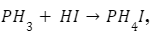 , phosphine behaves as:
A. Dehydrating Agent
B. Lewis Acid
C. Lewis Base
D. Oxidising Agent
Answer: Phosphine contains a lone pair on the phosphorus atom which it can donate to Lewis acids. In the given reaction, phosphine reacts with hydrogen iodide to form phosphonium iodide. Thus, it acts as a Lewis base. So, option C) is the correct answer.
Q2. What is the kind of hybridisation in phosphine?
A. sp3
B. sp3d
C. sp2
D. None of the above
Answer: Phosphine does not undergo any hybridisation at all. This is because pure p-orbitals participate in bond formation. So, option D) is the correct answer.
Q3. Which of the following is incorrect with respect to phosphine?
A. Phosphine is a colourless gas
B. Phosphine has a rotten fish smell
C. Phosphine is highly inflammable
D. Phosphine is a noxious gas
Answer: Phosphine is a colourless gas with a garlicky or rotten-fish like odour and is highly noxious. In its pure state, phosphine is non-flammable but in presence of impurities such as P2H4 or white phosphorous (P4), phosphine vapours become inflammable.
Q4. Holme’s signal can be represented by which reactions?
Answer: Containers containing calcium carbide and calcium phosphide are pierced and thrown into the sea.

Phosphine catches fire whereas acetylene produces a bright luminous flame. This is termed Holme’s signal.
Frequently Asked Questions - FAQ
Question 1. Is phosphine and phosphene the same?
Answer: Not at all! Phosphine is an inorganic phosphorus-based compound with the formula PH3. Phosphenes are basically some bright luminous floating illustrations which are star-like, swirly or zig-zag in shape, that we observe on closing our eyes tightly with pressed hands. One thing to be noted here is, Phosphine and phosphane are the same.
Question 2. Is phosphine harmful to human beings?
Answer: Inhalation of this gas can cause severe headaches, burning substernal pain, dizziness, nausea, vomiting, cough, laboured breathing, shortness of breath, chest tightness, and pulmonary edemas in humans. It is highly toxic and poisonous.
Question 3. What is the shape of phosphine?
Answer: Phosphine is trigonal pyramidal in shape with a lone pair of phosphorus atoms.
Question 4. Ammonia can form hydrogen bonds with water, can phosphine do the same?
Answer: No, phosphine cannot form hydrogen bonds with water. This is because of the low electronegativity and greater atomic radii of phosphorus as compared to that of nitrogen. Hence P-H bonds are less polar.
Related Topic
|
Phosphorus-Compound of P |
Sodium Hydroxide |
|
Phosphorus Halide |
Oxygen |

 Call Now
 Let's Chat
 Share
Share