-
Call Now
1800-102-2727


Oxidation Numbers-Oxidation States, Fractional Oxidation States, Concept of Oxidation Numbers, Individual and Average Oxidation States

As you already know that the mode of any transaction in a commercial world is money. Money is spent or earned depending upon the nature of transactions. Similarly, during a chemical reaction, there could be transactions of electrons, protons, etc.
So how can one figure out the changes?
Luckily, we have a simple yet brilliant way of deducing such changes. With the help of the concept of Oxidation number, we can identify which chemical species is oxidized and reduced during a chemical reaction.
Oxidation number plays an important role to decide which chemical species is oxidized or reduced. An increase in oxidation number means oxidation and a reduction in oxidation number is reduction.
Table of contents
- Oxidation Numbers - Oxidation States
- Fractional oxidation states
- Individual and Average Oxidation states
- Practice problems
- Frequently asked questions-FAQs
Oxidation number
It is a real or imaginary charge developed on an atom when it goes from its most stable elemental free state to the combined state.
Calculation of oxidation number is based on the electronegativity rule and the assumption that a complete transfer of an electron takes place from a less electronegative atom to a more electronegative atom.
General rules for calculating oxidation number:
A. Fluorine (F): Most electronegative element from the whole periodic table is fluorine. So, O.S of F in any compound is always -1.
E.g- HF, O.S of F is -1.
B. Hydrogen (H): Generally, the O.S of H atom in a compound is +1 but in the case of metallic hydrides O.S of H is -1 (confirmed by electrolysis).
E.g- HCl - O.S of H is +1
NaH - O.S of H is -1.
C. Halogens (Cl, Br, I not for F): Generally, O.S of halogens are -1 but with the more electronegative element they show +ve O.S.
E.g- HCl, O.S of Cl is -1
HClO4- O.S of Cl is +7
HClO3- O.S of Cl is +5
HClO2- O.S of Cl is +3
HClO- O.S of Cl is +1
D. O.S of group 1 metals (Li, Na, K, Rb & Cs) is -1 and O.S of group 2 metals is -2.
E. Oxygen (O): Generally, in oxides, the O.S of O is -2.
In the case of
Superoxides (O2-): O.S of O is -12
E.g- KO2- O.S of O is -12
Peroxides (O22-): O.S of O is -1
E.g- Na2O2- O.S of O is -1
F. O.S of elements in their free elemental forms is always zero.
|
Elemental form |
Oxidation state |
|
H2(g) |
0 |
|
O2(g) |
0 |
|
O3(g) |
0 |
|
Na(s) |
0 |
|
P4(s) |
0 |
|
Br2(l) |
0 |
G. Sum of the charges of all elements in a molecule is the zero and the sum of the charges of all atoms in an ion is equal to the charge on the Ion.
H. If the group no. of an element in the periodic table is ‘n’ then its O.S may vary from ‘n-18’ to ‘n-10’ (but it is mainly applicable in gr 13 to gr 17 elements)
E.g. S - atom belongs to XVI group in the periodic table therefore as per rule its oxidation number may vary from (16-18) which is -2 or (16-10) which is +6
Rules to calculate individual oxidation number
The individual oxidation number of the element in its compound can be calculated on the basis of the structure of the compound and some other parameters (like hybridization).
Formula: Oxidation Number of atom = Valence electron – number of electrons left after bonding
Case 1: neighbor elements with no electronegativity difference
O.S of Cl in Cl2is 0.
Cl — Cl
For O.S of Cl atom
No. of electrons in the valence shell = 7
No. of electrons left after bonding = 7
oxidation number = 7 – 7 = 0
O = O
O.S of O atom
No. of electrons in the valence shell = 6
No. of electrons left after bonding = 6
oxidation number = 6 – 6 = 0
O = C = O
O.S of O atom
No. of electrons in the valence shell = 6
No. of electrons left after bonding = 8
oxidation number = 6 – 8 = -2
Case 2: neighbor elements with electronegativity difference
(Cl is more electronegative than H)
H — Cl
For Cl atom
No. of electrons in the valence shell = 7
No. of electrons left after bonding = 8
Oxidation number = 7 – 7 = -1
For H atom
No. of electrons in the valence shell = 1
No. of electrons left after bonding = 0
Oxidation number = 1 - 0 = +1
Case iii:
1. Calculation of O.S of S atom in sodium tetrathionate (Na2S4O6)
Let, O.S of S is x
O.S of Na is +1
O.S of O is -2
2+4x+12=0
x=2.5
But from structure, all S atoms are sp3 hybridized
So, O.S of two S atoms attached with 3 O atoms is +5.
No. of electrons in the valence shell = 6
No. of electrons left after bonding = 1
Oxidation number = 6 - 1 = +5
So, the O.S of two S atoms attached to two S atoms is +0.
No. of electrons in the valence shell = 6
No. of electrons left after bonding = 6
Oxidation number = 6 - 6 = 0

If we calculate the average O.S of S atom 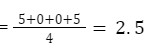
2. Calculation of O.S of S atom in hypo (Na2S2O3)
Let, O.S of S is x
O.S of Na is +1
O.S of O is -2
2+2x+6=0
x=2
But from structure, terminal S atom is sp2 hybridized and central S atom is sp3 hybridised.

(sp2 hybridized S atom (terminal) is more electronegative than sp3 hybridized S atom (central))
So,
Central S atom:
No. of electrons in the valence shell = 6
No. of electrons left after bonding = 0
Oxidation number of central S atom = 6 - 0 = +6
Terminal S atom:
No. of electrons in the valence shell = 6
No. of electrons left after bonding = 8
Oxidation number of terminal S atom = 6 - 8 = -2
If we calculate the average O.S of S atom = 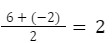
Practice problems
Q 1. Which oxidation state is not possible for N atom
a. -3
b. +3
c. +5
d. +6
Answer: (D)
generally, for elements of p-blocks,
gr no - 18 < Oxidation state < group number - 10
N belongs to group 15
15 - 18 < Oxidation state of N < 15 - 10
-3 < Oxidation state of N < +5
Q 2. Calculate the oxidation state of S in H2SO5
a. +5
b. +6
c. +7
d. +8
Answer: (B)
generally, for elements of p-blocks,
gr no - 18 < Oxidation state < group number - 10
S belongs to group 16
16 - 18 < Oxidation state of S < 16 - 10
-2 < Oxidation state of S < +6

One peroxy linkage present in the molecule. So, 2 O atoms have -1 O.S
Let, O.S of S = x, O.S of H = +1, O.S of oxides O atom = -2

x=+6
Q 3. Calculate the magnitude of difference between the different values of O.S for O atoms in CrO5
a. 1
b. 2
c. 3
d. 4
Answer: (A)

O.S of O atoms forming rings is -1 (peroxy linkage).
O.S of O atom attached with Cr with double bond -2.
Let, O.S of Cr = x,

x=+5
Q 4. Find the possible form of oxides and O.S of Pb in different oxides, in Pb3O4
a. PbO & Pb2O3; +2 & +3
b. PbO & PbO2; +2 & +4
c. PbO & PbO2; +2 & +3
d. PbO & Pb2O3; +2 & +4
Answer: (B)
Pb3O4 is a mixed oxide. From the inert pair effect, O.S of Pb lead can be +2 (more stable) & +4.
Pb3O4 mixed oxide present in form of 2: 1 molar ratio 2PbO PbO2
Frequently asked questions-FAQs
Q 1. What is the inert pair effect?
Answer: in heavier p block elements, the reluctance of s orbital electrons to take part is bonding is termed as inert pair effect.
E.g- General configuration of gr 13 element: ns2np1
Common oxidation state of gr 13 element is +3 but heavier elements of group 13 also exhibit +1 oxidation state.
Q 2. Can oxidation state of metals in compounds be zero?
Answer: yes, in a complex compound like Ni[(CO)4], the oxidation state of Ni is zero.
Q 3. Which scale of electronegativity is generally followed?
Answer: generally we follow the Pauling scale of electronegativity.
Pauling scale electronegativity of F, O, and N are 4,3.5 and 3 respectively.
Q 4. What is electronegativity?
Answer: Tendency of an atom to attract bonded pair of electrons towards itself in a covalently bonded molecule.
E.g- in HCl, Cl is more electronegative than H because Cl withdraws electronic clouds towards itself and a partial negative charge is generated on Cl and a partial positive part on H.
Related topics:
|
Normality |
Balancing of Redox equation |
|
Types of redox reactions |
Equivalent Weight |
|
Hybridization |
Electronegativity |

 Call Now
 Let's Chat
 Share
Share