-
Call Now
1800-102-2727


Structure of Nucleic acid - Nucleic acid, Base and Phosphate Groups, DNA and RNA, Practice Problems & FAQs

It is well known that each person has a unique set of fingerprints. For identification purposes, fingertips have been utilized for a very long time.
But did you know that these can be changed through surgery?
Ah, there should be another method which is more reliable for finding someone’s real identity. Right?
So, Which method or aspect of an individual's identity cannot be altered by any means?
Do you have any ideas?
No, Don’t worry!
Let me explain!
DNA fingerprinting is the process of gathering data on a person's specific DNA base sequence. No known treatment can change it because it is the same for all cells.
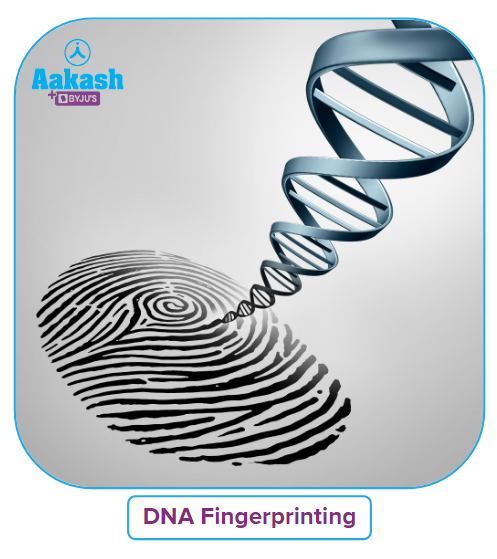
TABLE OF CONTENT
- Nucleic Acids
- Heterocyclic Base
- Sugars
- Phosphate Group
- Nucleosides and Nucleotides
- Structure of DNA
- Structure of RNA
- Practice Problems
- Frequently Asked Questions
Nucleic Acids:
As you are aware, every generation of every creature has numerous similarities to its predecessors. It has been determined that the passing of these traits, commonly known as heredity, from one generation to the next, occurs in the core of a human cell.
Nucleotides are the recurring units of nucleic acids. As a result, nucleic acids are also classified as polynucleotides. Nucleic acids have a polypeptide ester chain instead of a polyamide chain like proteins do.
Two categories of nucleic acids exist:
- Deoxyribonucleic acid, or DNA
- Ribonucleic acid, or RNA
There are three chemical components that make up a nucleotide:
(i) Heterocyclic base
(ii) Sugar
(iii) Phosphate group
Heterocyclic Base:
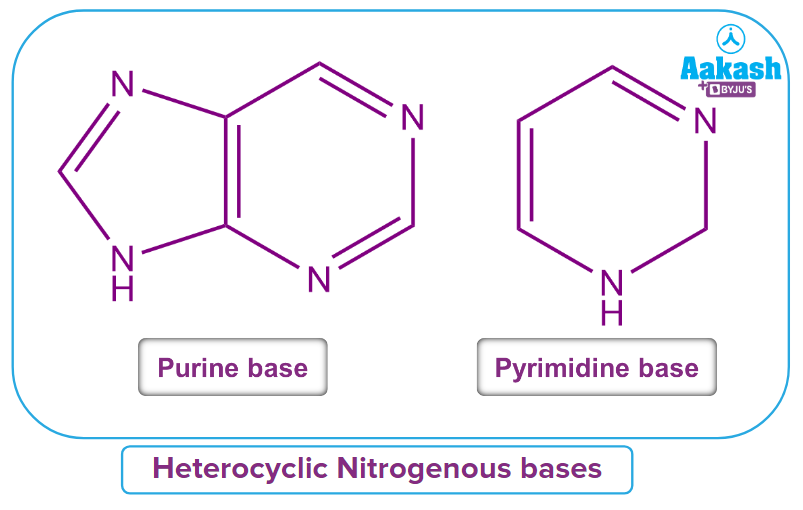
Heterocyclic nitrogenous bases come in two varieties. These are well-known pyrimidines and purines. While purines contain two fused rings, pyrimidines only have one heterocyclic ring. The substituted versions of these substances are found in nucleic acid.
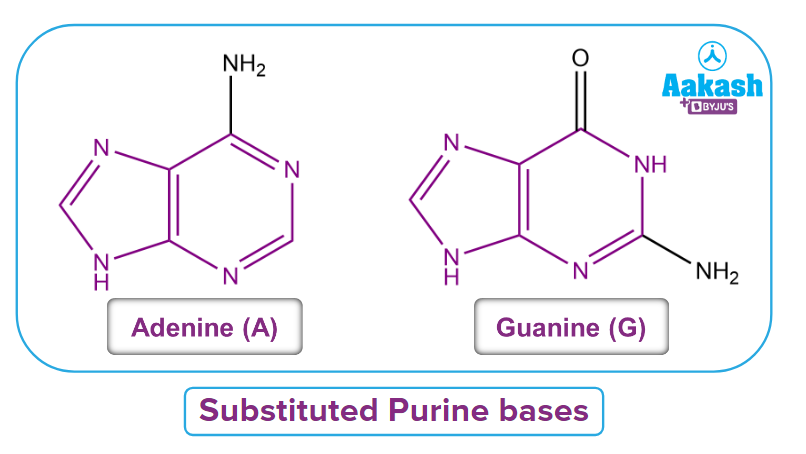
Purine bases present in Nucleic acids are Adenine (A) and Guanine (G). These both substituted purine bases are present in both Deoxyribonucleic acid, or DNA and Ribonucleic acid, or RNA
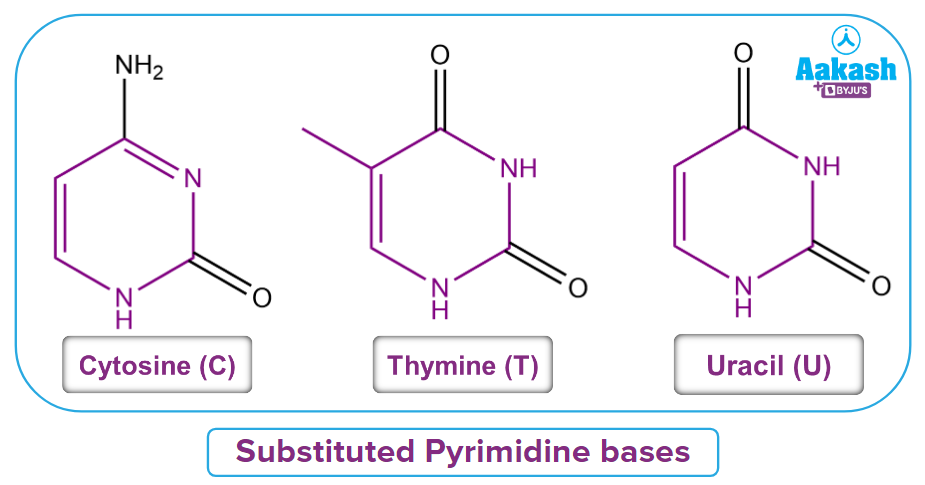
Pyrimidine bases present in Nucleic acids are Uracil (U), Thymine (T) and Cytosine (C). Cytosine (C) substituted pyrimidine base is present in both Deoxyribonucleic acid, or DNA and Ribonucleic acid, or RNA. But Thymine (T) is present only in Deoxyribonucleic acid, or DNA and Uracil (U) is present only in Ribonucleic acid, or RNA.
Sugars:
There are basically two types of sugars or carbohydrates present in the nucleic acids.
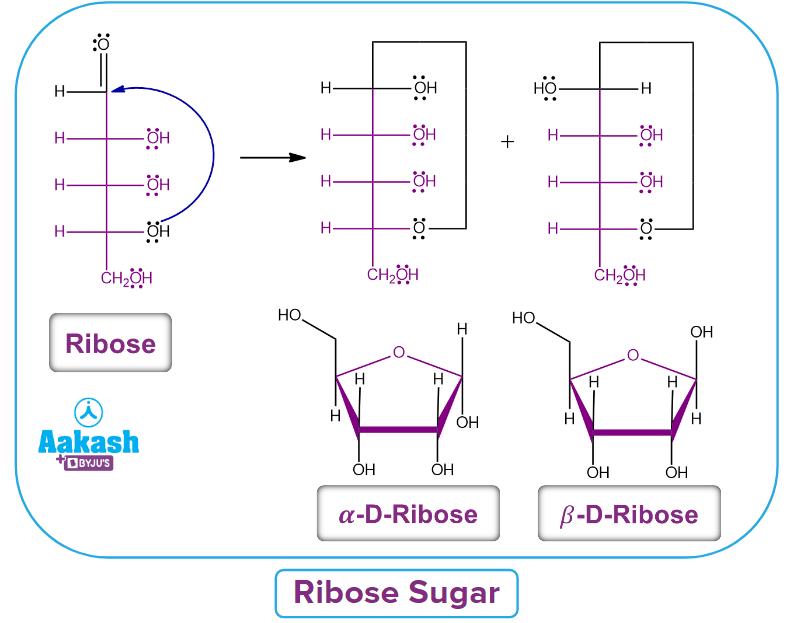
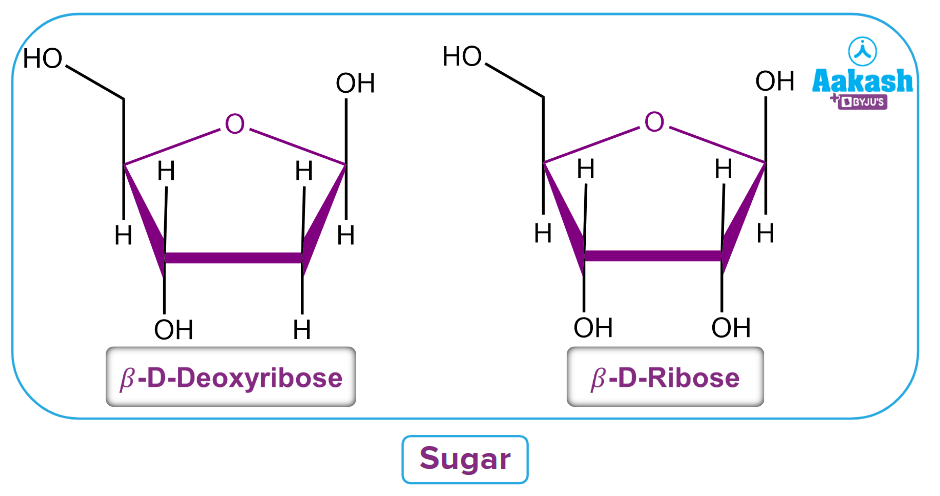
-D-ribose is present in RNA and -D-2 deoxyribose is present in DNA. Ribose is an Aldopentose carbohydrate having one aldehyde group and four alcoholic groups.
Phosphate Group:
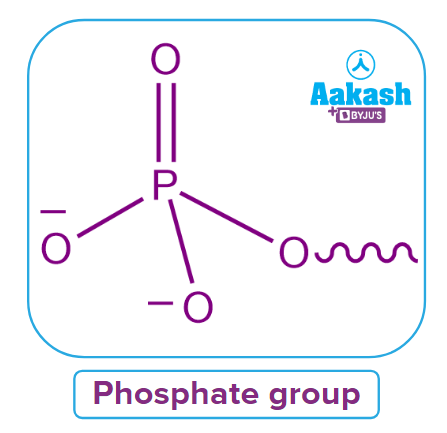
They are responsible for the stability and formation of Nucleic acids polymers. They are connected to the hydroxyl group of ribose present at C1 position.
Nucleosides and Nucleotides:
Nucleosides:
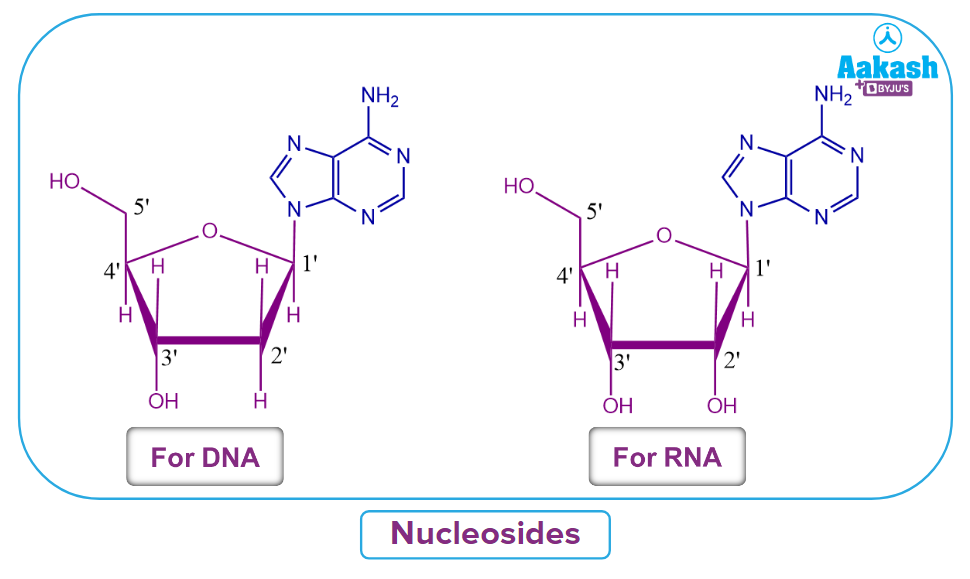
A nucleoside is a compound in which a sugar molecule is joined to one of the nitrogen bases (purine or pyrimidine).
Sugar + Base = Nucleoside
RNA and DNA have different nucleosides in two ways:
(i) RNA nucleosides contain ribose, whereas DNA nucleosides contain deoxyribose as their sugar.
(ii) The uracil base found in RNA replaces the thymine found in DNA in the nucleoside.
In order to identify nucleosides from bases, it should be highlighted that the carbon atoms in sugar molecules are given numbers 1', 2', 3', 4', and so on. Through N- glycosidic linkages, the purine or pyrimidine bases are joined to the position 1' of aldopentose sugar or ribose sugar.
According to the base present, the nucleosides are named as follows:
|
Base |
Abbreviation |
Nucleoside |
|
Adenine |
A |
Adenosine |
|
Guanine |
G |
Guanosine |
|
Cytosine |
C |
Cytosine |
|
Thymine |
T |
Thymidine |
|
Uracil |
U |
Uridine |
Nucleotides:
The molecule created is known as a nucleotide when the phosphate group is joined to the nucleoside. In other words, a nucleotide is a phosphate ester of a nucleoside and is made up of the aldopentose sugar, a purine or pyrimidine base, and one or more phosphate groups.
Sugar + Base + Phosphate unit = Nucleotide
A sugar unit is therefore connected to a nitrogen base and a phosphate group unit by a nucleotide. These are their skeletal arrangements:
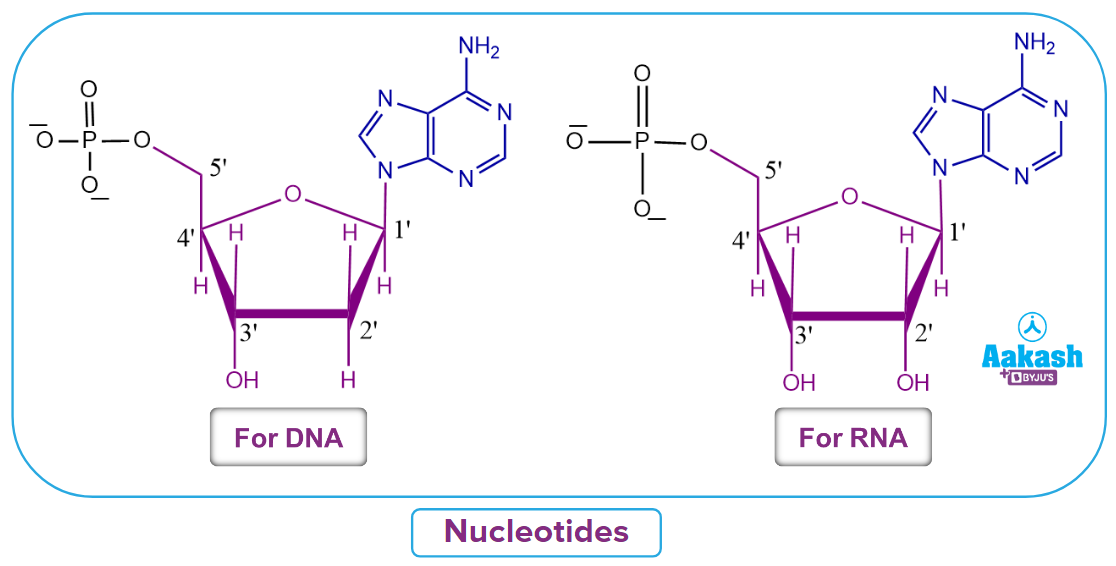
The nucleotides are shortened using three capital letters as shown below in the table.
|
Three letter Code |
Nucleotide |
|
AMP |
Adenosine Monophosphate |
|
ADP |
Adenosine Diphosphate |
|
ATP |
Adenosine triphosphate |
|
UDP |
Uridine Diphosphate |
|
GTP |
Guanosine triphosphate |
NOTE: Phosphodiester connections between 5' & 3' Carbon atoms of pentose sugar serve as the structural foundation for nucleotides.
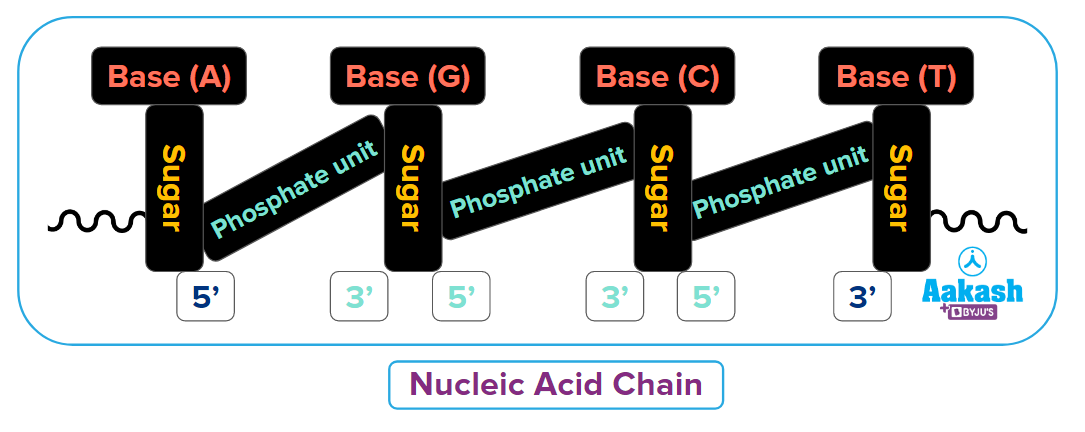
Therefore, a long chain polymer known as nucleic acid is produced by successively attaching the sugar unit of one nucleotide to the phosphate group of the next nucleotide.
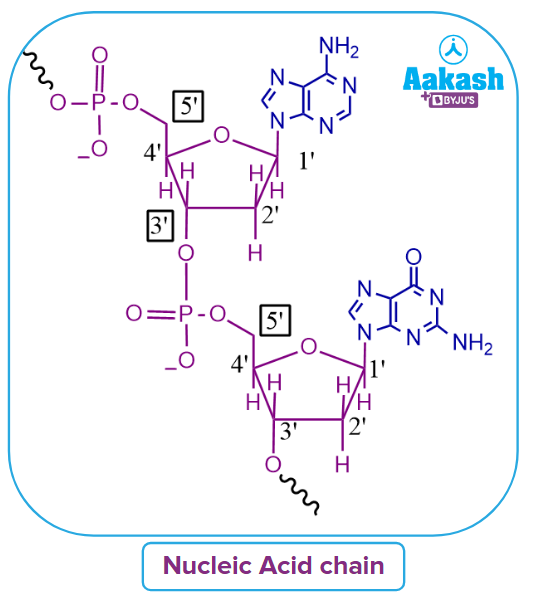
The backbone of nucleic acid is made up of alternating sugar and phosphate linkages. The 5' end of a nucleic acid chain is typically written on the left side of a one-letter code used to abbreviate a nucleic acid chain. As an illustration, ACGT stands for a tetranucleotide that consists of the bases adenine, cytosine, guanine, and thymine from the 5' end to the 3' end.
Structure of DNA:
Primary structure of DNA:
- The main structure of a nucleic acid chain refers to the arrangement of its nucleotides.
- E. Chargaff discovered that the number of adenine was always equal to the number of thymine (A = T), and the number of cytosine, always equal to the number of guanine (C = G).
It is often referred to as the Chargaff rule. In other words, the total amount of pyrimidines and purines was equal, or A + G = C + T.
- However, the AT/CG ratio differed greatly between species. The AT/CG ratio, for instance, is 1.52 in humans.
- On the basis of X-ray diffraction research, James Watson and Francis Crick discovered the three dimensional structure of DNA in 1953.
- According to Watson and Crick, DNA polymers are made up of two right-handed helical chains that are coiled around a common central axis.
- The two strands are antiparallel, which means their 5' 3' phosphodiester connections run in opposite directions. Inside the helix, the bases are placed perpendicular to the helical axis.
- In this configuration, the bases project inwards toward one another, while the sugar and phosphate molecules form an outer structural framework around the duplex.
Secondary structure of DNA:
Hydrogen bonds hold the two strands together. Because bases have only one possible pairing mode, this hydrogen bonding is exceedingly specific.
Guanine (G) is hydrogen linked to cytosine (C), and adenine (A) to thymine (T). Two hydrogen bonds can bind thymine to adenine, while three hydrogen bonds can bind cytosine to guanine.
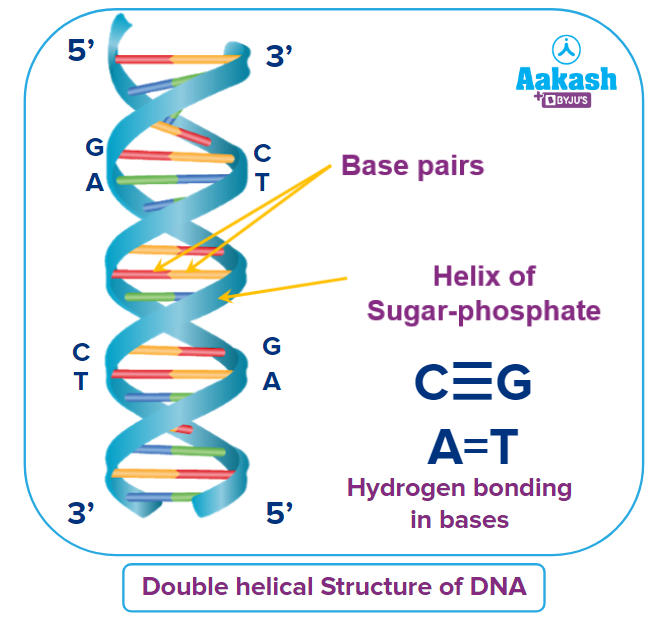
The two strands of DNA are believed to be complementary to each other in the sense that the sequences of bases in one strand automatically determine the sequences of bases in the other. For example, whenever the base adenine (A) occurs in one strand, the base thymine (T) occurs in the other strand.
Structure of RNA:
With the exception of being a single strand structure, RNA's structure is quite similar to that of DNA. They may reverse their folding pattern to generate a double helix structure. Three main forms of RNA molecules are known by the names messenger RNA (m-RNA), ribosomal RNA (r-RNA), and transfer RNA (t-RNA).

Related Video link: JEE Main 2022 - Top 10 Most Important & Expected Questions of Biomolecules Class 12 Chemistry
Practice Problems:
Q1. Which of the following bases are not present in DNA?
- Thymine
- Uracil
- Cytosine
- Adenine
Answer: (B)
Solution: Both Deoxyribonucleic Acid, or DNA, and Ribonucleic Acid, or RNA, include a pyrimidine base with a cytosine (C) substitution. However, uracil (U) is only found in ribonucleic acid, or RNA, not in DNA. While thymine (T) is only found in deoxyribonucleic acid, or DNA. Hence, the correct answer is option (B).
Q2. Which of the following bases are not present in RNA?
- Thymine
- Uracil
- Cytosine
- Adenine
Answer: (A)
Solution: Both Deoxyribonucleic Acid, or DNA, and Ribonucleic Acid, or RNA, include a pyrimidine base with a cytosine (C) substitution. However, uracil (U) is only found in ribonucleic acid, or RNA, while thymine (T) is only found in deoxyribonucleic acid, or DNA, not in RNA.
Hence, the correct answer is option (A).
Q3. The number of hydrogen bonds present in the Nitrogenous bases pair A & T and C & G are:
- 3 & 3
- 3 & 2
- 2 & 2
- 2 & 3
Answer: (D)
Solution: The two strands are joined together by hydrogen bonds. Bases can pair in just one way, making this hydrogen bonding extremely precise.
Guanine (G) and adenine (A) are hydrogen-linked to cytosine (C) and thymine (T), respectively. Thymine can form two hydrogen bonds with adenine, whereas cytosine can form three hydrogen bonds with guanine.
Hence, the correct answer is option (D).
Q4. Which Phosphodiester connections between carbon atoms of pentose sugar serve as the structural foundation for nucleotides?
- 2' & 3'
- 5' & 3'
- 3' & 2'
- 3' & 3'
Answer: (B)
Solution: Since the two strands are antiparallel, their 5'-3' phosphodiester linkages flow in the reverse direction. The structural framework for nucleotides is established by phosphodiester linkages between the 5' and 3' carbon atoms of pentose sugar.
Hence, the correct answer is option (B).
Frequently Asked Questions-FAQs:
1. What is annealing and melting temperature in DNA?
Answer: The two DNA strands break from one another when heated, a practice called melting. These two strands once more dimerize after they are cooled. The name of this technique is annealing. The temperature that causes the two strands to entirely separate is referred to as the melting temperature (Tm).
2. What's the relationship between DNA and RNA?
Answer: Protein, RNA, and DNA are all interconnected. DNA does not directly make proteins, but it does carry the information needed to encode proteins. The majority of cellular processes are carried out by proteins that are created by RNA, which carries the information from the DNA.
3. Why was DNA selected as the genetic component?
Answer: DNA is a superior genetic material. Unlike RNA, which has 2'OH in ribose sugar and is chemically reactive, DNA has 2'H in deoxyribose sugar, which makes it chemically stable. In addition, compared to uracil in RNA, thymine in DNA is less prone to tautomerism and mutations.
4. What makes genetic coding significant?
Answer: Important evidence supporting the shared origin of life on Earth comes from the genetic code shared by a variety of creatures. That is to say, it is likely that the many species found on Earth today developed from an ancient organism that already possessed the genetic code.

 Call Now
 Let's Chat
 Share
Share