-
Call Now
1800-102-2727


Noble Gases - Sources, Physical Properties, Chemical Properties and Uses of Argon and Krypton, Practice Problems and FAQ

The ability to remain calm in the face of adversity—to turn up one's nose and ignore minor human flaws—is widely regarded as a noble human trait. Have you ever heard of 'Yudhisthira' from the epic saga 'Mahabharata'? His name means "one who is unaffected by the enormous turmoils of war" and "one who is steady at war." This is a trait of the constant pursuit for human beings, but for noble gases, it comes naturally!
Noble gases are essentially too lazy to react with anyone. If they could speak, they would say, "I am so happy and content with what I have; please spare me from any chemical reactions."
Let’s find out what is so special about noble gases and how they are put to use by humans.

TABLE OF CONTENTS
- Noble Gases - Introduction
- Sources of Noble Gases
- Argon - Introduction
- Argon - Physical Properties
- Argon - Chemical Properties
- Argon - Uses
- Krypton - Introduction
- Krypton - Physical Properties
- Krypton - Chemical Properties
- Krypton - Uses
- Krypton - Toxicity
- Uses of Noble Gases
- Practice Problems
- Frequently Asked Questions - FAQ
Noble Gases - Introduction
The noble gases, commonly known as inert gases, are elements in group 18 of the modern periodic table. This group includes the following elements:
- Helium (He)
- Neon (Ne)
- Argon (Ar)
- Krypton (Kr)
- Xenon (Xe)
- Radon (Rn)
All noble gases occur in the gaseous phase under conventional temperature and pressure conditions. As they have stable electronic structures, they are noted for having a very low chemical reactivity (hence the name inert gas). This is why noble gases are generally found as monatomic gases and have a difficult time forming molecules.
The general electronic configuration of noble gases can be expressed as ns2 np6, the exception being Helium (1s2). As a result, the noble gases' outermost valence shells can be deemed 'full.' The chemical inertness of the group 18 elements is due to this fact.
Sources of Noble Gas
- Air contains neon, Argon, Krypton, and xenon, which can be extracted by liquefying it, followed by fractional distillation.
- The cryogenic separation of natural gas is the primary source of helium. The radioactive disintegration of heavier elements such as radium, thorium, and uranium produces radon, a radioactive noble gas.
- Element 118 (the newest noble gas) is a radioactive element created by accelerating particles and striking a target. Extraterrestrial sources of noble gases may be discovered in the future. Larger planets, in particular, have a higher abundance of helium than Earth.
Argon - Introduction
Argon is the first known gas from the family of noble gases that was invented by scientists. Argon was acknowledged by the English physicist Lord Rayleigh as well as Scottish chemist William Ramsay in 1894.
Argon comes from the Greek word "Argos" which implies "lazy" or "not active". Argon belongs to a family of noble gas that makes up a total of 0.93% of the atmosphere of Earth. Argon is considered to be the third most amount of ample gas in the environment. Non-flammable gases that are cryogenic in nature are often recognised as inert gases.
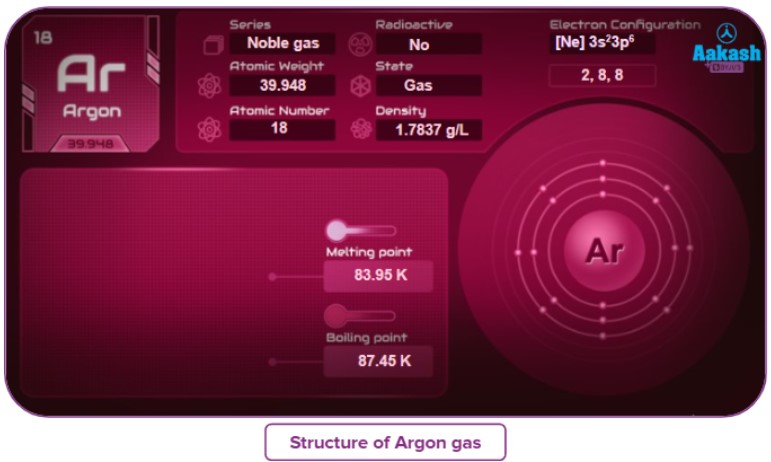
Argon - Physical Properties
|
Density |
1.784 g L-1 |
|
Molar Mass |
39.948 g mol-1 |
|
Boiling Point |
-185.8 °C |
|
Melting Point |
-189.4 °C |
|
Chemical Formula |
Ar |
|
Odour |
Odourless |
|
Appearance |
Colourless gas |
|
Period |
3 |
|
Block |
p |
|
Atomic Number |
18 |
|
Element category |
Noble gas |
|
Water Solubility |
62 mg L-1 at 20oC and 1 bar pressure |
Argon - Chemical Properties
Argon is a gas that is a member of the noble gas family recognised to be chemically inactive. At lower temperatures, it does not act as an inactive gas. The atoms of the noble gas family can be combined with different atoms which give rise to products that can survive in low temperatures. Due to the chemical inactiveness of the gas, it is called a noble gas.
- Argon was guessed to be present in the air by Henry Cavendish in the year 1785.
- The key isotope of Argon is Argon-40 which emerges from the procedure of radioactive decay of potassium-40.
Argon - Uses
- Argon plasma coagulation (APC) is an electrosurgical technique that coagulates tissue by using Argon discharges at atmospheric pressure. Because it is biochemically inert, has a low breakdown voltage, and is very inexpensive, Argon was chosen.
- Argon plasma coagulation utilises electricity to conduct Argon plasma as a medium to give a higher frequency current to clot the tissue. The non-contact characteristic allows fast coagulation with very little control and injury to the tissues.
- In electric lamps, Argon is utilised as the filling for lamps that are incandescent filament and also used as a discharge of neon tubes that are utilised in the making of advertising signs.
- Argon gas is widely utilised as a filing in fluorescent light bulbs so that oxygen is prevented from wearing the filament of the bulb that tends to get heated up at very high temperatures.
- Argon is also utilised to organise makeshift inert atmospheres that need shielding from other gases for purposes such as welding and rising semiconductor crystals.
Krypton - Introduction
Krypton is a noble gas belonging to group 18 of the periodic table. This element belongs to the p-block and has an atomic number of 36. It is an inert gas and is present in minute quantities in the atmosphere.
Krypton was discovered in the year 1898 by William Ramsay and Morris Travers while analysing the residues left from evaporating liquid gas. This inert gas emits several spectral lines and is used with other noble gases in illuminating devices. Krypton gas can be produced from the radioactive fission of uranium.
Krypton - Physical Properties
Krypton is a radioactive noble gas and has the following physical properties.
- The atomic number of Krypton is 36, and its electronic configuration is [Ar] 3d10 4s2 4p6. This completely filled valence shell is the reason behind the element being inert.
- The atomic weight of Krypton is 83.79 u, and its density is 0.003425 g cm-3.
- Krypton is a colourless and odourless gas with a density three times higher than the normal air.
- Like other noble gas elements, even Krypton has a face-centred cubic crystalline structure in its solid state.
- The boiling point and melting point of Krypton are -153.4 °C and -157.4°C, respectively.
Krypton - Chemical Properties
Krypton exhibits the following oxidation states: 0, +1, +2. Generally, due to its filled outermost shell, the element does not participate in reactions, and its oxidation state remains zero.
- Krypton has a set of isotopes with varying mass numbers, typically ranging from 69 to 102. There are 34 isotopes in total that have been discovered and studied, of which five are naturally occurring stable isotopes, and one is a radioactive isotope with a prolonged half-life. The isotopes occurring in nature are 78Kr, 80Kr, 82Kr, 83Kr, 84Kr and 86Kr.
- Being a radioactive element, Krypton emits intense spectral lines, especially of green and yellow colour.
- Krypton is sparingly soluble in water at a temperature ranging between 30° C and 40° C.
- As Krypton is an inert gas, it is majorly unreactive. However, there is one particular reaction in which Krypton participates.
In its +2-oxidation state, Krypton reacts with fluorine in the presence of an electrical discharge and at an extremely low temperature of -196° C to form the product Krypton fluoride. This compound of Krypton fluoride readily decomposes at elevated temperatures. Krypton only specifically reacts with fluorine and no other halogen atoms.
Krypton - Uses
- Krypton fluoride formed as a product of the reaction of Krypton with the halogen fluorine is used in the production of lasers.
- Krypton is used as a filler gas along with Argon in fluorescent lamps.
- It is also used in flashlights in super speed photography.
- The isotope of Krypton,81Kr, is used in the radioactive diagnosis of diseases. The process involves consuming the isotope in the form of nuclear medicine; the path of the inhaled medicine can be traced using gamma cameras to study the scars on the lungs.
- Krypton-83 is another isotope of Krypton that is used in magnetic resonance imaging (MRI).
- The illuminating blue-green signals used for displaying instructions in darkness are made up of Krypton in combination with mercury.
- Krypton has applications in particle physics, where the element in liquid form is used to construct quasi-homogeneous calorimeters.
- Krypton being an inert non-metal gas, in rare cases, is also used as an insulating material.
Krypton - Toxicity
Krypton gas is a simple asphyxiant that can hamper the functioning of an individual when inhaled in excess quantities. On inhalation of large quantities, Krypton acts as a narcotic and causes dizziness, numbness, vomiting and eventual loss of consciousness. In an atmosphere rich in Krypton and devoid of oxygen, the death of a human being can occur within a few seconds.
Krypton also has the potential of causing various diseases like cancer, complications in the thyroid gland, lung failure, kidney disorders and more. These are the reasons why industries let out the poisonous Krypton gas at elevated heights and away from civilization. Therefore, the gas should be handled with utmost care and precaution.
Summary: Krypton is an inert gas belonging to the p-block elements of the periodic table. The atomic number of Krypton is 36, and it has a stable valence shell electronic configuration. The presence of Krypton in the atmosphere is very minute and is extracted by fractional distillation of liquid gas. It is widely used as a filler gas in neon lamps and flashlights.
Uses of Noble Gases
Helium
- Asthma, emphysema and other breathing issues are treated with helium gas. Magnetic resonance imaging uses liquid helium.
- In semiconductor processing, helium is used.
- Helium is also employed in laser processing.
- It is used to avoid explosions in industries.
- It is utilised in cryogenics, among other things. When helium is cooled below its critical temperature of 5.2 K to create a liquid, the combination of its extremely low molecular weight and weak interatomic interactions produces fascinating features.
Neon
- Neon was once used in television tubes.
- Cryogenics uses neon as well.
- Neon is employed in signboards because it lights brightly when exposed to electricity.
- Lasers make use of neon.
- Wave meter tubes are made of neon.
- Neon is used to protect electrical equipment from lightning strikes.
- Neon is used in lighting systems such as lamps and other lighting devices.
- With metals like mercury, neon produces a variety of colours.
- It's employed in interior design and landscaping.
- Neon is used in aeroplane parts.
Xenon
- Xenon is a component of photographic flashes and high-pressure arc lights.
- It's found in the bulbs that go into ruby lasers. It is employed in bactericidal lights, which are used in food processing and preparation.
- In addition to studies of its chemistry and weak molecular bonding, Xenon is used in NMR spectroscopy, widely, as an innocuous physical probe of the solution and gas state.
- It is used to produce a protective layer on silicon microprocessors.
- It's a component of spacecraft.
- Bacteria can be killed with xenon lamps.
Radon
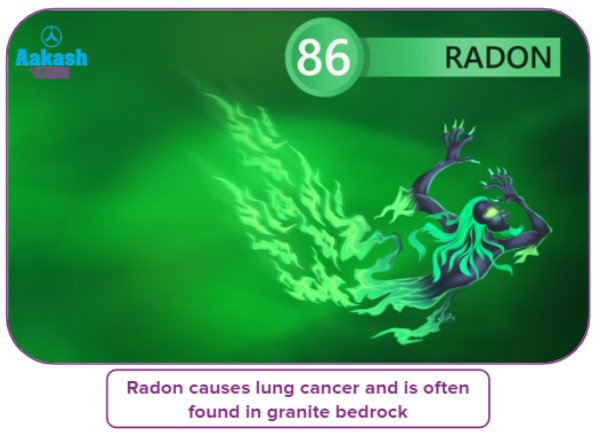
- Radon is a radioactive element that is chemically inert.
- It's used to treat cancer. It's a drug that's used to treat tumours.
- We can follow air masses by detecting radon content.
- It is employed in hydrological studies. It is useful for earthquake forecasting. Before and after earthquakes, the concentration of the radioactive element radon is known to alter in the ground. Due to foreshock activity and sluggish slip, previous investigations have demonstrated elevated radon levels in the atmosphere prior to the mainshock of a big inland earthquake.
- In industrial radiography, it is used.
- It is used in the treatment of arthritis.
- It can be used to make polonium by the radioactive breakdown.
- We can map surface geological faults by measuring radon concentration in soil.
Practice Problems
Q 1. Mention some physical and chemical properties of Group 18 or Zero group (noble gases)?
Answer:
- They are non-reactive in nature.
- Oxidation number = 0, due to the complete outer electron or valence shell.
- Ionisation energies are extremely high.
- Electronegativities are quite low.
- Boiling points are low (all monatomic gases at room temperature).
- Under normal circumstances, there is no colour, odour, or flavour (but may form coloured liquids and solids).
- They are non-flammable.
- They will conduct electricity and glow at low pressure.
Q 2. Name the noble gas that is produced in large quantities in the cosmic stars?
a. Neon
b. Xenon
c. Helium
d. Argon
Answer: Helium nuclei are produced due to nuclear fission in stars.
So, option C) is the correct answer.
Q 3. Which noble gas has the electronic configuration [Ar] 3d10 4s2 4p6?
a. Kr
b. He
c. Rn
d. Xe
Answer: The electronic configuration of [Ar] 3d10 4s2 4p6 belongs to Krypton with the atomic number 36.
So, option A) is the correct answer.
Q 4. Which particular noble gas forms oxy fluorides?
a. Kr
b. He
c. Ar
d. Xe
Answer: Xenon forms multiple compounds with the most electronegative elements, fluorine and oxygen, due to the presence of vacant d-orbitals. One such compound is XeOF4, Xenon oxytetrafluoride.
So, option D) is the correct answer.
Frequently Asked Questions - FAQ
Q 1. How is Argon produced?
Answer: In industries, Argon gas is manufactured through the procedure of fractional distillation of liquid air, which is then separated in a cryogenic air separation unit. This procedure distinguishes liquid nitrogen (whose boiling point is: 77.3 K) from Argon (whose boiling point is: 87.3 K) and liquid oxygen (whose boiling point is: 90.2 K). Each year about 700,000 tons of Argon are manufactured across the globe.
Q 2. Is Argon gas toxic?
Answer: Argon gas is not toxic. In covered areas it is 38 per cent thicker than air. Therefore, it can be considered a harmful asphyxiant. It's hard to spot due to its colourless, odourless, and tasteless properties.
Q 3. Xenon forms so many compounds with fluorine, but why XeF3 and XeF5 do not exist?
Answer: Xe has paired electrons in all of its filled orbitals. Promotion of one, two, or three electrons from the 5p filled orbitals to the 5d unoccupied orbitals produces 2, 4, and 6 half-filled orbitals, respectively. As a result, Xe can combine with an even number of F-atoms but not with an odd number. XeF3 and XeF5 will not exist, as they will form odd electron species, which will be highly unstable. Hence, XeF3 and XeF5 will not exist.
Q 4. Which noble gas is present in maximum quantity on earth?
Answer: Argon is the most abundant noble gas and the third most abundant gas in the Earth's atmosphere, with a concentration of 0.935 %. Argon is the most abundant noble gas in the Earth's crust, accounting for 0.00015 % of the crust.
Related Topics
|
S-block Elements |
Alkali Metals |
|
Ammonia |
p-Block Elements |
|
Calcium Oxide |
Oxidation States of p-Block Elements |

 Call Now
 Let's Chat
 Share
Share