-
Call Now
1800-102-2727


Mineral and Ore – Introduction, Classification of Minerals, Types of Ores, Differences, Practice Problems and FAQ

Have you ever heard the saying, "All groups are teams, but not all teams are groups"?
If so, do you understand what it means?
A group is an aggregation of people who coordinate their activities, whilst a team is an aggregation of people who share a common goal. A group of people concentrate on achieving their individual goals that contribute to the larger picture. This is a crucial distinction to bear in mind. A team, in contrast, concentrates on achieving collective objectives.
Why are we even talking about teams and groups right now?
In metallurgy, there is a saying that reads, "All ores are minerals, but not all minerals are ores," which is similar to the proverb cited above.
Minerals are the naturally occurring inorganic compounds in the Earth's crust. The minerals from which metals can be extracted conveniently and economically are called ores.
On this concept page, we will get to know more about minerals, ores and their differences.
TABLE OF CONTENTS
- Minerals – Definition
- Minerals – Types
- Minerals – Characteristics
- Ores – Definition
- Ores – Types
- Differences Between Minerals and Ores
- Practice Problems
- Frequently Asked Questions – FAQ
Minerals – Definition
- Minerals are the forms of metal that are found naturally in the earth's crust and may be extracted through mining. One or more metallic compounds with nearly constant chemical compositions may constitute a mineral.
- A mineral is described by a precise chemical formula since it has a known composition. Silicon (Si) and oxygen (O), the only two components that make up quartz (silicon dioxide), always occur in a 1:2 ratio, their chemical formula is SiO2.

Minerals – Types
Minerals can be categorised into two main groups namely, metallic and non-metallic, depending on their chemical and physical properties.
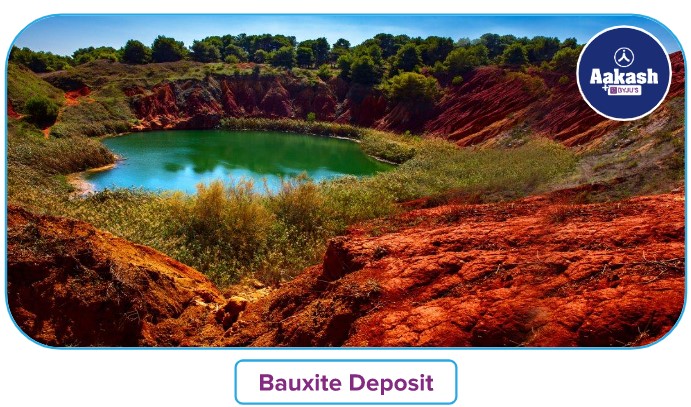
Metallic Minerals: The development of the metallurgical sector is supported by metallic minerals. This category includes metal-producing substances like bauxite. Metallic lustre or shine can be seen on the surface of metallic minerals.
Metallic minerals are divided into two subgroups; ferrous and non-ferrous metallic minerals.
1. Ferrous Minerals: All minerals containing iron are referred to as ferrous minerals. Chromites, iron ore, and manganese are a few examples of ferrous minerals. Ferrous minerals make up around three-fourths of the value of all metallic mineral output. These resources provide a strong base for the development of the metallurgical sectors, particularly those that make iron, steel, and alloys. India is in an excellent position in terms of ferrous mineral reserves and production.
2. Non-Ferrous Minerals: Iron-free minerals are considered non-ferrous minerals. Non-ferrous minerals include bauxite, copper and others. Except for bauxite, India has a little reservoir for non-ferrous metallic minerals.
Non-Metallic Minerals: Non-metallic minerals can be either organically or inorganically formed and lack extractable metals in their chemical composition. Based on where they come from, they are further separated into two groups namely, fuel minerals and other non-metallic minerals. India is blessed with a variety of non-metallic minerals, although only a few of them are important economically. Gypsum, phosphate, kyanite, sillimanite, dolomite, limestone, and mica are some of these minerals. These minerals are used in a wide range of industries, including those that manufacture electrical products, refractories, cement, and fertiliser.
1. Fuel Minerals: Fuel minerals such as coal and petroleum, are organic in nature and generated from buried animal and plant life. They go by the name of fossil fuels as well.
2. Other Non-Metallic Minerals: Other non-metallic minerals, like mica, limestone, and graphite, are inorganic in nature.
Minerals – Characteristics
The crystal structure of minerals is clearly defined. The basic characteristics of a mineral include the following:
- Minerals have a generally unique chemical combination.
- They are naturally occurring and driven inside the Earth’s crust.
- They are formed by inorganic methods.
- They are solid in nature.
At least three of these characteristics must be present for a rock to be categorised as a mineral.
- The uneven geographical distribution of minerals is one of their additional characteristics.
- Due to the inverse relationship between mineral quality and quantity, high-quality minerals are more uncommon than low-quality minerals.
- Minerals are geologically produced over very long periods of time, and they cannot be instantaneously supplied when needed.
Ores – Definition
Ores are the minerals from which a metal may be economically and easily mined. Therefore, all minerals are not ores, but all ores are minerals. For instance, FeS2, or iron pyrite, is widely distributed in the Earth's crust yet is ineffective as iron ore. Haematite, Fe2O3, is the chief ore of iron.
Ores – Types
Ores can be categorised into four types as mentioned below.
1. Native Ores: These ores include metals like gold, silver, mercury, copper, platinum, etc. in a free state. These are typically found in close proximity to rock or alluvial materials such as clay, sand, etc. Occasionally, chunks of pure metal are also discovered. They are known as nuggets. In addition to having 20 to 30% nickel, meteorites also include iron in its free state.
2. Sulphurised and Arsenical Ores: These ores are composed of simple and complex metal sulphides and arsenides. Significant ores in this category include the following.
|
Metal |
Name of the ore |
Composition |
|
Pb |
Galena |
PbS |
|
Zn |
Zinc blende |
ZnS |
|
Hg |
Cinnabar |
HgS |
|
Ag |
Argentite or silver glance |
Ag2S |
|
Ni |
Kupfer nickel |
NiAs |
|
Cu |
Copper pyrite or Chalcopyrite Copper glance |
CuFeS2 Cu2S |
- Halide Ores: Metallic halides are extremely rare in nature. Chloride ores are common among halide ores.
|
Metal |
Name of the ore |
Composition |
|
Na |
Common salt |
NaCl |
|
K and Mg |
Carnalite |
KCl.MgCl2.5H2O |
|
Ag |
Horn silver |
AgCl |
|
Cu |
Atacamite |
Cu2Cl(OH)3 |
- Oxide Ores: Ores that have been oxidised contain metals in the form of oxides or oxysalts, such as carbonates, sulphates, phosphates, silicates, etc. Significant ores in this category include the following ores.
|
Metal |
Name of the ore |
Composition |
|
Al |
Bauxite |
Al2O3.2H2O |
|
Sn |
Tin stone |
SnO2 |
|
Mn |
Pyrolusite |
MnO2 |
|
Cr |
Chromite |
FeO.Cr2O3 |
|
Zn |
Zincite |
ZnO |
|
Ti |
Ilmenite |
FeO.TiO2 |
|
Fe |
Haematite Magnetite |
Fe2O3 Fe3O4 |
|
Ca |
Limestone Gypsum |
CaCO3 CaSO4.2H2O |
|
Mg |
Magnesite |
MgCO3 |
|
Zn |
Calamine |
ZnCO3 |
|
Cu |
Ruby copper |
Cu2O |
Differences Between Minerals and Ores
|
Mineral |
Ore |
|
They are inorganic materials that are present in the crust of the Earth. |
They are minerals from which one can extract metals economically and conveniently. |
|
Minerals possess a distinct crystal structure. |
Ores lack a clearly defined structure. |
|
Not every mineral is an ore. |
Every ore is considered as a mineral. |
|
Clay, for example, is a mineral form of aluminium. |
Bauxite is an example of famous aluminium ore. |
Practice Problems
1. Ruby copper is an example of _____________ ore.
a. Oxide ores
b. Sulphide ores
c. Halide ores
d. Oxy salt ores
Answer: A
Solution: Ruby copper is an example of oxide ore. The chemical formula for the oxide ore copper is Cu2O.
So, option A is the correct answer.
2. Which among the following is not considered an ore of copper?
a. Copper glance
b. Atacamite
c. Cerrusite
d. Chalcopyrite
Answer: C
Solution: Copper glance (Cu2S), Atacamite (Cu2Cl(OH)3), and Chalcopyrite (CuFeS2)
are the major ores of copper. Cerussite (PbCO3) is a carbonate ore of lead.
So, option C is the correct answer.
3. __________ is considered as a non-metallic mineral.
a. Copper
b. Bauxite
c. Steel
d. Limestone
Answer: D
Solution: Non-metallic minerals lack extractable metals in their chemical components and can be either of organic or inorganic origin. Limestone (CaCO3) is an example of a non-metallic mineral.
So, option D is the correct answer.
4. Fluorspar is a common ore of __________.
a. oxide
b. sulphide
c. halide
d. oxy salt
Answer: C
Solution: Fluorspar is a common ore of halide with the chemical formula CaF2. It has 48.9% fluorine and 51.5% calcium in its purest form.
So, option C is the correct answer.
Frequently Asked Questions – FAQ
1. What are the minerals that are found in the human body?
Answer: Minerals are those substances found in meals and in the ground that our bodies require for healthy growth and development. Selenium, manganese, molybdenum, fluoride, copper, chromium, iodine, zinc, iron, magnesium, sodium, potassium, phosphorus, and calcium are among the nutrients that are crucial for good health.
2. How is an ore generated?
Answer: When a medium that carries and holds mineral-producing ore releases and deposits the ore, mineral deposits are created. One such means of transporting ores is lava. The lava along with the ore cools down and condenses to form microscopic minerals in the freshly formed igneous rocks.
3. Which region in India is rich in mineral resources?
Answer: The southwestern plateau region encompasses the majority of Karnataka, Goa, the surrounding uplands of Tamil Nadu, and Kerala. This region is rich in mineral resources. The majority of the mineral resources of the southwestern plateau are iron ore, manganese, and limestone. Kerala has monazite and thorium reserves, whereas Goa has iron ore reserves and bauxite clay.
4. What function do mineral resources serve in our day-to-day lives?
Answer: Minerals are necessary for the manufacture of items like tractors, homes, concrete roads, computers, appliances, jewellery, fertilisers, and electrical transmission lines. Without natural resources, the economy would collapse and living standards would decline.

 Call Now
 Let's Chat
 Share
Share