-
Call Now
1800-102-2727


HYPERCONJUGATION- Definition, Conditions, Applications, Reverse Hyperconjugation, Practice Problems & FAQs

You must be knowing that people have bank accounts and use them for depositing or withdrawing money or taking loans for emergencies The account is the bond connecting the person and the bank. If the person needs more money than what he has in the account, the bank can come to help by giving bank deposits of others to the person by way of a loan. The person can use this to tide over the present shortfall and return the money to the bank afterward.
A similar situation prevails in molecules too. Electrons of a bond can be shifted and utilized temporarily by a nearby atom/ group of the same molecule, to be returned later and the process is called Hyperconjugative effect.
TABLE OF CONTENT
- Hyperconjugation
- Conditions for hyperconjugation
- Hyperconjugative Structures
- Evidence of Hyperconjugation Effect
- Reverse Hyperconjugation
- Practice Problems
- Frequently asked questions
- Related Topics
Hyperconjugation
The delocalization of σ electrons of a C-H bond with a nearby vacant p-orbital or an antibonding π* orbital in an unsaturated or electron-deficient system is known as the hyperconjugation effect. It is also known as no bond resonance, Baker–Nathan effect, or σ-π conjugation.
Hyperconjugation is a permanent effect. It results in increased instability due to the resonance type stabilization.

Delocalization of electrons into vacant orbital
The concept of α, β, γ, δ carbons
A carbon atom directly bonded to a system that could be an atom, a group, a functional group, a
carbon-bearing a positive or negative charge, or other elements of interest is known as an α-carbon.
The carbon next to an α-carbon is known as a β-carbon, the carbon next to a β-carbon is known as
a γ-carbon, and the carbon next to a γ-carbon is known as a δ-carbon.

Conditions for hyperconjugation
- At least one α-hydrogen has to be present at the saturated α-carbon (sp3 hybridized) with respect to alkenes, benzene, carbocation, and free radicals.

- Higher the number of α-hydrogens(hydrogen present in the α- carbon atom) higher the resonance structure, and the higher the stability due to hyperconjugation
- A vacant p-orbital or an antibonding π* orbital, will be present on the atom adjacent to the
α- carbon atom.

Hyperconjugative Structure
- In Carbocation: Consider an ion, let us assume ethyl carbocation. It has three α-hydrogens.

Hyperconjugation in Ethyl carbocation
The hyperconjugative structures for the ethyl carbocation are shown as follows:
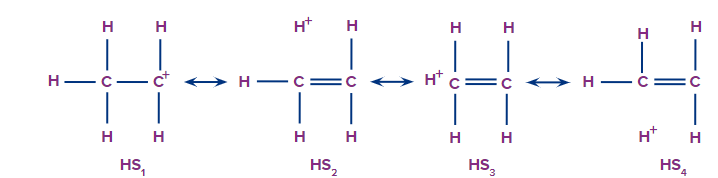
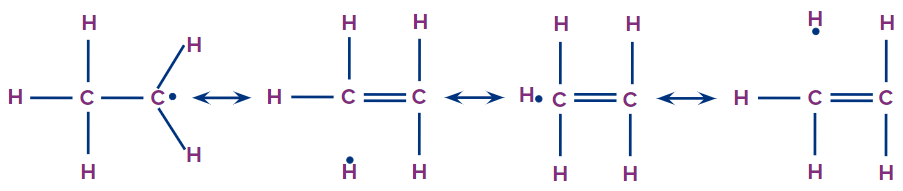
- In Free Radical: In the ethyl free radical, the carbon has an unpaired electron and is therefore electron-deficient, but the deficiency is much less than that in carbocations.
The hyperconjugative structures for the ethyl free radical are as given as follows:
- In Alkene: Consider an alkene, let us assume propene. It has three α-hydrogens. So, there will be three contributing structures showing hyperconjugation shown as follows:

- In Benzenoid compounds
If the carbon atom attached to the benzene ring has hydrogen, then it shows the hyperconjugation effect.
Considering toluene, we have three α-hydrogen atoms. So, there are a total of nine hyperconjugative structures.

Evidence of Hyperconjugation Effect
- Stability of Carbocation: The stability of carbocation depends on the hyperconjugation effect. As the number of α-hydrogens increases, more resonating structures are possible by hyperconjugation and the stability of the intermediate increases.
Stability of Carbocation:
Tertiary butyl carbocation > Isopropyl carbocation > Ethyl carbocation > Methyl carbocation

- Stability of Free Radicals: The stability of free radicals depends on the hyperconjugation effect. As the number of α-hydrogens increases, the stability increases.
It is the same as the stability of carbocations

- Stability of Alkenes: The stability of alkenes depends on the hyperconjugation effect. As the number of α-hydrogens increases, the stability increases.
Stability of alkenes:

This order of stability is because of a greater number of contributing structures, causing larger delocalization and hence the stability of alkenes.
- Heat of Hydrogenation: Heat of hydrogenation is the amount of heat evolved/mol in the addition of hydrogen to form a saturated hydrocarbon.

Heats of hydrogenation show that the greater the number of alkyl groups attached to the doubly bonded carbon atoms, the greater is the stability (i.e., lower is the heat of hydrogenation) of the alkene or the lesser the heat of hydrogenation, the lesser is the internal energy and more is the stability of the system.
Hyperconjugation decreases the heat of hydrogenation
The magnitude of Heat of Hydrogenation is as follows:
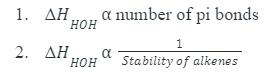
Example:
Cis-2-butene and trans-2-butene
The reaction for hydrogenation and energy profile diagram for cis-2-butene and trans-2-butene is
shown as follows:
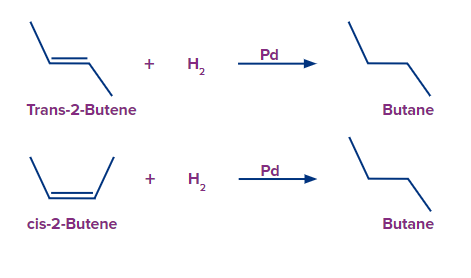
According to the reaction profile, the stability of alkene increases, and the energy difference between an alkene and the product, i.e., the heat of hydrogenation decreases. Thus, the trans alkene releases less heat as compared to the cis alkene since trans is more stable. In cis alkene, two methyl groups are close to each other hence their electronic clouds repel each other.
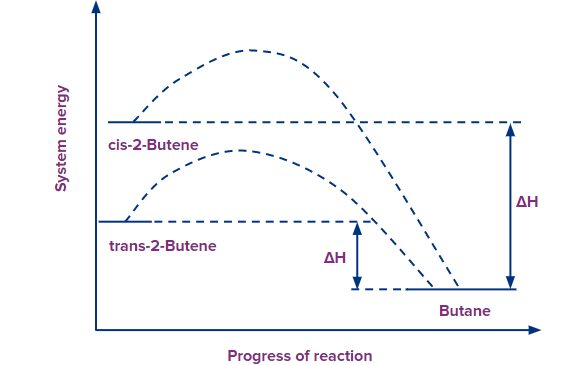
Similarly, as the hyperconjugation in an alkene increase, its stability increases. Hence, the heat of hydrogenation decreases.
- Effect of Hyperconjugation on Bond Length
Bond length is affected by hyperconjugation. As the number of α-hydrogens increases, the extent of hyperconjugation also increases. Hence, the C=C (double bonds) gain more single-bond-like character and C−C (single bonds) gain more double-bond-like character, due to which the bond length of C=C increases and that of C−C decreases.
Example:
Arrange the bond lengths (x, y, z bonds) for the given molecules (ethene, propene, but-2-ene) in the decreasing order.

Ethene has no α-hydrogen, propene has three α-hydrogens, and but-2-ene has six α-hydrogens. Due to hyperconjugation, the double bond will have a partial double bond character. Hence, its bond length will be greater.
So, the order of bond length will be: z > y > x
- Dipole Moment
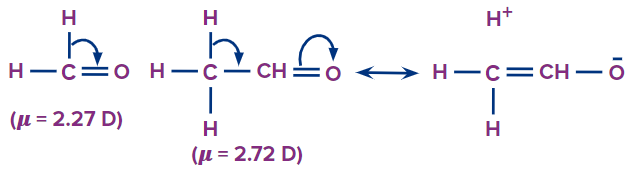
Since, hyperconjugation causes the development of charges, it also affects the dipole moment in the molecule. The increase in dipole moment, when the hydrogen of formaldehyde (u = 2:27 D) is replaced by a methyl group, i.e., acetaldehyde (u = 2.72 D) .., can be referred to as hyperconjugation, which leads to the development of charges.
- Orienting Influence of alkyl group
Ortho-, para-directing property of methyl group in toluene is partly due to +1 effect and partly due to hyperconjugation.

Reverse Hyperconjugation
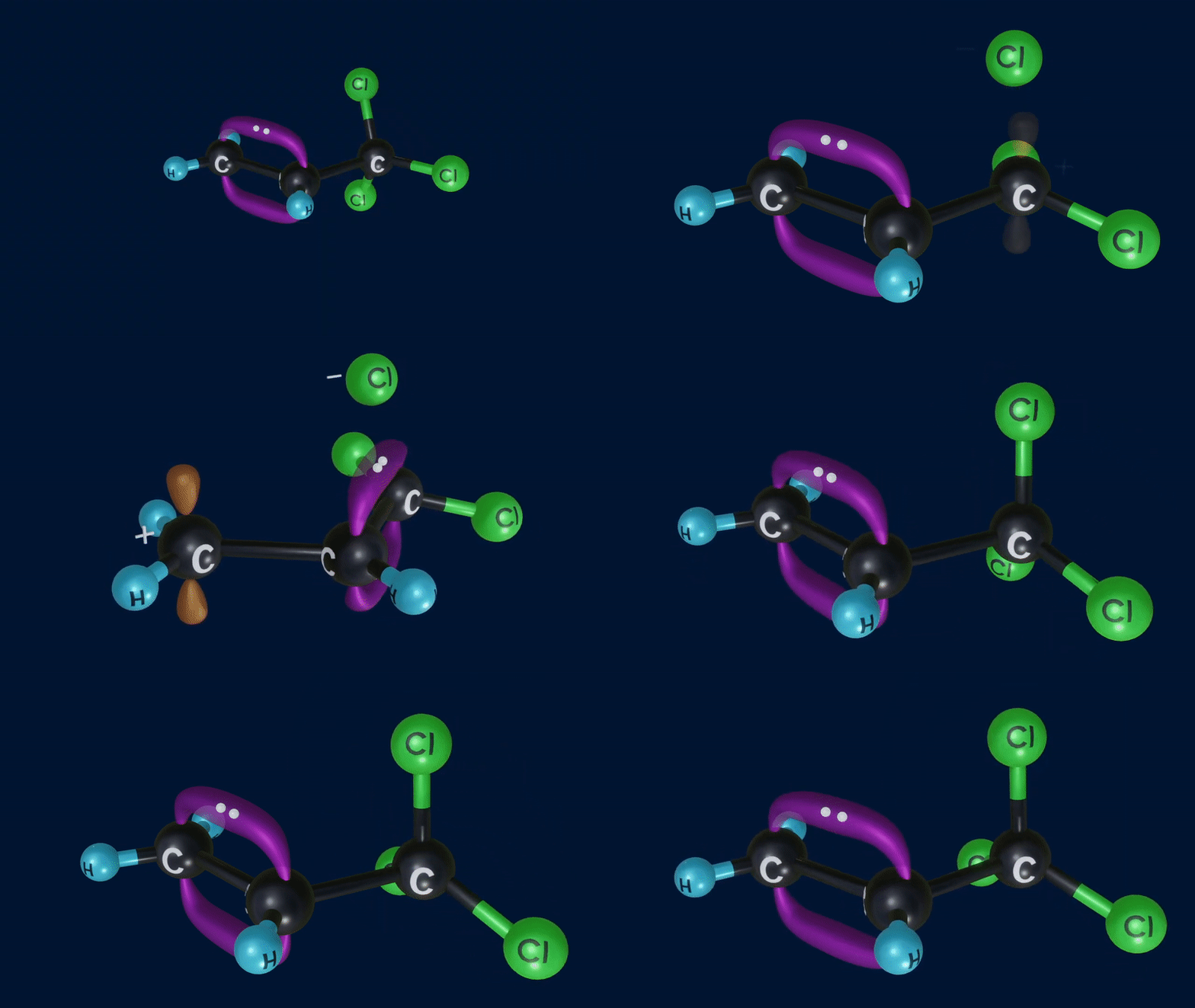
In reverse hyperconjugation, the delocalization of π electrons takes place with an antibonding σ*- orbital. Since the electron density flows in the opposite direction than it does in hyperconjugation, it is known as reverse hyperconjugation. It is also known as negative hyperconjugation or the −H effect. When a compound has halogen atoms attached to the α-carbon of the alkene, electrons from the π-orbital (or p-orbital) get delocalized to the empty σ*-orbital of halogen. Due to reverse hyperconjugation, the adjacent carbon-carbon single bond acquires a double-bond-like character. Thus, its bond length decreases.
Example 1:
In the molecule of CCl3CH=CH2, reverse hyperconjugation is observed.

Example 2:
In the molecule of benzotrichloride, reverse hyperconjugation is observed.

Practice Problems
Q1. Calculate the number of α−hydrogens in the given structure.
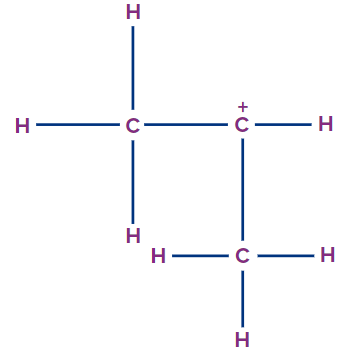
Solution: Since there are two sp3 hybridized carbon atoms directly attached to the carbon having a positive charge, hence there are are two alpha carbon atoms present. Since six hydrogen atoms are attached to two alpha carbon atoms, the number of α-hydrogens are six.
Therefore, the correct answer is 6.

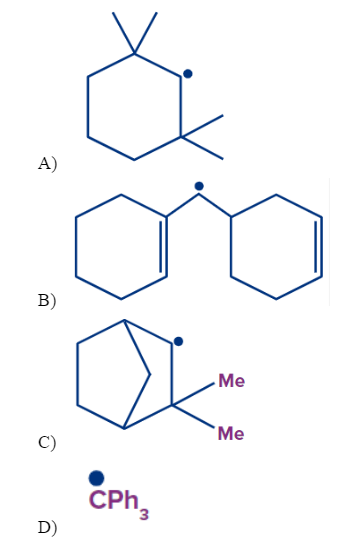
Q2. Hyperconjugation is not observed in which of the following ?
Solution:
- This free radical molecule does not have α-hydrogens. Since hyperconjugation is possible only for structures having α-hydrogens, it will not show hyperconjugation.
- The free radical has one α-hydrogen on the saturated carbon (right-sided ring). Also, since α-hydrogens are also present for the double bonds, hyperconjugation takes place in alkenes.
- This free radical has one α-hydrogen at the bridgehead carbon, so it cannot participate in hyperconjugation. As a result, this molecule will not show hyperconjugation.
- This free radical does not have any α-hydrogen, so it will not show hyperconjugation.
Therefore, (A), (C), and (D) are the correct answers.
Q3. Find the total number of contributing structures showing hyperconjugation (involving C–H bonds) for the given carbocation.
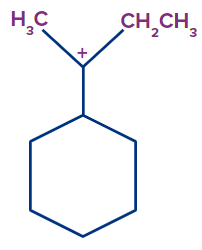
Solution: The number of contributing structures showing hyperconjugation is equal to the number of α-hydrogens. There are six α-hydrogens (three on CH3 , two on CH2, and one on C of the cyclohexyl ring). Therefore, six contributing structures show hyperconjugation.

Q4. Compare the heats of hydrogenation of the following molecules.

Solution:
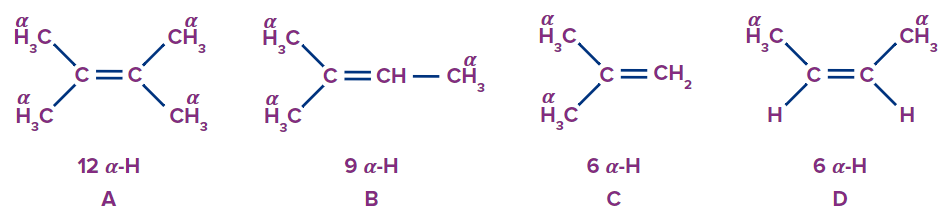
The heat of hydrogenation is inversely proportional to the stability of alkenes (or number of α-hydrogens). Since A has the highest number of α-hydrogens followed by B, the heat of hydrogenation will be less for A than for B.
Now, we have to compare C and D. C, being the isobutene, is more stable than D. This can be
explained as in the hyperconjugative structure of D, the negative charge on carbon is destabilized by
the methyl group attached to it due to its +I effect. Therefore, D will have more heat of hydrogenation.
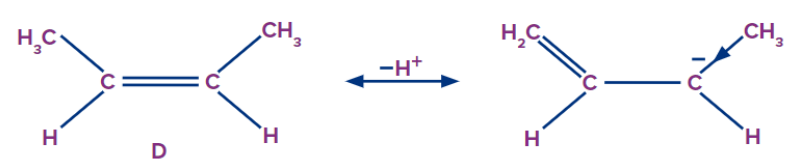
Therefore, the correct order of the heat of hydrogenation is as follows: D > C > B > A.
Frequently Asked Questions - FAQ
Question 1. Can hyperconjugation occur in the case of carbanions?
Answer: Since carbanions are not electron-deficient and the carbon atom does not have a vacant p-orbital, no hyperconjugation is observed in carbanions.
Question 2. Which orbital overlaps in hyperconjugation?
Answer: The delocalization of σ electrons with vacant p-orbital or antibonding π* orbital takes place in
hyperconjugation.
Question 3. Which has more extent of hyperconjugation in carbocation or free radical?
Answer: The deficiency of electrons is less in radicals as compared to carbocations, the extent of
hyperconjugation is also less in free radicals as compared to carbocations.
Question 4. How many hyperconjugative structures can an isobutyl radical form?
Answer: Isobutyl radical has only one α-hydrogen, so it will form only one hyperconjugative structure.
Related Topics
|
Chlorination |
Friedel-crafts reaction |
|
Electrophilic Aromatic Substitution reactions of benzene |
Wurtz reaction |
|
Chemical Reactions of Alkynes |
Toluene |

 Call Now
 Let's Chat
 Share
Share