-
Call Now
1800-102-2727


Hydroxylation of Alkyne- Hydroxylation, Anti-dihydroxylation, Syn-Dihydroxylation, Baeyer’s Reagent and Test, Practice Problems and FAQs

What cake flavour is your favourite?
The butterscotch flavour is what I like the most.
Do you know who or what chemical is in charge of creating such a delicious flavour?
These are essentially aromatic diketones from the vicinal family, such as 2,3-butanedione and 2,3-pentanedione, which add sweet butter, caramel, or butterscotch flavours and fragrances.
Can someone, however, explain to us how to create them in our chemistry lab? By hydroxylating alkynes with oxidising agents like potassium permanganate or osmium tetraoxide, vicinal diketones can be produced. Let's discuss this in more depth.
Table of Contents
- Hydroxylation of alkyne
- Anti-Dihydroxylation
- Syn-Hydroxylation
- Baeyer’s Reagent (Potassium Permanganate)
- Baeyer’s Test
- Practice Problems
- Frequently Asked Questions-FAQs
Hydroxylation of alkyne
The carbon-hydrogen bond in the alkene oxidises to a carbon-hydroxyl bond during hydroxylation. Alkyne hydroxylation is an oxidation reaction. An oxidising agent is a reagent that increases the oxidation number.
Alkynes can be hydroxylated via two distinct stereochemical routes:
- Anti-dihydroxylation - when hydroxyl group attacks from opposite sides
- Syn-dihydroxylation - when hydroxyl group attack from same side
The anti-dihydroxylation mechanism is used to open epoxides, whereas potassium permanganate produces syn-dihydroxylation products.
Anti-Dihydroxylation
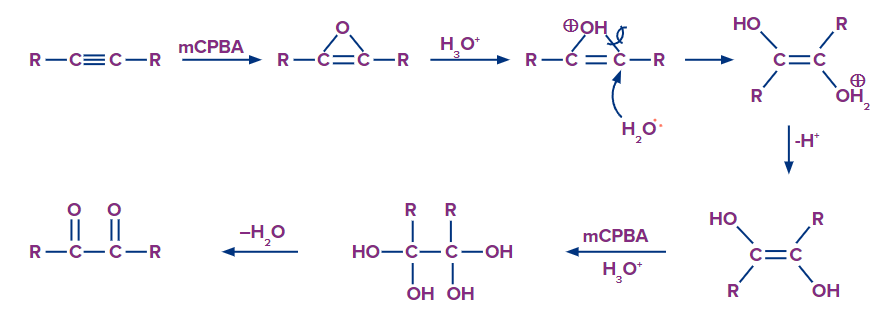
Aqueous acid can cleave epoxides which can be formed by using m-CPBA (meta-chloro peroxy benzoic acid). Proton transfer from the acid catalyst produces the epoxide's conjugate acid, which is attacked by nucleophiles such as water. The result is the anti-hydroxylation of the triple bond. The hydration of an epoxide has no effect on the oxidation state of any of its atoms or groups. The mechanism of ring-opening in epoxides is determined by the reaction conditions.
Syn-Hydroxylation
Dihydroxylated products are formed by reacting pyridine with aqueous potassium permanganate. We would expect syn-stereoselectivity in the bonding to oxygen based on the mechanism shown here.
Baeyer’s Reagent (Potassium Permanganate)
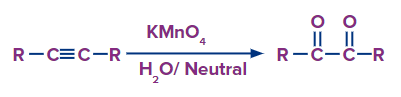
Alkynes, like alkenes, can be gently or strongly oxidised depending on the reaction environment. Because alkynes are less stable than alkenes, the reaction conditions can be more. In neutral permanganate solution, for example, alkynes form vicinal dicarbonyls.
The generic reactions for the various oxidative conditions - gentle- are summarised below.
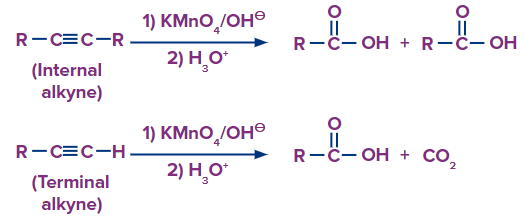
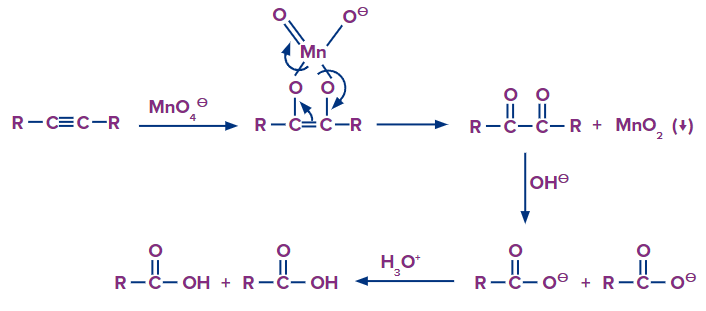
The alkyne is cleaved into two products during strong oxidation with basic potassium permanganate. Because at least one of the reaction products is a carboxylic acid, the acid-base chemistry of the product in the reaction solution must be considered. Carboxylic acids are deprotonated to carboxylates in basic solutions. To protonate the carboxylate to the neutral form of the carboxylic acid, a second reaction step is required.
The generic reactions for the various oxidative conditions - strong- are summarised below.
Mechanism:
Baeyer’s Test
In qualitative organic analysis KMnO4 is used to test for the presence of unsaturation. It is also known as Baeyer's reagent after the German organic chemist Adolf von Baeyer.
The reagent used in Baeyer’s test is an alkaline potassium permanganate solution.
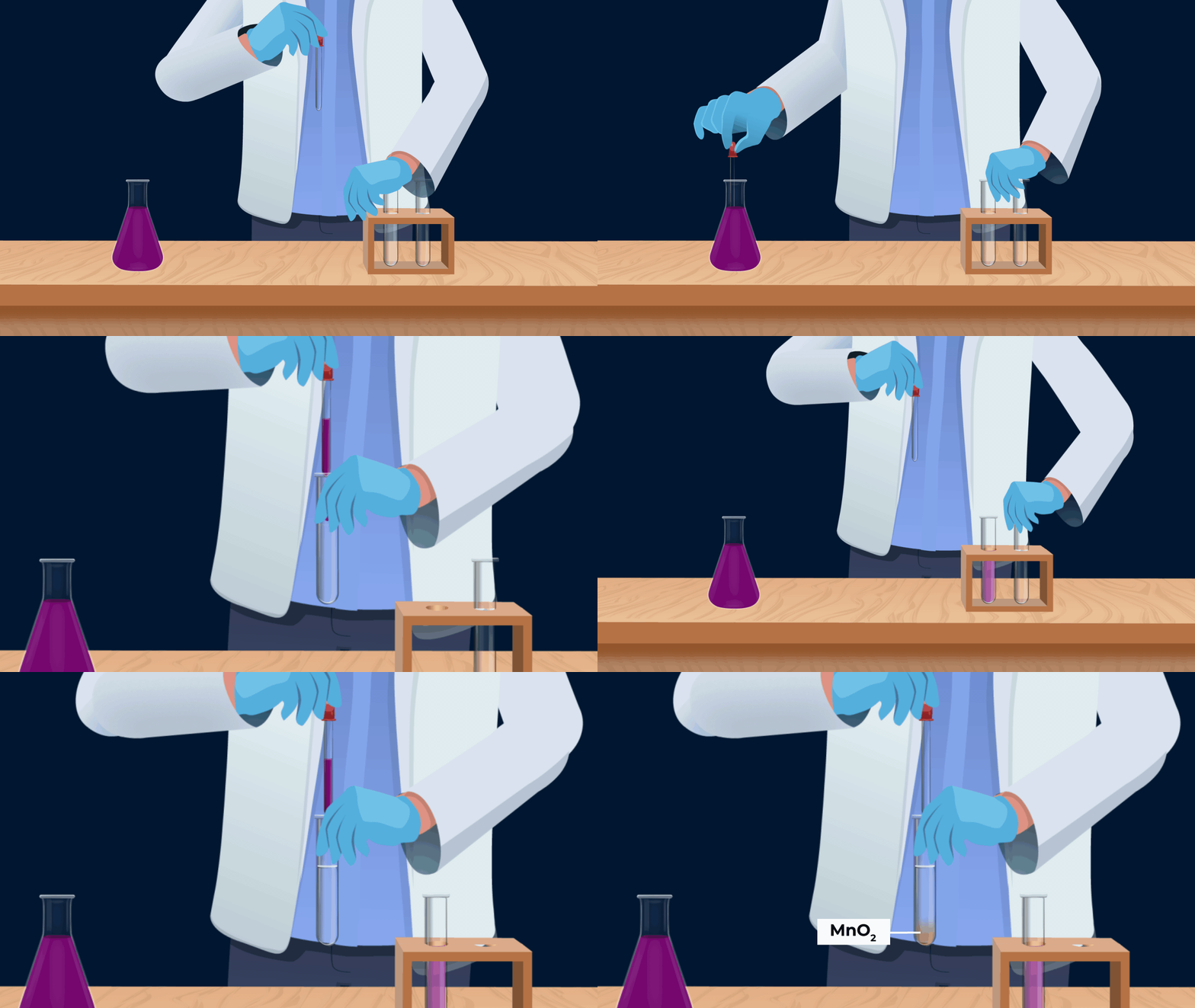
When alkaline potassium permanganate is added to an unsaturated hydrocarbon like alkenes and alkynes, the pink colour of potassium permanganate disappears. The colour fades from purplish-pink to brown when it reacts with double or triple bonds (-C=C- or -C≡C-).
Baeyer’s reagent will give brown precipitates with both terminal and Non- terminal alkynes. Hence, this test can be used for the detection of alkynes but does not specify whether they are terminal alkynes or non-terminal alkynes.
Baeyer’s Reagent Brown precipitate
Baeyer’s Test
Practice Problems
Q1. The metal atom manganese in permanganate occupies the centre of a tetrahedral grouping of negatively charged oxygen atoms. So, how would such a species interact with a double bond's nucleophilic pi-electrons?
Answer: One possible explanation is that an electrophilic metal atom's empty d-orbital extends far beyond the surrounding oxygen atoms and initiates electron transfer from the double bond to the metal, similar to how platinum does. This interaction is completed by back-bonding of the nucleophilic oxygens to the antibonding *-orbital.
Q2. Which test can be used to distinguish between But-2-yne and Butane?
A. Tollen’s Test
B. Ammoniacal cuprous chloride
C. Baeyer’s Test
D. All of these
Solutions: But-2-yne being nonterminal alkyne and Butane being alkane can be distinguished with baeyer’s tests as in option (A) Tolen’s test and option (B) Ammoniacal cuprous chloride gives precipitates with terminal alkynes only.
Baeyer’s Reagent Brown precipitate
When alkaline potassium permanganate is added to an unsaturated hydrocarbon, the pink colour of potassium permanganate disappears. The colour fades from purplish-pink to brown when it reacts with double or triple bonds (-C=C- or -C≡C-). Baeyer’s reagent will give brown precipitates with both terminal and Non- terminal alkynes. Hence, this test can be used for the detection of alkynes.
Hence, the correct option is (C).
Q3. What would be the expected product when propyne is made to react with aqueous potassium permanganate?
A. Acetic Acid
B. Carbon dioxide
C. Both (A) and (B)
D. Pyruvic Acid
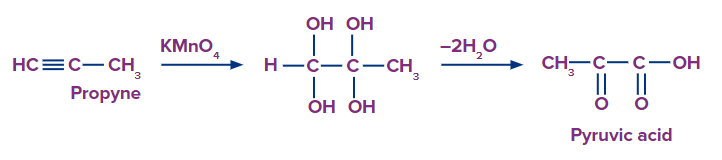
Solution: When propyne is reacted with potassium permanganate in a neutral solution, it will yield pyruvic acid instead of two products acetic acid and carbon dioxide which are expected. It is an experimental observation.
Q4. What would be the expected product when But-2-yne is made to react with alkaline potassium permanganate and acidified water?
A. Butanoic acid
B. Acetic Acid
C. Propanoic acid
D. Butane-1,3-dione
Solution: During strong oxidation with basic potassium permanganate, the alkyne is cleaved into two products. In basic solutions, carboxylates are formed by deprotonation of carboxylic acids. A second reaction step is required to protonate the carboxylate to the neutral form of the carboxylic acid.
Hence, the product should be acetic acid. The correct answer is an option (B).

Q5. What would be the expected product when But-2-yne is made to react with alkaline potassium permanganate and acidified water?
A.Butanoic acid
B. Acetic Acid
C. Propanoic acid
D. Butane-1,3-dione
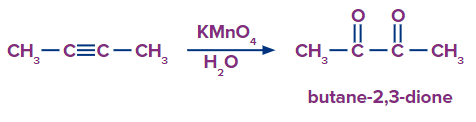
Solution: Alkynes, for example, form vicinal dicarbonyls in neutral permanganate solution. The generic reactions for the various oxidative conditions are summarised below.
Hence, the product should be Butane-1,3-dione. The correct answer is an option (D).
Frequently Asked Questions-FAQs
Q1. How can the toxicity of osmium tetraoxide be reduced?
Answer: Because osmium tetroxide is expensive and highly toxic, it can be avoided by using catalytic amounts of OsO4 and stoichiometric amounts of an oxidising agent such as hydrogen peroxide.
Q2. Which reagent is more useful, osmium tetroxide or potassium permanganate for hydroxylation?
Answer: Because OsO4 is toxic, potassium permanganate, KMnO4, is used instead. Although syn diols are produced by the reaction of KMnO4 and an alkene, potassium permanganate is less useful due to low product yields due to overoxidation.
Q3. What is the Hydroxylation reaction of Alkynes?
Answer: Hydroxylation of alkenes is an oxidation reaction in which a carbon-carbon pi bond is converted into two carbon-hydroxyl bonds, which are then hydrolyzed to produce vicinal diketones. In the presence of vigour, they can also produce carboxylic acids.
Q4. Is hydroxylation both an oxidation and a reduction process?
Answer: No, Alkyne hydroxylation is an oxidation reaction. An oxidising agent is a reagent that increases the oxidation number. Potassium permanganate is an oxidizer.

 Call Now
 Let's Chat
 Share
Share