-
Call Now
1800-102-2727


Heterogeneous Catalysis Features, Practice Problems and FAQ

Catalyst use has greatly expanded recently across a variety of industries, particularly those in the chemical and petroleum sectors. As intended, these industrial catalysts increase yield and accelerate the production process. This is the reason why the petroleum industry is expanding despite the fact that it produces non-renewable fuel and has a finite amount of it.
What exactly are industrial catalysts then?
Industrial catalysts, which are generally heterogeneous in nature can be defined as the catalysts that accelerate reactions and enhance product selectivity in industries like chemical, petroleum, and agrochemical ones.

In this article, we will get to know more about heterogeneous catalysts, their mechanism of action, and their importance.
TABLE OF CONTENTS
- Heterogeneous Catalysis
- Heterogeneous Catalysis – Examples
- Heterogeneous Catalysis – Mechanism
- Heterogeneous Catalysis – Important features
- Heterogeneous Catalysis – Zeolite
- Practice Problems
- Frequently Asked Questions – FAQ
Heterogeneous Catalysis
- Heterogeneous catalysis, as used in chemistry, is the catalysis in which the phases of the catalyst and the reactants or products are different.
- In contrast, in homogeneous catalysis, the catalyst, reactants, and products are all present in the same phase. Phase can differentiate between components that are solid, liquid, or gas, as well as immiscible mixes (like oil and water), or any location where an interface is present.
- Typically, solid-phase catalysts and gas-phase reactants are used in heterogeneous catalysis.
- At the catalyst surface, in this instance, a cycle of molecule adsorption, reaction, and desorption takes place. The rate (kinetics) of a reaction is influenced by thermodynamics, mass transfer, and heat transmission.
- Because it permits more rapid, large-scale production and the synthesis of selective products, heterogeneous catalysis is crucial.
- Heterogeneous catalysis is vital to the chemical and energy sectors.
Heterogeneous Catalysis – Examples
Below are a few typical instances of reactions involving heterogeneous catalysis (reactions in which the physical states of the reactants and catalysts differ).
|
Process |
Catalyst |
|
Haber’s Process: In industry, ammonia is manufactured by Haber’s process. |
Finely divided iron is used as the catalyst with molybdenum as the promoter. The necessary conditions are 200 bar pressure and 723 – 773 K. |
|
Contact Process: Sulphuric acid is manufactured in the industry by the contact process. |
The temperature needed for this procedure is 673 – 723 K, and the catalyst can be vanadium pentoxide (V2O5) or platinized asbestos. |
|
Ostwald’s Process: Ostwald's method is used in the industry to produce nitric acid. |
The reaction temperature required for this technique is 573 K, and the catalyst used is platinum gauze. |
|
Decomposition of H2O2: When H2O2 is exposed to impurities or catalysts like metallic surfaces, it decomposes quickly. |
In an exothermic reaction, hydrogen peroxide also breaks down into water and oxygen when a metal oxide-like solid MnO2catalyst is present. |
Heterogeneous Catalysis – Mechanism
Here are a few basic points which must be kept in mind to understand heterogeneous catalysis mechanism.
- Reactants diffuse from the bulk fluid phase to adsorb to the catalyst surface in heterogeneous catalysis.
- Reactant molecules must move across the surface to an active site since the adsorption site is not always an active catalyst site. Reactant molecules will react at the active site to create product molecules by using a more energy-comfortable route through catalytic intermediates.
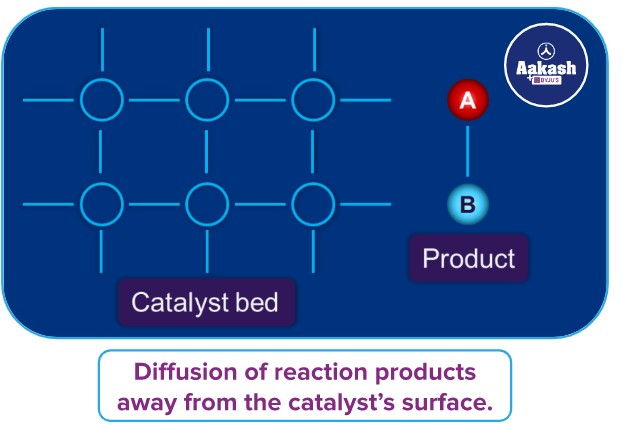
- The product molecules then diffuse away after desorbing from the surface. The catalyst itself is unharmed and available to mediate other reactions. The observed response rate is also affected by transport phenomena like mass and heat transfer.
Few steps are mentioned below to understand the mechanism of heterogeneous catalysis which is known as modern adsorption theory.
Step 1: The reactants diffuse onto the catalyst's surface. The reactants approaching the catalyst bed get diffused to the surface of the catalyst.
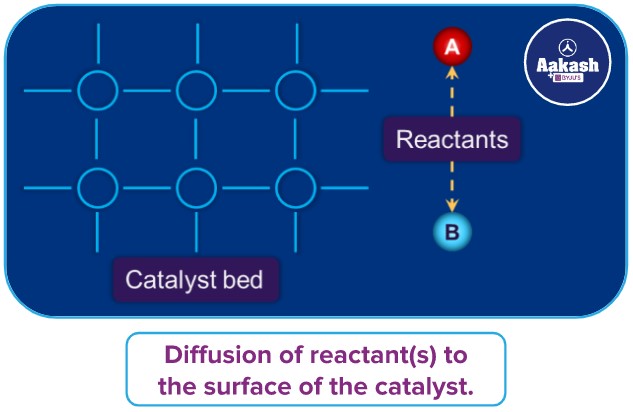
Step 2: Adsorption of reactant molecules onto the catalyst's surface.
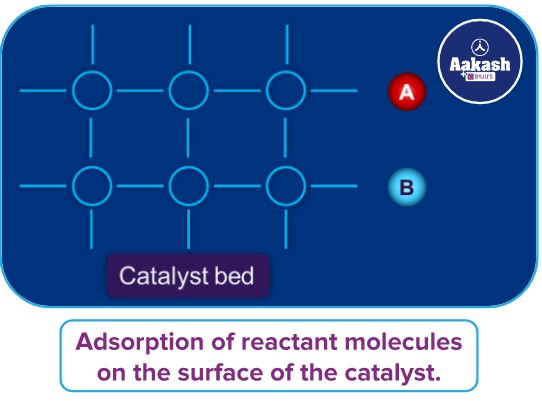
Step 3: Chemical reaction takes place on the catalyst's surface and results in the creation of an intermediate.
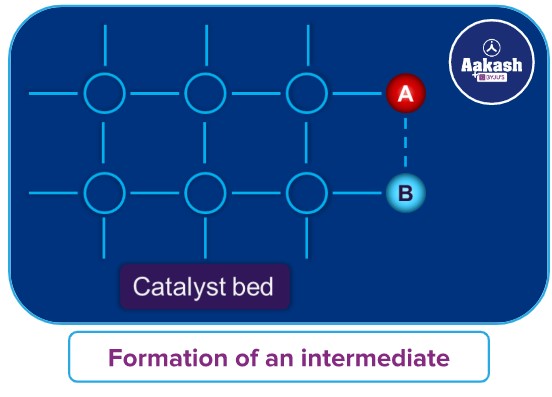
Step 4: Desorption of reaction products from the catalyst surface frees up the surface for other reactions to take place.
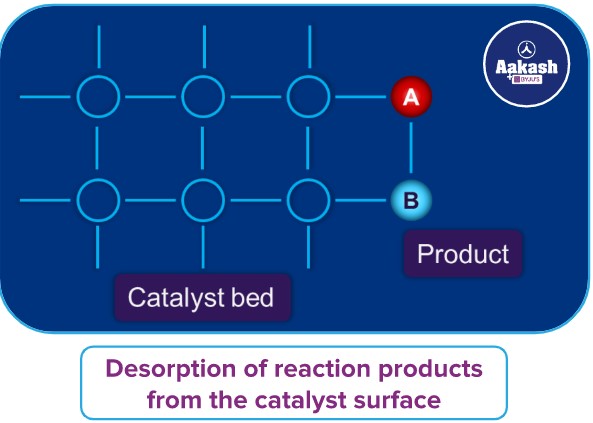
Step 5: The reaction product diffused away from the catalyst's surface.
Heterogeneous Catalysis – Important Features
- Because these catalysts permit more rapid, large-scale production and the synthesis of selective products, heterogeneous catalysis is crucial.
- Since 90% of all chemical reactions are thought to be catalysed, catalysis has a significant economic influence, accounting for 30% to 40% of the world's gross domestic product.
- Heterogeneous catalysts aid in the synthesis of 90% of compounds (by volume).
- Heterogeneous catalysis is vital to the chemical and energy sectors. As an illustration, the Haber-Bosch process uses metal-based catalysts to create ammonia, a crucial component of fertiliser, of which 144 million tonnes were produced in 2016.
Heterogeneous Catalysis – Zeolite
Natural or artificial microporous aluminosilicates with the formula are known as Zeolite.
Where
n = Valency of metal cation
z = Water of crystallisation
A catalytic reaction that is affected by the size of the molecules in the reactant and product as well as the pore structure of the catalyst is referred to as shape-selective catalysis. Zeolite means "Boiling Stone" in Greek. It received its name from the water that got stuck in the catalyst's pores. For instance, a zeolite catalyst called ZSM-5 (zeolite sieve molecular porosity 5) transforms alcohol into gasoline or hydrocarbons in the petrochemical industry. In the crevices, the alcohol dehydrates and produces hydrocarbons.

Some essential points about zeolites:
1. These are aluminosilicates with the general formula Mx/n [(AlO2)x (SiO2)y]. zH2O.
2. These are three-dimensional silicate networks in which some silicon atoms have been replaced by aluminium atoms.
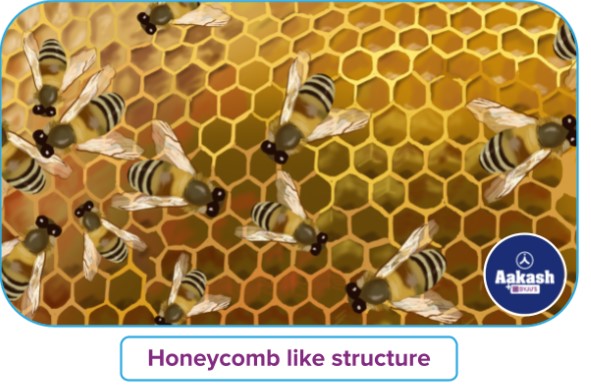
3. Zeolites are shape-selective catalysts with honeycomb-like structures.
4. A specific size of the molecule can enter and exit the active sections of zeolites' pores. These have molecular-sized cavities and are permeable.
5. These have molecular-sized cavities and are permeable. An intricate system of tubes and chambers makes up a zeolite's interior structure. Zeolites have a huge surface area as a result.
Recommended Videos
Surface Chemistry Class 12 Chemistry One-Shot (Full Chapter Revision) Concepts+Ques | JEE Main 2022
Top 10 JEE Main Most Important Questions of Surface Chemistry Class 12 | JEE Mains Chemistry 2022
Practice Problems
1. The mentioned reaction is an example of which type of catalysis?

a. Homogeneous catalysis
b. Mixed catalysis
c. Heterogeneous catalysis
d. Demoivre catalysis
Answer: C
Solution: In the given reaction, the reactants and products are in the gaseous phase whilst the catalyst is in the solid phase. Since the phases of the reactants, products and catalyst are different, the mentioned reaction is an example of heterogeneous catalysis.
So, option C is the correct answer.
2. Which theory is more appropriate for heterogeneous catalysis?
a. Intermediate
b. Absorption
c. Paratoid
d. Nucleate
Answer: B
Solution: Because there are other molecules present in a heterogeneous complex, the primary component divides into smaller pieces before disintegrating. Absorption theory is the name given to this hypothesis. Reactants diffuse from the bulk fluid phase to adsorb to the catalyst surface in heterogeneous catalysis.
So, option B is the correct answer.
3. Read the below-mentioned steps.
a. Adsorption of the reactant molecules on the catalyst surface.
b. Diffusion of reactants to the catalyst's surface.
c. Diffusion of products from the catalyst's surface.
d. Desorption of reaction products from the catalyst surface, making the surface available for further reaction.
1. Chemical reaction on the catalyst's surface that results in the formation of an intermediate.
Arrange the following steps in the correct order.
a. ii-i-v-iv-iii
b. i-ii-iii-iv-v
c. ii-iii-i-iv-v
d. v-iii-ii-i-iv
Answer: A
Solution: The Modern Adsopion theory has five important steps in its mechanism. The correct order of the given steps is mentioned below.
1. Diffusion of reactant to the catalyst's surface.
2. Adsorption of reactant molecules on the catalyst surface.
3. Chemical reaction on the catalyst's surface results in the formation of an intermediate.
4. Desorption of reaction products from the catalyst surface, making the surface available for further reaction.
5. Diffusion of product from the catalyst's surface
So, option A is the correct answer.
4. __________ is the catalyst used in the contact process for the production of sulphuric acid.
a. P2O5
b. V2O5
c. Cl2O5
d. V2O3
Answer: B
Solution: Sulphuric acid is manufactured in the industry by the contact process. The temperature needed for this procedure is 673–723 K, and the catalyst can be vanadium pentoxide (V2O5) or platinized asbestos.
So, option B is the correct answer.
Frequently Asked Questions – FAQ
1. Surface catalysis is one of the names given to heterogeneous catalysis, why?
Answer: Heterogeneous catalysis, in which the catalyst is in a different phase, is a key component of many significant industrial processes. The rate-limiting step often takes place at the solid surface since the catalyst is typically solid and the reactants are gases. As a result, surface catalysis is another name for heterogeneous catalysis.
2. What are the conditions required for a catalyst to act as an efficient heterogeneous catalyst?
Answer: Strong enough to allow the reactant molecules to react, but not so strongly that the product cannot desorb, is required for something to function as a suitable heterogeneous catalyst.
3. What distinguishes homogenous catalysis from heterogeneous catalysis?
Answer: There are two basic categories of catalysts: heterogeneous and homogeneous. The catalyst and the reactants are in various phases during heterogeneous catalysis. The catalyst and reactants are in the same phase during a homogeneous catalysis.
4. Can we consider enzymes as heterogeneous catalyst or not?
Answer: Since enzymes must be in the same state as the reactants in order to mix well and hasten the breakdown of the biomolecule, they are homogeneous catalysts.

NEET Related Links
JEE MAIN Related Links
JEE Advanced Related Links
JEE Advanced Eligibility Criteria
JEE Advanced Chemistry Syllabus
JEE Advanced Registration Dates
CUET Related Links
Important Topics
Anemometer : Measurement of Wind Speed
Angular Acceleration Atomic Theory Audible and Inaudible Sound Average Speed and Average Velocity Average Velocity Avogadros Number Avogadros Hypothesis Azimuthal Quantum Number Balanced Force Bar Magnet Biconvex Lens Boyles Law Buoyancy Calorimeter Carnot Engine Celestial Bodies Centripetal And Centrifugal Force Concave and Convex Lenses Concave Convex Mirrors Contact and Non Contact Force Controlled Thermonuclear Fusion Convection Currents Convex Lens Convex Mirror Destructive Interference Difference Between Conduction Convection and Radiation Difference Between Electric Field and Magnetic Field Difference Between Heat And Temperature Difference Between Series And Parallel Circuits Differences Between Acceleration And Velocity Distance and Displacement Distance Time Graph Electrical Force : Electric Forces and Their Types Electromagnetic Waves : Definition, Equation and Properties of Electromagnetic Waves Electromagnetism Electron Spin Fluid Flow : Bernoullis Equation Derivation and Fluid Mechanics Fluid Friction : Types and Factors of Fluid Friction Frames of Reference : Inertial and Non- Inertial Frame of Reference Frequency and Wavelength Frictional Force Importance of Hydrosphere Instantaneous Speed and Velocity Introduction to Motion Kinetic and Potential Energy Difference Law Of Conservation of Energy Layers of the Earth Light Energy Light Sources List of physics scientists and Their inventionsLoudness of Sound
Magnetic Dipole Moment Magnetic Field Non - Contact Force Non - Renewable Energy Ohms Law Optics P Wave Physics Symbols Plane Mirrors Poissons Ratio Projectile Motion Properties of Water : Anomalous Expansion of Water Radius of Gyration Reflection of Light Reflection of Waves Relative Density Resonance Reverberation Rolling Friction Rotation and Revolution Screw Gauge Semiconductors and Insulators Sliding Friction Speed Time Graphs Static Friction Stefan Boltzmann Law Stress Tension Tension Force Thermometer: Clinical Laboratory Thermometer Types of Rocks Types of Waves Uniform Motion and Non Uniform Motion Unit of Voltage Uses of Convex Lens Uses Of Convex Mirror Uses of Electromagnet Uses of Optical Fibre Wave Wavelength of Light What is Scattering of Light Working of Electric Bell Conventional and Non-conventional Sources of Energy Buoyant Force Bulk Modulus of Elasticity Bernoulli’s Principle Angular Momentum Difference Between Speed And Velocity ForceUnit of Heat
Difference between Distance and Displacement Simple Microscope Derivation Of Equation Of Motion Thermometer: Clinical & Laboratory Thermometer Difference between Concave and Convex LensDerivation Of Lens Maker Formula
Unit Of Pressure Velocity Uses of Plane Mirror
Wave Theory of Light
Unit of Density Unit of Light Unit of Force Unit of Magnetic Field Unit of wavelength Unit of Viscosity Uses of Electroplating Young's Modulus
What is the Scattering of Light
Lenz Law Space Wave Propagation Schrodinger Wave Equation Relation between Fahrenheit and Celsius Refractive Index Potentiometer Working Pascal Law Oscillatory Motion Optical Instruments Newton's Laws of Motion - First Law Modulation and Demodulation Magnetic Flux Lens Formula and Magnification Kaleidoscope Faradays Law Epsilon Naught Value Energy Bands Electrostatics Electroscope AC Generator Unit of Current Lithosphere Bending Equation Derivation Difference Between Pound and Kilogram Semiconductor Devices OTEC - Ocean Thermal Energy Conversion Hall Effect Rectilinear Propagation of Light Difference Between Ammeter and Voltmeter Coefficient of Linear Expansion Ampere’s Law Cyclone and Thunderstorm Save The Environment From Pollution Particle Nature of Light Types of DC Motor Uses Of Transistor Derivation of Phase Rule Unit of Humidity

 Call Now
 Let's Chat
 Share
Share