-
Call Now
1800-102-2727


Group 17 Elements - Introduction, Electronic Configuration, General Trends, Properties & Uses

Paper has many uses, from books to novels to notebooks to newspapers. Paper is our daily life need but do you know how the paper which we use in our daily life is manufactured? Well! Chemicals play an essential role in the manufacturing of paper. Can you name one such chemical substance which is used in the paper and pulp industry?
It is chlorine which belongs to a group known as the halogen group i.e., an element of group 17 of the modern periodic table and this element acts as a bleaching agent in the paper and pulp industry. Now, let's take a tour of the modern periodic table and we will try to learn more about the elements of group 17 and we will see what are the applications of these elements.
Table of contents
- Introduction to Group 17 Elements
- Electronic Configuration of Group 17 Elements
- Properties of Group 17 Elements
- General Trends Observed in Group 17 Elements
- Uses of Group 17 Elements
- Practice Problems
- Frequently asked question-FAQs
Introduction to Group 17 Elements
Group 17 elements belong to the VII A group of p-block elements of the periodic table. These are highly reactive non-metals, and the elements belonging to this group include fluorine, chlorine, bromine, iodine, astatine and tennessine. These elements were given the name halogen, which in Greek means ‘to produce salt’, owing to their ability to form salts with the element sodium.
These elements are highly reactive and share numerous similar chemical properties and hence are clubbed together in a group; however, certain trends can be observed across the group, making the elements distinct. Astatine and tennessine are artificially prepared radioactive elements while other elements of this group generally exist in combined form.
Electronic Configuration of Group 17 Elements
All the group 17 elements have the same outermost electronic configuration. In general, it can be represented as ns2 np5, where ‘n’ stands for the shell number.
|
Element |
Atomic number |
Electronic configuration |
|
Fluorine |
9 |
[He] 2s2 2p5 |
|
Chlorine |
17 |
[Ne] 3s2 3p5 |
|
Bromine |
35 |
[Ar] 4s2 3d10 4p5 |
|
Iodine |
53 |
[Kr] 5s2 4d10 5p5 |
|
Astatine |
85 |
[Xe] 6s2 4f14 5d10 6p5 |
|
Tennesine |
117 |
[Rn] 7s2 5f14 6d10 7p5 |
As it can be seen from the electronic configurations of group 17 elements, the outermost shell of the halogen elements has 7 electrons. In order to stabilize their valence p-orbital, they only need one more electron. This high valency of electrons makes halogens highly electronegative and reactive. As the last electron lies in the p-orbital, it also justifies its position in the p-block of the periodic table.
Properties of Group 17 elements
- Physical state: Halogen elements are present in various states of matter at room temperature. Halogens exist as covalent diatomic molecules held together by weak van der Waals force of attraction but this van der Waals force of attraction increases with an increase in molecular mass and therefore the physical state of halogens also changes moving down the group. Fluorine and chlorine exist as a gas, bromine exists as liquid whereas iodine, astatine, and tennessine exist as a solid.
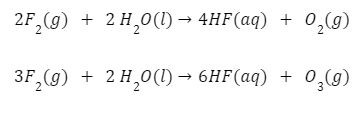
- Solubility: Halogen group elements are generally insoluble in water due to their non-polar nature but fluorine reacts with the water molecule forming oxygen and ozone.
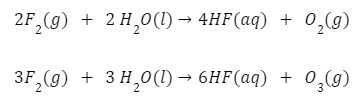
Elements present in this group like (Cl2, Br2, I2) are more soluble in an organic
solvent like carbon tetrachloride (CCl4), Chloroform (CHCl3) etc. as they are
non-polar in nature.
- Colour: All the elements present in this group are coloured. The colour of the elements depends upon the amount of energy released when an electron comes back from a higher energy state to a lower energy state and this electromagnetic wave which is emitted lies in the visible spectra. The colours of the halogen group elements (in the diatomic state) are given as follows:
|
Element |
Colour of the halogen |
|
Fluorine |
Light yellow |
|
Chlorine |
Yellowish green |
|
Bromine |
Reddish-brown |
|
iodine |
Deep violet |
|
Astatine |
Black |
- Oxidation State: All elements of the halogen group show ( -1) oxidation state since they all have seven valence electrons and only need one electron to complete their respective shells when combining with the less electronegative element.
Fluorine always shows (-1) oxidation state as it is the most electronegative element in the periodic table and belongs to the 2nd period so it does not have a vacant d-orbitals where valence electrons can be excited and show multiple oxidation states.
Chlorine, bromine, and iodine, on the other hand, can produce compounds with higher oxidation states as well, such as +1, +3, +5, and +7 due to the presence of vacant d-orbitals in the valence shell.
The capacity of an element to react with other elements is also determined by its oxidation state. The elements that have (-1) oxidation state can accept an electron from other elements to form salts.
From fluorine to astatine down the group among halogens, the strength of oxidation of Group 17 elements decreases. Fluorine based chemicals, such as fluoride, are the most stable.
|
Oxidation state |
Fluorine |
Chlorine |
Bromine |
Iodine |
|
-1 |
HF, NaF, MgF2, XeF4 etc. |
NaCl, MgCl2, HCl CaCl2 etc |
HBr, NaBr, AgBr etc. |
HI, NaI, MgI2 etc. |
|
+1 |
No compound |
HClO, Cl2O etc |
HBrO, Br2O etc |
ICl, HIO etc |
|
+3 |
No compound |
ClF3 , HClO2 |
BrF3 |
ICl3 |
|
+4 |
No compound |
ClO2 |
BrO2 |
I2O4 |
|
+5 |
No compound |
HClO3 |
BrF5, HBrO3 |
HIO3 |
|
+6 |
No compound |
Cl2O6 |
Br3O8(2 bromine atoms are in +6 oxidation state and one bromine atom is in +4 oxidation state) |
No compound |
|
+7 |
No compound |
HClO4 |
No compound |
IF7, HIO4 |
General Trends Observed in Group 17 Elements
Atomic and Ionic Radii
- The distance between the nucleus and the outermost electron provides the basis for both atomic and ionic radii.
- Halogens have the shortest radii among the other elements in their respective rows since they belong to group 17 and have seven electrons in their outermost orbital. This is because the number of electrons increases by one unit as we move from left to right in a period, with the increase in the number of electrons the attraction of electrons from the nucleus also increases and decreases the size of the atom.
- As we move down the group in group 17 (i.e., from fluorine to iodine), the number of shells increases due to the increase in the number of shells, both atomic and ionic size increases on moving down the group.
Order of atomic size in group 17: F<Cl<Br<I
Order of ionic size (X-): F-<Cl-<Br-<I-
Ionization Enthalpy
- Ionization enthalpy is defined as the amount of energy required to remove the outermost valence electron of an isolated gaseous atom in the ground state.
- Fluorine has the highest ionization enthalpy. The ionization enthalpy value decreases down the group from (fluorine to iodine) because on moving down the group number of shells increases due to which there is a decrease in the attraction force between the valence electrons and the nucleus and it becomes easier to remove an electron from the valence/outermost shell of an atom.
Order of ionisation enthalpy in the group 17: F>Cl>Br>I
Electron Gain Enthalpy
- Electron gain enthalpy is defined as the amount of energy released when an electron is added to the valence shell of an isolated gaseous atom in the ground state.
- The electron gain enthalpy value decreases as we move down the group from fluorine to iodine. Fluorine has an exceptionally low electron affinity as compared with chlorine because of its small structure when the extra electron is added to the valence shell due to its high electron density the incoming electrons feel the repulsion and energy decreases.
Order of electron gain enthalpy in the group 17: Cl>F>Br>I
Note: In the case of group 17 elements the electron gain enthalpy value is negative which signifies that the energy is released when the electron is added in the valence shell of an isolated gaseous atom.
Electronegativity
- Electronegativity is defined as the tendency of an atom to attract the shared pair of electrons more towards itself in a covalently bonded molecule.
- Group 17 elements are highly electronegative in their respective rows and this electronegativity value decreases down the group with the addition of new shells.
Order of electronegativity in the group 17: F>Cl>Br>I
- Fluorine is the most electronegative atom among the halogen atoms.
- Due to a decrease in electronegativity value the non-metallic character of an element decreases from fluorine to iodine.
Atomic volume and density
Atomic volume and density of the element in the liquid state increase from fluorine to iodine.
The trend in atomic volume for the group 17: I>Br>Cl>F
The trend in the density of an environment in a liquid state for the group 17: I>Br>Cl>F
Bond dissociation energy
- When the size of an atom increases the bond dissociation energy decreases from fluorine to iodine.
- In actual bond dissociation energy of F2 is less than Cl2 and Br2 because of the lower size of fluorine atom there is high repulsion among non-bonding electrons in the 2p- orbitals of fluorine atom. The order in bond dissociation energy for the group 17: Cl2>Br2>F2>I2
Reduction potential and oxidizing nature
Standard reduction potential values of halogens are positive and decrease from fluorine to iodine. More the positive value of reduction potential easier it is for the element to get reduced.
The order in standard reduction potential value for the group 17: F2>Cl2>Br2>I2
|
Reduction Half Reaction |
Standard Reduction Potentials, E°(Volt) |
|
|
2.87 V |
|
|
1.36 V |
|
|
1.09 V |
|
|
0.54 V |
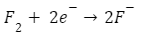
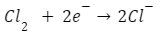
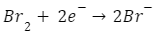
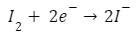
Halogens act as a strong oxidizing agent and their oxidising power decreases from fluorine to iodine.
This trend is observed in the group-17 elements as they are the most electronegative element in their respective period but it decreases down the group because the electronegativity decreases on moving down the group and as a result the oxidising power also decreases.
The order in oxidising power value for the group 17: F2>Cl2>Br2>I2
For example Fluorine when reacts with water, it oxidises the oxygen present in the water to form oxygen or ozone.
Uses of halogen
- Fluorine is an important component of toothpaste, and it prevents mild gum disease or decaying of teeth.
- Iodine in the form of Tincture Iodine is used as an antiseptic to clean wounds.
- Chlorine owing to its high reactivity is used as a bleach in paper industries, and textile industries.
- Chlorine is used as a disinfectant to clean polluted water.
- Bromine water is used in organic chemistry to test unsaturation present in an organic compound
- Iodine is used in the preparation of iodoform, iodides, dyes etc.
- Iodine is used in the preparation of photosensitive papers and films
Recommended video:
Practice problems
Q1. Select the correct option for the element which will have the highest bond dissociation energy.
A. Br2
B. Cl2
C. F2
D. I2
Answer: (B)
Solution: When the size of an atom increases the bond dissociation energy should decrease from fluorine to iodine. But actually bond dissociation energy of F2 is less than Cl2 and Br2 because of the lower size of fluorine atom there is high repulsion in non-bonding electron in the 2p- orbitals of fluorine atoms. The order of bond dissociation energy in the group 17 is Cl2>Br2>F2>I2.
Q2. Select the correct option among the following elements which has maximum solubility in water.
A. Br2
B. I2
C. Cl2
D. F2
Answer: (D)
Solution: Halogen group elements are generally insoluble in water due to their non-polar nature but fluorine reacts with the water molecule forming oxygen and ozone. Elements present in these groups like (Cl2, Br2, I2) are more soluble in an organic solvents. 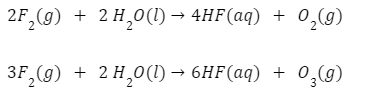
Q3. Select the option for the compound which exhibits the highest dipole moment.
A. HCl
B. HF
C. HI
D. HBr
Answer: (B)
Solution: HF has the highest dipole moment as compared with other hydrogen halides because dipole movement depends upon the difference in electronegativity of two atoms which are bonded together. More the electronegativity difference value, more will be the bond polarity and higher will be the dipole movement. Fluorine has the highest electronegativity, hence the difference between the electronegativity value in HF will be the highest. So, the order of dipole moments of hydrogen halides will be: HF>HCl>HBr>HI
Q4. Select the correct order of the boiling point of the given hydrogen halide compounds.
A. HCl>HBr>HI>HF
B. HF>HI>HBr>HCl
C. HI>HF>HBr>HCl
D. HBr>HI>HF>HCl
Answer: (B)
Solution: HF has a highest boiling point among the hydrogen halides due to strong intermolecular hydrogen bonding present in the molecule.

But in the case of other hydrogen halides (i.e., HCl, HBr, HI) , there exhibits dipole-dipole interactions between molecules and the higher the molecular mass higher will be the boiling point. Therefore, the order of boiling point is: HF>HI>HBr>HCl.
Q5. Select the correct option for the element that has the maximum electron gain enthalpy.
A. Br
B. I
C. Cl
D. F
Answer: (C)
Solution: The electron gain enthalpy value decreases down the group from fluorine to iodine. Fluorine has an exceptionally low electron affinity as compared with chlorine because of its small structure when the extra electron is added to the valence shell due to its high electron density the incoming electrons feel the repulsion and energy decreases.
Order of electron gain enthalpy in the group 17 is Cl>F>Br>I.
Frequently Asked Questions - FAQs
Q1. What is the reason that fluorine cannot form a compound in the excited state?
Answer: Fluorine element belongs to group 17 and 2nd period. It cannot excite its valence electron due to the unavailability of vacant d-orbitals. Whereas, chlorine and other elements present in this group contain vacant d-orbitals and therefore it can excite its valence electron to form hypervalent compounds.
Q2. What are the reasons for the anomalous behaviour of fluorine element in the halogen family?
Answer: The fluorine element shows anomalous behaviour as compared with the other elements present in the same group because of the following reasons:
- It possesses the highest electronegativity.
- It has the smallest size as compared with the other elements present in that group [i.e., Chlorine(Cl), bomine(Br) and iodine(I)]
- It does not possess vacant d-orbital in its valence shell.
- It has the highest positive standard reduction potential value.
Q3. What is the trend of the non-metallic character of the elements present in group 17?
Answer: The non-metallic character of the elements present in the halogen family decreases from fluorine to iodine due to a decrease in ionisation energy and electronegativity value from fluorine to iodine.
The order of non-metallic character in the group 17 is F>Cl>Br>I.
Q4. What are interhalogen compounds?
Answer: Interhalogen compounds are the type of compounds formed by combing different elements of the halogen family (F, Cl, Br, I). Different halogen elements combine together to form compounds due to the differences in the electronegativity of the elements of the halogen group. Some examples of interhalogen compounds are- IF7, BrF5, ClF3 etc.
Related topics
|
Dinitrogen |
Group-14 elements |
|
Chemical properties of group-13 |
Fluorine |
|
Bleaching powder |
P-block elements |
|
Interhalogen compounds |
Oxoacids of halogen |

 Call Now
 Let's Chat
 Share
Share