-
Call Now
1800-102-2727


Flame Test - Definition, Chemistry of Flame Test, Procedure, Inference, Interpretation, Applications, Practice problems and FAQ

Colours are indeed what make the world interesting to the eyes. What we perceive is what we believe in. In fact, sometimes the identity of a certain thing becomes analogous to its colour.
Swami Vivekananda once said,
“Do not believe a thing because you have read about it in a book. Do not believe a thing because another man has said it was true. Do not believe in words because they are hallowed by tradition. Find out the truth for yourself. Reason it out. That is the realisation.”
The flame test is one such attempt to find out the truth of what is exactly present in a given sample. It is a qualitative test performed in order to find out the exact cation present in a given compound by identifying its actual flame colour. Let's delve deeper into it to find out more.

TABLE OF CONTENTS
- What is Flame Test?
- Chemistry Behind Flame Test
- Procedure of Performing Flame Test
- Bunsen Burner and Flame
- Interpretation of Flame Test
- Limitations of Flame Test
- Applications of Flame Test for the identification of Alkali metals
- Practice Problems
- Frequently Asked Questions - FAQ
What is Flame Test?
A flame test is a qualitative process for determining the particular metal ion, depending on the colour of the produced flame. In other words, a flame test is a qualitative analysis used by chemists to identify the metal and metalloid ion in a sample. Not all metal ions emit colour when heated in the gas burner. A flame test is the simplest way of identifying the presence of group 1 metal ions in the compound. For other metals, there are plenty of reliable techniques, but a flame test will give a better hint on where to look.
There are some safety techniques to perform the flame test in the laboratory.
- Use chemical splash/impact goggles
- Perform the flame test under the direction or supervision of chemistry teachers.
All alkali metals give a characteristic colour to flame. When the sample is heated, metal ions gain energy and shift from a lower energy level to a higher energy level. Ions are not stable at a high energy level, and they return to the ground level by releasing energy. The energy is released in the form of light and it varies from one metal ion to another. Thus, each metal ion gives a characteristic change of colour when it is heated.
Chemistry Behind Flame Test
When the atoms of an element in a gaseous or vapour state are excited, for instance by heating or by applying an electrical field, their electrons are able to move from their ground state (unexcited state) to higher energy levels. When they come back to the ground state or lower level, following clearly defined paths as per their quantum numbers, they emit photons of very specific energy. This energy corresponds to particular wavelengths of light, and so when the emitted energy falls in the visible range of the electromagnetic spectrum, particular colours of light/flame are produced.
- When an excited electron falls back from the excited state to lower levels (ground level), which can happen simultaneously or in several steps, the energy they had absorbed earlier during excitation is released in the form of light.
- All these jumps or transitions result in the formation of a spectrum of lines. Some of these lines are part of the visible part of the spectrum.
- For example, in the case of a sample of sodium chloride, sodium has low ionisation enthalpy as it is an alkali metal.
- The configuration of the unexcited state of sodium atom is 1s2 2s2 2p6 3s1, and within the flame, there are different sorts of excited states of the electrons.
- Sodium gives a bright orange-yellow flame colour. This results from promoted electrons falling back from the 3p1 level to their ground 3s1 level.
- Hence, we can conclude that each metal will have a different pattern of spectral lines, and so have a distinct flame colour.
- Alkali metals (elements of Group 1) are the easiest metals that can be accurately identified using the flame test due to their low ionisation enthalpy.
Procedure of Performing Flame Test
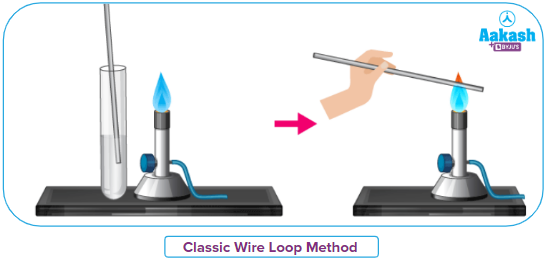
Classic Wire Loop Method - Platinum or nickel-chromium alloy (nichrome) wire.
- Clean the wire by dipping it in a concentrated solution of HCl (hydrochloric acid). Wash the wire with distilled or deionized water and burn it in the hot bunsen burner flame until the wire shows no colour in the flame.
- Dip the clean wire in the powder or in the ionic metal salt solution. Then, heat the wire in the bunsen burner flame.
- Observe and record the flame colour.
Wooden Splint or Cotton Swab Method
Wooden splints or cotton swabs or even melamine foam are an inexpensive alternative to platinum wire loops which are generally expensive.
- To use wooden splints, soak the wooden splints overnight in distilled water.
- Pour out the water and rinse the splints with clean water carefully so as to avoid contaminating the water with sodium (from sweat on your hands).
- Take a damp splint or cotton swab after moistening it in water, dip it in the sample to be tested, and wave the splint or swab through the flame.
- Be cautious not to hold the sample in the flame as this would cause the splint or swab to ignite.
- Ensure you use a new splint or swab for each test.
Bunsen Burner and Flame
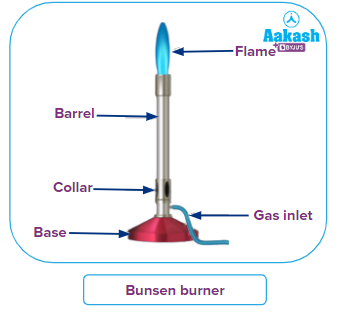
A Bunsen burner is a laboratory instrument that can be used to provide a single, continuous flame by mixing gas with air in a controlled fashion.
- The burner operates on natural gas, much like the burners of a gas stove.
- There are two parts to it. A barrel (or tube or stack) and a base, and the tube screws onto the base. The drilled holes at the bottom end of the tube are air holes.
- There is a gas inlet at the top of the base. Natural gas and air are mixed in the tube, and this mixture is ignited at the top of the tube.
- The collar is used to obstruct or open the air hole and influence the temperature.
- The air hole controls the temperature.
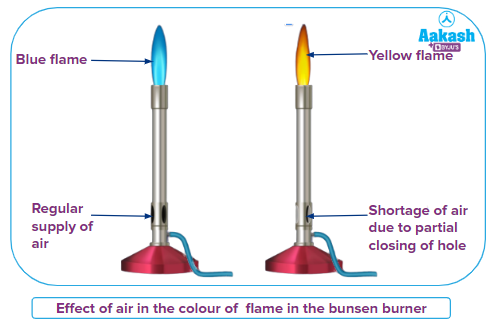
The flame provides the heat and can either be yellowish or bluish. If the collar stops the supply of the air, then the colour of the flame is yellow. However, if there is a regular supply of air, then the colour of the flame is blue.
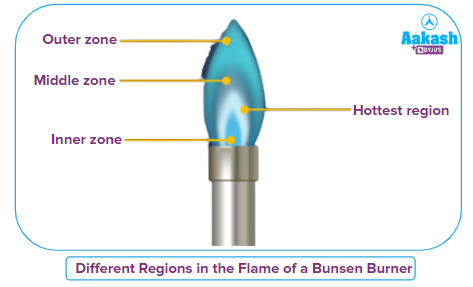
Different Regions in the Flame of a Bunsen Burner
The flame of the Bunsen burner is divided into three parts, which are given as follows:
- Primary flame (inner zone): It has a pale blue flame and it is seen as a small inner cone.
- Secondary flame (middle zone): It has an almost colourless flame and is larger than the inner zone.
- Outer zone: It is an outer zone of the flame that results when the remaining gas is completely oxidised by the surrounding air. Bunsen Burner
The hottest part of the Bunsen flame is found at about one-third of the height of the flame and is approximately equidistant from inside and outside the mantle. It reaches about 1500–1550 °C.
Interpretation of Flame Test Results
The cation/metal element present in a sample can be identified by simply checking the characteristic colour produced by the flame. The characteristic colours of flame portrayed by various metallic elements are enlisted below.
|
Ions |
Flame colour |
|
Lithium |
Carmine Red, invisible through green glass |
|
Sodium |
Strong flame, Bright golden yellow |
|
Potassium |
Lilac (violet) |
|
Calcium |
Brick Red, light green as seen through blue glass. |
|
Rubidium |
Red (red-violet) |
|
Barium |
Pale green/Apple green |
|
Lead |
Greyish- bluish-white |
|
Copper |
Bluish-green (often with white flashes) |
|
Strontium |
Crimson to Scarlet red |
|
Caesium |
Blue-violet |
|
Boron |
Bright green |
|
Arsenic |
Blue |
|
Iron |
Iron (II) - Gold when very hot such as an electric arc, bright blue, or green turning to orange-brown. Iron (III) - Orange-brown |
|
Magnesium |
Colorless due to MgO layer, but burning Mg metal gives an intense white |
|
Manganese (II) |
Yellow-green |
|
Molybdenum |
Yellow-green |
|
Phosphorous |
Pale blue-green |
|
Antimony |
Pale green |
|
Strontium |
Crimson |
|
Scandium |
Orange |
|
Selenium |
Azure |
|
Thallium |
Bright pure green |
|
Tellurium |
Pale green |
|
Zinc |
Blue-green to pale green |
|
Bismuth |
Azure |
|
Cadmium |
Brick red |
|
Cerium |
Yellow |
|
Cobalt |
Silver-white |
|
Chromium |
Silver-white |
|
Mercury |
Red |
|
Molybdenum |
Yellowish green |
|
Tin |
Blue-white |
|
Zirconium |
Mild red |
Several elements like gold, silver, platinum and palladium do not produce characteristic colour during the flame test.
Limitations of Flame Test
- If the ion concentration is very low, then the ions are not detected by the flame test.
- The light intensity varies from one sample to another. Think of the same amount of sodium and lithium, for example. Yellow sodium emissions during the flame test are much more intense than red litmus emissions.
- The test results will be influenced by the presence of impurities, especially sodium. It is present in most of the compounds and gives the yellow colour flame. To prevent that, cobalt blue glass is used. The yellow colour is removed and the flame colour associated with the other substance is visible.
- Many metallic atoms produce a similar range of visible colours, so it is hard to detect.
Application of Flame Test for the identification of Alkali metals
The alkali metals and their salts impart characteristic colour to an oxidising flame. This is because the heat from the flame excites the outermost orbital electron to a higher energy level.
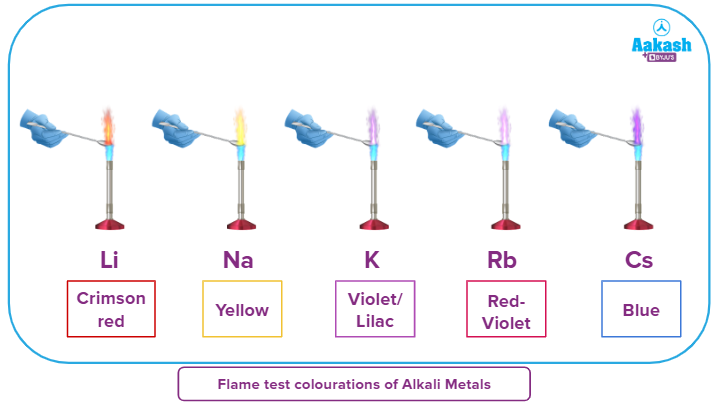
- When the excited electron comes back to the ground state, there is an emission of radiation in the visible region of the spectrum.
- Flame test is most commonly used for identification of alkali metal ions as they produce distinct colours. Due to their low ionisation energy, they are readily excited and de-excited to give colour spectrum in the visible range.
Practice Problems
Q1. What is the characteristic colour imparted to flame by a salt of potassium sulphate (K2SO4)?
- Red
- Lilac
- Blue
- Green
Answer: A sample of potassium sulphate has got K+ ions. Hence, it exhibits lilac coloured flame that is the characteristic flame colour of potassium. So, option B) is the correct answer.
Q2. What will a substance having low ignition temperature do?
- Catched fire easily
- Do not catch fire.
- Catch fire after sometime
- None of these
Answer: Substances which have very low ignition temperature readily catch fire with a flame and are called inflammable substances. So, option A) is the correct answer.
Q3. Which among the following are needed to perform a flame test?
- Nichrome wire
- Hydrochloric acid
- Bunsen burner
- All of these
Answer: A nichrome or a platinum wire post cleaning is dipped in the concentrated solution of HCl. Then, the sample paste is taken on it and it is brought to flame produced by a bunsen burner. Hence, all the given items are needed. So, option D) is the correct answer.
Q4. Which of the following will produce carmine red flame?
- Li+
- Na+
- Ba2+
- K+
Answer:
- Carmine red flame is the characteristic flame colour of lithium ion.
- The characteristic flame colour of Na+ is bright golden yellow.
- The characteristic flame colour of Ba2+ is apple green.
- The characteristic flame colour of K+ is liliac.
So, option A) is the correct answer.
Frequently Asked Questions - FAQ
Question 1. Why do we see the flame at times through cobalt blue glass?
Answer: Sodium is a common contaminant in many compounds and its spectrum tends to dominate over others owing to its bright golden yellow colour. Thus, the test flame is often viewed through cobalt blue glass to filter out the yellow of sodium and allow easier viewing of colours produced from other metal ions. The blue glass will absorb the yellow colour, and the other substance’s flame can be seen.
Question 2. Why flame test is more predominantly used for the detection of alkali metals?
Answer: Alkali metals have the lowest ionisation potential among all the other groups in the periodic table. Flame test is most commonly used for the identification of alkali metal ions as they produce distinct colours by readily getting excited and de-excited (due to low ionisation energy) to give off electromagnetic radiation in the visible spectrum (colour).
Question 3. What is oxidising flame?
Answer: The outer cone of a gas flame which has an excess of oxygen where oxidation of metals occur is known as oxidising flame.
Question 4. Why gold, silver and platinum donot give flame test?
Answer: These metals are chemically inert and are collectively known as noble metals. The thermal energy of the flame is not sufficient enough to ionise the outer electrons of the atoms of these elements. Hence, they do not get ionised and neither give characteristic colour to the flame.
Related Topics
|
Alkali Metals |
Sodium Hydroxide |
|
Sodium Chloride |
Modern Periodic Table |
|
Metallic and Non-metallic Character |
Sodium Carbonate |

 Call Now
 Let's Chat
 Share
Share