-
Call Now
1800-102-2727


Ferrous Sulphate- Definition, Structure, Physical properties, Chemical Properties, Uses, Practice problems, FAQ

Human body is always in need of nutrients for its sustenance. Naturally, with deficiency of such nutrients the workings of a human body would be affected and in severe cases might actually lead to permanent damages.
One such nutrient is iron. The body primarily uses iron as part of the red blood cell proteins myoglobin and haemoglobin, which are essential for transporting and storing oxygen. Besides that, iron also plays an important role in the formation of hormones, the health and development of the nervous system, and basic cell functioning.
Iron deficiency leads to anaemia signs and symptoms may include extreme fatigue, weakness, pale skin, chest pain, fast heartbeat or shortness of breath, headache, dizziness or lightheadedness
So how do we maintain a regular and optimal intake of iron?
In a regular diet, foods such as red meat, spinach, dried apricots, pumpkin seeds, seafood, etc provide the necessary quantities. However, in order to increase the intake, one can take supplements. Supplement makers use multiple types of iron in dietary supplements, the most common being ferrous sulfate,
Let's start with the study of the composition, properties, and applications of ferrous sulphate.
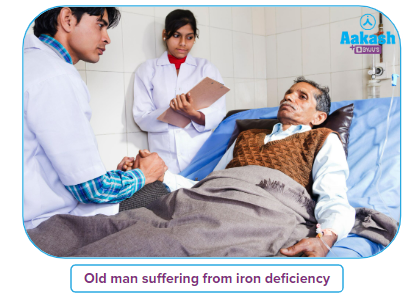
Table of Content
- What is ferrous sulphate?
- Structure of ferrous sulphate
- Physical Properties of ferrous sulphate
- Chemical properties of ferrous sulphate
- Uses of ferrous sulphate
- Practice problems
- Frequently asked questions-FAQ
What is ferrous sulphate?
The best and cheapest iron supplement known to us is ferrous sulphate. The most common kinds of iron in supplements are ferric and ferrous.
The chemical state of the iron atoms determines this. Ferrous sulphate salt exists in many hydrated forms (containing water of crystallization) or non-hydrated forms (containing no water of crystallization).
Examples include anhydrous ferrous sulphate (FeSO4), Monohydrate ferrous sulfate (FeSO4.H2O), Pentahydrate ferrous sulfate (FeSO4. 5xH2O), Hexahydrate ferrous sulfate (FeSO4. 6H2O), and Heptahydrate ferrous sulfate (FeSO4. 7H2O) also known as green vitriol.
Structure of Ferrous sulphate:
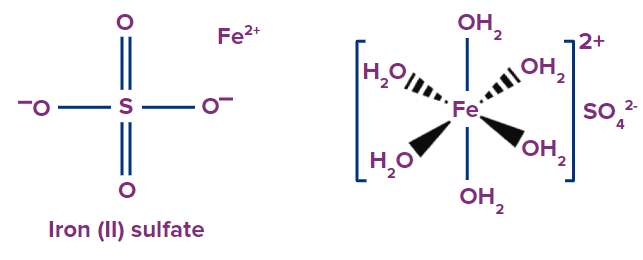
The structure of Ferrous sulphate is shown below in the image. Ferrous sulphate coves a range of salts with a formula FeSO4.xH2O. Below is the drawn structure showing the formation of hexahydrate.
Sulphur in iron sulphate shows hybridisation of sp3 whereas the hexaaqua iron (II) complex shows sp3d2 hybridisation.
Physical Properties of ferrous sulphate:
Below is the few physical properties of ferrous sulphate. Let’s have a look over that.
|
Chemical formula |
FeSO4 |
|
Molar mass |
151.91g mol-1 |
|
Physical appearance |
White crystals (anhydrous) |
|
Density |
3.65 g cm-3 |
|
Melting point |
680℃ |
|
Solubility |
Soluble in water |
|
Refractive index |
1.591 |
|
Odour |
odourless |
|
Standard enthalpy of formation |
-928.4 kJ mol-1 |
Chemical properties of Ferrous sulphate
1. Displacement reaction: Under displacement reaction, ferrous sulphate interacts with aluminium to generate aluminium sulphate and metallic iron. The following is a chemical reaction.

2. In the presence of sulphuric acid, ferrous sulphate interacts with potassium permanganate to create ferric sulphate, manganese sulphate, potassium sulphate, and water10 
3. Decomposition of ferrous sulphate:
Ferrous sulphate decomposes into ferric oxide along with oxides of sulphur as gaseous products.

Uses of Ferrous sulphate
- Patients with disorders caused by iron deficiency should take iron supplements as ferrous sulphate
- Ferrous sulphate is used for iron deficit in pregnancy and therapy of iron deficiency anaemia.
- If sedation or general anaesthesia is required, this ferrous sulphate medication is used as a precaution to avoid a hypotensive episode.
- Chlorine can also be utilised with ferrous sulphate. Chlorinated copper as therapy is the common name for this treatment.
- The soil amendment ferrous sulphate is used to reduce the pH of a high alkaline soil so that plants can more easily access the nutrients.
- Many industrial and sanitary wastewater treatment applications use ferrous sulphate as a coagulant.
- Ferrous sulphate acts as a reagent in the identification of mushrooms.
- Ferrous sulphate acts as a frothing reagent for beer.
- Inks were made with ferrous sulphate, the most famous of which was iron gall ink, which was used from the Middle Ages until the end of the eighteenth century.
- Ferrous sulphate is also used as a mordant in wool dyeing.
- Iron chlorosis, a yellowing of plant leaves due to iron deficiency, is treated with ferrous sulphate in horticulture.
- The combination of ferrous sulphate and folic acid can enhance haemoglobin levels. Folic acid and ferrous sulphate treatment affect the linear and weight growth of anaemic and non-anaemic mice.
Practice Problems:
Q1. Why do we use freshly prepared ferrous sulphate solution while doing the brown ring test?
Solution: A newly prepared ferrous sulphate solution is utilised in the brown ring test. When exposed to the atmosphere, it oxidises to ferric sulphate, which does not produce a brown ring.
This is the below-mentioned reaction.

Q2. What is the oxidation state of iron in Mohr salt?
A. +1
B. 0
C. +2
D. +3
Answer: (C)
Ammonium iron(II) sulphate, often known as Mohr's Salt, is an inorganic compound with the chemical formula 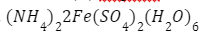 . Iron exists as Fe(II)
Q3. The hybridisation of sulfur is sulfate ion is______
A. sp3
B. sp
C. sp2
D. d3s
Answer: (A)
Sulphur in sulfate ion shows hybridisation of sp3
Q4. In green vitriol, the number of water of crystallization is _____
A. 3
B. 4
C. 5
D. 7
Answer: (D)
Heptahydrate ferrous sulfate (FeSO4. 7H2O) also known as green vitriol.
Frequently asked questions-FAQ’s
Question 1. What are the notable side effects of low iron intake?
Answer: The symptoms of iron deficiency anemia can be mild at first, and one may not even notice them. Most people don’t realize they have mild anemia until they have a routine blood test. Due to low iron intake, one may suffer from headaches, fatigue, hair loss, tongue swelling or soreness, cold hands and feet, strange cravings to eat items with no nutritional value, pale skin and brittle nails.
Question 2. In which form do humans take ferrous sulphate to overcome iron deficiency?
Answer: Oral pills are the most common type of ferrous sulphate supplementation. You can also take them as a droplet of liquid.
Question 3. What exactly is the distinction between ferrous and ferric iron?
Answer: Ferric indicates that the iron atom has lost three electrons to create, Fe3+ .The electronic configuration of Fe3+ is [Ar]3d5 and Fe2+indicates that the iron atom has lost two electrons.The electronic configuration of Fe2+ is [Ar]3d6
Question 4. Why is iron referred to be ferrous?
Answer: "Ferrous" usually indicates "iron-containing." The phrase comes from the Latin word Ferrum, which means "iron." Steel and pig iron (with a few percent carbon contents) are ferrous metals, as they are iron alloys with other metals.
Question 5. Does ferrous sulphate help you in gaining weight?
Answer: If patients receiving iron treatment do not follow a diet or have a metabolic disorder, they will gain weight. As a result, iron therapy raises serum ferritin levels in accompanying body weight.
Related topics
|
Iron |
Potassium Permanganate |
|
f block elements |
Water |
|
Hydrogen |
Important compounds of copper |

 Call Now
 Let's Chat
 Share
Share