-
Call Now
1800-102-2727


Faraday’s Laws: Statement of Faraday’s First and Second Law of Electrolysis, Electrochemical Equivalent, Current Efficiency, Practice Problems, FAQs:

Imagine your teacher is making a visit to your house at 6 pm in the evening for just 10 minutes. To make a good impression you decided to make a good cup of tea for him as he is fond of hot tea. Now the challenge is to prepare tea before he arrives and at the same time, it shouldn’t get cold. At what time you should put the milk on the burner and what should be the temperature of the burner? Well,I don’t think you can do the calculation that easily as the data wasn’t sufficient.
Similarly when the process of electrolysis was invented everyone started looking for the relationship between the amounts of substances liberated at the electrodes during electrolysis and the amount of current passed. This relationship was very necessary to improve the production in industries. To answer all these queries Michael Faraday in 1833 put forward the famous Faraday's Laws of Electrolysis.
- Statement of Faraday First Law of Electrolysis:
- Electrochemical Equivalent of the Substance (Z)
- Faraday’s second law of Electrolysis
- Current Efficiency
- Practice Problems
- Frequently Asked Questions (FAQs)
Faraday First Law of Electrolysis:
Faraday’s law states that the mass deposited/ released/produced of any substance
during electrolysis is proportional to the amount of charge passed into the
electrolyte
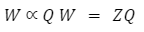
● W: Mass deposited or liberated
● Q: Amount of charge passed
● Z: A proportionality constant called Electrochemical equivalent of the substance
Electrochemical Equivalent of the Substance (Z)
Electrochemical equivalent of a substance may be defined as the mass of the substance deposited when a current of one ampere is passed for one second.
Z is the mass deposited or liberated when 1 C of charge is passed into the solution.
Unit of Z

Equivalent Mass (E)
Mass of any substance produced or consumed when 1 mole of  are passed through the solution is called equivalent mass.
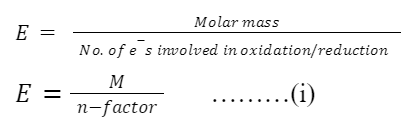
n – factor and calculation of equivalent mass
For redox reactions,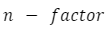 can be calculated from:
1. From the no. of electrons involved for a specific species
2. Change in oxidation state of the species considered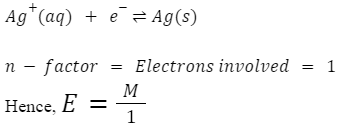
1 mol of electrons is required for reduction of 1 mol of silver ions
Examples
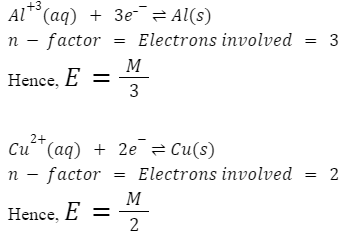
Faraday’s First Law

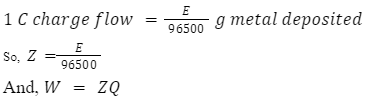
Now substituting the value of Z we get,
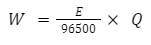 …………(ii)
We know,
 ……….(iii)
Where,
i: Current flow in amperes (A)
t: time in second(s)
Using eq. 1 & eq. 3 in eq. 2
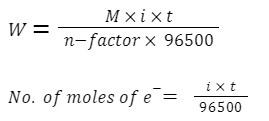
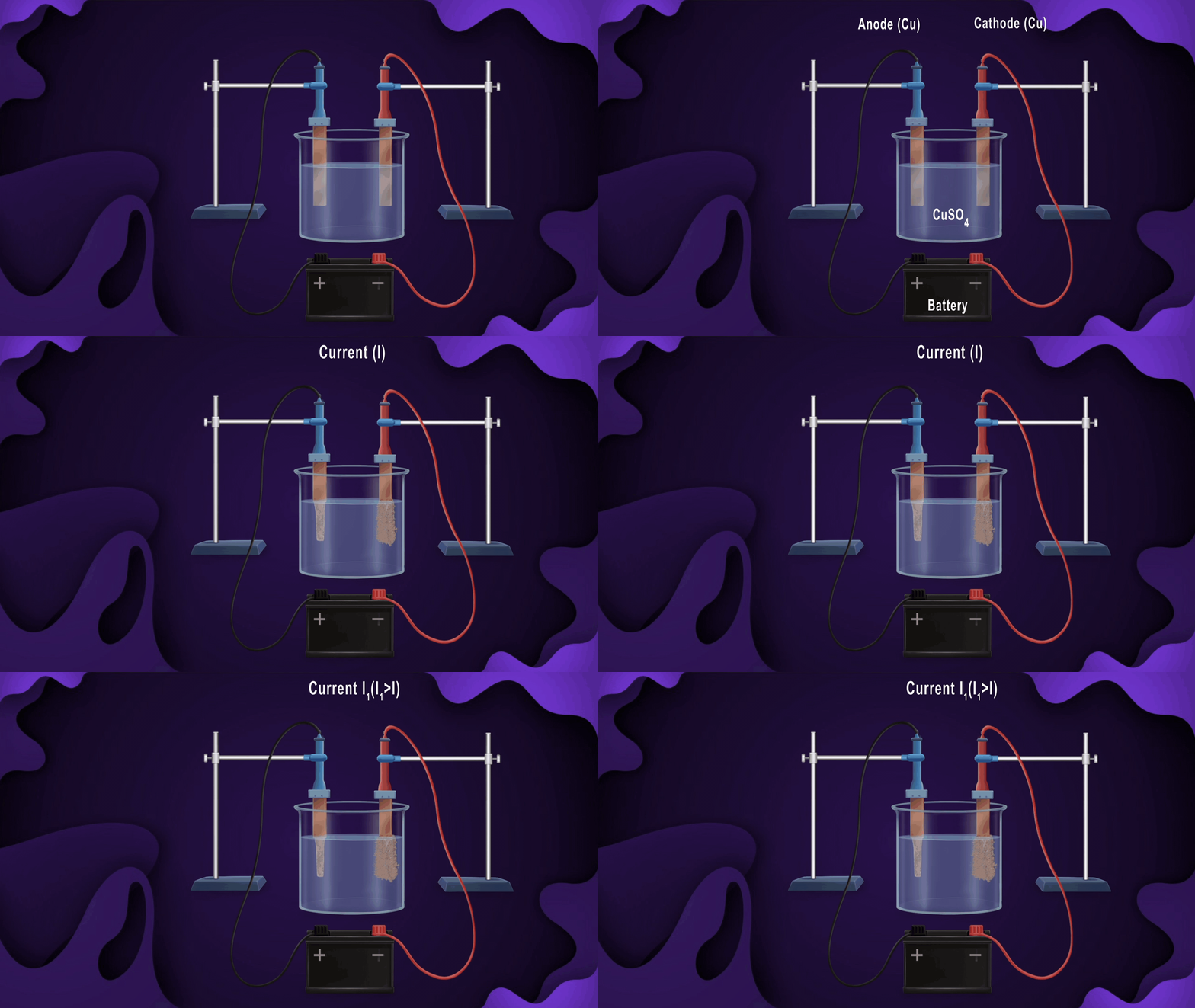
Faraday’s First law of Electrolysis
Faraday’s 2nd law of Electrolysis
According to the second law of Faraday, If equal amount of charge (Q) is passed
through two different solutions then the amount of substance deposited or
liberated (w) is proportional to their chemical equivalent weights (E).
Proof
Consider two electrolytic cells 1 and 2.
The amount of substance deposited or liberated (W1) from the first cell is equal to the product of electrochemical equivalent (Z1) and charge transferred (Q1).
i.e., 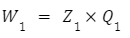
The amount of substance deposited or liberated (W2) from the second cell is equal to the product of electrochemical equivalent (Z2) and charge transferred (Q2).
I.e., 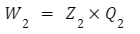
Now, if the charge transferred in both the cells are same;
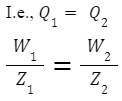
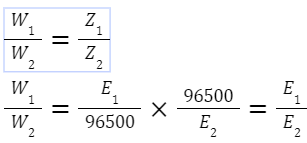
Here, E1and E2 are the equivalent weight of species in 1 and 2 cells respectively.
From the equations above it’s clear that by passing one mole of electrons 1 mole of Ag gets deposited and by passing 2 moles of electrons 1 mole of CU gets deposited. So, if one mole of electrons is passed to both the solutions by the battery 1 mole of Ag gets deposited in left beaker and 1⁄2 moles of
CU gets deposited on the right beaker
Current Efficiency
From thermodynamics we know that no system is 100% efficient. So in an electrochemical system, this inefficiency is determined quantitatively by current efficiency as follows:

Practice Problems
Q 1. The same quantity of electricity that liberates 4.316 g of silver from AgNO3 solution was passed through a solution of gold salt. If the atomic weight of gold be 197 u and its valency in the above-mentioned salt be 3, calculate the weight of gold deposited at the cathode and the quantity of electricity passed.
Answer: In the first cell, the species reducing is Ag+ according to the following equation:

So, the equivalent mass of Ag+ is given by

So, the equivalent mass of Au+3 is given by:

Now, according to the second law of Faraday:
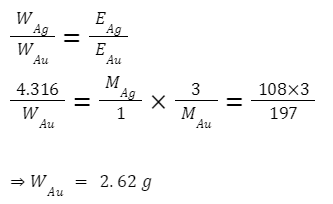
(ii) Calculating the amount of electricity passed
As we know, the amount of metal deposited is given by:
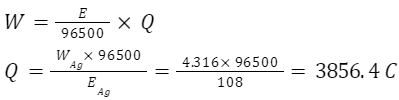
Therefore, the amount of gold deposited is 2.62 g and the amount of electricity
passed is 3856.4 C.
Q 2. What will be the mass of copper deposited at the cathode when 2 faraday of electricity is passed through a solution of CuSO4?
A. 63.5 g
B. 2 g
C. 127 g
D. 0 g
Answer: (A)
CU2+ reduces according to the following equation:

Since, 1 mol of CU2+ reacts with 2 mol of e-
And, 2 mol of e- corresponds to the 2 F of charge.
So, 2 F of charge will deposit = 1 mol of  .
.
Q 3. During the electrolysis of an aqueous solution of copper sulphate, how many electrons would be required to deposit 6.35g of Cu at the cathode? (NA= Avogadro's constant)
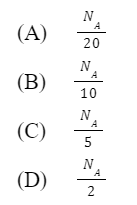
Answer: (C)
CU2+reduces according to the following equation:

Since, 1 mol of CU2+ reacts with 2 mol of e-;
So, 2 mol of e-

Now, 1 mol has NA particles,
so, 0.2 mol has  particles of e-
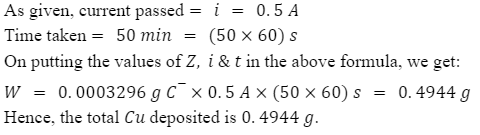
Q 4. Calculate the amount of copper deposited by a current of 0.5 A flowing through copper sulphate solution for 50 Min . If the electrochemical equivalent (Z) of CU is 0.0003296 g C-
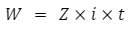
Answer: As we know, the amount of copper deposited (W) is related to the current (I),
time (T), and electrochemical equivalent (Z) as follows:
Frequently Asked Questions (FAQs)
Qusetion 1. What do you understand by Faraday constant?
Answer: Faraday constant, F= 96500 coulombs. It is that quantity of electricity that deposits one gram equivalent of the substance or it is the charge carried by one mole of electron.
Qusetion 2. Is Faraday and Farad the same?
Answer: Faraday is the unit of electric charge whereas Farad is the SI unit of electrical capacitance.
Qusetion 3. What are electrolytes?
Answer: An electrolyte is a substance that, when exposed to water, dissociates into charged particles known as ions which conduct electricity. Cations are positively charged ions. Anions are negatively charged ions.
Qusetion 4. Why no electrical system is 100% efficient?
Answer: An electrical system needs to convert all the electrical energy into work (for example chemical energy), but the conduction of electricity is affected by many factors such as resistance.The efficiency of the system is reduced by these factors. We can make the most efficient system but not 100% efficient.
Related Topics
| Types of Electrodes | Electrolysis |
| Fuel Cell | Electrochemical series |
| Standard Electrode Potential | Nernst Equation |

 Call Now
 Let's Chat
 Share
Share