-
Call Now
1800-102-2727


Enzymes as a Drug Target- Definition, Catalytic Action of Enzymes, Drug-Enzyme Interaction, Practice Problems, FAQs

What do we do if we get sick? We use medicines or treatments to assist our bodies to mend and get better. But have you ever thought about how this occurs? What is the mechanism of action of these medications, and how do they prevent or cure disease? The interaction between medications and their targets explains how pharmaceuticals work. Whenever you visit your doctor, have you ever asked this question, how he remember so many medicines name. It seems difficult for us but not for doctors. You must have seen that doctors prescribe medicines based on age also. A child can not intake the medicine of a young person and vice-versa also takes place. This is due to differences in the drug actions in both children and adult human bodies. These enzymes work on the principle of lock and key. You must have seen that a specific key can open a specific lock, the same happens with drugs also.
Let’s, study how these enzymes work on the human body and learn more about this topic in detail.
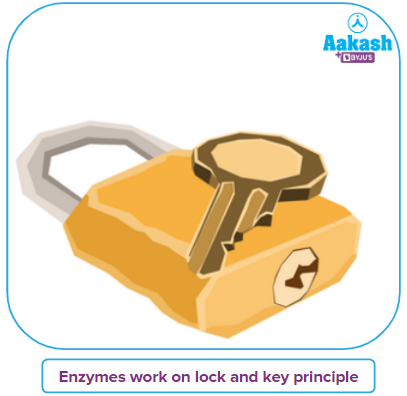
Table of content:
- What are enzymes?
- The catalytic action of enzymes.
- Drug-enzyme interaction
- Practice Problems
- Frequently asked questions-FAQs
What are enzymes?
- Biological macromolecules provide a variety of activities in the body. For example, Enzymes are proteins that act as biological catalysts in the body.
- Receptors, on the other hand, are proteins that are critical to the body's communication system.
- Polar compounds are transported across the cell membrane by carrier proteins.
- The genetic information for the cell is encoded in nucleic acids.
- The cell membrane is made up of lipids and carbohydrates. We'll use enzymes and receptors as examples to describe how drugs interact with their targets.
- The majority of enzymes are proteins with catalytic properties that are required to carry out various operations.
- A group of enzymes that are required for life carry out metabolic processes and other chemical reactions in the cell.
- The enzymes, which react with a substance termed the substrate, are responsible for the first stage of the metabolic process. The products are enzymes that transform the substrates into other compounds.
The Catalytic action of enzymes:
It's crucial to understand how enzymes catalyse reactions in order to comprehend drug-enzyme interactions. Enzymes have two major purposes in their catalytic activity.
- An enzyme's first job is to hold the substrate for a chemical reaction. Enzyme active sites keep the substrate molecule in a good place so that the reagent may attack it effectively.
Ionic bonding, hydrogen bonding, van der Waals interaction, and dipole-dipole interaction are some of the ways that substances connect to the enzyme's active site.
Enzyme inhibitors or inactivators are typical medications used to treat infectious disorders, malignancies, inflammatory, cardiovascular, and metabolic problems. There are inhibitors for all six kinds of enzymes, but hydrolases, transferases, and oxidoreductases are the most common. At concentrations of 100 nanomolar or fewer, enzyme inhibitors or inactivators that progress to become medicines often exhibit significant potency toward their targets, with excellent selectivity for their targets.
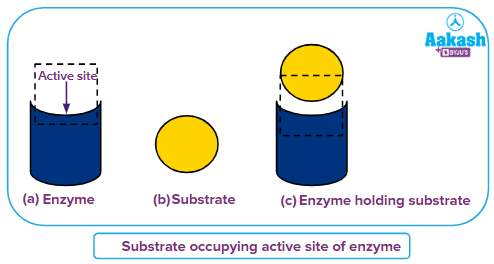
- An enzyme's second job is to provide functional groups that attack the substrate and carry out chemical reactions.
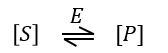
- The following example illustrates the concept of enzymatic catalysis, in which an enzyme acts on a molecule (referred to as a substrate [S]) and converts it to a product (P) as a result of the reaction. The reaction can be expressed as follows in the absence of the enzyme: [S]⇌[P]
- The chemical equilibrium between S and P is represented by the ratio of forwarding and reverse reaction rates (SP and PS, respectively) and is controlled by thermodynamic rules (covered more in the next section of this chapter).
- The conversion of S to P is expedited in the presence of the appropriate enzyme, but the balance between S and P remains unchanged.
- As a result, the enzyme must equally accelerate forward and reverse processes. The following is an example of a reaction:
[S]⇌[P] - Because the reaction has no effect on the enzyme (E), the chemical equilibrium is defined purely by the thermodynamic properties of S and P.
- The energy changes that must occur during the conversion of S to P are the best example of the enzyme's effect on such a reaction.
Enzymes' catalytic activity is dependent on their substrates binding to create an enzyme-substrate complex ([ES]). - The substrate binds to the active site, which is a specific area of the enzyme. The substrate is transformed into the reaction product while bound to the active site, and the enzyme is subsequently released. As a result, the enzyme-catalyzed reaction can be written as:
S+E ⇌ [ ES] ⇌ E+P - The equilibrium is unaffected since E appears unchanged on both sides of the equation. The enzyme, on the other hand, creates a surface on which the processes that convert S to P can take place more easily. This is due to interactions between the enzyme and the substrate, which reduce the energy of activation and favour transition state creation.
- Enzymes speed up processes by causing their substrates' conformation to approach that of the transition state.
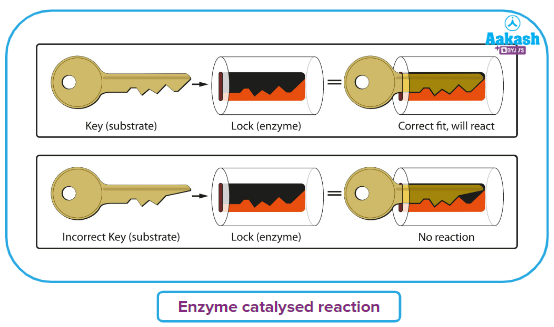
- The lock and key model, in which the substrate fits precisely into the active site, is the most basic model of enzyme-substrate interaction. In many circumstances, however, substrate-binding changes the configurations of both the enzyme and the substrate, a process known as induced fit. In such circumstances, the substrate's conformation is changed to more closely approximate that of the transition state.
- By weakening crucial bonds, the stress induced by such substrate distortion can further assist its conversion to the transition state. Furthermore, the transition state is sustained by its close attachment to the enzyme, decreasing the activation energy required.
Drug-enzyme interactions:
Enzyme activity is inhibited by drugs. These can either block the enzyme's binding site, prevent substrate binding, or reduce the enzyme's catalytic activity.
Drugs hinder substrate attachment to active sites of enzymes in two ways:
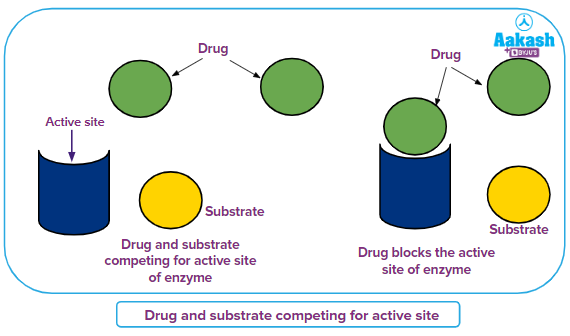
(I) drugs compete with the natural substrate for substrate attachment to active sites of enzymes; . Competitive inhibitors are a type of medication that works in this way.
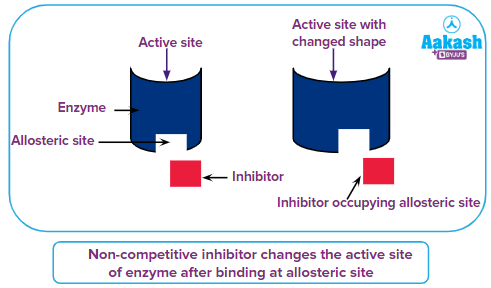
(II) Some medicines do not bind to the active site of the enzyme. These attach to an enzyme's allosteric site, which is different from the active site.
The binding of the inhibitor at the allosteric site (a location where chemicals can activate or inhibit (or switch off) enzyme activity. It's not the same as an enzyme's active site, which is where substrates bind) alters the structure of the active site, making it unrecognisable to the substrate. If the covalent link formed between an enzyme and an inhibitor is strong and difficult to break, the enzyme is permanently inhibited.
The enzyme-inhibitor complex is then degraded, and the new enzyme is synthesised.
Practice Problems:
Q1. ______________ belongs to the serine proteases family of enzymes that degrade proteins by catalysing the breakdown of peptide bonds.
A. Adrenaline
B. Threonine deaminase
C. Chymotrypsin
D. Hyaluronidase
Answer: C
Solution: Chymotrypsin belongs to the serine proteases family of enzymes that degrade proteins by catalysing the breakdown of peptide bonds.
Q2. The ____________ enzyme complexes are involved in alcoholic fermentation
A. Maltase
B. Invertase
C. Pepsin
D. Zymase
Answer: D
Solution: Zymase is an enzyme complex that catalyses the conversion of sugar to ethanol and CO2. It's naturally found in yeasts. The activity of zymase varies depending on the yeast strain.
Q3. The ___________ enzyme connects the ends of two nucleic acid strands.
A. Helicase
B. Ligase
C. Synthetase
D. Polymerase
Answer: B
Solution: The enzyme DNA ligase is in charge of forming the phosphodiester bond between nucleotide base pairs. In the DNA damage repair pathways, this enzyme is very important.
Q4. Diastase is involved in the digestion of which of _________
A. Fat
B. Starch
C. DNA
D. Protein
Answer: B
Solution: Diastase refers to a group of enzymes that catalyse the conversion of starch to maltose. If the diastase level is related to the patient's clinical symptoms, urine diastase is beneficial in recognising confusing abdominal conditions, particularly when pancreatitis, stones in the common bile duct, jaundice, and ruling out surgical pancreatic injury are suspected.
Frequently asked questions- FAQ
Question 1. Are drug medicines addictive?
Solution: Physical addiction appears to develop when a drug's continuous usage alters the way your brain perceives pleasure. Some nerve cells (neurons) in your brain undergo physical alterations as a result of the addictive drug. Neurotransmitters are substances that neurons utilise to communicate. After you stop using the drug, these changes can continue for a long period.
Question 2. What role do enzymes play in human health?
Solution: Enzymes aid in the acceleration of chemical reactions in the human body. They attach themselves to molecules and change them in precise ways. Breathing, digestion, muscle and nerve function and a number of other functions are all dependent on them.
Question 3.Can we produce drugs from plants?
Solution: Yes we can produce drugs from natural resources like plants. Opium is the main example of such drugs.
Question 4. What do you understand by the term optimum temperature?
Solution: Enzymes function best at a specific temperature and pH. The temperature or pH at which a substance exhibits maximum activity is referred to as the optimal temperature or pH. Proteins are the building blocks of enzymes. The molecular structure of enzymes can be altered by a temperature or pH that is higher than ideal. The ideal pH for enzymes is generally thought to be between 5 and 7.
Question 5. Which enzyme is not a protein, given that almost all enzymes are proteins?
Solution: All enzymes, with the exception of ribozymes, are protein-based. A ribozyme is an enzyme that catalyses a chemical reaction using ribonucleic acid (RNA). In a similar fashion to protein enzymes, the ribozyme catalyses certain processes. Ribozymes, also known as catalytic RNA, are present in the ribosome, where they combine amino acids to build protein chains.
Related topics
|
Drugs and their classification |
Chemicals in food |
|
Receptor as drug targets |
Pesticides |
|
carbohydrates |
Enzymes |

 Call Now
 Let's Chat
 Share
Share