-
Call Now
1800-102-2727


Dichromatic Titration - Titrations, Redox Titrations, Dichromate Titration, Practice Problems and FAQs

I'm sure everyone has heard about chlorine water treatment or chlorination in the pools.
Do you know what chlorination is, though?
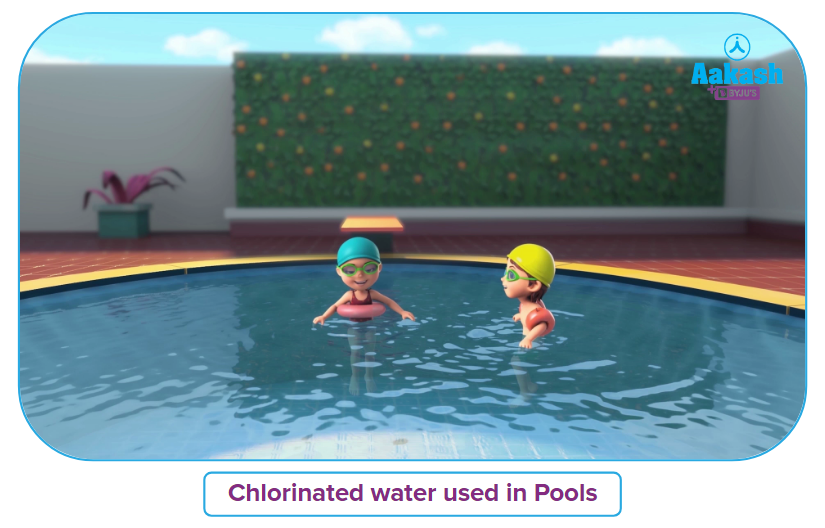
Chlorination is used to disinfect drinking water in order to get rid of germs and viruses. When a public water supply is chlorinated, several chlorine-containing species are produced and referred to as the total chlorine residual. The species is unhealthy for people.
Hence, Chlorine should be added to water in balance for best health effects.
Redox titrations are used to evaluate the chlorination of public water supplies.
In Redox titration, chlorine is oxidized by the application of various oxidizing agents. The optimal level of chlorine can be found by adding indigo as an indicator, which is colorless before the equivalence point. However, once the equivalence point is reached, unreacted indigo gives the solution a permanent color.
Table of Contents
- Titration
- Redox Titrations
- Potassium dichromate titrations
- Practice Problems
- Frequently Asked Questions
Titration:
Titration is a technique used to compare a solution's concentration to that of another solution with a known concentration. Titration is a quantitative and volumetric method for deriving the concentration of an unknown solution from the concentration of a known solution when there is an indicator present.
Procedure used for titration:
- A solution is added to a titration flask during this procedure.
- The titrant is the solution used in the burette, whereas the other solution used in the titration flask is known as the analyte.
- The titration is carried out until the stoichiometric ratios of the two reagents, titrant and analyte, have become equal.
For instance, when a strong acid like HCl and a strong base like NaOH are titrated, the following reaction occurs.
(i) The point at which complete neutralization of HCl and NaOH takes place, it is known as an endpoint or the equivalence point.
(ii) This is the simplest technique in which indicators are added to solutions that change color at the equivalence point into the solution.
Redox Titrations:
The basis of redox titration is a redox reaction that takes place between the analyte and the titrant. Between the analyte and the titrant, an oxidation-reduction process takes place simultaneously.
Numerous oxidizing agents like acidified KMnO4 (Potassium permanganate), acidified K2Cr2O7(Potassium dichromate) and iodine solution, are used to oxidize the reducing agents such as ferrous sulfate , oxalic acid, sodium thiosulfate, potassium iodide, etc.
There are basically three type of redox titrations and these are:
(i) Potassium permanganate titration
(ii) Iodine titration
(iii) Potassium dichromate titration
Potassium dichromate titrations:
Acidified potassium dichromate K2Cr2O7 is also used as an oxidizing agent in redox titrations. It is a somewhat weaker oxidizing agent than KMnO4.
However, since these titrations do not produce a noticeable auto-color shift, it is not a self-indicator titrations like KMnO4 titration. These titrations typically employ indicators such diphenylamine, N-phenylanthranilic acid, and the potassium ferricyanide, K4[Fe(CN)6] external indicator.
For instance, K2Cr2O7 oxidizes the indicator diphenylamine just after the equivalence point or at the endpoint to create a strong blue color that signifies the endpoint.
Titration of Cr2O72- against Fe2+ions:
Reduction Half Reaction:
Oxidation Half Reaction:
Overall reaction:
Practice Problems:
Q1. Find n-factor of Fe in Fe2+ in the given reaction-
- 2
- 3
- 6
- 1
Answer: (D)
Solution:
Let O.S of Fe in Fe2+ = x
Let O.S of Fe in Fe3+ = y
n-factor of Fe in Fe3+ = |3 - 2| = 1
Hence, option (D) is the correct answer.
Q2. In the Potassium dichromate redox titrations, Potassium dichromate behaves as:
- Reducing agent
- Oxidizing agent
- Neither reduced nor oxidized
- Self Indicator
Answer: (B)
Solution: It cannot act as a self-indicator because these titrations do not result in a noticeable auto-color shift and an external indicator needs to be added for detection of the endpoint.
In redox titrations, acidified potassium dichromate K2Cr2O7 is also employed as an oxidizing agent.
If we consider the titration of Cr2O72- against Fe2+ions-
As oxidation state of Cr in Cr2O72- is +6 which decreases to +3 in Cr3+. If the oxidation state decreases, reduction occurs and hence Cr2O72- acts as an oxidizing agent.
Hence, option (B) is the correct answer.
Q3. Which of the given titration methods do not fall under the category of redox titrations?
- Potassium permanganate titration
- Iodine titration
- Acid-Base titrations
- Potassium dichromate titration
Answer: (C)
Solution: Redox titration is an oxidation-reduction process that takes place simultaneously.
Numerous oxidizing agents like acidified KMnO4 (Potassium permanganate), acidified K2Cr2O7(Potassium dichromate) and iodine solution are used to oxidize the reducing agents.
The three major redox titrations are
(i) Potassium permanganate titration
(ii) Iodine titration
(iii) Potassium dichromate titration
As acid-base titration do not fall under the category of redox titrations. It is a different class of titrations. Hence, the correct answer is option (C).
Q4. Pick out the correct statement about Potassium dichromate Titrations.
- In Potassium dichromate titration, Potassium dichromate itself acts as an indicator.
- Titrant used in Potassium dichromate titration is the Potassium dichromate whose concentration is unknown.
- Analyte used in Potassium dichromate titration is the Potassium dichromate whose concentration is known.
- All the given statements are incorrect.
Answer: (D)
Solution: A standard solution with a known concentration is known as the titrant and whose concentration is unknown is known as the analyte. Potassium dichromate (K2Cr2O7) is taken in a burette and added dropwise in the titration flask. Hence, the concentration of Potassium dichromate (K2Cr2O7) is unknown and acts as an analyte in this titration.
Potassium dichromate (K2Cr2O7) does not function as a self-indicator because these titrations do not result in a noticeable auto-color shift. External indicators are frequently used in these titrations.
Hence, option (D) is the correct answer.
Frequently Asked Questions-FAQs:
1. Do excessive amounts of indicator impact titrations?
Answer: A too-great indicator addition will modify the concentration of the solution to which the titrant is added, which will have an impact on the titration process.
Assume for the moment that the indicator is acidic in nature. If you mix it with acid, it will increase the acidity of the acid beyond what you anticipated. Your entire experiment will be ruined since it will be inaccurate because more bases will be needed to neutralize the acid.
2. What kinds of titration errors are possible?
Answer: Just a few of the factors that could cause errors in titration findings include misreading volumes, choosing the incorrect concentrations, and applying substandard techniques. Care must be used when transferring a known concentration of solution into a specific volume of the unknown using laboratory glassware like a burette or pipette.
3. How can the peroxide concentration of teeth-whitening products be regulated using redox titration?
Answer: As it is well known, redox titration uses the oxidation-reduction reaction theory. Here, oxidizing chemicals such as acidified KMnO4 (Potassium permanganate), acidified K2Cr2O7(Potassium dichromate), and iodine solutions diminish the peroxide in teeth-whitening products. As a result, we can calculate the peroxide content.
4. What distinguishes an endpoint from an equivalence point?
Answer: The primary distinction between an equivalence point and an endpoint is that an endpoint is a point at which the color of a system changes, whereas an equivalence point is a point at which the equivalents of the acid and the equivalent of the base are equal.

NEET Related Links
JEE MAIN Related Links
JEE Advanced Related Links
JEE Advanced Eligibility Criteria
JEE Advanced Chemistry Syllabus
JEE Advanced Registration Dates
CUET Related Links
Important Topics
Anemometer : Measurement of Wind Speed
Angular Acceleration Atomic Theory Audible and Inaudible Sound Average Speed and Average Velocity Average Velocity Avogadros Number Avogadros Hypothesis Azimuthal Quantum Number Balanced Force Bar Magnet Biconvex Lens Boyles Law Buoyancy Calorimeter Carnot Engine Celestial Bodies Centripetal And Centrifugal Force Concave and Convex Lenses Concave Convex Mirrors Contact and Non Contact Force Controlled Thermonuclear Fusion Convection Currents Convex Lens Convex Mirror Destructive Interference Difference Between Conduction Convection and Radiation Difference Between Electric Field and Magnetic Field Difference Between Heat And Temperature Difference Between Series And Parallel Circuits Differences Between Acceleration And Velocity Distance and Displacement Distance Time Graph Electrical Force : Electric Forces and Their Types Electromagnetic Waves : Definition, Equation and Properties of Electromagnetic Waves Electromagnetism Electron Spin Fluid Flow : Bernoullis Equation Derivation and Fluid Mechanics Fluid Friction : Types and Factors of Fluid Friction Frames of Reference : Inertial and Non- Inertial Frame of Reference Frequency and Wavelength Frictional Force Importance of Hydrosphere Instantaneous Speed and Velocity Introduction to Motion Kinetic and Potential Energy Difference Law Of Conservation of Energy Layers of the Earth Light Energy Light Sources List of physics scientists and Their inventionsLoudness of Sound
Magnetic Dipole Moment Magnetic Field Non - Contact Force Non - Renewable Energy Ohms Law Optics P Wave Physics Symbols Plane Mirrors Poissons Ratio Projectile Motion Properties of Water : Anomalous Expansion of Water Radius of Gyration Reflection of Light Reflection of Waves Relative Density Resonance Reverberation Rolling Friction Rotation and Revolution Screw Gauge Semiconductors and Insulators Sliding Friction Speed Time Graphs Static Friction Stefan Boltzmann Law Stress Tension Tension Force Thermometer: Clinical Laboratory Thermometer Types of Rocks Types of Waves Uniform Motion and Non Uniform Motion Unit of Voltage Uses of Convex Lens Uses Of Convex Mirror Uses of Electromagnet Uses of Optical Fibre Wave Wavelength of Light What is Scattering of Light Working of Electric Bell Conventional and Non-conventional Sources of Energy Buoyant Force Bulk Modulus of Elasticity Bernoulli’s Principle Angular Momentum Difference Between Speed And Velocity ForceUnit of Heat
Difference between Distance and Displacement Simple Microscope Derivation Of Equation Of Motion Thermometer: Clinical & Laboratory Thermometer Difference between Concave and Convex LensDerivation Of Lens Maker Formula
Unit Of Pressure Velocity Uses of Plane Mirror
Wave Theory of Light
Unit of Density Unit of Light Unit of Force Unit of Magnetic Field Unit of wavelength Unit of Viscosity Uses of Electroplating Young's Modulus
What is the Scattering of Light
Lenz Law Space Wave Propagation Schrodinger Wave Equation Relation between Fahrenheit and Celsius Refractive Index Potentiometer Working Pascal Law Oscillatory Motion Optical Instruments Newton's Laws of Motion - First Law Modulation and Demodulation Magnetic Flux Lens Formula and Magnification Kaleidoscope Faradays Law Epsilon Naught Value Energy Bands Electrostatics Electroscope AC Generator Unit of Current Lithosphere Bending Equation Derivation Difference Between Pound and Kilogram Semiconductor Devices OTEC - Ocean Thermal Energy Conversion Hall Effect Rectilinear Propagation of Light Difference Between Ammeter and Voltmeter Coefficient of Linear Expansion Ampere’s Law Cyclone and Thunderstorm Save The Environment From Pollution Particle Nature of Light Types of DC Motor Uses Of Transistor Derivation of Phase Rule Unit of Humidity

 Call Now
 Let's Chat
 Share
Share