-
Call Now
1800-102-2727


Diamonds - Definition, Structure, Properties and Applications.

We all are familiar with diamonds. Everyone likes the shiny little rock. From just being a shiny little gem, it is one of the hardest materials found on Earth. Where do diamonds come from? How are they formed? Apart from jewellery, what are the other uses of diamonds? Yes, there are other applications of diamonds too. The properties of diamonds make them a very useful material.
Table of Contents
- What are diamonds?
- Structure of diamond
- Chemical and physical properties of diamonds
- Applications of diamonds
- Practice problems
- FAQs
What are diamonds?
Diamonds are carbon allotropes that have a three-dimensional lattice structure. Each carbon atom makes strong covalent bonds with four nearby carbon atoms, forming a tetrahedral configuration. Diamonds have extraordinary hardness and stability due to this configuration.
Diamonds tend to form deep within the Earth's crust under extreme pressure and temperature settings. For millions of years, carbon atoms have been exposed to extreme heat and pressure during the process. Volcanic explosions drive the diamonds to the Earth's surface, where they are finally extracted.
Diamonds have four major optical properties: lustre, dispersion of light, transparency and colour. A diamond is completely clear and transparent in its pure carbon form.
Structure of Diamond
Diamond is the lowest mass element capable of forming an intact covalently bonded crystal lattice, which is very symmetric and securely bonded.
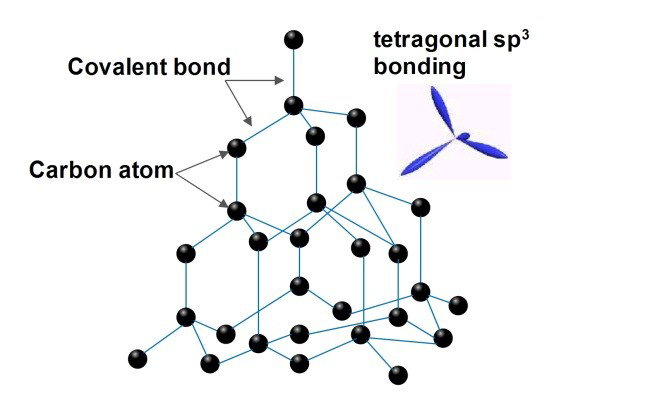
Image: structure of a diamond
A face-centred cubic lattice structure with additional carbon atoms inside the cube serves as the foundation for a diamond. The carbon atoms are covalently coupled to four additional carbon atoms in a tetrahedral form and are sp3 hybridised.
Each carbon has a coordination number of four. As a result, a diamond is a massive, three-dimensional molecule with strong covalent bonds formed by carbon-carbon bonds measuring 154 pm in length. The bond angles are each 109.5°.
|
Did you know? Diamonds have the highest lustre and are known as adamantine. It is the highest form of lustre found in any non-metallic mineral. |
Chemical and Physical Properties of Diamonds
The chemical and physical properties of diamonds include the following:
- Carbon atoms make up the entire structure of diamonds. In order to build a three-dimensional lattice structure, each carbon atom creates four strong covalent bonds with its adjacent carbon atoms.
- The diamond lattice, a cubic crystal structure, is unique to diamonds. The remarkable stability and hardness of the diamond are a result of its structure.
- Diamonds are the hardest naturally occurring material known to mankind. The hardness of diamonds is due to the strong covalent bonds formed between carbon atoms.
- Diamonds have an average density of about 3.5 grams per cubic centimetre, making them relatively dense.
- Diamonds come in various colours: white, yellow, brown, blue, green, pink, red, and purple. The amount of impurities or structural errors within the crystal lattice impact the colour of a diamond.
- Due to their high refractive index, diamonds cause light to be bent at a sharp angle as it travels through the diamond.
- Diamonds have a high degree of dispersion. When light enters the diamond, the high dispersion of diamonds produces an appealing display of spectral colours.
- Diamonds have very good heat conductivity. Diamonds transfer heat approximately five times more effectively than copper, making them highly efficient at heat dissipation.
- Pure diamonds are excellent electrical insulators. They don't conduct electricity because of the strong covalent bonds that make up their crystal structure. However, when some impurities, for instance, boron or nitrogen, are present, diamonds may exhibit semiconducting or conductive qualities.
- Diamonds have very high chemical stability. At room temperature, they are resistant to most acids and alkalis. However, in the presence of oxygen, diamonds can burn or oxidise at extremely high temperatures (about 800-1,000 degrees Celsius).
Applications of Diamonds
Diamonds are widely used in several industries. Some of the applications of diamonds are as follows:
- The most prevalent uses for diamonds are in jewellery and other forms of ornamentation.
- Diamonds are often used in industrial processes for cutting, grinding, and drilling hard materials.
- Diamonds are useful in electronics because of their superior thermal conductivity, which enables effective heat control.
- When doped with particular impurities, diamonds have distinctive electrical characteristics. Due to these characteristics, diamonds are well suited for use in high-power electronics, radiation detectors, quantum computing, and high-frequency gadgets.
- Diamonds can be used as windows and lenses in high-power lasers, spectrometers, infrared imaging systems, and scientific instruments.
- Nitrogen Vacancy-diamonds can be used as sensors for magnetic fields, temperature, pressure, and strain. They are useful for monitoring the environment, diagnosing illnesses, and conducting scientific research.
- Diamonds have a distinctive characteristic known as superhydrophobicity, which makes them extremely water-repellent and is used for processes like desalination, self-cleaning surfaces, and oil-water separation.
- Diamonds make a high-quality sound as they're very hard and easily vibrate at high speeds. It is often used in accredited recorders and DJ equipment.
- Diamonds are used to make dental tools. Nano-diamonds have been used in the treatment of cancer. Additionally, diamonds may be used to create bionic eye implants to help visually challenged people.
- Each high-tech automobile contains 1.5 carats of diamonds. The automotive industry depends greatly on the application of drill bits and other parts in the manufacture of automobiles.
|
Did you know? There are millions of small diamonds in a candle flame. |
Practice Problems
Q 1. The carbon atoms in a diamond are
A. sp4 hybridised
B. sp3 hybridised
C. sp2 hybridised
D. None of the above
Ans. B. The carbon atoms in a diamond are sp3 hybridised in a crystal lattice structure.
Q 2. Diamonds are
A. Good conductors of heat and electricity.
B. Poor conductors of heat and electricity.
C. Good conductors of heat and poor conductors of electricity.
D. None of the above.
Ans. C. Diamonds are good at heat dissipation and are good electrical insulators. In certain cases, when diamonds have some impurities like nitrogen, they become good conductors of electricity.
Q 3. The weight of diamonds is measured in
A. Pounds|
B. Grams
C. Kilograms
D. Carats
Ans. D. Carat is the unit of measurement for diamonds. A carat is equal to 0.2 grams.
FAQs
Q1. What are the four types of diamonds?
Ans. There are four major types of diamonds: natural diamonds, lab-grown diamonds, treated diamonds and natural fancy colour diamonds.
Q2. Where do diamonds come from?
Ans. Diamond formation occurs when the carbon deposits deep inside the Earth are subjected to high temperatures and pressures. Some of these diamonds take days and months to form, whereas some take millions of years to take shape or materialise.
Q3. What type of rock is diamond found in?
Ans. Diamonds are found in the ultrabasic volcanic rock kimberlite. It is formed very deep inside Earth’s crust. The extreme pressure needed for diamonds is reached at depths greater than 150 km.

 Call Now
 Let's Chat
 Share
Share